
Some people search for Depression treatment near me late at night, after weeks of pushing through work, missing texts, sleeping too much or not at all, and wondering whether this is stress or something more. Others search after a primary care visit, a hard conversation with family, or a day when getting out of bed felt harder than it should.
That search matters. In 2021, an estimated 21.0 million U.S. adults had at least one major depressive episode, representing 8.3% of all adults, and 61.0% received treatment according to the National Institute of Mental Health major depression statistics. Depression care is common, established, and worth pursuing. The challenge usually isn't whether treatment exists. It's figuring out where to start, what kind of care fits, and how to pay for it without getting overwhelmed.
This guide is written from the perspective of psychiatric nurse practitioners who help adults sort through those decisions every day. For readers exploring local and online care, it helps to know what standard outpatient treatment looks like, when higher-intensity options may come up, and how newer modalities are discussed in resources like this guide to TMS addiction recovery. For those who want a starting point for clinician-led care, this depression care resource in Pennsylvania shows one path patients often consider.
Table of Contents
- Your Search for Depression Treatment Starts Here
- Choosing Your Path Telepsychiatry vs In-Person Care
- How to Navigate Insurance and Payment for Treatment
- Preparing for Your First Appointment and Treatment
- Start Your Recovery with Integrative Psychiatry of America
Your Search for Depression Treatment Starts Here
Typing a phrase like Depression treatment near me often happens when decision-making already feels heavy. The search results can make that worse. Some pages are vague, some are overly sales-driven, and many don't explain the actual differences between therapy, medication management, outpatient psychiatry, intensive programs, or telehealth.

A practical starting point is to treat the search as a sorting task, not a commitment. The first goal isn't choosing the perfect clinic in one sitting. It's narrowing care to the right level, the right format, and the right payment path.
What the first search should answer
When a patient begins this process, three questions matter more than everything else:
- What kind of symptoms are showing up: low mood, loss of interest, anxiety, sleep changes, hopelessness, irritability, slowed thinking, or trouble functioning.
- How urgent it feels: routine outpatient care is appropriate for many people, but severe symptoms, safety concerns, or major functional decline need faster evaluation.
- What kind of access is realistic: some people want a nearby office, while others need private care from home because of work, transportation, childcare, or privacy concerns.
Practical rule: If a clinic page can't clearly explain who it treats, how appointments work, and what treatment actually includes, it usually creates confusion later too.
What often works better than endless browsing
A stronger approach is to shortlist two or three providers and compare them on the basics. Look for whether they offer medication management, whether they coordinate with therapy, whether they treat co-occurring issues, and whether they provide ongoing follow-up instead of a one-time consultation.
Patients often feel pressure to solve everything on day one. That isn't necessary. The useful win is getting a qualified evaluation scheduled and entering a treatment process that can be adjusted over time.
Choosing Your Path Telepsychiatry vs In-Person Care
The biggest practical choice for many adults in Pennsylvania isn't whether to get help. It's whether help should happen at home or in an office. Both can work. The better option depends on symptoms, privacy needs, transportation, schedule stability, and how much structure a patient wants around the visit.
The healthcare system already manages depression heavily in outpatient settings. The CDC reports 15.0 million physician office visits with depressive disorders as the primary diagnosis, which shows how often depression care happens outside hospitals in standard medical practice, as noted in the CDC depression fast facts.
Telepsychiatry at home
Telepsychiatry fits patients who want privacy, easier scheduling, and less friction around follow-up. For many adults, that matters more than they expect. If the visit requires commuting, parking, taking extra time off work, sitting in a waiting room, and then reversing the trip while already exhausted, missed appointments become more likely.
A Pennsylvania telehealth option such as online depression treatment in Philadelphia can make access simpler for patients who want medication management and psychiatric follow-up without traveling across the state or across the city.
When in-person care still makes sense
In-person care may feel better for patients who concentrate more easily in a dedicated office, prefer face-to-face interaction, or need services that can't be delivered remotely. Some people also like the ritual of physically going somewhere for treatment. That structure can help with accountability.
The right format is the one a patient can actually continue. A good plan on paper isn't useful if attending visits becomes too difficult.
Telepsychiatry vs. In-Person Care at a Glance
| Factor | Telepsychiatry (e.g., IPA) | Traditional In-Person Care |
|---|---|---|
| Convenience | Joins from home, work break, or private space | Requires travel, check-in, and time on site |
| Accessibility | Helpful for rural areas, mobility limits, tight schedules | Helpful for people who prefer office-based care |
| Privacy | No waiting room, less public exposure | Some patients value the separation of a clinic setting |
| Treatment environment | Home setting can feel more comfortable | Office setting can feel more structured |
| Follow-up practicality | Often easier to maintain regular medication visits | Can be harder if commute or scheduling is difficult |
What doesn't work well
What usually fails is choosing based only on proximity or website appearance. A nearby provider isn't helpful if they don't explain follow-up, don't communicate clearly, or don't match the patient's actual needs. A polished website also doesn't guarantee good continuity of care.
A better test is simple. Can the clinic explain intake, treatment options, communication, refills, and follow-up in plain language? If it can't, patients usually feel that friction later.
How to Navigate Insurance and Payment for Treatment
Cost worries stop many people before treatment even starts. That hesitation is understandable. Mental health billing can feel opaque, and many patients don't know what their plan covers until a claim processes.
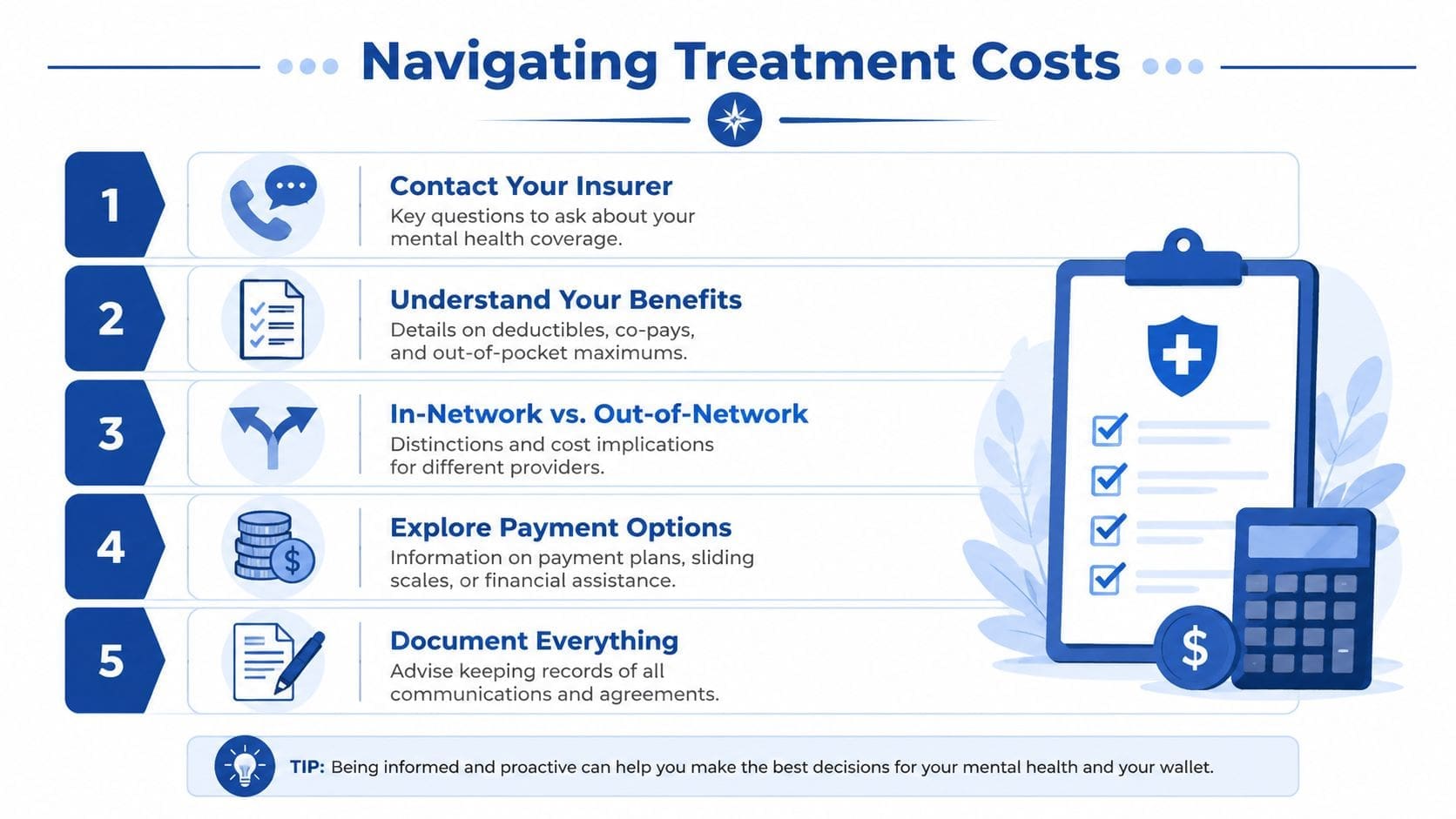
Many people need lower-cost pathways, not just private-pay listings. Publicly funded systems can be part of that search. As described in this overview of public mental health access and sliding-scale options, community systems may offer affordable counseling, referrals, case management, and other supports. The details vary by location, but the principle holds in many markets. Patients shouldn't assume private insurance is the only route.
Questions to ask before booking
Call the insurance company before the first appointment if possible. Ask direct questions and write down the answers.
- Ask about outpatient mental health coverage. Use that exact phrase. It helps separate general medical benefits from behavioral health benefits.
- Ask whether the provider is in-network or out-of-network. If out-of-network benefits exist, ask how reimbursement works.
- Ask whether preauthorization is required. Some plans require approval for certain services or treatment settings.
- Ask what applies first. Deductible, copay, or coinsurance can change what the first several visits cost.
- Ask about telehealth specifically. Some plans process virtual visits differently from office visits.
For patients who want to understand the administrative side more fully, this mental health billing codes guide can help decode the language that often appears on claims and statements.
Terms worth understanding
- Deductible: What the patient may need to pay before some benefits start.
- Copay: A fixed amount attached to a covered visit.
- Coinsurance: A percentage of the allowed charge that the patient may owe.
- Out-of-pocket maximum: The point at which covered healthcare costs may change under the plan.
This video gives a general overview that can make insurance conversations easier before the first call:
If insurance isn't the best fit
Some patients are uninsured. Others don't want mental health claims processed through insurance. Some discover their deductible makes insured care feel similar to cash pay early on. In those cases, it can make sense to ask about private-pay visits, membership models, or other transparent pricing structures.
A telepsychiatry option such as online psychiatric care in Pennsylvania may also offer a more straightforward intake and payment process for adults comparing insurance, self-pay, and ongoing follow-up models.
Keep a small record after every call. Write the date, the representative's name, and what was said. That habit prevents billing confusion later.
Preparing for Your First Appointment and Treatment
The first psychiatric appointment is usually much more practical than people expect. It isn't a test, and it isn't about saying the perfect thing. The clinician's job is to understand the pattern of symptoms, how long they've been present, what has already been tried, and what level of support makes sense now.
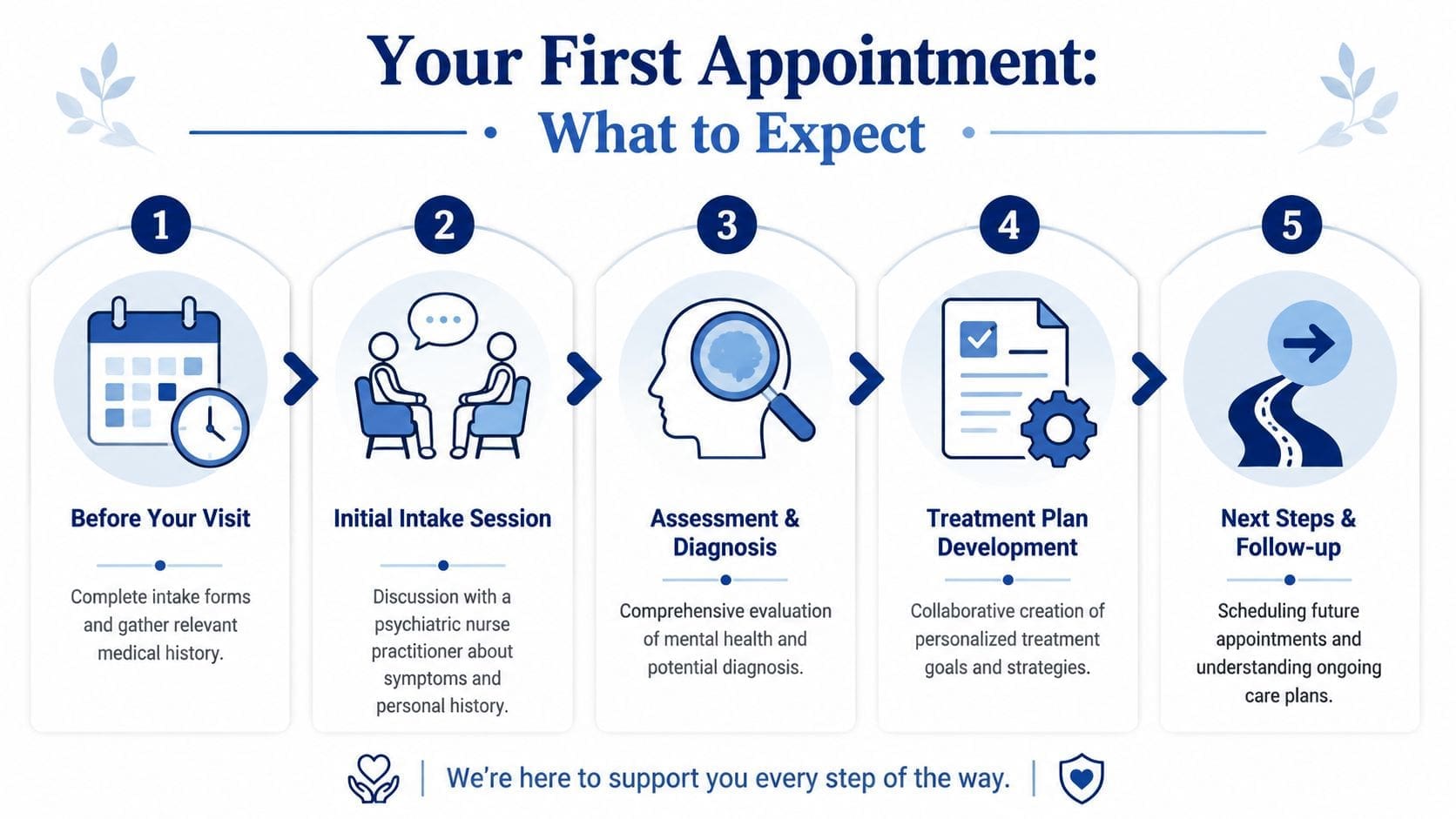
A structured process matters because depression treatment often unfolds in steps. Clinical guidance described by Johns Hopkins on treatment-resistant depression supports starting with evidence-based psychotherapy and or medication, then checking adherence, dose adequacy, and time on treatment before escalating. That review also notes response around 41% for psychotherapy at about two months, compared with lower response in usual care or waitlist conditions. That doesn't mean therapy fails when symptoms persist. It means follow-up and adjustment are part of good treatment.
What the clinician usually asks
Expect questions about mood, sleep, appetite, energy, concentration, anxiety, panic, trauma history, substance use, medical conditions, current medications, past psychiatric treatment, and family history. Functional impact matters too. A provider needs to know whether symptoms are affecting work, relationships, self-care, or daily tasks.
Patients searching for a psychiatrist often don't realize that psychiatric nurse practitioners also diagnose mental health conditions, prescribe psychiatric medications, monitor response, and adjust treatment plans. The credential matters less than whether the clinician practices carefully, follows up consistently, and explains decisions clearly.
Questions worth asking at intake
Bring a short list. That keeps the visit focused when concentration is low.
- How will progress be tracked: Ask how the clinician measures symptom change between visits.
- What is the initial treatment plan: Clarify whether the recommendation is therapy, medication, lifestyle changes, or a combination.
- How are side effects handled: Patients should know what to watch for and when to call.
- What happens if the first plan doesn't help enough: Good care includes a second-step plan.
- Are there cases where lab or genetic review is useful: Some patients may want to ask about genetic testing considerations for depression treatment as part of medication planning.
A solid intake doesn't promise instant relief. It gives the patient a rational next step and a way to judge whether treatment is moving in the right direction.
What tends to help and what tends to stall
Treatment usually works better when the plan is specific. Medication without follow-up, therapy without goals, or supplements without a diagnostic evaluation often leads to drift. Patients feel like they're "doing something" without knowing whether anything is changing.
What tends to help is a measured approach. Start with evidence-based treatment, monitor symptoms, adjust if response is limited, and reconsider the diagnosis or treatment intensity when progress stalls. For more complex or treatment-resistant cases, higher-intensity options may come up later, but only after the basics have been done well.
Start Your Recovery with Integrative Psychiatry of America
By the time many adults finish searching for Depression treatment near me, they're not looking for more articles. They're looking for a clear next step, fewer barriers, and a treatment relationship that doesn't feel confusing from the start.
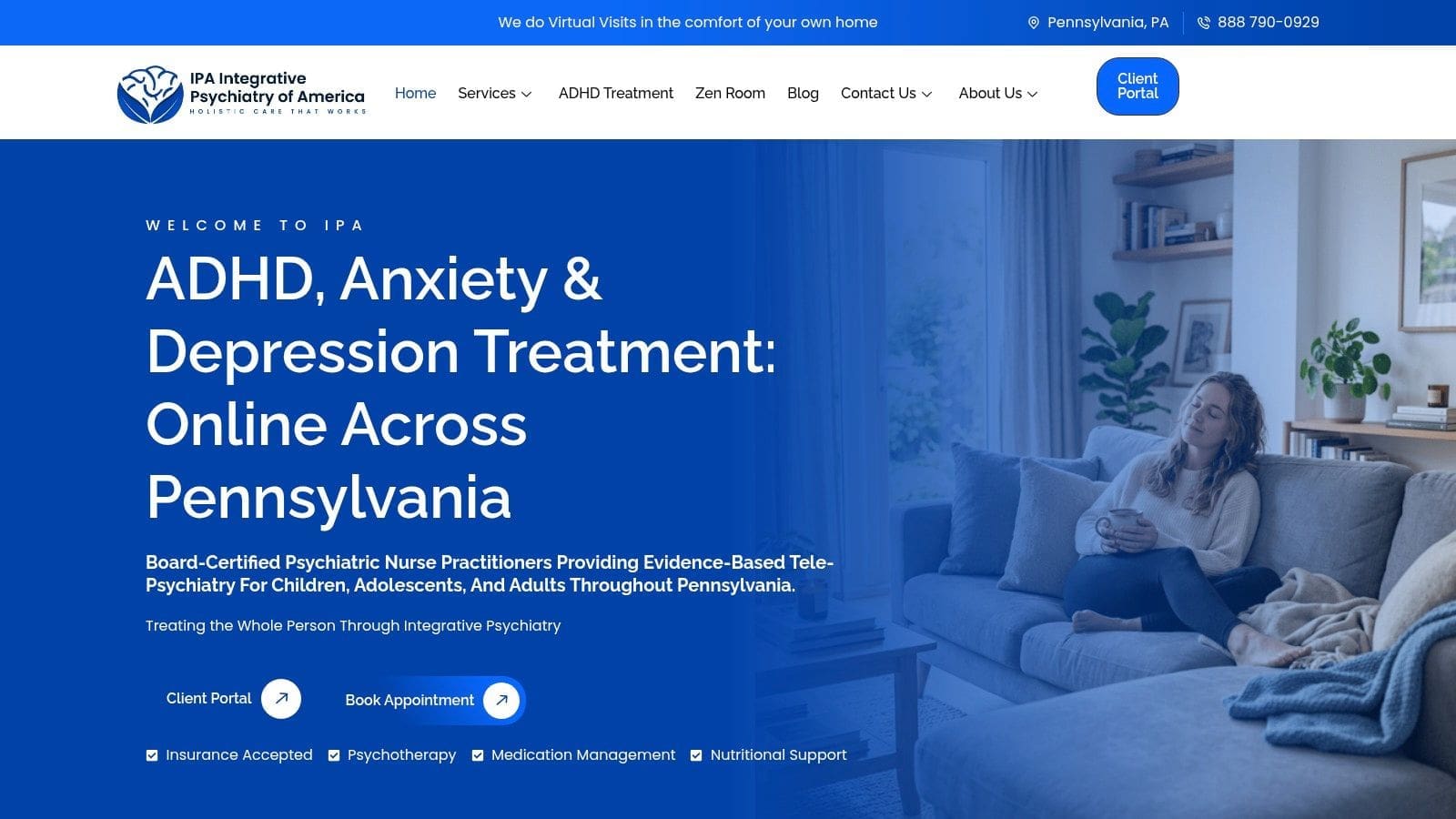
One option patients in Pennsylvania may consider is online depression treatment at Integrative Psychiatry of America. The practice provides telepsychiatry across Pennsylvania, including Philadelphia, through psychiatric nurse practitioner-led care, medication management, psychotherapy support, and integrative strategies such as exercise counseling, nutrition education, mindfulness, and screening options when clinically indicated.
Why this model fits many adults
Telepsychiatry removes several common drop-off points at once. It cuts travel time, lowers the hassle around follow-up, and gives patients a private setting for visits. That doesn't solve depression by itself, but it does make consistency easier.
This kind of model also helps adults who want one place to discuss mood symptoms alongside sleep, focus, stress, lifestyle patterns, and medication response. Some patients also like reviewing supportive wellness topics between visits, including practical resources on cognition and daily functioning such as this article on reduce brain fog with supplements, while keeping psychiatric treatment decisions grounded in clinician oversight.
What to look for before booking
Choose a practice that can answer basic operational questions without friction:
- Scheduling clarity: How quickly can a new patient complete intake and book follow-up?
- Communication process: Is there a patient portal for messages, refills, and appointment requests?
- Payment transparency: Can the office explain insurance verification, cash pay, or membership options?
- Treatment scope: Does the practice handle straightforward depression care as well as more layered presentations that may include anxiety, trauma, or substance-related concerns?
Patients do better when access is simple and treatment is organized. That combination matters more than flashy language on a website.
If you're ready to stop searching and start care, Integrative Psychiatry of America offers online psychiatric treatment across Pennsylvania with a practical, whole-person approach. Patients can review services, verify insurance, and request an appointment through the website.