
A Pennsylvania adult may be reading this after another missed deadline, another pile of half-finished tasks, or another argument that started with “Why didn't you just do it?” The search for answers often happens late at night, usually after years of assuming the problem was stress, poor discipline, anxiety, or burnout.
That's why adult ADHD diagnosis online gets searched so often. People want clarity, but they also want to avoid getting rushed into a label by a website that treats a serious psychiatric evaluation like a checkout form. For adults in Philadelphia, Pittsburgh, Harrisburg, Erie, Scranton, Allentown, Lancaster, Reading, and smaller Pennsylvania communities, telepsychiatry can open the door to real care. It can also expose patients to low-quality shortcuts if they don't know what to look for.
Table of Contents
- The Search for Clarity Considering an Online ADHD Diagnosis
- How a Proper Telehealth ADHD Evaluation Works
- Your First Virtual ADHD Assessment Appointment
- How to Prepare for a Successful Evaluation
- Choosing Between Online and In-Person ADHD Care
- Avoiding Pitfalls in Your Search for Online Care
- What Happens After a Diagnosis Treatment Options in PA
The Search for Clarity Considering an Online ADHD Diagnosis
A common Pennsylvania story sounds like this. Someone did well enough in school to stay off anyone's radar, then adulthood got more complicated. Work requires planning. Parenting requires consistency. Bills, emails, deadlines, appointments, and household tasks don't wait for motivation to show up.
The person may live in Center City Philadelphia, outside Pittsburgh, or in a rural area where specialty mental health care isn't easy to access. They start reading about adult ADHD and recognize themselves in the pattern. Chronic disorganization. Losing track of tasks. Starting strong, then stalling. Feeling bright, capable, and frustrated all at once.
That's usually the moment hope and skepticism collide. An online evaluation sounds convenient and private, but it also raises fair questions. Is it real medicine? Is it just a quiz? Is someone checking whether the symptoms fit ADHD, anxiety, depression, sleep loss, or something else?
A good evaluation should leave a patient feeling understood, not processed.
Some adults also look into self-management ideas before they book care. For readers sorting through lifestyle options, HempWell USA's ADHD CBD insights offer a grounded discussion of benefits, limits, and risks worth understanding before trying to treat concentration problems alone.
Another point of confusion is symptom overlap. Many adults aren't sure whether they're dealing with anxiety, attention problems, or both. A quick self-check like this anxiety or ADD comparison tool can help organize concerns before a formal evaluation, but it shouldn't replace one.
Why this search feels urgent
Adults usually don't pursue an assessment because they're casually curious. They do it because the strain has become visible.
- Work is affected. Missed details, late starts, unfinished projects, and avoidable mistakes can threaten job performance.
- Relationships are affected. Partners may interpret forgetfulness or inconsistency as lack of effort.
- Self-esteem takes a hit. Many adults start blaming character when the underlying issue may be neurodevelopmental.
The goal isn't to chase a diagnosis. The goal is to find the right explanation, then build a treatment plan that actually fits.
How a Proper Telehealth ADHD Evaluation Works
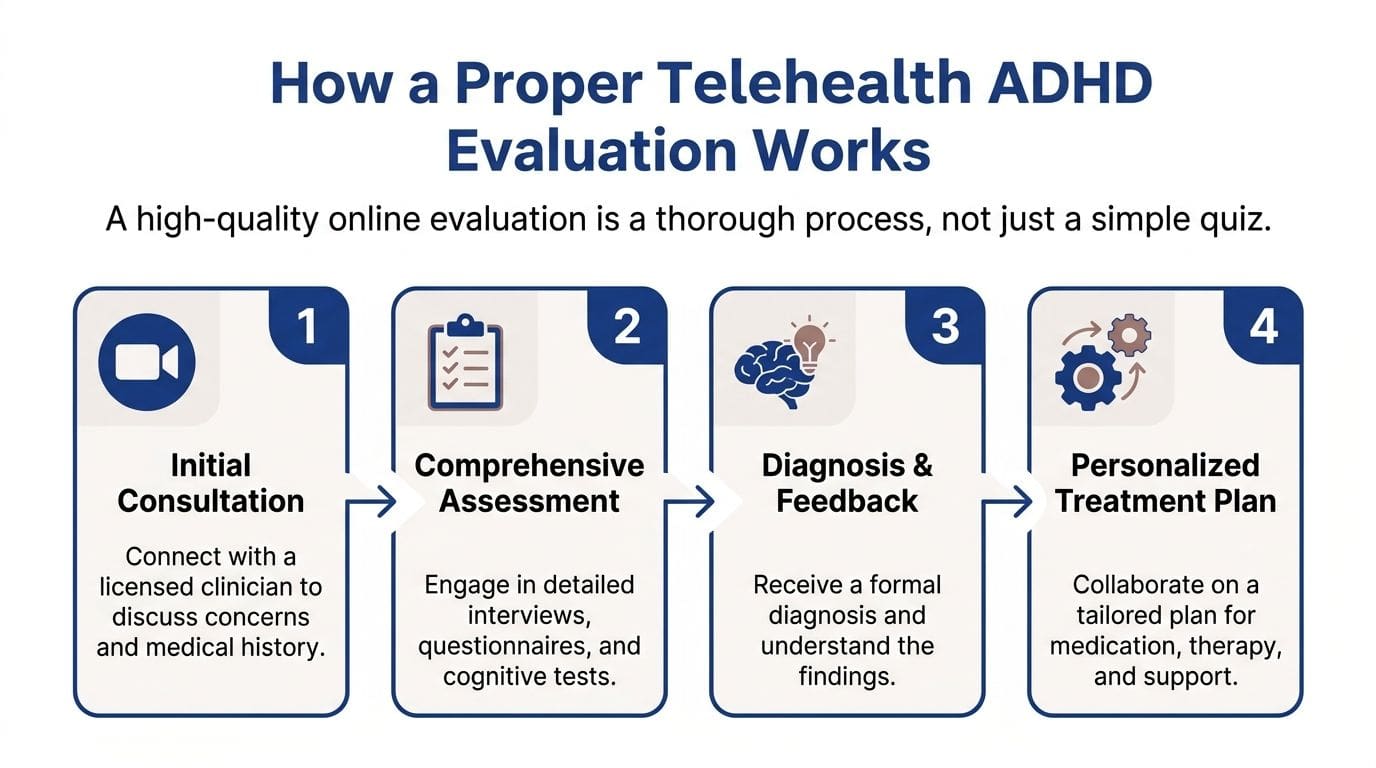
A high-quality online evaluation is a clinical process. It isn't a personality quiz, a five-minute intake form, or an automatic prescription pipeline.
What makes online diagnosis legitimate
A proper telehealth evaluation uses the same diagnostic standards expected in a physical office. The technology changes access. It does not change the clinical responsibility.
Validated online ADHD assessment protocols for adults demonstrate a sensitivity of 80.6% and a positive predictive value of 94.9%, with approximately 78% diagnostic agreement with traditional in-person clinical evaluations conducted by licensed professionals, according to this review of online ADHD assessment methods. That only applies when the process is structured, evidence-based, and done by qualified clinicians.
A legitimate evaluation usually includes:
- A live video appointment with a licensed clinician. The provider needs to hear the story directly, ask follow-up questions, and observe how symptoms are described.
- Use of validated screening tools. Tools such as the ASRS, CAARS, and DIVA can support the process. They help identify patterns, but they do not diagnose on their own, as outlined by CAMH's adult ADHD screening and assessment overview.
- Developmental history. The clinician should ask what life looked like in childhood, school, home, and early functioning.
- Functional review across settings. Symptoms should be explored at work, at home, in relationships, and in daily routines.
Patients looking for statewide virtual care can review a Pennsylvania telehealth psychiatry option to understand how secure online psychiatric visits are typically structured.
A short educational overview can also help patients visualize what a proper process looks like in practice.
What the clinician is actually evaluating
The provider isn't just counting distracted moments. The provider is testing whether the full pattern fits ADHD and whether another condition explains it better.
That means the interview may include questions about:
- School history. Report cards, teacher comments, unfinished assignments, behavioral patterns.
- Adult responsibilities. Bills, appointments, time management, task completion, driving, paperwork.
- Emotional patterns. Frustration tolerance, overwhelm, shame, and stress responses.
- Medical and psychiatric context. Sleep problems, anxiety, depression, substance use, thyroid concerns, trauma history, or other conditions that can affect focus.
Practical rule: If an online service can diagnose ADHD without a thorough interview, it can also miss the reason the symptoms started.
Your First Virtual ADHD Assessment Appointment
The first appointment is usually more conversational than many patients expect. It should feel organized, but not mechanical.
What the conversation usually covers
The clinician will often begin with the patient's reason for seeking care now. Sometimes the tipping point is work performance. Sometimes it's graduate school, parenting demands, relationship conflict, or the realization that years of “trying harder” haven't fixed the same problems.
From there, the provider usually asks for examples rather than yes-or-no answers. Instead of only asking whether the patient is forgetful, the clinician may ask what gets forgotten, how often, and what the consequences are. Instead of only asking whether focus is poor, the clinician may ask whether the problem shows up during paperwork, conversations, reading, driving, or routine chores.
That detail matters because formal diagnosis has specific requirements. Diagnosis of ADHD in adults requires that at least five symptoms of inattention or hyperactivity-impulsivity be present for six months or longer, with several symptoms having been evident before age 12, and that these symptoms cause measurable impairment in at least two settings, based on AAFP's summary of adult ADHD criteria.
Why the provider asks about more than focus
Some patients feel caught off guard when the visit includes questions about sleep, mood, medical history, trauma, or substance use. That isn't the clinician “changing the subject.” That's the clinician doing the job correctly.
A medically sound evaluation has to consider whether another issue is contributing to the symptoms. An adult may feel unfocused because of untreated anxiety. Another may be mentally foggy from chronic sleep loss. Someone else may have both ADHD and depression. Sorting that out is the difference between careful treatment and a wrong turn.
The provider may also ask whether a spouse, parent, sibling, or someone else who knows the patient well can confirm long-term patterns. Corroborating information is often useful when self-report alone doesn't tell the whole story.
For patients who are unsure what kind of clinician is qualified to perform this evaluation, this guide on a psychiatric NP versus psychiatrist can clarify training, scope, and what to expect.
A first appointment often includes these themes:
- History of symptoms. When attention, restlessness, disorganization, or impulsivity first became noticeable.
- Degree of impairment. Whether the symptoms create real problems, not just occasional inconvenience.
- Pattern over time. ADHD tends to be longstanding. A sudden recent change raises different questions.
- Differential diagnosis. The clinician evaluates what fits, what doesn't, and what still needs clarification.
Many adults feel relief during the visit simply because someone is finally asking the right questions.
How to Prepare for a Successful Evaluation
Preparation can make the appointment less stressful and more accurate. It also helps the patient give examples that might otherwise be forgotten during a live conversation.
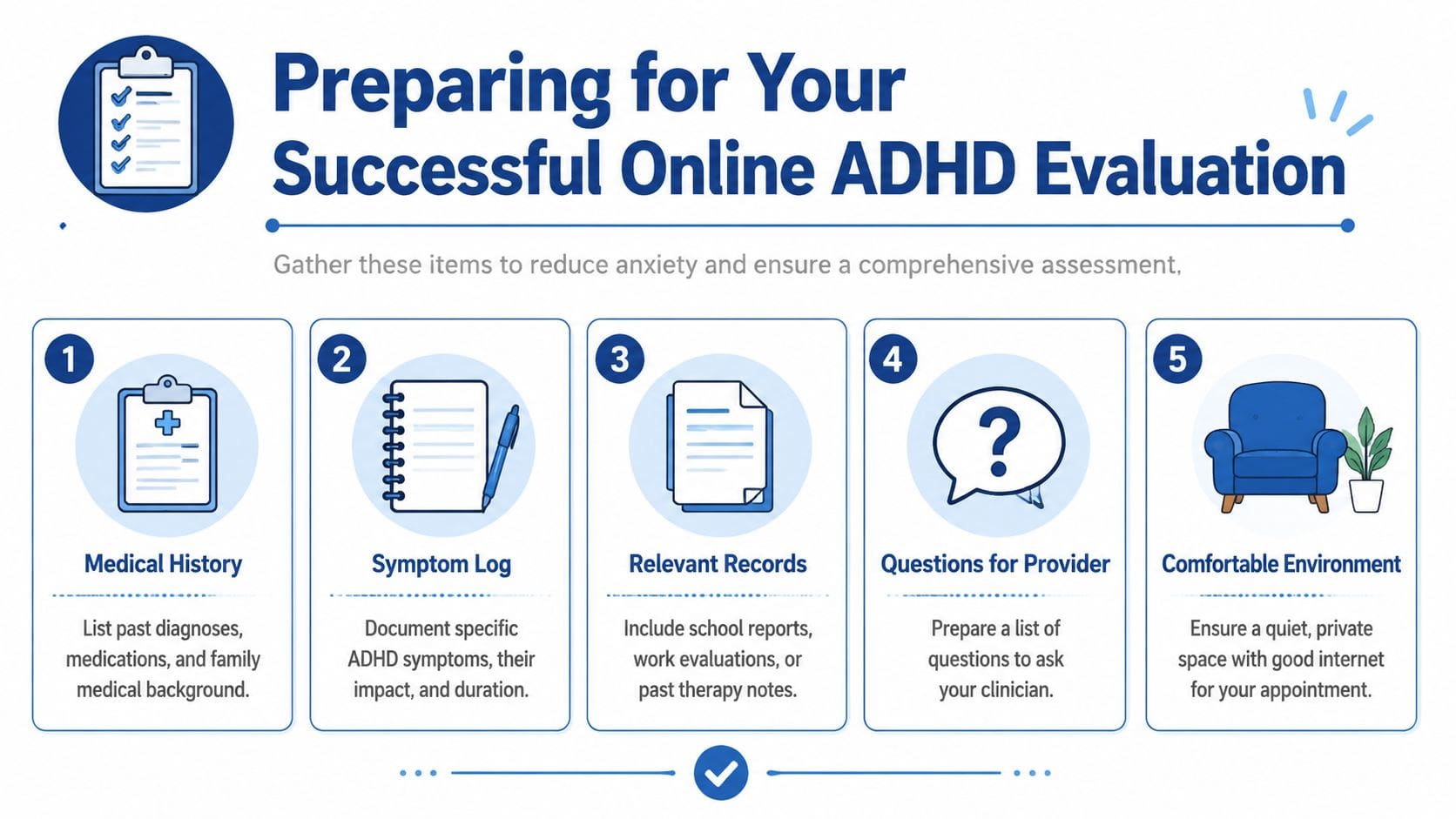
What to gather before the visit
A patient doesn't need a perfect file folder. A few concrete records and notes can go a long way.
- Past school records. Old report cards, standardized comments, or documentation showing distractibility, inconsistent effort, missed work, or behavioral concerns.
- Work examples. Performance reviews, repeated feedback about organization, lateness, follow-through, or avoidable mistakes.
- Medication and mental health history. Prior diagnoses, medication trials, therapy history, and family psychiatric history.
- A symptom log. Specific examples are better than broad statements. “Missed two bill payments this month” is more useful than “bad at adulting.”
Patients who want to organize concerns ahead of time can review information about ADHD testing costs and evaluation planning before booking.
Questions worth writing down in advance
A strong evaluation should invite questions. It helps to bring them written down, especially if attention is already under strain.
Consider asking:
- How do you distinguish ADHD from anxiety, depression, or sleep problems?
- Do you use validated tools as part of the evaluation?
- What records or collateral information would help?
- If ADHD is diagnosed, what treatment options are usually discussed?
- If it isn't ADHD, what happens next?
Some patients also benefit from completing a structured self-reflection before the visit, such as an adult ADHD assessment worksheet, a daily planner, or a journal that tracks mood, focus, and task completion patterns. The point isn't to self-diagnose. The point is to arrive prepared with clearer examples.
Choosing Between Online and In-Person ADHD Care
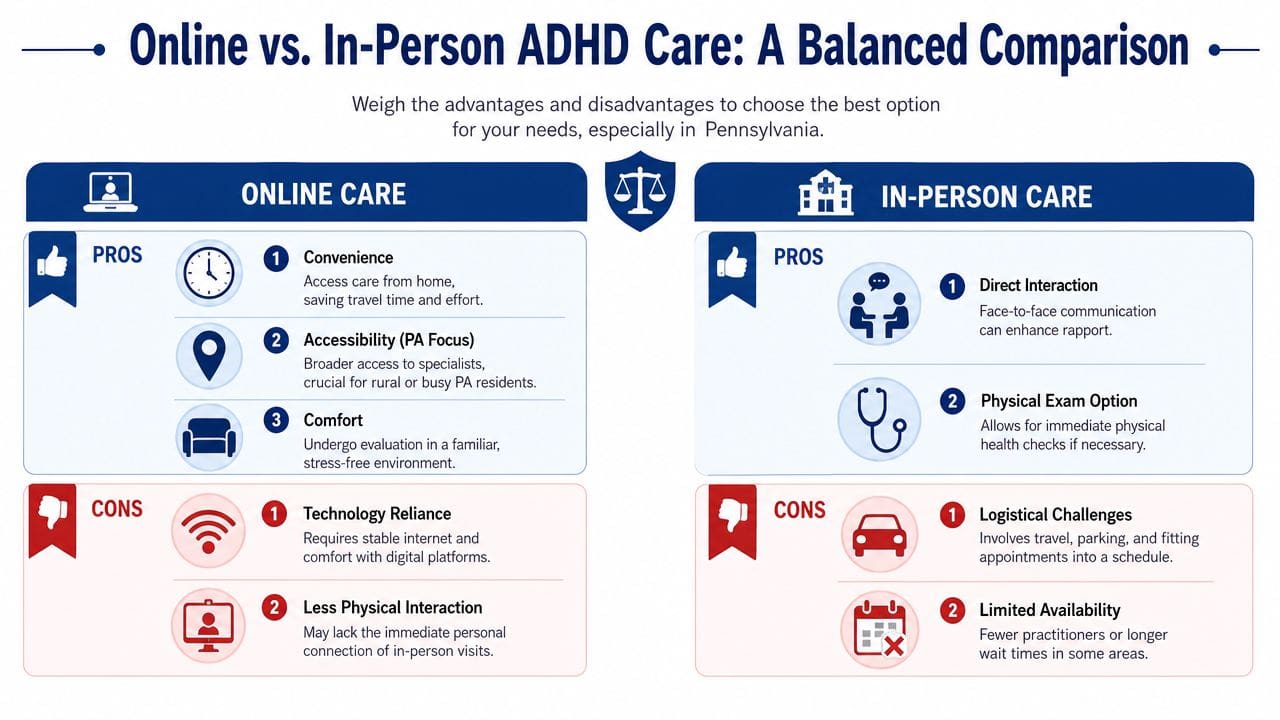
For many adults in Pennsylvania, a key question isn't whether online care can work. It's whether online or in-person care fits their situation better.
A practical comparison
Here's the simplest way to compare them.
| Care format | Often works well for | Main trade-off |
|---|---|---|
| Online telehealth | Busy adults, parents, professionals, college students, and people outside major metro areas | Requires comfort with video visits and a stable internet connection |
| In-person visits | Patients who strongly prefer face-to-face interaction or need coordinated local medical services | Travel, scheduling strain, parking, and fewer specialty options in some areas |
Telehealth has become common in ADHD care. Since the onset of the COVID-19 pandemic, about 30.5% of adults with current ADHD used online services to obtain ADHD medication prescriptions, according to the CDC's MMWR report on adult ADHD and telehealth use.
That matters in Pennsylvania. A patient in Philadelphia may choose telehealth for convenience. A patient in Erie, Lancaster, Reading, or a rural county may choose it because it widens access to qualified ADHD clinicians without a long drive.
When in-person care may still make sense
Online care isn't always the better fit.
In-person visits may be worth prioritizing when:
- A physical medical issue needs immediate hands-on evaluation.
- The patient has significant technology barriers.
- Privacy at home is hard to secure.
- A person communicates better in the room than on screen.
Still, for many adults, the strongest advantages of virtual care are practical. It reduces travel friction, makes follow-up easier, and allows treatment to fit around work and family obligations. When the process is clinically sound, the quality comes from the evaluation itself, not from the waiting room.
Convenience is helpful. Clinical rigor is non-negotiable.
Avoiding Pitfalls in Your Search for Online Care
The fastest way to waste time and money is to choose an online service that promises certainty before it gathers enough information to earn it.
Red flags that should make a patient pause
Some warning signs are obvious. Others are subtle.
- Instant diagnosis language. If the website suggests a patient can be diagnosed in minutes, caution is warranted.
- No live video evaluation. A serious psychiatric diagnosis shouldn't come from a form alone.
- Quiz-only model. Screening tools are useful, but they are not the whole evaluation.
- No interest in childhood history. ADHD doesn't begin out of nowhere in adulthood.
- No discussion of alternative explanations. A clinician who never asks about sleep, anxiety, depression, trauma, or medical issues may miss the correct diagnosis.
One of the most important concerns in online ADHD care is the failure to assess conditions that mimic ADHD. A critical gap in online diagnosis is identifying “ADHD mimics,” and up to 40% of self-reported adult ADHD cases may be misdiagnosed because of comorbid or alternative conditions such as anxiety or sleep apnea, as discussed in this educational review on ADHD mimics.
That's why speed can be dangerous. A patient may walk away with a label that feels validating but doesn't explain the full picture.
Green flags that suggest a safer process
Reliable telepsychiatry usually has a different tone. It feels slower, clearer, and more medically grounded.
Look for these signs:
- Transparent credentials. The provider's license, role, and specialty training should be easy to verify.
- A clear diagnostic process. The practice explains that evaluation involves history, symptom review, functional impairment, and differential diagnosis.
- Thoughtful prescribing practices. Medication is discussed within a broader treatment framework, not treated like the only point of the appointment.
- Direct answers to patient questions. Good practices explain how they assess adult ADHD and what happens if the diagnosis isn't confirmed.
A careful provider won't promise the answer a patient wants. A careful provider will work to find the answer that fits.
What Happens After a Diagnosis Treatment Options in PA
A diagnosis can bring relief, but it's only the starting point. Treatment is where daily life begins to change.
Treatment is broader than medication alone
Adult ADHD is common enough that adult-focused care matters. Approximately 6% of U.S. adults have an ADHD diagnosis, and nearly half of those adults received their diagnosis in adulthood, according to the American Psychiatric Association's adult ADHD overview.
After diagnosis, treatment may include:
- Medication management. Some adults consider stimulant options. Others need non-stimulant approaches because of side effects, preferences, health history, or co-occurring conditions.
- Therapy referrals. Skills-based therapy can help with routines, emotional regulation, time management, and self-defeating patterns.
- Lifestyle support. Sleep, exercise, nutrition, and structure often shape how well any treatment plan works.
Patients interested in a broader discussion of evidence-informed care can review these adult ADHD treatment options. For people who are also curious about complementary approaches, this guide to natural supplements for ADHD focus may help frame questions to bring to a licensed clinician before trying over-the-counter products.
What next steps can look like statewide
For adults across Pennsylvania, follow-up care often needs to be realistic. A plan that works on paper but doesn't fit a person's schedule usually falls apart.
That's where virtual care can be useful. Integrative Psychiatry of America provides online psychiatric evaluations, medication management, and evidence-informed treatment for adults throughout Pennsylvania. Patients in Philadelphia, Pittsburgh, Harrisburg, Scranton, Allentown, Lancaster, Reading, Erie, and statewide can also pair clinical care with practical support tools such as an Adult ADHD Assessment, Daily Agenda Planner, Feeling Journal, Exercise Routine Generator, Anxiety Symptom Checker, and 5-4-3-2-1 Grounding Tool.
The strongest treatment plans are usually the ones patients can sustain. Clear diagnosis, careful follow-up, and realistic daily strategies tend to matter more than any promise of a quick fix.
If persistent distractibility, disorganization, or follow-through problems are affecting work, relationships, or daily life, Integrative Psychiatry of America offers a next step to explore legitimate virtual psychiatric care in Pennsylvania. Patients can learn about treatment options, verify insurance coverage, schedule an appointment, or start with one of the free mental health tools to prepare for a more informed evaluation.