
Searching for ADD testing in Philadelphia County often starts the same way. An adult notices years of missed deadlines, unfinished projects, restless sleep, mental clutter, or a constant sense of working harder than everyone else just to stay organized. Then the search results make the process look either suspiciously easy or unnecessarily confusing.
The biggest point to clear up early is this: ADHD testing usually isn't one single decisive test. Many adults expect a fast scan, a short quiz, or one computerized task to settle the question. In practice, authoritative care models treat ADHD evaluation as a broader clinical assessment that looks at history, symptoms, and functioning across settings. That matters because co-occurring conditions also need attention, and one Philadelphia-focused review notes they affect 78% of kids with ADHD in care discussions around thorough evaluation and treatment planning (Blackbird Health's overview of ADHD evaluation in Philadelphia).
Adults in Pennsylvania who are trying to find real answers usually benefit from a process that's structured, practical, and clear about tradeoffs. Quick screening has a role. It's just not the same thing as diagnosis. For people comparing telehealth options, local clinics, and specialty programs, this guide walks through what tends to work, what often creates confusion, and how to approach the process without wasting time.
Table of Contents
- Starting Your Search for ADHD Testing in Philadelphia
- How to Prepare for Your ADHD Evaluation
- Choosing a Provider Telehealth vs In-Person Care
- What to Expect During the ADHD Assessment
- Understanding Insurance and Costs for Testing
- After the Diagnosis Your Path to Thriving with ADHD
Starting Your Search for ADHD Testing in Philadelphia
A lot of adults begin with the phrase ADD testing Philadelphia County because they want clarity fast. That's understandable. The problem is that many listings blur the line between a screening, a diagnostic evaluation, and treatment planning.
Some pages highlight speed. Others focus on one tool, such as a computerized attention test. Those tools can be useful, but they don't replace a full clinical evaluation. Adults usually need a provider who can sort through attention symptoms alongside anxiety, depression, sleep disruption, trauma history, substance use, academic struggles, and job-related burnout.
What a serious search should look for
A practical search should focus less on the word “test” and more on the quality of the assessment. Good evaluation pages usually describe:
- Clinical interview: A real conversation about current symptoms, childhood patterns, work performance, routines, and functioning.
- History gathering: Developmental, medical, and psychiatric background that helps separate ADHD from lookalike conditions.
- Rating scales and collateral input: Structured forms and, when appropriate, outside observations that add context.
- Next-step planning: Diagnosis alone isn't enough. Adults need a plan for treatment, follow-up, and symptom management.
For adults comparing providers, this often matters more than whether the office markets itself with terms like ADHD clinic or psychiatrist. The provider should explain how diagnosis is made.
Practical rule: If a page promises a quick answer but doesn't explain how history, impairment, and differential diagnosis are reviewed, it's worth slowing down before booking.
Some adults also want a provider who can continue care after diagnosis instead of handing off the next step. That often reduces delays and confusion. For readers looking at broader care options, finding an ADHD doctor near you through Integrative Psychiatry of America is one telehealth pathway available in Pennsylvania.
A better question than “Where can this be done fast?”
A more useful question is, “Who can help determine whether this is ADHD, something overlapping with ADHD, or something else entirely?” That shift changes the search. It moves the goal from a quick label to an accurate answer.
How to Prepare for Your ADHD Evaluation
Preparation makes ADHD assessment far more efficient. Adults often arrive with a general sense that things have been hard for a long time, but the evaluation gets stronger when those patterns are turned into concrete examples.
A simple checklist helps organize the first appointment.
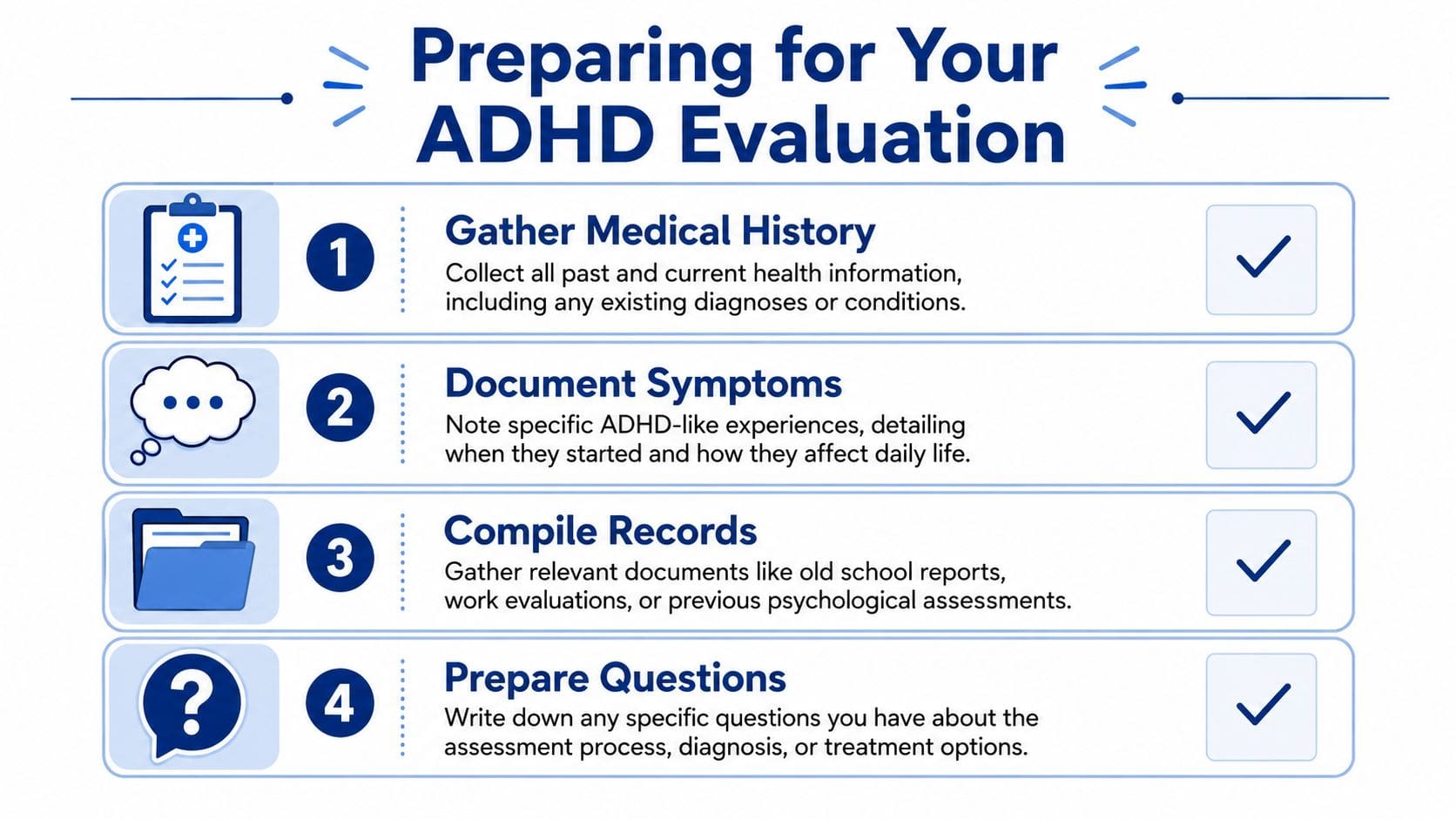
What to gather before the visit
Bring information that shows patterns over time, not just a bad week.
- Medical background: Past diagnoses, current medications, prior mental health treatment, sleep problems, and substance use history.
- Symptom examples: Specific moments matter. Missing bill payments, zoning out in meetings, chronic lateness, losing important items, or abandoning projects halfway through are more useful than saying “focus is bad.”
- School or work records: Old report cards, teacher comments, academic evaluations, performance reviews, or workplace feedback can be helpful.
- Family observations: A partner, parent, sibling, or close friend may notice patterns the patient normalizes.
Adults often underestimate how important examples are. ADHD is about more than distraction. Clinicians look at consistency, onset, impairment, and context.
A short prep exercise that helps
Before the appointment, it helps to write out answers to these questions:
- When did the attention or organization problems start becoming noticeable?
- Where do they show up most. Work, home, relationships, school, driving, finances?
- What has already been tried. Calendars, reminders, therapy, coaching, caffeine, medication, strict routines?
- What's the cost of the symptoms. Missed opportunities, stress, conflict, underperformance, exhaustion?
That preparation often leads to a sharper diagnostic conversation than trying to remember everything in the moment.
For adults who want a plain-language overview of the process, this guide on how to get an ADHD diagnosis as an adult can help frame what to expect.
A brief educational video can also make the process feel less abstract:
Bring examples from ordinary life, not polished summaries. The forgotten errands, incomplete work tasks, and repeated “small failures” usually tell the clearest story.
Choosing a Provider Telehealth vs In-Person Care
Adults in Philadelphia County often have two realistic paths. They can pursue telehealth ADHD evaluation or book an in-person assessment. Both can be appropriate. The right fit depends on clinical needs, scheduling constraints, privacy preferences, and whether extra testing is necessary.
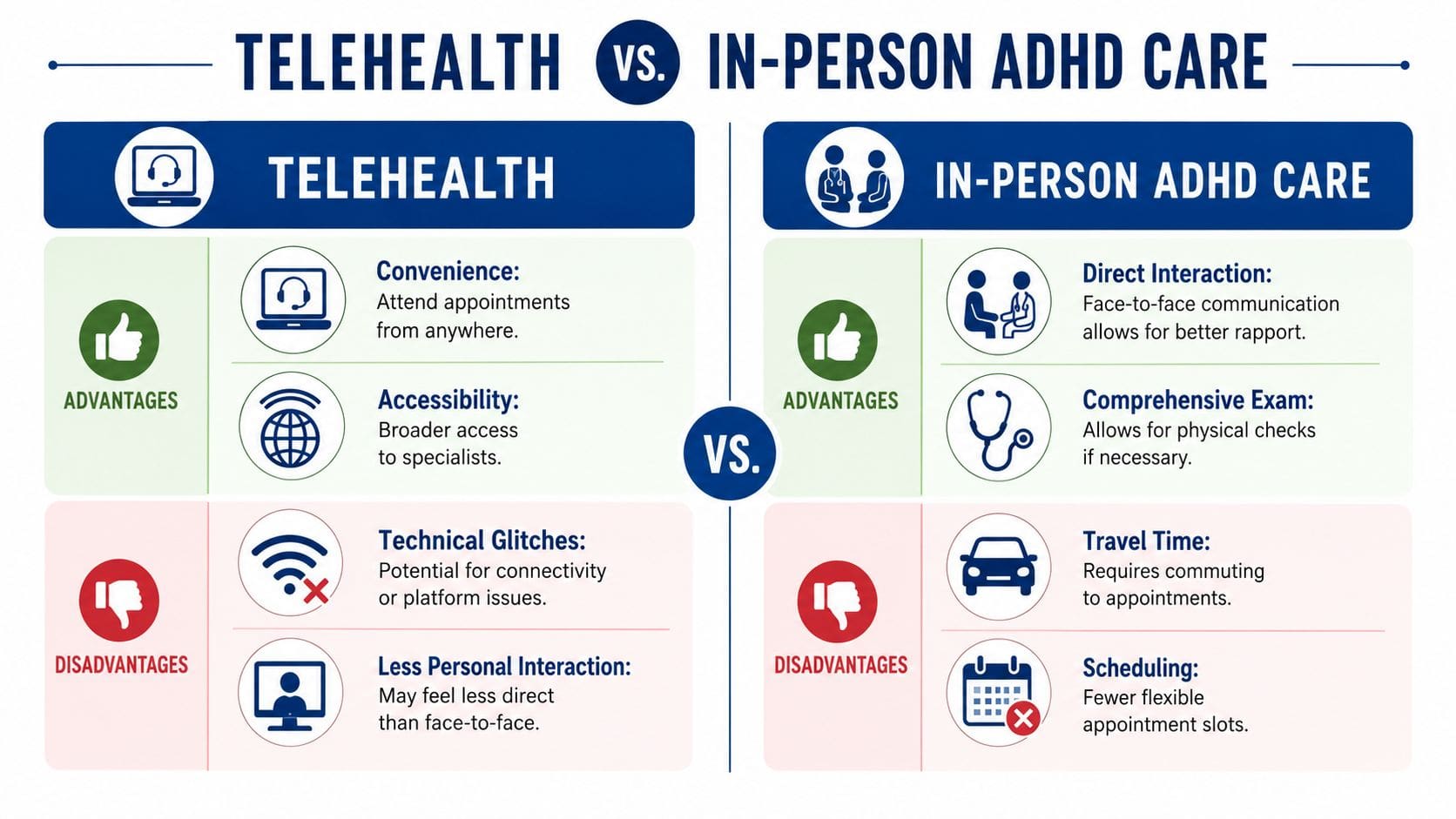
Where telehealth works well
Telehealth is often a strong fit for adults who can describe their history clearly, complete forms reliably, and attend visits from a quiet private setting. It reduces commute time, makes follow-up simpler, and expands access to clinicians across Pennsylvania.
That convenience has changed the local market. One Philadelphia ADHD resource notes that the market includes telehealth offers with $150 consultations and quick scheduling, while also stressing the need to understand the tradeoffs. The same source notes that robust remote evaluations may integrate objective tools like QbTest to supplement interviews and questionnaires rather than replace them (ADHD Philadelphia on telehealth and testing tradeoffs).
Where in-person care may be the better fit
In-person evaluation can be preferable when the case is more complex. That includes adults with unclear developmental history, major diagnostic overlap, cognitive concerns beyond ADHD, or a need for testing that's easier to administer on site. Some patients also communicate better face to face.
A traditional setting may feel more grounded for people who dislike video visits or have privacy challenges at home. That isn't a minor issue. If the patient can't speak openly, the assessment quality drops.
Side-by-side decision points
| Care format | Often a good fit when | Main limitation |
|---|---|---|
| Telehealth | The adult wants convenience, privacy, and easier follow-up | Some patients need more objective or in-person assessment support |
| In-person | The diagnostic picture is complicated or the patient prefers face-to-face visits | Travel, scheduling, and local availability can slow the process |
For Pennsylvania residents who want a remote option, online ADHD evaluation through Integrative Psychiatry of America is one available telepsychiatry route. The practice uses psychiatric nurse practitioners, not a psychiatrist, and the key question remains the same as with any provider: how thorough is the evaluation, and what happens after the diagnosis?
What doesn't work well
The weakest approach is choosing purely by speed or price. Fast access is useful. Thin assessment is not. If a provider can't explain when questionnaires are enough, when objective testing might help, and how they screen for overlapping conditions, that's a meaningful limitation.
What to Expect During the ADHD Assessment
A solid adult ADHD assessment gathers multiple data points and fits them together clinically. The process is less like taking an exam and more like building a case carefully enough that the diagnosis makes sense.
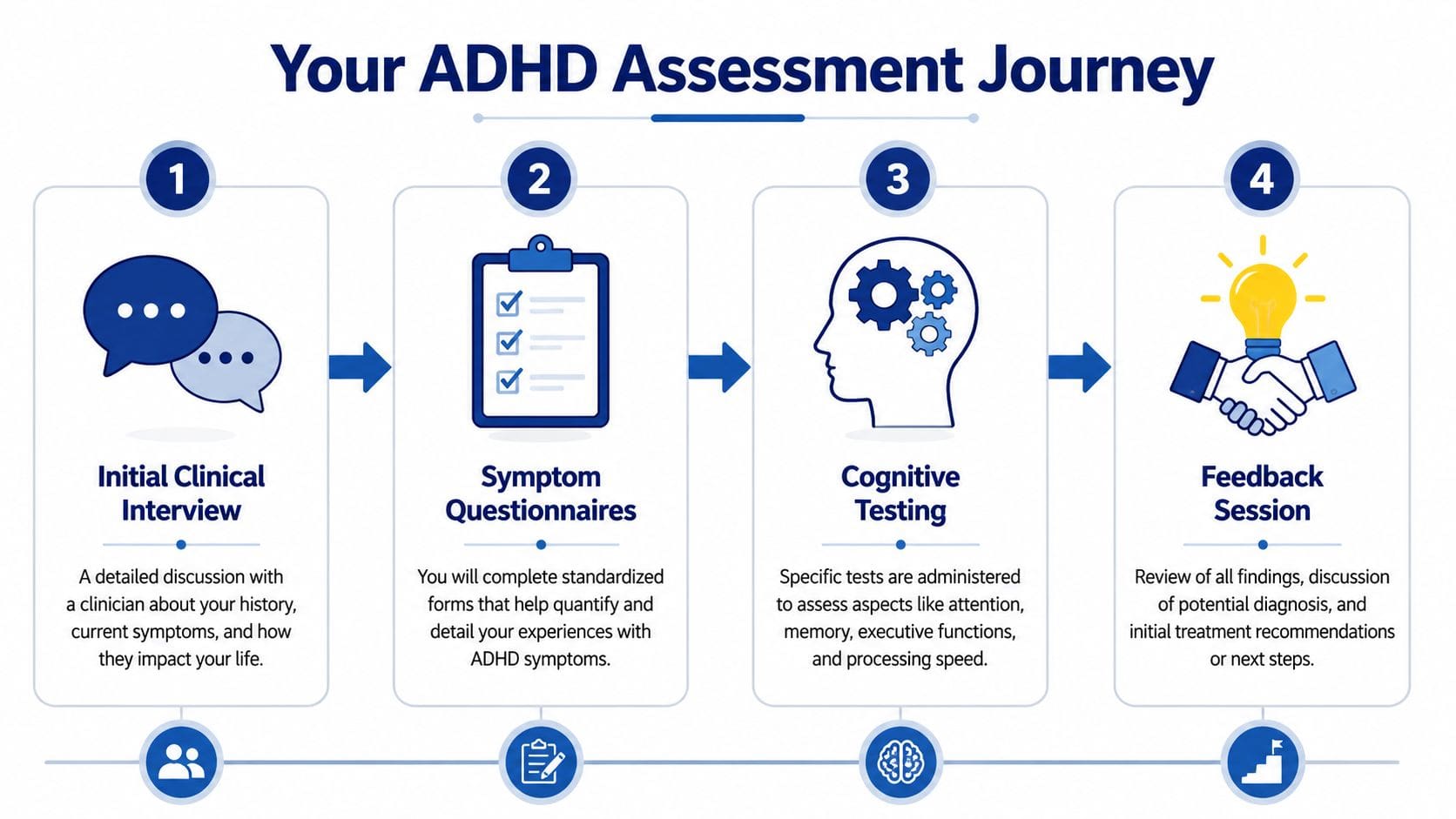
A high-quality ADHD evaluation combines a structured clinical interview, multi-informant rating scales, a review of developmental history, and a review of functional impairment across multiple settings. That same clinical approach also helps screen for differential diagnoses such as mood, sleep, or anxiety disorders (American Academy of Pediatrics review on ADHD diagnosis and care).
The interview matters more than many adults expect
The interview usually covers:
- childhood behavior and school functioning
- current work performance
- household organization
- relationship patterns
- sleep quality
- mood symptoms
- anxiety symptoms
- prior treatment history
Adults sometimes worry that they'll say the wrong thing or forget details. That's normal. The clinician's job is to organize the story, ask follow-up questions, and look for consistency.
Rating scales and collateral information
Standardized questionnaires help structure the assessment. They don't diagnose ADHD by themselves, but they make symptoms easier to compare and discuss. Outside input can be helpful too, especially when a spouse, partner, or parent can describe longstanding patterns.
Here's the key point: checklists support diagnosis, they don't replace clinical judgment.
Symptoms have to make sense in context. A high score on a form doesn't automatically mean ADHD, and a low score doesn't always rule it out.
When computerized testing enters the picture
Some clinics use tools such as TOVA or QB-type tests as adjuncts. They can add objective information about attention and task performance, but they shouldn't be used alone. One pediatric and behavioral health source describing a thorough evaluation notes administration times of around 30 minutes for computerized tasks and 60 to 90 minutes for a full initial evaluation, with diagnosis often taking 2 to 4 weeks from first contact to final review (Belle Health's description of ADHD comprehensive evaluation).
That timing helps explain why a short test isn't the same thing as a complete diagnostic process. A person can perform one way during a brief task and very differently in daily life.
The feedback session and next steps
The final stage is where the pieces come together. The clinician reviews whether the evidence supports ADHD, whether another condition may better explain the symptoms, or whether multiple issues are present at once. After that, treatment planning begins.
Some adults move into medication management quickly. Others need therapy first, more diagnostic clarification, or targeted support for sleep, anxiety, depression, trauma, or substance use. For readers exploring that next phase, psychological testing for ADHD and related services can clarify what additional assessment may involve.
Understanding Insurance and Costs for Testing
Cost keeps many adults from booking an evaluation even when they've needed one for years. The challenge usually isn't just price. It's uncertainty. Patients often don't know whether they're looking at an office visit, a formal assessment package, out-of-network reimbursement, or an ongoing treatment relationship.
Philadelphia does have an established adult ADHD care footprint. Penn Medicine lists an Adult ADHD Treatment and Research Program at 3535 Market Street, Philadelphia, PA 19104, which shows that adult evaluation and treatment are established services within a major local health system (Penn Medicine Adult ADHD Treatment and Research Program). That usually means insurance pathways exist, even if they take work to go through.
Questions to ask insurance before booking
A short benefits check can prevent expensive surprises.
- Ask about behavioral health coverage: Confirm whether ADHD evaluation is covered under mental health benefits.
- Clarify provider status: Check whether the clinician is in-network or out-of-network.
- Ask how assessment is billed: Some evaluations are billed as visits, while others involve separate testing-related codes.
- Request reimbursement details: If using an out-of-network provider, ask whether a superbill can be submitted and what documentation is required.
What changes the cost
ADHD assessment costs vary based on the structure of care. A straightforward diagnostic interview is different from a broader testing battery. Ongoing treatment planning, medication follow-up, and additional documentation can also affect the total.
A simple way to compare options is to ask providers these questions:
| Question | Why it matters |
|---|---|
| What does the evaluation include | Helps distinguish screening from full diagnosis |
| Are follow-up visits separate | Prevents confusion about total cost |
| Do you provide documentation for reimbursement | Important for out-of-network claims |
| Will treatment continue here if ADHD is diagnosed | Reduces fragmentation |
For adults trying to budget before scheduling, this ADHD testing cost guide offers a practical framework for comparing evaluation models and follow-up costs.
After the Diagnosis Your Path to Thriving with ADHD
A diagnosis often brings relief, but it shouldn't be treated like the finish line. The useful question is what changes next. Adults do best when the diagnosis leads to a plan that addresses both symptoms and daily functioning.
For children ages 6 years and older, the CDC states that treatment generally includes behavior therapy and medication, preferably together. The CDC also reports that 7 million children ages 3 to 17 in the United States have ever been diagnosed with ADHD, equal to 11.4% of that age group based on 2022 parent survey data (CDC ADHD data and treatment guidance). While adult care isn't identical to pediatric care, the same broad principle carries over well: treatment usually works best when it isn't reduced to one tool.
What treatment often includes
A practical adult plan may combine several elements:
- Medication management: When appropriate, medication can improve attention, task initiation, and impulse control.
- Therapy or coaching: Especially useful for planning, emotional regulation, procrastination, and shame that has built up over time.
- Lifestyle support: Sleep, exercise, nutrition, routines, and stress management often influence symptom severity.
- Functional systems: Calendars, reminders, body doubling, environmental changes, and workplace accommodations can make treatment stick.
The integrative piece matters
Many adults don't need only symptom reduction. They need a way to function more consistently at work, at home, and in relationships. That's where whole-person care becomes useful. Integrative Psychiatry of America is one telehealth option in Pennsylvania that provides ADHD evaluation, diagnosis, and medication management through psychiatric nurse practitioners, alongside broader support that may include psychotherapy, exercise counseling, nutritional education, and other integrative services when clinically appropriate.
The most effective plan is usually the one the patient can actually follow on an ordinary Tuesday, not the one that sounds ideal on paper.
Adults sometimes expect treatment to create instant organization or erase years of overwhelm. It usually doesn't work that way. What does happen, with accurate diagnosis and consistent follow-up, is that the fog starts to lift and tasks become more manageable.
If you're looking for a practical next step, Integrative Psychiatry of America offers secure telepsychiatry for adults in Pennsylvania who want ADHD evaluation, diagnosis, and ongoing treatment planning from psychiatric nurse practitioners. A consultation can help determine whether symptoms fit ADHD, whether another condition needs attention, and what a realistic treatment plan should look like.