
A lot of adults in Pennsylvania sit down to work, open five tabs, answer none of the emails, and then wonder why simple tasks feel impossible. Bills get paid late. Laundry stalls in the washer. Meetings are missed, not because of laziness, but because the mind keeps slipping away from the thing it meant to do.
For many people, that pattern has been explained away for years as stress, burnout, anxiety, or poor discipline. Sometimes those issues are part of the picture. Sometimes ADHD is, too. ADHD meds can be a useful part of treatment when symptoms are persistent, impairing, and carefully evaluated in the full context of a person's life.
Table of Contents
- Your Guide to ADHD Medication Management in Pennsylvania
- Stimulants vs Non-Stimulants The Two Main Classes of ADHD Meds
- How ADHD Medications Work in the Brain
- Choosing the Right ADHD Medication for You
- Safety Monitoring and Managing Side Effects
- Beyond the Prescription Integrative Strategies for ADHD
- Getting ADHD Medication Online in Pennsylvania
Your Guide to ADHD Medication Management in Pennsylvania
An adult in Philadelphia, Pittsburgh, Harrisburg, or a smaller Pennsylvania town may look successful on paper and still feel like daily life is held together with reminders, panic, and last-minute effort. Common complaints sound familiar: trouble starting tasks, missed deadlines, chronic procrastination, emotional reactivity, and the exhausting cycle of knowing what needs to be done but not being able to make the brain cooperate.
That doesn't automatically mean ADHD. It does mean a proper assessment matters.
ADHD treatment has become far more visible in adults over time. A nationwide Swedish study reported that ADHD medication use in adults increased more than 10-fold, from 0.1% to 1.3% from 2006 to 2020, and medication use was associated with lower risks of self-harm, unintentional injury, and traffic crashes in that study period, according to JAMA Psychiatry's nationwide ADHD medication analysis.
What patients are often trying to sort out
Some adults are asking whether they need medication at all. Others already suspect ADHD but don't know whether telehealth can handle diagnosis and treatment safely. Many are carrying years of shame from being told they're scattered, forgetful, too emotional, or inconsistent.
A careful medication conversation usually starts with questions like these:
- When did the symptoms start. ADHD rarely makes sense as a story that began only last month.
- Where is impairment showing up. Work, school, relationships, finances, driving, and daily routines all matter.
- What else could be contributing. Anxiety, depression, trauma, poor sleep, substance use, and medical issues can overlap with ADHD symptoms.
- What does the patient want help with first. Some people want better focus. Others want less impulsivity, less overwhelm, or better follow-through.
For families also looking at younger patients, integrative ADHD treatment for kids can help clarify how age, school demands, and developmental stage change the treatment discussion.
ADHD medication should never be reduced to “take a stimulant and see what happens.” Diagnosis comes first. Fit comes second.
For adults who want a telehealth option, online ADHD medication management in Pennsylvania can make follow-up, dose adjustments, and side-effect review more practical from home.
Stimulants vs Non-Stimulants The Two Main Classes of ADHD Meds
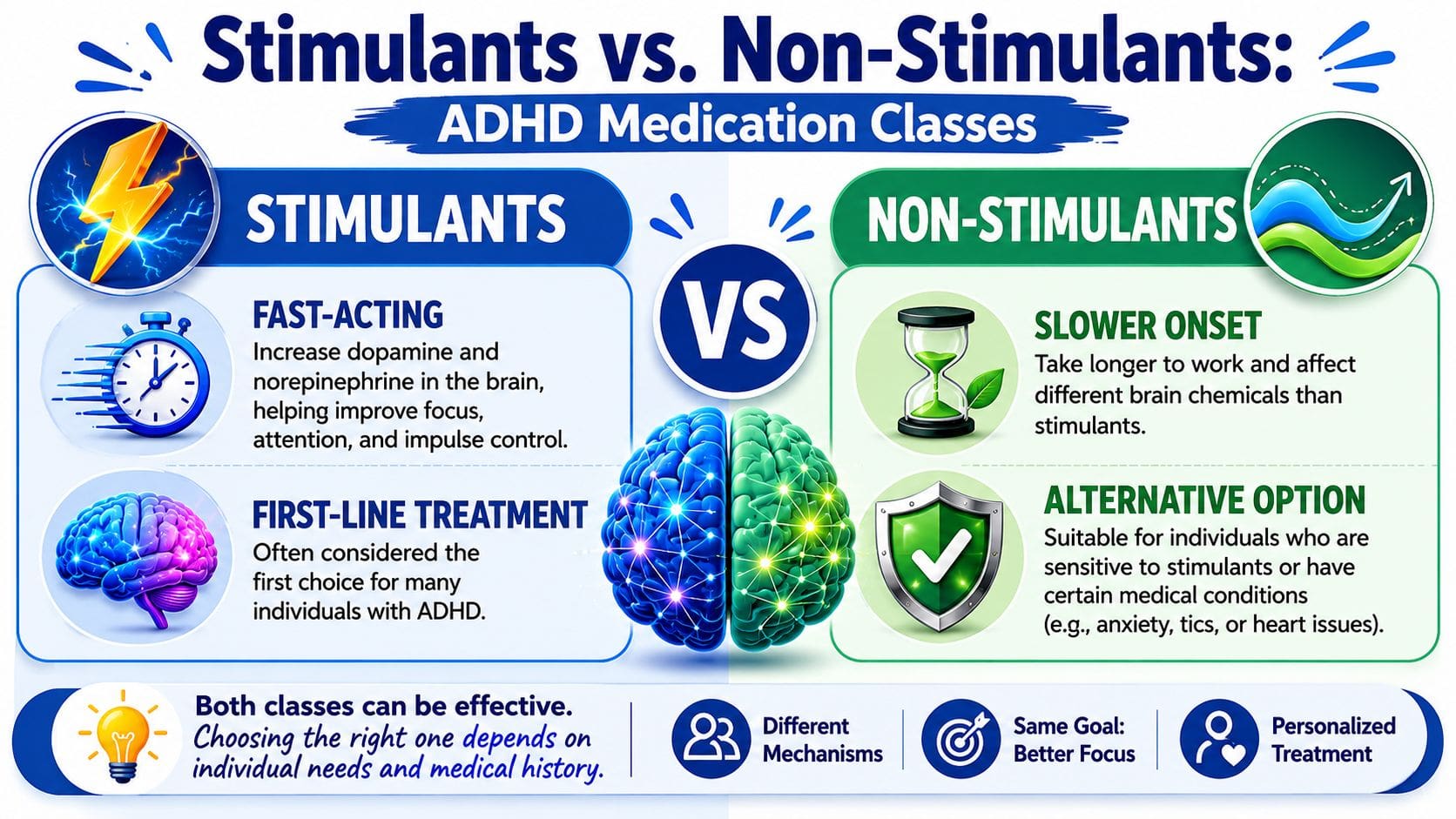
Most ADHD meds fall into two broad groups. Stimulants are often the faster-acting option. Non-stimulants work differently and are often considered when stimulants aren't tolerated, aren't available, or aren't the right clinical fit.
How they differ in real life
A practical comparison helps more than a label.
| Medication class | What patients often notice | Common clinical use |
|---|---|---|
| Stimulants | Faster symptom change, clearer focus window, more obvious “kick in” and “wear off” pattern | Often chosen when rapid symptom relief is important |
| Non-stimulants | Slower buildup, steadier feel for some people, less emphasis on immediate effect | Often considered when stimulant side effects, misuse risk, or shortages complicate care |
Stimulants include familiar names such as Adderall, Ritalin, Concerta, and Vyvanse. Non-stimulants include atomoxetine and viloxazine. Guanfacine ER and clonidine ER are also part of the non-stimulant conversation, though age indications and use patterns differ.
When non-stimulants become especially important
The stimulant shortage changed this discussion for many patients. During shortages, FDA-approved non-stimulants such as atomoxetine and viloxazine, along with some off-label options, become important alternatives, as described in GoodRx's review of non-stimulant ADHD medications.
That matters because medication changes are not just about “stronger” versus “weaker.” They involve trade-offs:
- Speed. Stimulants are usually felt sooner. Non-stimulants generally require more patience.
- Tolerability. Some patients feel jittery, anxious, or emotionally flat on a stimulant. Others feel far better on one.
- Misuse concerns. Controlled substances require more monitoring and more caution.
- Availability. A medication can be clinically appropriate and still hard to find.
Clinical reality: The “best” ADHD medication is often the one a patient can tolerate, access consistently, and use safely.
Patients who already know they want to explore alternatives can review non-stimulant ADHD treatment options online.
What doesn't work
What tends not to work is chasing a brand name because someone online said it was the strongest. Another common mistake is abandoning a non-stimulant too early without discussing expectations, timing, and goals with a prescriber. A slower onset doesn't mean a medication is failing. It means the treatment plan has to match the medication's timeline.
How ADHD Medications Work in the Brain
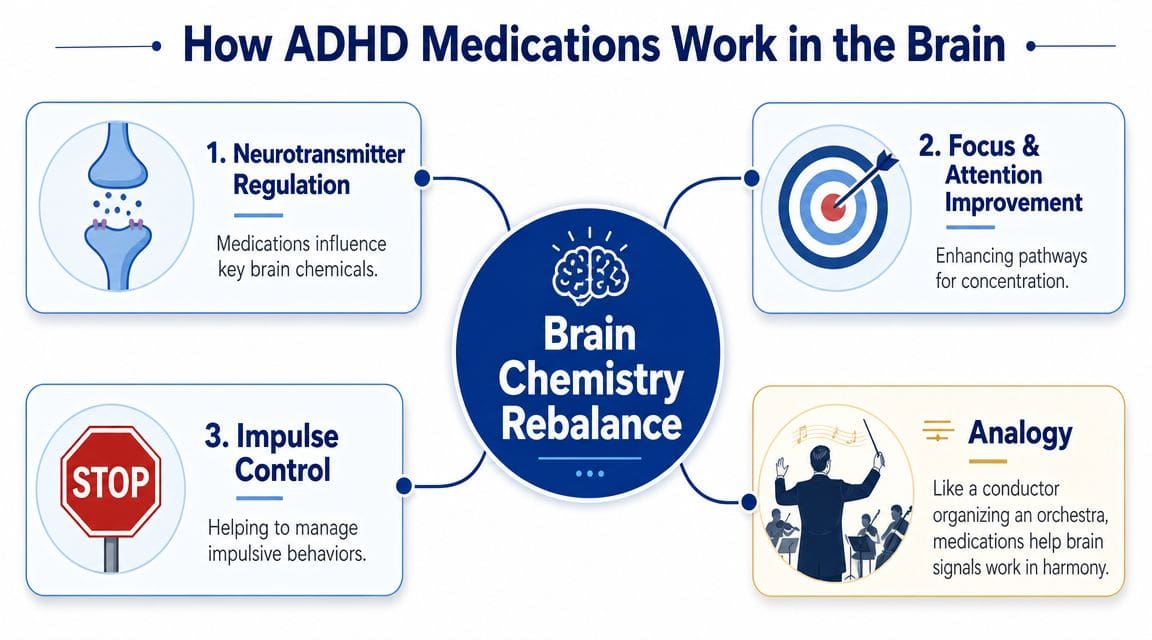
A useful way to explain ADHD meds is to think of the brain as a radio system. The station is there, but the signal isn't coming through cleanly. Important messages compete with background noise. The result can look like distractibility, poor task persistence, impulsive decisions, or trouble organizing actions in sequence.
ADHD medications don't create discipline out of nowhere. They aim to improve signal quality.
The role of dopamine and norepinephrine
For methylphenidate-based stimulants, the core mechanism is blockade of the dopamine and norepinephrine transporters, which increases synaptic availability of both neurotransmitters and is believed to improve signaling in the prefrontal cortex, according to the Psychopharmacology Institute review of methylphenidate.
That brain region helps with functions patients care about every day:
- Task initiation
- Sustained attention
- Working memory
- Impulse control
- Planning and sequencing
This is one reason ADHD medication can feel less like “being stimulated” and more like being able to stay with a task long enough to finish it.
Why formulation matters so much
Medication class is only part of the story. Formulation changes the day-to-day experience.
The same methylphenidate source notes that short-acting formulations usually last about 3 to 5 hours, while long-acting versions are designed for about 8 to 12 hours of effect. That difference can shape work performance, parenting demands, evening routines, and rebound symptoms.
A patient who only needs focused coverage for a narrow task window may prefer a short-acting option. Another who needs support from the morning commute through late-afternoon responsibilities may do better with a longer-acting version.
A medication that works for only part of the day can still fail the patient's actual life.
Some patients also want to understand related brain chemistry terms because ADHD often overlaps with anxiety, mood symptoms, or sleep issues. A simple overview of what serotonin does in mental health can be helpful when sorting out overlapping symptoms and medication questions.
What patients often misunderstand
Patients sometimes expect medication to create motivation on demand. That's not how it works. ADHD meds can improve the brain's ability to direct attention and reduce interference, but they don't replace sleep, routines, or good task systems. Medication may make it easier to use those tools. It doesn't make them unnecessary.
Choosing the Right ADHD Medication for You
The right ADHD medication is rarely obvious on day one. Good prescribing is a matching process. Symptoms matter, but so do schedule, sleep, appetite, anxiety level, medical history, and the kind of problems that need the most help.
A person with mainly inattentive symptoms and a structured office job may need something different from a parent who has to function early in the morning, late in the evening, and through unpredictable household demands.
The questions that actually shape medication choice
A practical evaluation usually looks at several layers at once.
- Symptom pattern. Is the bigger problem distractibility, impulsivity, hyperactivity, emotional reactivity, or task paralysis?
- Coexisting conditions. Anxiety, panic symptoms, depression, trauma history, and substance use history can all change the medication discussion.
- Daily rhythm. Some people need early morning control. Others need evening coverage when home responsibilities begin.
- Side-effect sensitivity. If sleep is already fragile or appetite is already poor, those issues deserve attention before a prescription is chosen.
This is also where patient preferences matter. Some people value quick onset. Others care more about a smoother feel and fewer peaks and troughs.
Delivery systems can change the entire experience
One of the most underappreciated parts of ADHD prescribing is how the medication is delivered, not just which ingredient is used. The release pattern can determine whether a medication feels abrupt, smooth, too short, or mistimed for the patient's real day.
Advanced delivery systems can shift that experience substantially. OROS methylphenidate, such as Concerta, uses an osmotic pump with an initial peak at about 1 hour and roughly 78% gradual release over 9 hours, while Jornay PM uses a delayed-release and extended-release design that can postpone release for up to 10 hours, as described in Additude's overview of ADHD medication delivery systems.
That can matter for people who struggle most:
- Before school or work starts
- During long afternoon stretches
- When medication wear-off triggers irritability or rebound
- When adherence is difficult with multiple daytime doses
The right formulation can solve a problem that looks like the wrong medication.
Personalization sometimes includes lab and genetic context
Medication choice is still guided primarily by clinical evaluation and follow-up. In some cases, additional tools can support decision-making. Pharmacogenomic information doesn't pick an ADHD med automatically, but it may offer clues about how a person metabolizes certain psychiatric medications or why side effects may be more pronounced.
Patients who want to explore that layer can learn more about genetic testing for mental health treatment.
What usually backfires
Two patterns commonly create frustration. The first is choosing a medication based only on what helped a friend. The second is assuming that a stronger feeling means a better result. The most useful ADHD medication is the one that improves functioning without creating a new set of problems.
Safety Monitoring and Managing Side Effects
ADHD meds can be very helpful, but safe treatment requires more than writing a prescription. The main question isn't whether a medication can improve focus. The better question is whether it improves daily life safely, consistently, and with clear monitoring.
Common side effects and practical responses
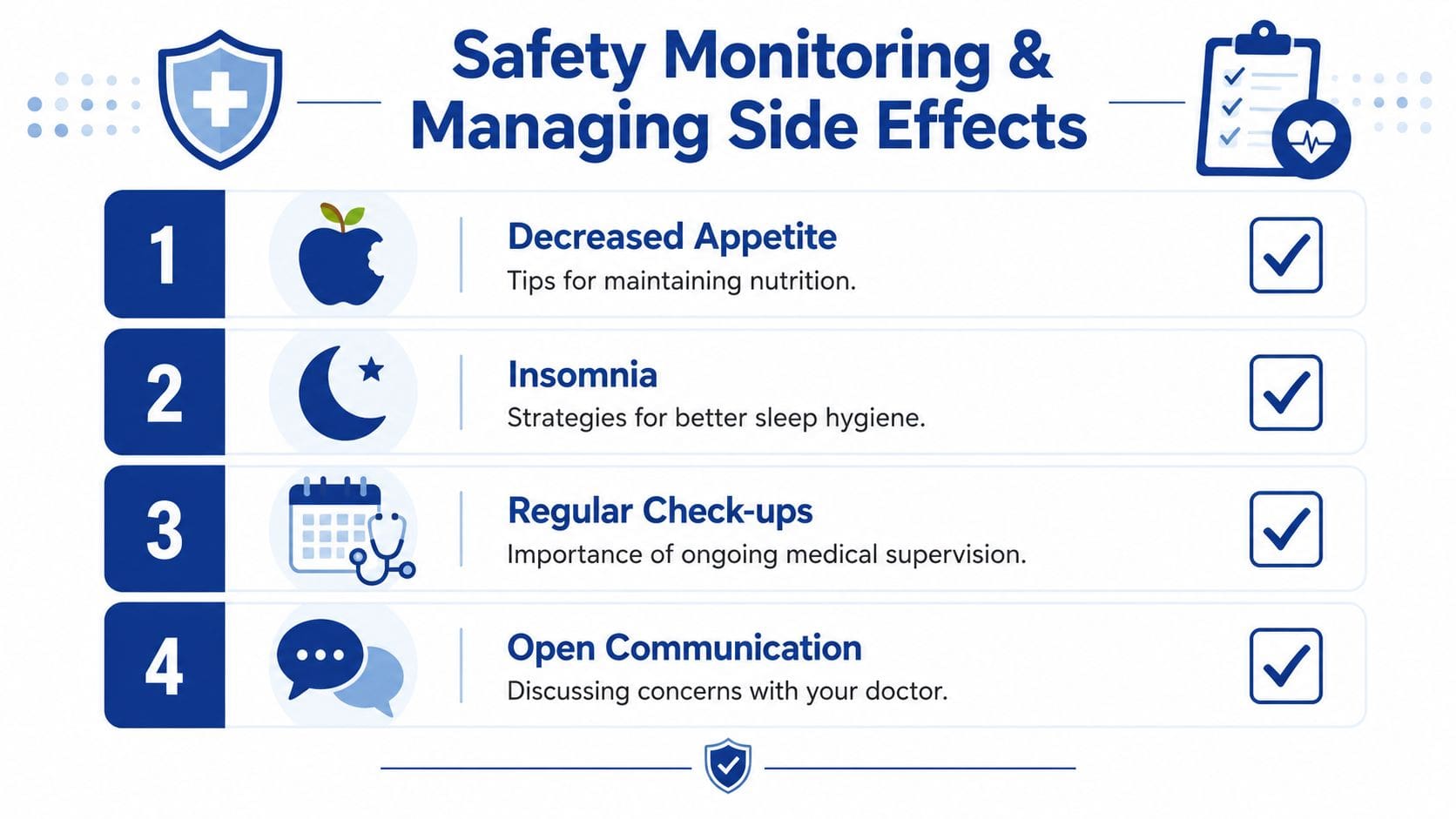
The side effects patients ask about most often are decreased appetite, insomnia, feeling too activated, headaches, dry mouth, and changes in heart rate or blood pressure. Not every patient gets them, and not every side effect means the medication is wrong. Sometimes the dose is too high. Sometimes the timing is off. Sometimes the formulation doesn't fit the patient's day.
A few practical adjustments often help:
- For appetite loss. Plan meals intentionally, especially earlier in the day or when hunger is strongest.
- For sleep problems. Recheck dose timing, caffeine intake, and whether the medication is lasting too late into the evening.
- For jitteriness. Look at dose, food intake, hydration, and the possibility that an anxious system is being pushed too hard.
- For rebound irritability. Consider whether a smoother or longer formulation makes more sense.
Monitoring is part of treatment, not an add-on
Responsible ADHD prescribing includes ongoing review of symptom benefit, side effects, sleep, appetite, mood, and vital signs. Some patients also need closer medical review if they have cardiac symptoms, a complex medication list, or a history that raises concern.
Public-health surveillance also matters here. ADHD stimulants have been associated with risks tracked through emergency department data, which is one reason careful diagnosis and follow-up are so important, as discussed in the NIH-indexed commentary on ADHD stimulant access and harms.
A safe monitoring plan often includes:
- Baseline review of medical history, current medications, and substance use.
- Regular follow-ups to assess benefit and emerging side effects.
- Vital sign tracking when clinically indicated.
- Honest discussion about misuse, sharing medication, or taking more than prescribed.
Safety principle: If a patient can't discuss side effects, sleep, or substance use openly, medication management becomes less safe very quickly.
Misuse and diversion need plain language
Stimulants are controlled substances. That means storage, refill timing, and transparent communication all matter. Sharing pills with a friend, doubling up before a deadline, or mixing prescribed stimulants with unreported substances creates real risk.
What doesn't help is shame. What does help is a straightforward partnership where problems are identified early, before they become emergencies.
Beyond the Prescription Integrative Strategies for ADHD
Medication can lower the friction. It usually doesn't build the whole system. Adults with ADHD tend to do better when medication is paired with changes that support attention, emotional regulation, and daily structure.
That whole-person approach matters because many ADHD struggles aren't only about concentration. They involve sleep, eating patterns, stress load, self-criticism, and the absence of reliable routines.
What supports medication instead of competing with it
Several non-prescription strategies tend to make ADHD treatment more workable:
- Sleep protection. A medication plan can fall apart fast if bedtime drifts, sleep is fragmented, or the patient runs on chronic exhaustion.
- Therapy and skills work. Cognitive behavioral approaches, ADHD coaching strategies, and practical behavior systems can help translate symptom relief into actual life change.
- Movement. Regular exercise often helps patients discharge restlessness, regulate mood, and create a more stable day.
- Nutrition and hydration. This becomes especially important when meds blunt appetite or make patients forget meals.
Emotional regulation often needs more than medication
Many adults seek treatment because of procrastination, but stay in treatment because of emotional dysregulation. They describe snapping at loved ones, spiraling after small mistakes, or feeling flooded by routine demands.
Medication may help that indirectly by improving self-control and reducing overwhelm. Therapy, mindfulness practice, and better daily pacing often do the rest of the work. Even simple habits can matter, such as using external reminders, breaking large tasks into smaller steps, and scheduling recovery time after demanding blocks of work.
Treatment works better when the patient stops asking one pill to do every job.
What tends to disappoint patients
The most disappointing expectation is believing medication should erase ADHD entirely. It won't. Good care aims for better functioning, fewer collisions with daily life, and more room to use skills consistently. That's a strong outcome, even if the patient still needs calendars, alarms, lists, or therapy.
Getting ADHD Medication Online in Pennsylvania
Telehealth has made ADHD care more reachable for adults who would otherwise delay evaluation for months. That includes people in Philadelphia and across Pennsylvania who are balancing work, parenting, transportation barriers, privacy concerns, or the difficulty of fitting mental health care into an already overloaded schedule.
A telehealth process should still feel thorough. Convenience should never replace clinical judgment.
What the online process usually looks like
Most patients start with a scheduled intake, complete paperwork, and meet with a licensed psychiatric prescriber by secure video. That first visit should review symptom history, impairment across settings, prior treatments, current medications, sleep, mood, anxiety, substance use, and relevant medical history.
Follow-up visits are where medication management happens. That's where dose timing gets adjusted, side effects are reviewed, and the treatment plan gets refined based on actual day-to-day response.
A solid telehealth ADHD process usually includes:
- Thorough evaluation before any medication decision
- Clear treatment goals so progress can be judged in real life, not just in theory
- Structured follow-up for titration and monitoring
- Secure communication for questions, refill issues, and medication updates
One option for Pennsylvania residents is online ADHD medication treatment through a telehealth practice, which offers psychiatric nurse practitioner follow-up and medication management remotely.
Questions worth asking any provider
Before starting care, patients should ask practical questions.
- How is ADHD evaluated in adults
- What happens if stimulants aren't tolerated or can't be found
- How are side effects monitored
- How often are follow-ups scheduled during medication changes
- How are refills, messaging, and urgent concerns handled
These questions often tell more about the quality of care than a clinic's marketing language.
For a quick overview of what online psychiatric services can look like, this short video is useful context before booking an appointment.
When telehealth is a good fit
Telehealth works especially well for adults who need privacy, consistency, and lower-friction follow-up. It can also help patients stay engaged during titration, when small medication changes often matter more than people expect.
What still matters, online or in person, is the same core standard: accurate diagnosis, careful monitoring, and a treatment plan built around the patient's actual life.
If ADHD symptoms are disrupting work, relationships, motivation, or emotional steadiness, Integrative Psychiatry of America offers online psychiatric care in Pennsylvania with ADHD evaluation, medication management, and a whole-person treatment approach through secure telehealth.