
A lot of adults in Pennsylvania start in the same place. They are missing deadlines they care about, rereading the same email three times, forgetting why they opened a browser tab, and wondering whether this is stress, burnout, anxiety, lack of sleep, or something that has been there for years.
That question often leads to a late-night search for ADHD evaluation online. For many people, that search brings equal parts relief and skepticism. Relief, because telepsychiatry makes care more accessible. Skepticism, because the internet is full of quizzes, promises, and mixed messages about what counts as a real evaluation.
This guide is written from the perspective of a Psychiatric Nurse Practitioner practice serving Pennsylvania. The goal is simple: make the process understandable, explain what a legitimate online ADHD assessment looks like, and help adults in Philadelphia and across the state make careful, informed decisions about care.
Table of Contents
- Is an Online ADHD Evaluation Right for You
- What to Expect During Your Online ADHD Assessment
- Core Components of a Thorough Evaluation
- Choosing a Qualified Online Provider in Pennsylvania
- Logistics and Next Steps After Your Diagnosis
- How IPA Supports Your Entire ADHD Journey
- Frequently Asked Questions About Online ADHD Evaluations
Is an Online ADHD Evaluation Right for You
A common Pennsylvania scenario looks like this. Someone in Philadelphia is doing well enough on paper, holding a job, showing up for family, and keeping things moving. But behind the scenes, the effort is exhausting. Bills get paid late, tasks pile up, conversations drift, and simple routines take far more energy than they should.
That person often doesn't need another internet checklist. That person needs a real clinical answer.

For many adults, seeking an ADHD evaluation online is a practical step, not a shortcut. A major 2023 U.S. analysis found that 46.0% of adults with ADHD had used telehealth for related services, showing that remote evaluation and follow-up had already become a mainstream access channel by 2023, according to this peer-reviewed ADHD telehealth analysis.
Signs that an online route may fit
Online assessment can make sense when the barrier isn't motivation. It's logistics. Commute time, childcare, work schedules, privacy concerns, and difficulty finding local specialists all push people toward virtual care.
It can also fit adults who have spent years compensating. Many high-functioning adults don't look obviously impaired from the outside. They look overwhelmed, chronically behind, and frustrated that strategies that help other people never seem to stick.
Practical rule: If symptoms affect work, relationships, school, organization, or emotional regulation across everyday life, a clinical evaluation makes more sense than another self-test.
When online is helpful and when it isn't enough
Telepsychiatry works best when the service is structured, licensed in Pennsylvania, and designed around careful assessment rather than speed. It is less useful when a platform offers only a quick screener and presents that as if it were a diagnosis.
Adults who are starting this process often benefit from reading a grounded overview of how to get an ADHD diagnosis as an adult. That helps separate a real medical assessment from the kind of online experience that only labels symptoms without explaining them.
An online evaluation is right for many Pennsylvanians. The better question isn't whether virtual care is real. It's whether the provider is doing real clinical work.
What to Expect During Your Online ADHD Assessment
A legitimate virtual evaluation should feel organized, calm, and thorough. It should not feel rushed. Most adults are surprised by how detailed the conversation is, because ADHD assessment isn't just about whether someone gets distracted. It is about patterns over time, real-life impairment, onset, and ruling out other explanations.
A visual overview helps many people understand the flow before the first appointment.
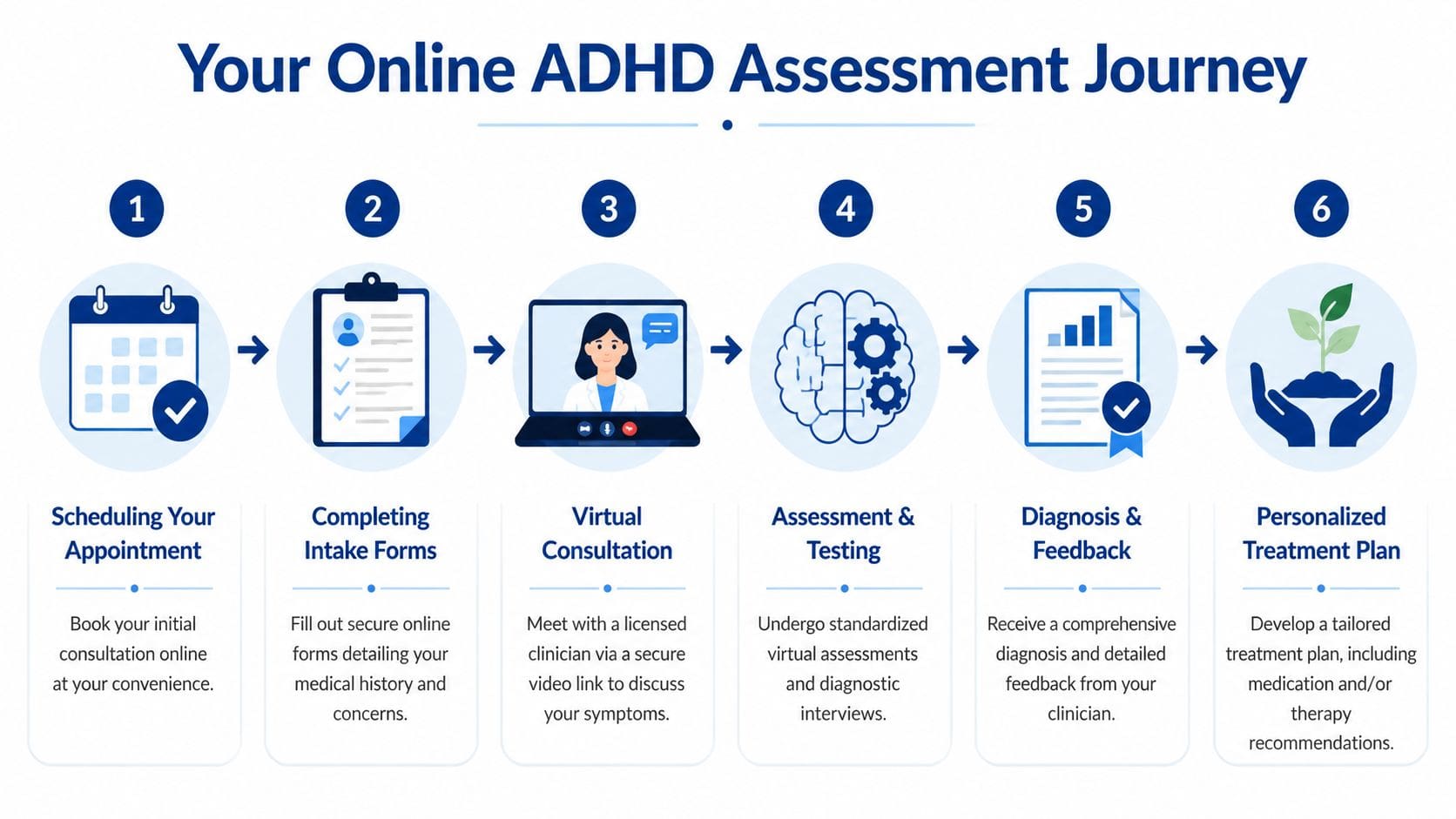
What the process usually looks like
Most high-quality telepsychiatry workflows include several stages rather than one quick call.
Scheduling and intake
Patients usually complete forms through a secure portal. These forms cover current concerns, medical history, medications, mental health symptoms, and functional problems in daily life.Symptom review
The clinician asks how attention problems show up at work, at home, in conversations, during planning, and with follow-through. Adults often realize during this step that the issue isn't just focus. It may also involve procrastination, disorganization, impulsive decisions, emotional frustration, or chronic inconsistency.Developmental history
ADHD doesn't begin out of nowhere in adulthood. The interview explores childhood patterns, school behavior, report cards, family observations, and whether similar issues showed up earlier in life.Functional impact and differential diagnosis
Here, a careful clinician separates ADHD from anxiety, depression, trauma, sleep problems, substance effects, or other conditions that can look similar.
Later in the process, some patients also complete structured testing or screening measures. A practical overview of available psychological testing for ADHD can clarify how those tools fit into care.
What makes the visit legitimate
The gold standard for an adult ADHD assessment is a semi-structured diagnostic interview that systematically evaluates DSM-5-TR criteria, childhood onset, and impairment, and an adequate assessment often takes 2 hours or more, as described in this adult ADHD assessment quality standard.
That matters because a strong evaluation usually includes:
- Detailed examples: not just “Do you have trouble focusing?” but “What happens when you try to complete billing, emails, studying, or household tasks?”
- Cross-setting review: symptoms should be explored across more than one environment.
- Clarification of timeline: when symptoms started, how long they've persisted, and whether they worsened under stress.
- Discussion of consequences: missed deadlines, relationship strain, driving issues, unfinished projects, academic problems, or emotional burnout.
A short educational video can also make the process feel less abstract before the first appointment.
A real online ADHD assessment doesn't try to “catch” patients. It tries to understand the full picture.
Core Components of a Thorough Evaluation
A thorough evaluation is built from several pieces that support each other. No single checklist, attention test, or symptom score should carry the whole diagnosis. When adults understand the parts of the evaluation, they're much better equipped to recognize quality care.
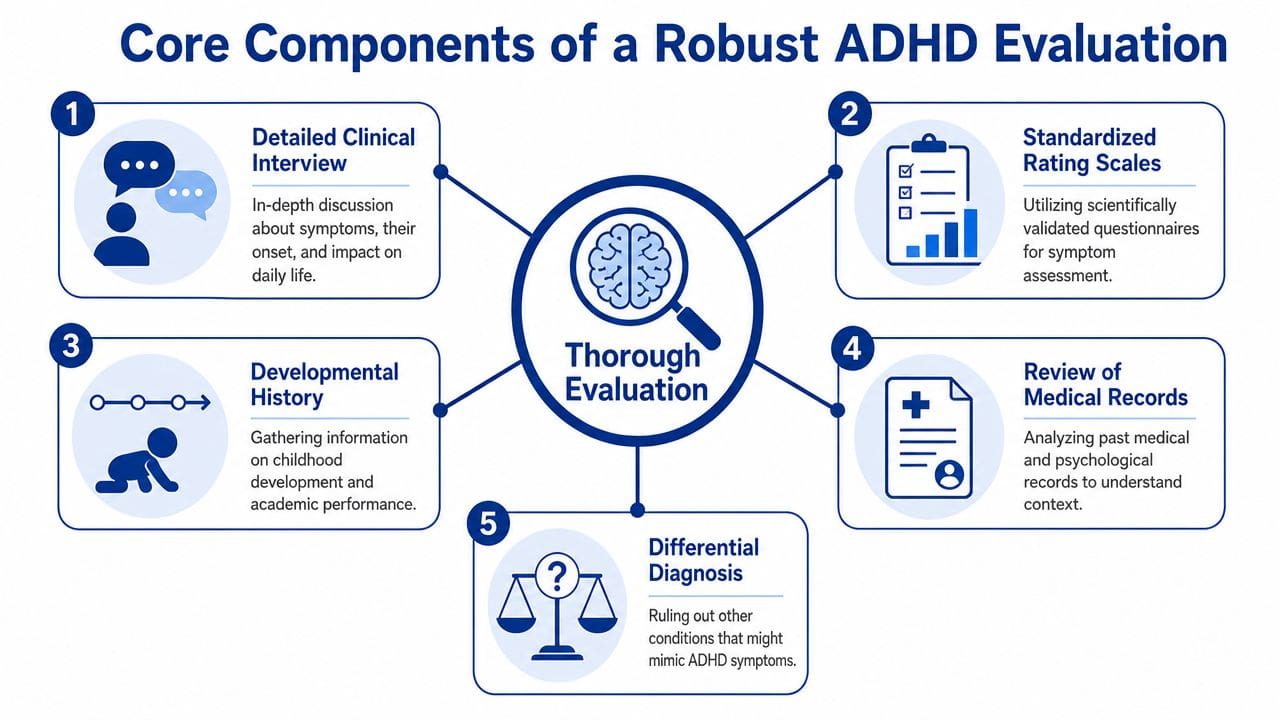
The interview matters most
The interview is where the diagnosis either becomes clearer or starts to fall apart. A clinician has to examine the 18 DSM symptom criteria, how those symptoms appear in real life, whether they were present earlier in development, and whether they create meaningful impairment.
That conversation is more nuanced than many patients expect. A person may say, “I can focus if it's interesting,” or “I'm productive right before deadlines,” or “I've always been messy.” Those statements are useful, but they don't diagnose anything by themselves. The clinician has to ask what happens on ordinary days, in boring tasks, under pressure, in relationships, and in responsibilities that don't provide immediate reward.
What supporting tools add
The Adult ADHD Self-Report Scale (ASRS v1.1), developed with the World Health Organization and Harvard Medical School researchers, uses 18 items aligned to DSM criteria and is a key evidence-based tool for screening, though not for standalone diagnosis, as summarized in this review of online ADHD assessment methods.
That distinction is important. Screening tools are useful because they create structure and help capture symptom patterns consistently. They are not enough on their own.
A robust evaluation may also include:
- Collateral information: input from a spouse, parent, or someone who has observed long-term patterns
- Old records: school comments, prior evaluations, or treatment history when available
- Medical and psychiatric review: current medications, sleep patterns, substance use, anxiety symptoms, trauma history, mood symptoms
- Objective adjunct tools: some practices use digital cognitive tasks to add another data layer, but those tools support clinical judgment rather than replace it
Clinical takeaway: The strongest online evaluations combine structured tools with a careful human interview. The weaker ones substitute the tool for the interview.
Adults often find this reassuring. A thoughtful process doesn't depend on whether someone fills out a questionnaire in a certain way on a certain day. It looks for a stable, explainable pattern.
Choosing a Qualified Online Provider in Pennsylvania
Not every virtual ADHD service is practicing at the same standard. Some platforms are careful. Some are hurried. Some are built around assessment and continuity. Others are built around volume, and patients can usually feel the difference quickly.
The risk isn't just missed diagnosis. It's also false positives, incomplete evaluations, and treatment decisions made before the clinician has ruled out overlapping conditions.
What to verify before booking
One peer-reviewed comparison cited in search results reported that a structured online ADHD tool had a 12% false-positive rate, while standard in-person interviews in that study had a 56% false-positive rate, which is a useful reminder that method matters more than the setting alone, as discussed in this overview of online ADHD evaluation accuracy.
That doesn't mean online is automatically better. It means a methodologically sound process matters. Adults in Pennsylvania should look for a provider who can explain how the assessment works and why.
A practical checklist:
- Pennsylvania licensure: verify that the clinician is licensed to evaluate and treat patients in Pennsylvania.
- Thorough interview: avoid services that promise diagnosis from a quiz alone.
- Differential diagnosis: ask how the clinician rules out anxiety, depression, sleep disorders, trauma, autism traits, or substance-related issues.
- Follow-up plan: find out who handles next steps if ADHD is diagnosed.
- Secure care model: the platform should use secure telehealth systems and standard clinical documentation.
For people comparing telehealth ecosystems more broadly, directories of virtual health clinic partners can be useful as a starting point, but those listings should still be followed by direct verification of licensing, scope, and evaluation methods.
Adults looking specifically for a Pennsylvania-based psychiatric provider can also review options for an online psychiatric provider in Pennsylvania and compare the assessment model carefully before booking.
High-Quality Evaluation vs. Red Flag Service
| Feature | High-Quality Evaluation (What to Look For) | Red Flag Service (What to Avoid) |
|---|---|---|
| Clinical interview | Uses a structured, clinician-led interview with follow-up questions | Relies mostly on a short questionnaire |
| Diagnostic reasoning | Explains why symptoms do or do not fit ADHD | Labels symptoms quickly without much explanation |
| Overlapping conditions | Screens for anxiety, depression, sleep issues, trauma, and other look-alikes | Treats attention complaints as if they always mean ADHD |
| Developmental history | Asks about childhood onset and long-term patterns | Focuses only on current stress and productivity |
| Treatment planning | Clarifies whether medication management and follow-up are available | Leaves next steps vague |
| Licensure and scope | Clearly states Pennsylvania licensure and service limits | Makes it hard to verify who is evaluating you |
If a service makes the process sound effortless, that's usually a reason to slow down, not sign up faster.
Logistics and Next Steps After Your Diagnosis
A diagnosis can bring relief, but it also creates practical questions. What should be done with it? Does it help with school or work accommodations? Can treatment begin right away? Who handles refills, side effects, or medication adjustments if medication becomes part of the plan?
Those questions matter because ADHD care doesn't end at diagnosis.
What a diagnosis can help with
Depending on the setting, documentation from a formal evaluation may help support requests for workplace or academic accommodations. Colleges, graduate programs, and employers often have their own documentation requirements, so patients should ask what form of diagnostic letter or evaluation summary is needed before assuming any single report will automatically qualify.
Some adults also use the diagnosis as a decision point rather than a paperwork tool. They begin behavioral strategies, therapy, medication management, coaching, or structured support around sleep, routines, planning, and emotional regulation.
Treatment plans can include both non-medication and medication options. For patients whose care includes medication, it is important to clarify who is handling prescribing, monitoring, and follow-up. Information about ADD meds online is often useful only when it is paired with a broader discussion of safety, diagnosis, and continuity.
Questions to ask about treatment continuity
CHADD notes that some online practitioners only offer an evaluation and are unable to prescribe medication, which can leave patients with a diagnosis but no clear path to treatment or follow-up, as explained in this CHADD guide to finding telemedicine services.
That's one of the biggest gaps in virtual ADHD care. Adults assume the process is one continuous path, but it can be fragmented.
Before booking, patients should ask:
- If ADHD is diagnosed, who manages treatment after that?
- If medication is considered, who handles titration and refill policies?
- How are side effects monitored?
- What happens if the clinician decides it isn't ADHD after all?
- Does the practice coordinate therapy, behavioral support, or outside records when needed?
A diagnosis without a plan can leave people feeling more stuck than before. A useful online care model ties evaluation to next-step decision-making, not just a report.
How IPA Supports Your Entire ADHD Journey
People often start an online ADHD evaluation hoping for answers and end up piecing together care on their own. The assessment happens with one clinician, medication questions go somewhere else, therapy requires a separate search, and follow-up feels unclear. In practice, that kind of split care often slows treatment and increases frustration.
At Integrative Psychiatry of America, we try to reduce those handoffs for Pennsylvania patients. The goal is straightforward: evaluate symptoms carefully, explain what the findings do and do not support, and keep the next steps connected within the same telepsychiatry practice when that is clinically appropriate.
That continuity matters over time.
ADHD care rarely ends with a single appointment. Some patients need medication management and dose adjustments. Some need help sorting out overlapping anxiety, depression, trauma, sleep problems, or burnout before an ADHD diagnosis is confirmed. Others need support with behavioral strategies, work functioning, or referral coordination. A practice that can stay involved across those stages usually makes care easier to follow and easier to adjust when the first plan is not the right one.
Cost questions come up early, too. Patients often want to know what testing or diagnostic visits may involve before they book, which is why a clear review of ADHD testing cost and evaluation pricing can be helpful alongside questions about treatment access and follow-up.
From a clinical standpoint, the strongest online model is not just convenient. It creates accountability. When the same team evaluates attention symptoms, considers other psychiatric factors, and manages ongoing care when indicated, patients are less likely to feel dropped after the diagnosis step.
Frequently Asked Questions About Online ADHD Evaluations
Can adults and younger patients both be evaluated online
Yes, many telepsychiatry practices assess adults, adolescents, and children through secure video visits. The exact process may differ by age. Younger patients often require parent participation, school history, and broader collateral information. Adults usually need a detailed developmental history and a review of how symptoms affect work, home life, and daily responsibilities.
Will an online diagnosis count for accommodations
It may, but the school or employer sets the documentation standard. Some institutions accept a formal diagnostic summary from a licensed clinician. Others ask for more detailed paperwork. It helps to ask the disability office, human resources department, or academic support office what they require before the evaluation is finalized.
How is privacy protected
A legitimate telepsychiatry practice should use secure, HIPAA-compliant systems for video visits, forms, and messaging. Patients should know how records are stored, how follow-up communication works, and how prescription questions are handled. If a service feels casual about privacy, that's a warning sign.
What if the evaluation shows it is not ADHD
That outcome can still be useful. A strong evaluation doesn't force an ADHD diagnosis. It may identify anxiety, depression, trauma-related symptoms, sleep disruption, substance effects, or another explanation for concentration problems. That gives the patient a more accurate treatment path.
How much should patients expect to pay
Costs vary widely by practice, level of assessment, insurance participation, and whether follow-up is included. Reviewing a breakdown of how much ADHD testing can cost can help patients ask better questions before scheduling.
If attention problems, disorganization, procrastination, or emotional overload have been affecting daily life, Integrative Psychiatry of America offers Pennsylvania patients a clear path to confidential telepsychiatry care. Patients can explore evaluation, treatment planning, and follow-up support from home through a secure online process designed for real clinical assessment, not quick labels.