
A Pennsylvania professional closes another workday with ten browser tabs open, three unfinished tasks, and the same private question that has been hanging around for years. Why does everything feel harder than it should. Bills get paid late. Emails get reread five times. Meetings drift by, but the mind doesn't stay put. Eventually the search bar gets the words many adults type in frustration: ADHD doctors near me.
That search usually makes things more confusing, not less. One result says psychiatry. Another says therapy. Another says testing. Some offer telehealth across Pennsylvania. Others list an office nearby but don't clearly say whether they diagnose ADHD, prescribe medication, or only provide counseling. For adults already struggling with focus, sorting through that mess can feel like one more task that won't get finished.
The need for care is real and common. The National Institute of Mental Health estimates current ADHD prevalence in U.S. adults ages 18 to 44 at 4.4%, with lifetime prevalence estimated at 8.1%, which supports why so many adults are looking for evaluation and follow-up care close to home or online (NIMH ADHD statistics). A broader search for mental health support also shows why clinicians increasingly pay attention to online visibility and patient access. For practices trying to understand how people find care online, resources on how clinics acquire patients with Google Ads help explain why some search results appear before others.
Adults looking for broader telepsychiatry options in Pennsylvania can also compare services like integrative psychiatry near you in Pennsylvania to see whether online care fits their schedule and location.
Table of Contents
- The Search for ADHD Care in Pennsylvania Begins
- Decoding the Different Types of ADHD Providers
- What to Look For in a Qualified ADHD Professional
- Telehealth vs In-Person Care for Your ADHD Treatment
- Navigating Costs Insurance and Treatment Expectations
- How to Book Your ADHD Appointment in Pennsylvania
The Search for ADHD Care in Pennsylvania Begins
Typing ADHD doctors near me is rarely casual. Most adults reach that moment after months or years of friction. They've tried planners, reminders, productivity apps, and promises to “just be more disciplined,” but the same patterns keep coming back. Missed deadlines. Chronic lateness. Mental restlessness. Trouble starting simple tasks.
In Pennsylvania, that search often turns up a mix of local offices, national platforms, therapists, nurse practitioners, and physician practices. The problem isn't just finding someone nearby. The core problem is finding someone who can evaluate adult ADHD thoroughly, explain options clearly, and manage treatment in a way that fits real life.
A common Pennsylvania scenario
A patient in Philadelphia may want evening appointments because workdays are packed. A parent in the suburbs may need video visits because arranging child care for every follow-up is difficult. Someone in a smaller Pennsylvania town may find that the closest office doesn't focus on adult ADHD at all.
Practical rule: “Near me” should mean accessible, qualified, and appropriate for the kind of care needed. It doesn't only mean a building within driving distance.
That's why the search has to move beyond simple geography. The next questions matter more. Who can diagnose ADHD. Who can prescribe. Who offers therapy. Who works with adults instead of only children. Who uses telehealth well instead of treating it like an afterthought.
Decoding the Different Types of ADHD Providers
The biggest point of confusion isn't whether ADHD care exists in Pennsylvania. It's knowing which clinician type matches the problem. Many adults book with the wrong professional first, then lose time, money, and momentum.
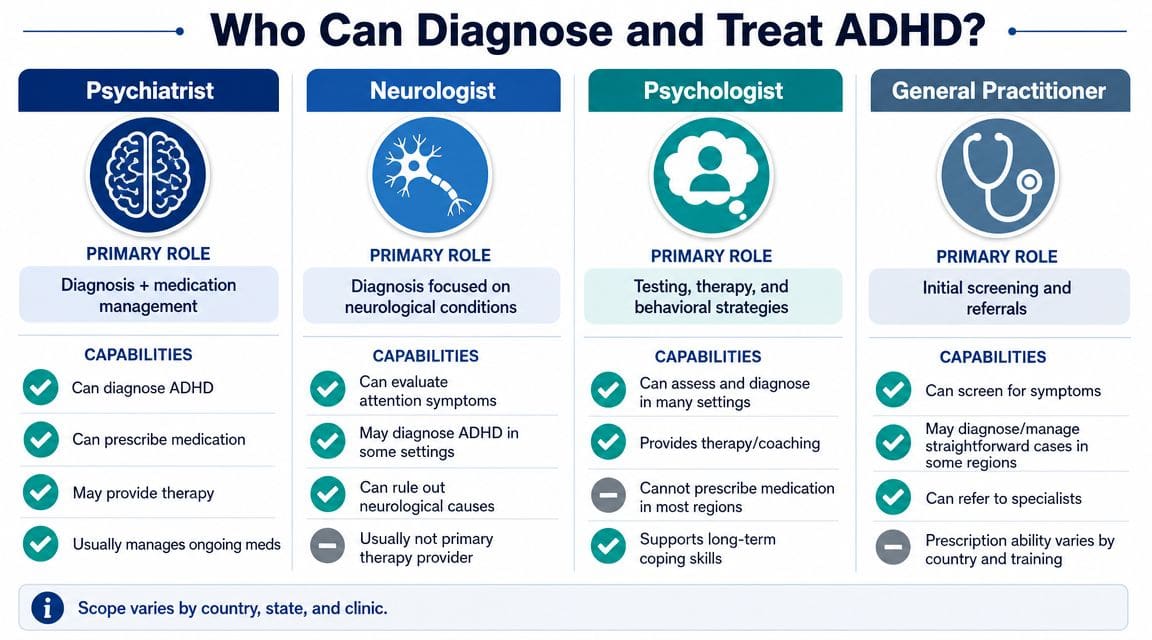
ADHD care is already spread across multiple clinician types. The CDC reports that in 2021, about 1 in 5 children with Medicaid received ADHD care from a nurse practitioner, showing how important nurse practitioners have become in expanding access to care (CDC ADHD data). That same real-world shift helps explain why search results in Pennsylvania often include physician practices, psychiatric nurse practitioners, therapy clinics, and hybrid telehealth models.
Adults comparing psychiatric clinicians can also review a practical breakdown of psychiatric NP vs psychiatrist when they want more detail on training, role, and treatment scope.
Who usually handles what
A short comparison helps:
| Provider type | Can assess ADHD | Can prescribe medication | Can provide therapy |
|---|---|---|---|
| Psychiatrist (MD or DO) | Usually yes | Yes | Sometimes, but many focus on medication management |
| Psychiatric nurse practitioner (PMHNP-BC) | Usually yes | Yes | May provide supportive therapy and treatment planning |
| Psychologist (PhD or PsyD) | Often yes, especially formal testing | No | Yes |
| Primary care clinician | Sometimes starts screening or follow-up | Often yes, depending on practice | No, usually refers out |
The search for suitable care often presents challenges. A psychologist may be excellent for testing and therapy, but can't prescribe medication. A primary care clinician may be helpful for an initial discussion, but may refer out if the picture is complex or if other mental health conditions are involved. A psychiatric nurse practitioner or psychiatrist may be a strong fit when the patient needs evaluation plus medication management in one care path.
Why titles alone can mislead
A website might say “ADHD specialist” without clearly stating what services are offered. That matters. Some clinics only do therapy. Others only manage medication after a diagnosis done elsewhere. Some offer brief screening, but not a full adult diagnostic workup.
The right question isn't “Who treats ADHD?” It's “Who can handle the part of ADHD care that's needed right now?”
For an adult who wants diagnosis, treatment planning, and ongoing follow-up, a prescribing psychiatric clinician is often the most direct route. For someone who already has a diagnosis but struggles with habits, time management, and shame, a therapist with ADHD experience may be the missing piece. Many adults need both.
What to Look For in a Qualified ADHD Professional
A polished website doesn't prove clinical quality. Adults searching for ADHD doctors near me need a simple filter that separates convenience from competence.
A proper adult ADHD diagnosis should be thorough. Expert guidance states that it requires a detailed diagnostic interview, review of childhood history, and screening for co-existing conditions, not just a brief checklist (ADDA guidance on getting diagnosed with ADHD). That point matters because anxiety, depression, trauma, sleep problems, substance use, and medical conditions can overlap with ADHD symptoms.
Credentials to verify first
Start with the basics, but don't stop there.
- Pennsylvania licensure: Confirm the clinician is licensed to practice in Pennsylvania.
- Relevant board certification: For psychiatric nurse practitioners, look for PMHNP-BC. For physicians, look for psychiatry training and board status when available.
- Adult ADHD experience: General mental health experience is useful, but adults should ask whether the clinician regularly evaluates and treats adult ADHD.
- Clear treatment scope: The practice should plainly state whether it offers diagnosis, medication management, therapy, or referrals for testing.
A strong clinician should also be willing to explain the evaluation process before the first appointment. If the office can't tell a prospective patient how ADHD is assessed, that's useful information.
Warning signs during the intake process
Some red flags are easy to miss because adults are eager to get help quickly.
- Checklist-only diagnosis: If the entire evaluation sounds like a short form with no history-taking, caution is warranted.
- No questions about childhood: Adult ADHD still requires evidence of earlier patterns, not just current stress.
- No screening for overlap: A good assessment should ask about sleep, mood, anxiety, trauma, and substance use.
- No follow-up plan: ADHD treatment usually needs monitoring, adjustment, and ongoing discussion.
A rushed diagnosis can create a rushed treatment plan. That often leads to frustration, side effects, or missed diagnoses rather than real progress.
The best fit isn't always the first provider who has an opening. It's the one who can explain the process, document it carefully, and keep working with the patient after the first visit.
Telehealth vs In-Person Care for Your ADHD Treatment
For many Pennsylvanians, the phrase ADHD doctors near me doesn't mean what it used to mean. The question now is whether care is easy to access, clinically appropriate, and workable over time.
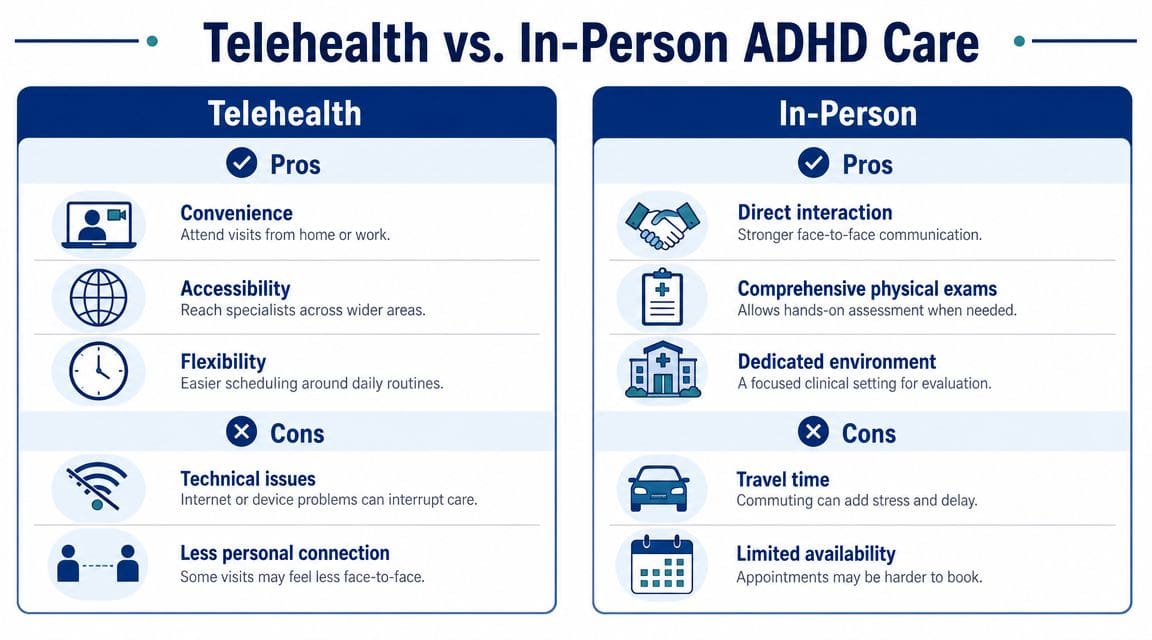
Telehealth has changed the geography of ADHD care. A background review of patient search intent notes that many adults now care less about physical distance and more about specialized care, scheduling flexibility, and statewide access, especially in places like Pennsylvania (adult ADHD telehealth access discussion). Adults comparing remote options can look at online psychiatry for Pennsylvania ADHD care to see how statewide telehealth works in practice.
When telehealth makes sense
Telehealth is often a strong fit when:
- Travel creates friction: Long drives, parking, traffic, and missed work make follow-up harder.
- Routine check-ins matter: ADHD treatment often works better when patients can attend appointments consistently.
- Location limits options: Rural and smaller-town patients may need access beyond their immediate area.
- Privacy matters: Some adults feel more comfortable starting care from home.
A short overview may help with decision-making:
When in-person care may be the better fit
In-person care still has value. Some adults prefer face-to-face visits because they focus better in a clinic setting. Others want direct physical presence, or they have a more complicated medical picture that benefits from local coordination.
| Best fit for telehealth | Best fit for in-person care |
|---|---|
| Busy professionals | Patients who dislike video visits |
| Adults outside major metro areas | Those needing close local medical coordination |
| People who want easier follow-up | Those who focus better in a structured office setting |
Good ADHD care depends less on the screen and more on the quality of the clinical process.
The wrong telehealth setup feels rushed and impersonal. The right one is organized, consistent, and easy to return to for ongoing medication management and treatment review.
Navigating Costs Insurance and Treatment Expectations
Cost worries delay care more often than many clinics realize. Adults often postpone evaluation because they assume it will be unaffordable, confusing, or open-ended.
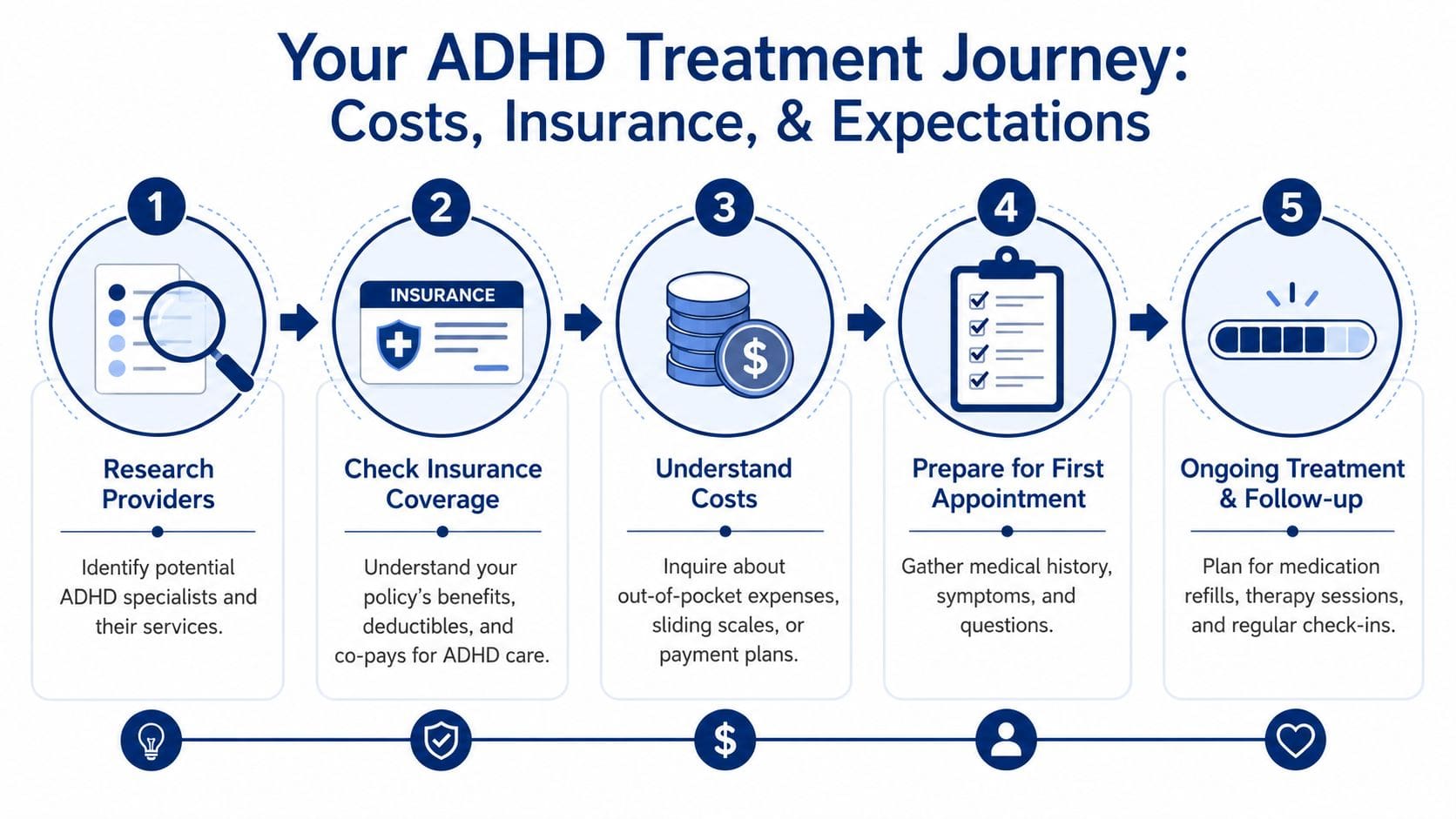
The first move is practical. Check whether the practice is in-network, whether telehealth visits are covered, and whether separate charges apply for assessment, follow-up, or testing. Adults comparing options can review how much ADHD testing costs to understand what questions to ask before booking. Broader insurance literacy can also help, and some readers may find My Policy Quote's mental health advice useful when thinking through coverage and support needs.
Questions to ask before booking
Don't settle for a vague “we take insurance.” Ask direct questions.
- What services are included: Does the first appointment cover only intake, or also diagnostic decision-making?
- How are follow-ups handled: ADHD care usually requires recurring visits, not a one-time consult.
- What happens if testing is needed: Some patients need formal psychological testing, while others can be diagnosed clinically.
- How are medication issues managed: Ask how refill requests, side effects, and treatment adjustments are handled.
These questions don't just protect the wallet. They also reveal how organized the practice is.
What treatment usually looks like after diagnosis
Treatment should be framed as a plan, not as a prescription-only transaction. A large review of 695 interventional ADHD trials found that behavioral therapy was the only non-pharmacological intervention with a statistically significant effect, while stimulants such as methylphenidate and amphetamine were the most effective medications. Atomoxetine, guanfacine, and clonidine were secondary options (review of ADHD interventions).
That means patients should expect a broader conversation that may include:
- Medication options: Risks, benefits, monitoring, and what response should realistically look like.
- Behavioral strategies: Calendars, task breakdown, coaching-style systems, and therapy support.
- Lifestyle review: Sleep, exercise, and routines matter because unmanaged basics can amplify attention problems.
- Follow-up adjustments: The first plan isn't always the final plan.
One option adults may encounter is Integrative Psychiatry of America, which provides online ADHD evaluation and medication management across Pennsylvania through psychiatric nurse practitioners. That model is one example of how patients can combine diagnostic care, follow-up, and telehealth access in a single practice.
How to Book Your ADHD Appointment in Pennsylvania
Once the search shifts from browsing to action, the next step should be simple. Adults looking for treatment don't need a long intake maze. They need a clear path to evaluation, practical follow-up, and a provider who understands adult ADHD.
For patients who want online care, book ADHD meds online in Pennsylvania is one direct route to review appointment options and start the scheduling process.
A straightforward booking process usually looks like this:
- Verify insurance first. Confirm whether the practice accepts the plan and whether telehealth visits are covered.
- Schedule the initial evaluation. Choose a time when distractions will be low and records can be gathered.
- Prepare for the visit. Write down current symptoms, old school or work patterns if remembered, past mental health treatment, current medications, sleep concerns, and family history if available.
- Expect a real assessment. A qualified clinician should ask detailed questions, not just hand over a rating form.
- Plan for follow-up. ADHD care works best when medication decisions, behavioral strategies, and check-ins are handled as part of one ongoing process.
The hardest part for many adults is starting. Once the first appointment is on the calendar, the search itself finally ends.
If ADHD symptoms have been affecting work, relationships, organization, or day-to-day functioning, Integrative Psychiatry of America offers online psychiatry across Pennsylvania with psychiatric nurse practitioners who evaluate and treat ADHD through secure telehealth. The practical next step is to verify insurance, schedule an initial visit, and come prepared for a thorough assessment rather than another round of guessing.