
A lot of adults in Philadelphia start looking for help at the same point. Sleep is lighter. The chest feels tight before work. Small decisions take too much effort. Weekends don't reset anything. Then comes the practical problem. Finding care feels like another task on top of an already overloaded mind.
That's why anxiety treatment in Philadelphia needs to be judged on more than credentials or office location. It needs to work in real life. People need care they can start, attend consistently, and continue without turning every appointment into a commute, parking problem, or scheduling scramble.
Table of Contents
- Navigating Anxiety in Philadelphia
- Core Anxiety Treatment Models Explained
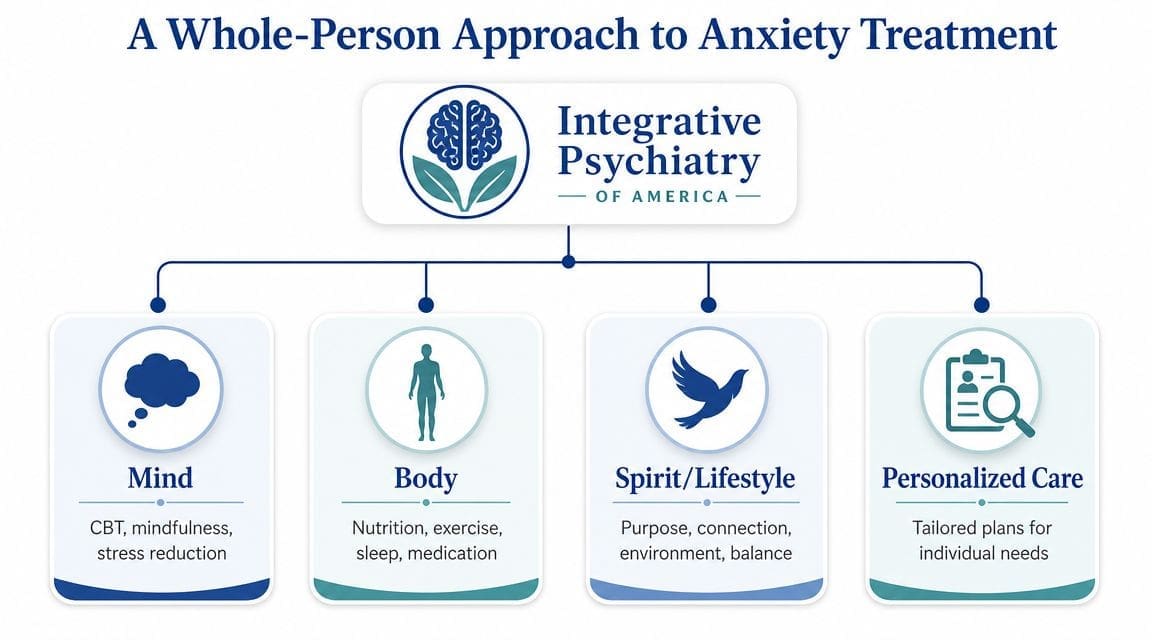
- Why a Whole-Person Approach Matters for Anxiety
- How Online Anxiety Treatment Actually Works
- Your Guide to Insurance and Costs for Anxiety Care
- How to Start Your Journey with Integrative Psychiatry of America
Navigating Anxiety in Philadelphia
Philadelphia offers strong mental health resources, but access is still a real barrier for many adults. In Pennsylvania, 39.8% of adults experienced symptoms of anxiety or depression, while 25.7% were unable to get needed counseling or therapy, according to state-level data summarized here. That gap matters when someone is already exhausted, overwhelmed, or avoiding one more difficult phone call.

For many adults, the first challenge isn't deciding whether anxiety is serious enough. It's figuring out where to begin. Philadelphia has therapy practices, hospital systems, specialty clinics, crisis lines, and community resources. But a long list of options can still leave people stuck, especially when anxiety itself makes planning and follow-through harder.
Telehealth solves a practical problem first. It removes travel, reduces missed work time, and makes follow-up care easier to maintain. That matters because anxiety treatment usually isn't one appointment. It's a process of evaluation, symptom tracking, adjustment, and steady repetition of skills over time.
Clinical reality: The best treatment plan is the one a patient can actually access and continue.
A telehealth practice led by psychiatric nurse practitioners can be a good fit when a patient wants medication evaluation, ongoing follow-up, and a broader discussion of sleep, stress, attention, or mood rather than therapy alone. Adults who aren't sure whether they need therapy, medication, or both often benefit from starting with a psychiatric assessment. For readers sorting out that question, this article on when to see a mental health prescribing clinician can help clarify the next step.
A useful way to think about anxiety treatment in Philadelphia is simple. First, find a care model that matches the symptoms. Second, choose a format that supports consistency. Third, make sure the plan can adapt if anxiety turns out to overlap with something else.
Core Anxiety Treatment Models Explained
A common Philadelphia pattern looks like this. Someone starts with weekly therapy, makes some progress, then realizes the anxiety is still driving insomnia, panic, nausea, or constant mental overdrive. Another person begins medication through primary care, feels partial relief, but never gets a structured plan for avoidance, reassurance-seeking, or obsessive worry. The treatment model matters because each option solves a different part of the problem.
Philadelphia does have strong anxiety programs. The University of Pennsylvania's Center for the Treatment and Study of Anxiety is well known for evidence-based care across age groups. Telehealth should meet that same standard. The format is different, but the core question stays the same: does the treatment match the symptom pattern, and can the patient stay with it long enough for it to work?
Therapy changes the anxiety cycle
Therapy is often the best starting point when anxiety is being maintained by avoidance, catastrophic thinking, compulsive checking, reassurance-seeking, or fear of physical sensations. Structured approaches such as CBT, ACT, and exposure-based therapies target those patterns directly.
For a patient with panic symptoms, that may mean learning to stop treating a racing heart as proof of danger. For a patient with social anxiety, it may mean reducing rehearsal, people-pleasing, or post-event rumination. For someone with OCD features, it usually means a more specific exposure framework rather than general supportive talk therapy.
Common therapy goals include:
- Breaking avoidance: Gradually re-entering situations, places, or tasks that anxiety has narrowed.
- Testing feared predictions: Looking at what is likely, not just what feels possible in the moment.
- Reducing safety behaviors: Cutting back on checking, escape plans, overpreparing, or repeated reassurance.
- Building tolerance for discomfort: Increasing function even when anxiety is still present.
This is one reason I encourage patients to ask a practical question before choosing a therapist. Is the therapy structured enough to target the anxiety pattern, or is it mainly supportive conversation?
Medication can reduce symptom intensity
Medication management addresses a different layer of care. It can lower baseline distress, reduce the frequency or intensity of panic, improve sleep, and quiet the physical overactivation that makes it hard to use therapy skills consistently. In standard psychiatric practice, SSRIs and SNRIs are often considered first-line medication options for many anxiety disorders, while the right choice still depends on side effects, other diagnoses, past response, and patient preference.
The trade-off is straightforward. Medication may create enough relief for a person to function better, but it does not replace exposure work, cognitive skills, or behavior change. It also requires follow-up. Dose timing, early side effects, activation, sedation, sexual side effects, and sleep changes all affect whether a patient sticks with the plan.
In telehealth psychiatry, this is often where nurse practitioner care fills a gap for Philadelphia adults who do not need a hospital-based program but do need ongoing prescribing, monitoring, and adjustment from home. A broader integrative psychiatry approach to mental health care can also help when anxiety overlaps with mood symptoms, attention problems, or chronic stress patterns.
Comparing Anxiety Treatment Approaches
| Treatment | How It Works | Best For Addressing |
|---|---|---|
| CBT and related therapy | Identifies anxious thinking and changes avoidance patterns through structured practice | Worry cycles, phobias, panic behaviors, social fear, compulsive habits |
| Exposure-based therapy | Repeated, planned contact with feared cues without escape rituals | Panic, OCD-related symptoms, phobias, trauma-linked avoidance |
| Medication management | Uses prescribing and follow-up to reduce symptom intensity and physiological arousal | Persistent anxiety, panic, sleep disruption, high baseline distress |
| Combined care | Integrates psychotherapy with medication when clinically indicated | Mixed symptom profiles, moderate to severe anxiety, long-standing impairment |
Combined care is often the most effective option for patients whose anxiety is impairing work, relationships, sleep, or daily routines. It is also the model that many busy adults can sustain better through telehealth, especially when travel across the city, parking, childcare, or time away from work would otherwise break continuity.
Whole-person care matters here too. Even resources outside psychiatry, such as this guide to balanced senior living, reflect a broader truth. Anxiety treatment works better when care looks at the full person, not just the loudest symptom.
The main goal is clarity. Patients do better when they know whether they need skills-based therapy, medication support, or both, and when one clinician or team is tracking the plan over time instead of leaving them to piece it together alone.
Why a Whole-Person Approach Matters for Anxiety
Anxiety rarely stays in one lane. It affects sleep, appetite, concentration, energy, relationships, and work performance. It also gets tangled up with habits that seem unrelated at first, like late-night scrolling, inconsistent meals, caffeine overuse, or pushing through chronic exhaustion.
Anxiety rarely arrives alone
Comorbidity is the rule, not the exception, in anxiety disorders, as summarized on this Philadelphia social anxiety resource citing NIH-supported guidance. That's one of the biggest reasons a narrow treatment plan can miss the mark. A patient may think the problem is anxiety, but the bigger driver may be untreated ADHD, obsessive thinking, trauma symptoms, depression, or poor sleep.
That overlap changes treatment decisions in a practical way. Someone with intrusive thoughts and rituals may need a different therapy framework than someone with classic generalized worry. Someone with anxious overthinking plus inattention may need a workup that looks at executive function, not just stress. Someone who feels “wired and tired” may need sleep patterns addressed early, because poor sleep can make anxiety treatment feel weaker than it is.
A whole-person model asks broader questions, such as:
- How is sleep functioning: Trouble falling asleep, staying asleep, or waking unrefreshed can intensify daytime anxiety.
- What else is happening mentally: Depression, OCD features, trauma symptoms, and attention problems often reshape the treatment plan.
- Are lifestyle inputs worsening symptoms: Caffeine, alcohol, erratic meals, and low activity can amplify physical anxiety signals.
- What pattern shows up in the body: Restlessness, GI distress, headaches, and muscle tension may guide medication and behavioral choices.
What a broader evaluation can uncover
An integrative evaluation doesn't assume every anxious patient needs the same script. It may include medication review, psychotherapy planning, sleep assessment, basic lifestyle screening, and, when clinically appropriate, discussion of labs or other medical contributors. At Integrative Psychiatry of America's overview of the integrative psychiatry approach, readers can see how a telehealth practice may combine medication management with psychotherapy, mindfulness, nutrition support, and other individualized tools.
That kind of framework can be especially helpful for adults who want sustainable improvement rather than temporary symptom suppression. A broader wellness lens can also support family members and older adults who are working on stability across mind and body. For readers interested in that perspective, this guide to balanced senior living offers a useful example of how mental and physical wellbeing often reinforce each other.
The more complex the symptom picture, the less useful a one-size-fits-all plan becomes.
How Online Anxiety Treatment Actually Works
Many people are open to telehealth but still aren't sure how online anxiety care works when medication management is part of the plan. That confusion is common, and it matters because behavioral health remains one of the most common uses of telehealth, as noted in this discussion of anxiety therapy and telehealth access.
What happens before the first visit
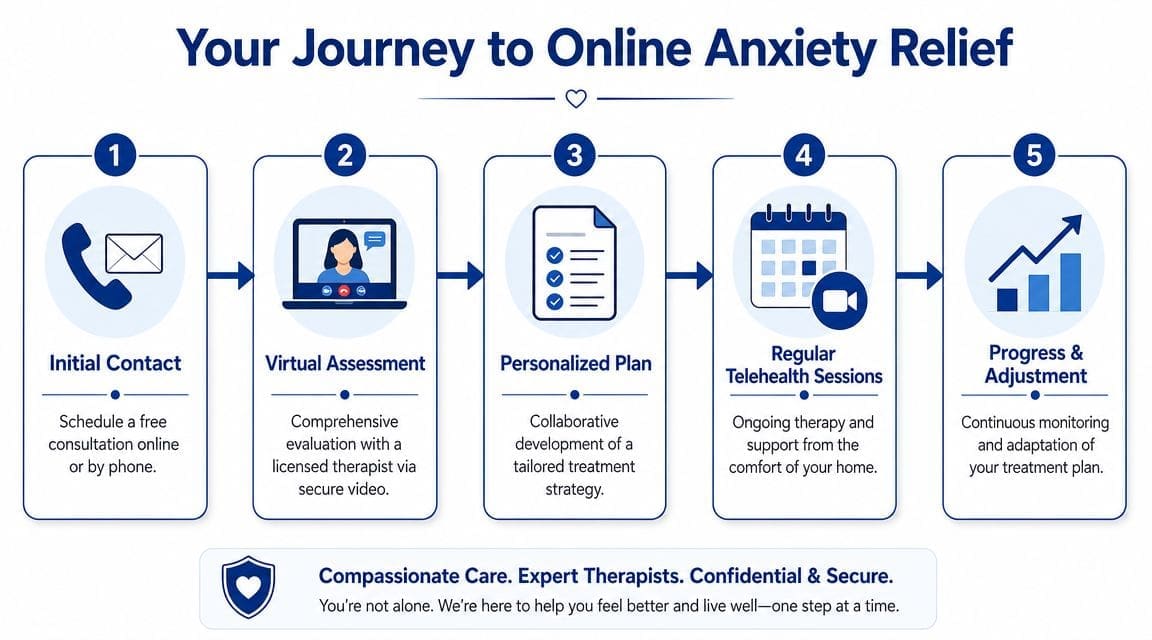
The process usually starts with scheduling through a website or patient coordinator. The patient completes intake forms, reviews consent paperwork, and provides history on symptoms, current medications, medical issues, and treatment goals. Secure telehealth platforms are designed for private, HIPAA-compliant video visits, so the appointment can happen from home, work, or another confidential setting in Pennsylvania.
The first appointment is more than a quick prescription check. A psychiatric nurse practitioner typically reviews symptom patterns, onset, triggers, sleep, mood, concentration, trauma history, substance use, physical symptoms, prior treatment response, and functional impairment. The goal is to decide what the anxiety is, what it isn't, and what needs attention first.
For people comparing options for remote prescribing care, this page on online mental health medication management across Pennsylvania gives a practical look at the format.
A brief overview can also help make the process feel more familiar:
What ongoing care looks like
Follow-up care is where telehealth often becomes especially useful. Anxiety treatment usually needs monitoring, not guesswork. If a medication is started, follow-up visits track benefits, side effects, and whether the dose fits the genuine symptom pattern. If therapy is part of the plan, the clinician also looks at whether the patient is using the skills and whether obstacles are getting in the way.
A typical online treatment flow often includes:
Initial assessment
The clinician identifies the likely diagnosis and clarifies whether anxiety stands alone or overlaps with other concerns.Personalized treatment plan
The plan may include therapy referral, medication management, sleep changes, symptom tracking, and behavioral targets.Prescription and coordination
When medication is appropriate, prescriptions are sent electronically and adjusted over time rather than left on autopilot.Portal-based communication
Patients often use a portal for messages, refill requests, forms, and appointment management.Measurement-based follow-up
Progress gets judged by symptom intensity, daily function, avoidance patterns, and consistency, not just whether the patient feels “a little better.”
What doesn't work well in telehealth is treating anxiety as a one-visit transaction. What does work is structured follow-up, a clear plan, and a patient who knows exactly what the next step is after each appointment.
Your Guide to Insurance and Costs for Anxiety Care
A common Philadelphia scenario goes like this. Someone is ready to get help, finds a clinician, then stalls at the insurance question. They are not avoiding treatment. They are trying to avoid an open-ended bill.
That caution is reasonable. Anxiety care often involves an evaluation, follow-up visits, and sometimes medication management over time, so the actual question is not just whether the first appointment is covered. It is whether the full treatment plan is affordable enough to continue.
Questions to ask before booking
Before scheduling with any anxiety provider, ask the insurer or practice for specifics. General mental health benefits do not tell you enough, especially if you want telehealth access from home, work, or anywhere else in the city.
Focus on these points:
- Are telehealth behavioral health visits covered under my plan? Some plans process virtual psychiatric visits differently from office-based care.
- Are medication management visits covered? Coverage for therapy does not always match coverage for prescribing appointments with a psychiatric nurse practitioner or psychiatrist.
- Is the clinician in network, and if not, do I have out-of-network benefits? That difference can change the total cost substantially.
- How does my deductible apply? A covered visit may still be billed at the full contracted rate until the deductible is met.
- Do follow-up visits have the same copay or coinsurance as the intake? Anxiety treatment usually requires more than one appointment.
- Do I need prior authorization? Some plans create delays if this step is missed.
In practice, I tell patients to budget for a course of care, not a single visit. Good anxiety treatment may include prescribing, symptom review, and coordination with a therapist or primary care clinician. Telehealth can reduce travel time and make follow-up easier to keep, but the financial piece still needs to be clear from the start.
When self-pay can make sense
Self-pay is often the better fit for people with high deductibles, limited in-network options, or long waits for local appointments. I see this often in Pennsylvania telehealth care. A patient technically has coverage, but the nearest available prescriber is booked out, out of reach, or only offers fragmented follow-up.
Clear self-pay pricing can solve that problem. Patients know the visit fee, know how often follow-up is expected, and can decide whether the plan is sustainable before they begin. That transparency matters, especially for adults who want online treatment they can actually maintain.
Adults comparing virtual and local prescribing options can review Philadelphia psychiatric care options for anxiety and medication management. For urgent safety concerns, crisis resources should stay separate from routine outpatient planning. A regular intake is for evaluation and treatment planning, not emergency response.
Paying for care gets easier when the expected visits, coverage rules, and refill process are all clear before treatment starts.
How to Start Your Journey with Integrative Psychiatry of America
Starting care is often the hardest part. Not because the process is complicated, but because anxiety makes uncertainty feel larger than it is. A good next step should be concrete, low-friction, and easy to follow through on.
A simple way to move forward
High-quality anxiety care uses structured, measurement-based methods such as CBT and exposure-focused approaches, and these models can also be delivered through virtual formats with strong continuity of care, as described by Philadelphia anxiety specialists who emphasize measurement-based treatment. That makes online care a realistic option for adults who need consistency without the disruption of repeated travel.
A straightforward path looks like this:
Learn how the care model works
Review the practice's services, visit format, and approach to medication management, therapy coordination, and follow-up.Check coverage or payment options
Verify whether insurance applies and whether self-pay or membership options fit better.Book an initial assessment
A psychiatric evaluation helps determine whether the symptoms point to generalized anxiety, panic, OCD-related symptoms, trauma-related anxiety, or a mixed presentation.Commit to follow-up, not just the first visit
Anxiety treatment works better when patients expect adjustment, tracking, and repetition rather than immediate resolution.Choose a model that fits daily life
If in-person visits create too much friction, telehealth may improve consistency, making care easier to attend.
Readers who want a practical entry point can review Philadelphia integrative psychiatry services to see how telehealth-based psychiatric nurse practitioner care is structured for adults across Pennsylvania.
If anxiety has been narrowing work, sleep, relationships, or daily function, Integrative Psychiatry of America offers online psychiatric care across Pennsylvania with a whole-person approach that includes medication management, psychotherapy-informed support, and ongoing follow-up through secure telehealth.