
Some people in Philadelphia are doing everything they were told to do and still don’t feel well. They tried a medication that helped a little but caused side effects. They found therapy useful, but not enough. They sleep poorly, feel wired and exhausted at the same time, and start wondering whether anyone is looking at the full picture.
That gap is where Philadelphia, integrative psychiatry at IPA becomes useful. A whole-person psychiatric approach doesn’t stop at symptom control. It asks better questions about biology, habits, stress load, medical contributors, and what kind of treatment plan a person can sustain in daily life. For many adults in Pennsylvania, that kind of care is easier to access through telehealth than through a traditional office model.
Table of Contents
- Your Path to Whole-Person Mental Wellness in Philadelphia
- Understanding the Philosophy of Integrative Psychiatry
- Our Comprehensive and Personalized Treatment Components
- Conditions We Treat with an Integrative Approach
- How Telepsychiatry Makes Integrative Care Accessible
- Navigating Payments and Starting Your Journey with IPA
Your Path to Whole-Person Mental Wellness in Philadelphia
A common Philadelphia story looks like this. An adult is managing work, parenting, school, or caregiving while anxiety, depression, ADHD symptoms, trauma responses, or burnout keep getting in the way. They may have seen a psychiatrist before, or started treatment through primary care, but the care felt narrow, rushed, or disconnected from the rest of their health.

A psychiatric nurse practitioner working in an integrative model approaches that situation differently. The clinical task isn’t just choosing a prescription. It involves understanding sleep, nutrition, stress physiology, past treatment response, attention patterns, trauma history, medical contributors, and the patient’s goals. That’s often the difference between temporary symptom relief and a treatment plan that starts to make sense.
Pennsylvania also has a real access problem. A state workforce report noted that over half of adults with mental illness went untreated in recent years and recommended expanding the role of PMHNPs to improve access across the state, according to the Pennsylvania mental health workforce report. That matters because a lot of articles talk about mental health access in general terms, but fewer explain what psychiatric nurse practitioners do in advanced telepsychiatry care.
What a PMHNP-led model actually means
PMHNPs assess, diagnose, prescribe when appropriate, monitor treatment response, and build plans that combine conventional psychiatry with broader health interventions. In practice, that can include medication management, lab review, lifestyle assessment, referral coordination, and close follow-up through telehealth.
Clinical reality: Medication can be useful, but it rarely works best when it’s treated as the whole plan.
For patients searching for a local fit, integrative psychiatric care near Philadelphia often means finding a clinician who can hold both sides of the work at once. That includes symptom relief now and root-cause investigation over time.
What tends to work better
A practitioner-led integrative model usually works best when the plan is:
- Specific to the person: not based on a generic depression or anxiety template.
- Flexible enough to adjust, because early treatment often reveals new information.
- Practical for real life: sleep routines, food choices, and follow-up only help if a patient can realistically maintain them.
What doesn’t work well is a fragmented approach in which one clinician prescribes, another offers general wellness advice, and nobody connects the dots.
Understanding the Philosophy of Integrative Psychiatry
Traditional psychiatry can sometimes resemble weed-pulling. The visible problem gets addressed quickly, but the soil, roots, water, and growing conditions stay the same. Integrative psychiatry is closer to careful gardening. It still removes what’s harmful, but it also asks what conditions allowed the problem to keep returning.
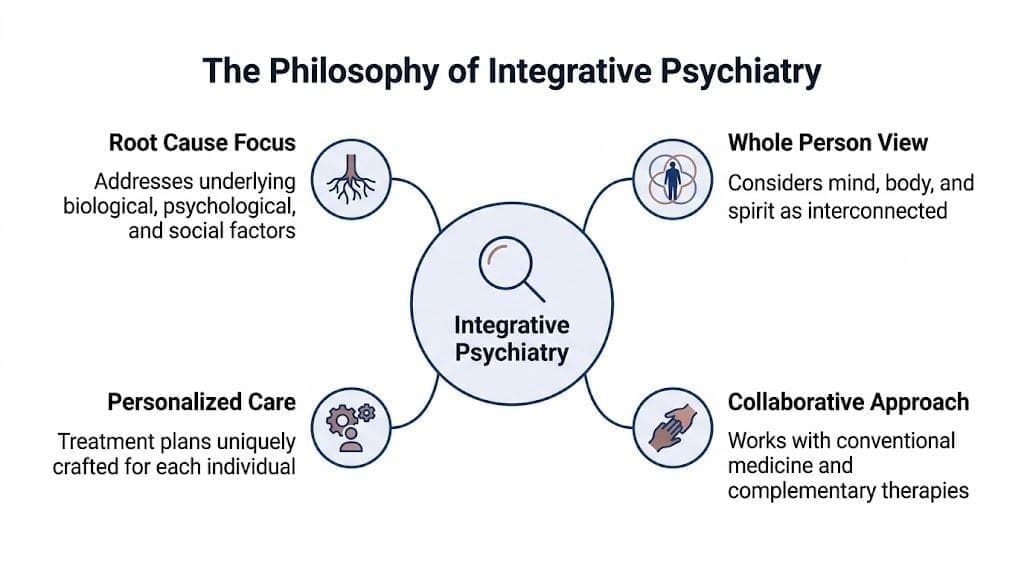
That philosophical shift matters. Many people don’t need less serious care. They need more complete care. If treatment focuses only on symptoms while ignoring sleep disruption, nutritional patterns, chronic stress, hormonal issues, inflammation, trauma, or metabolic problems, the results can feel partial and frustrating.
The brain and body aren’t separate systems
Mental health symptoms live in the brain, but they’re shaped by the rest of the body. Chronic stress can affect energy, sleep, concentration, and emotional regulation. Poor nutrition can worsen mood stability. Irregular routines can intensify anxiety and ADHD symptoms. Trauma can show up physically, not just psychologically.
That’s why an integrative plan looks beyond a diagnostic label. It asks what’s driving the presentation. It also asks what’s keeping it going.
A useful operational example appears in discussions of modern mental health therapy practices, where care systems work best when communication, follow-up, and treatment planning support the full clinical picture rather than a single transaction.
Root cause doesn’t mean anti-medication
This point gets misunderstood. Integrative psychiatry isn’t opposed to medication. It’s opposed to using medication as the only lens. Evidence-based prescribing has an important place. So do psychotherapy, habit change, medical workup, and targeted wellness interventions.
Effective psychiatric care often means combining tools, not defending one tool against all others.
Patients who want a broader overview of the model can review this explanation of the integrative psychiatry approach. The key idea is simple. Better outcomes usually come from understanding how biological, psychological, and behavioral factors interact, then building a plan around that interaction.
Our Comprehensive and Personalized Treatment Components
An integrative treatment plan shouldn’t feel like a random menu of services. Each component should solve a specific clinical problem. One patient may need more structured medication management. Another may need lab review, sleep repair, and trauma treatment before medication changes will even make sense.

Medication management with more context
Medication can reduce suffering fast when it’s well matched to the clinical picture. But rushed prescribing often creates avoidable problems. If a patient has side effects, inconsistent benefit, or a long history of failed trials, it’s worth slowing down and asking why.
That’s where personalization matters. According to what to expect when starting psychiatric treatment, 40 to 60% of people who don’t respond to SSRIs have CYP2D6 or CYP2C19 poor metabolizer variants, and pre-treatment pharmacogenomic testing can reduce the trial-and-error period by 30 to 50%. Those numbers don’t mean testing replaces judgment. Meaning testing can help guide dosing and medication choice when the history suggests genetics may matter.
Therapy referrals and trauma-focused modalities
Psychiatric prescribing is more effective when emotional and behavioral patterns are also addressed. Some patients benefit from traditional psychotherapy. Others need a trauma-specific intervention such as EMDR therapy, especially when PTSD symptoms are shaping concentration, sleep, panic, or emotional reactivity.
A treatment plan becomes stronger when medication and therapy are coordinated around the same goals rather than running in parallel.
Nutrition, exercise, and mindfulness
These aren’t side notes. They’re part of psychiatric care because they affect energy, cognition, inflammation, and nervous system regulation. Nutrition can influence mood stability and focus. Exercise can support sleep quality and stress tolerance. Mindfulness can help patients notice activation earlier and respond with more control.
A practical primer on how nutrition affects mental health can help patients understand why these changes belong in a psychiatric plan, not outside it.
Practical rule: Lifestyle work only helps when it’s concrete. “Eat better” and “reduce stress” aren’t plans. Specific meals, sleep targets, movement goals, and coping practices are plans.
Additional tools when clinically indicated
Some cases call for deeper biological assessment or specialized treatment. Depending on the presentation, that can include:
- Genetic screenings: useful when medication response has been inconsistent or side effects have been prominent.
- Hormonal and metabolic lab panels: relevant when fatigue, low motivation, poor focus, or mood instability suggest a medical contributor.
- TRT evaluation: considered in appropriate cases when symptoms and lab findings support it.
- Ketamine treatments and TMS: options in more complex presentations when conventional approaches haven’t been enough.
The point isn’t to use every tool. The point is to use the right tool for the right patient, in the right sequence.
Conditions We Treat with an Integrative Approach
A diagnosis tells part of the story. It doesn’t tell the whole story. Two people can both meet criteria for anxiety or ADHD and need very different treatment plans because the drivers of their symptoms aren’t the same.
ADHD in a high-need Philadelphia setting
ADHD care matters locally because the need is substantial. In Philadelphia public schools, ADHD diagnosis rates are 15% compared with the national childhood average of 9.8%, according to this review of ADHD prevalence in Philadelphia psychiatry. That statistic speaks to children, but it also reflects a region where many adults are now recognizing long-standing attention symptoms in themselves.
An integrative ADHD plan may include medication management, structured routines, sleep work, nutritional support, and screening for overlapping anxiety or depression. When care focuses only on distractibility, patients often continue to struggle with overwhelm, procrastination, and burnout.
Depression that isn’t just a low mood
One patient presents with sadness and loss of motivation. Another presents with irritability, physical heaviness, poor concentration, and emotional numbness. Both may carry a depression diagnosis, but treatment may look different if one case is strongly tied to trauma, another to disrupted sleep, and another to metabolic or hormonal issues.
Single-track treatment can miss those differences. A broader plan can combine medication support, therapy referral, habit repair, and medical assessment when the pattern suggests it.
Anxiety, PTSD, OCD, and addiction-related care
Anxiety often looks like overthinking from the outside, but in practice, it can involve body tension, sleep disruption, panic, GI symptoms, avoidance, and constant threat monitoring. PTSD adds trauma memory patterns and nervous system overactivation. OCD brings intrusive thoughts and compulsions that need careful diagnostic clarity. Opioid dependence requires structure, accountability, and recovery support, not just symptom suppression.
Some patients also need care that respects their environment and identity, not just their diagnosis. Specialized support for first responders, athletes, gamers, and LGBTQ+ patients matters because stressors, routines, stigma, and treatment priorities can differ across communities.
The most useful psychiatric plan is the one that matches the real life of the person receiving it.
How Telepsychiatry Makes Integrative Care Accessible
For many adults, access is the first barrier. Time, traffic, childcare, work schedules, mobility limits, and privacy concerns can all delay treatment. Telepsychiatry removes many of those obstacles when it’s done in a structured, secure way.

According to IPA, the practice was founded in 2019 and uses HIPAA-compliant telehealth to make care available statewide without a referral. The same source notes 43% employee growth over the past year, reflecting rising demand for convenient, integrated mental health services.
What the process usually looks like
A patient typically starts by reviewing services, selecting an appointment type, and completing online intake paperwork. The first visit is usually more detailed than patients expect, because a whole-person plan requires more history than a symptom checklist.
After that, follow-up tends to be more efficient. Secure telehealth sessions allow medication review, treatment adjustments, lab discussion, goal setting, and coordination of next steps without travel time. For many patients, the patient portal also makes messaging, refill requests, and scheduling easier to manage.
A closer look at virtual mental health services in Pennsylvania can help patients decide whether the format fits their needs.
What a virtual visit feels like
A good telepsychiatry visit shouldn’t feel impersonal. It should feel focused. Patients are often more comfortable at home, which can make discussions about sleep, routines, anxiety triggers, trauma symptoms, or medication effects more candid and more useful.
For readers who want a visual overview, this short video provides additional context on the telehealth experience.
Navigating Payments and Starting Your Journey with IPA
A common Philadelphia telepsychiatry scenario looks like this. Someone is finally ready to get help, then pauses at the payment page and wonders whether out-of-network psychiatric care will create more stress than relief. That concern is reasonable, and it deserves a clear answer.
At Integrative Psychiatry of America, patients pay directly for care and can use current pricing information to review visit options before booking. For many patients, visits may also be paid with HSA or FSA funds, and itemized superbills can support requests for out-of-network reimbursement. Coverage depends on the individual insurance plan, so it helps to verify benefits before the first appointment.
As a psychiatric nurse practitioner, I find that payment questions are often tied to broader clinical questions. What kind of care is a patient trying to get? Insurance-based models can work well for some people. They can also limit visit length, reduce flexibility, and make it harder to address the full picture, including medication response, sleep, nutrition, stress physiology, and other contributors that often shape psychiatric symptoms.
That trade-off matters in integrative care. PMHNPs at IPA do more than prescribe and refill medications. We perform psychiatric assessment, diagnose, build treatment plans, monitor outcomes, and adjust care using a whole-person, evidence-based framework. For patients who want that level of practitioner-led attention through telehealth, self-pay and out-of-network care can be a practical fit, even if the reimbursement process takes extra effort.
The administrative side still needs to be handled clearly. Patients usually have the easiest start when they follow a simple order:
- Review fees and visit types, and confirm which appointment best matches your needs.
- Call your insurer: Ask about out-of-network mental health reimbursement and whether superbills are accepted.
- Check payment tools: Confirm HSA or FSA eligibility if you plan to use those funds.
- Book the intake thoughtfully: Choose a time with privacy and enough room for a detailed first discussion.
- Prepare your information: Have your medication list, past diagnoses, previous treatments, and main goals ready.
Good systems also make the process easier for patients. A practical example appears in AI virtual receptionist streamlining operations for mental health therapists, which shows how front-end communication tools can reduce delays and confusion around scheduling and intake.
Integrative Psychiatry of America provides online psychiatric care in Pennsylvania through psychiatric nurse practitioners who combine medication management with broader treatment planning. That model is not the right fit for every budget or every insurance situation. For many adults, though, it offers something standard psychiatric care often leaves out: time, clinical depth, and a whole-person plan delivered from home.