
Some Philadelphia adults reach the point where missed deadlines, unread emails, abandoned tasks, and constant mental noise stop feeling like “just stress.” They start wondering whether the underlying issue is adult ADHD, and whether telehealth can make treatment simpler, more private, and more realistic for a busy life.
For many people, the search begins with one practical question: how does Adderall prescription Philadelphia work through telepsychiatry? The answer is manageable, but it needs to be approached carefully. A proper evaluation matters. Safety screening matters. Ongoing follow-up matters just as much as the first prescription.
This guide is written from the perspective of a Psychiatric Mental Health Nurse Practitioner approach to care in Pennsylvania. The focus isn't only on whether Adderall might help. The focus is whether ADHD is confirmed, whether stimulant treatment is appropriate, how remote prescribing works legally, and how to build a treatment plan that holds up in real life.
Table of Contents
- Your Guide to Getting an Adderall Prescription in Philadelphia
- Could It Be Adult ADHD Recognizing the Signs
- The Telepsychiatry Evaluation Process for an Adderall Prescription
- Pennsylvania Law Insurance and Costs for Telehealth Prescriptions
- Building Your Holistic ADHD Treatment Plan
- Frequently Asked Questions About Adderall and Telepsychiatry
Your Guide to Getting an Adderall Prescription in Philadelphia
A common Philadelphia pattern looks like this. An adult keeps changing planners, tries caffeine, downloads productivity apps, and still can't finish routine work without a crisis-level deadline. At home, small tasks pile up. At work, attention drifts during meetings. The problem isn't effort. The problem is that focus feels inconsistent and unreliable.
That's often the moment when ADHD treatment Philadelphia adult searches begin. Many people also search for an online ADHD evaluation Pennsylvania, telehealth ADHD diagnosis, ADHD medication management Philadelphia, or Adderall prescription online Pennsylvania because they need care that fits around work, parenting, commuting, or privacy concerns.

Telepsychiatry makes that first step easier. A secure video visit allows an adult to discuss symptoms, medical history, and treatment goals without sitting in traffic or taking half a day off. For people comparing options for Philadelphia integrative psychiatry care, that convenience often removes the biggest barrier to getting evaluated.
Why telehealth works well for ADHD care
ADHD care is conversation-heavy and pattern-based. The clinician needs to hear how symptoms show up across work, relationships, routines, sleep, and emotional regulation. That translates well to a video appointment when the process is structured and compliant.
A solid adult ADHD assessment Philadelphia usually includes:
- Symptom history: not just poor focus, but how long the pattern has been present and where it causes problems
- Functional impact: missed bills, disorganization, late assignments, impulsive decisions, or inconsistent work output
- Rule-outs: anxiety, depression, trauma, sleep issues, substance use, and medical factors that can imitate ADHD
- Medication fit: whether Adderall, another stimulant, or a non-stimulant makes the most sense
Practical rule: A legitimate telehealth evaluation doesn't promise an Adderall prescription. It determines whether ADHD is present and whether stimulant treatment is appropriate.
People often use phrases like online psychiatrist Philadelphia, ADHD provider Pennsylvania, virtual mental health Philadelphia, and controlled substance telehealth Pennsylvania when looking for this kind of care. The wording varies. The need is the same: confidential, serious assessment with follow-up that doesn't feel rushed.
Could It Be Adult ADHD Recognizing the Signs
Adult ADHD usually isn't just “getting distracted sometimes.” It's a pattern that follows a person into multiple areas of life. Work suffers. Home tasks become harder than they should be. Relationships can carry the strain of forgetfulness, lateness, unfinished plans, and emotional reactivity.
In Philadelphia, stimulant prescribing has also shifted more toward adults. The proportion of stimulant prescriptions for Philadelphia residents aged 18 and older increased from 59% to 63% between 2016 and 2019, while prescribing for those under 18 decreased, according to the Philadelphia Department of Public Health report. That doesn't diagnose anyone by itself, but it reflects a broader recognition that ADHD often persists into adulthood.
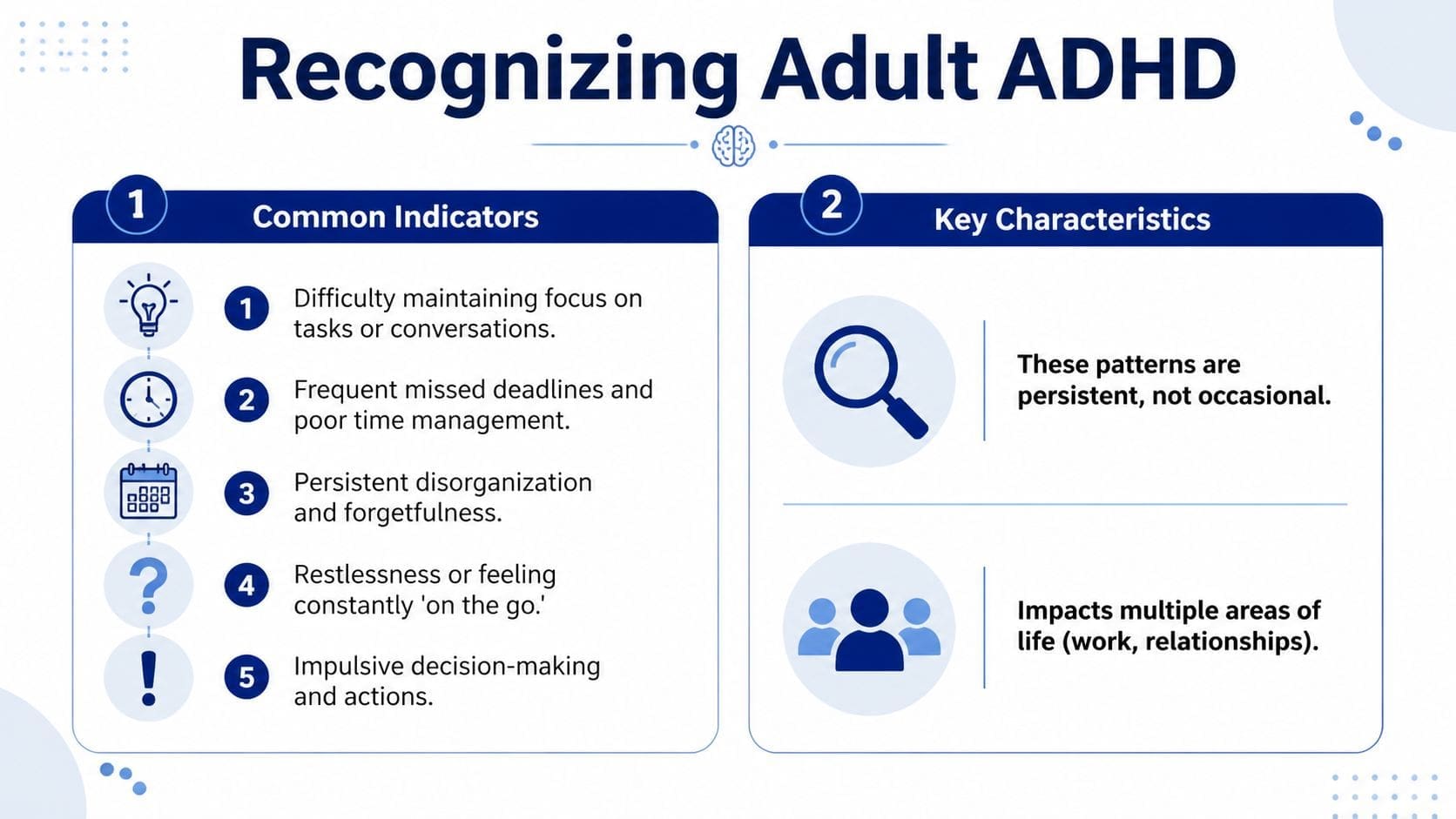
What adult ADHD often looks like day to day
Some signs are obvious. Others are easy to mistake for burnout or anxiety.
- Attention slips during ordinary tasks: conversations drift, emails get reread, and simple admin work takes far longer than expected
- Time feels hard to manage: lateness, deadline trouble, and underestimating how long tasks will take are common
- Organization never seems to stick: calendars, reminder apps, notebooks, and lists may help briefly, then stop working
- Restlessness shows up internally or externally: some adults feel physically fidgety, while others describe a mind that never slows down
- Impulsivity causes friction: overspending, interrupting, reacting too fast, or starting projects without planning
A useful self-check is whether these patterns are persistent and affect more than one setting. Someone who only struggles during a chaotic work quarter may be stressed. Someone who has repeated the same patterns across school, jobs, finances, home life, and relationships may need an ADHD evaluation.
ADHD in adults often hides behind labels like lazy, careless, scattered, or inconsistent. Those labels miss the clinical question.
What helps before the evaluation
A good evaluation goes better when the patient brings specifics instead of general frustration. Helpful material can include old report cards, prior testing, work reviews, medication history, or notes from a partner who has seen the pattern up close. None of those are always required, but they can sharpen the picture.
Questions worth considering before scheduling an ADHD diagnosis adult Pennsylvania visit:
| Reflection area | What to think about |
|---|---|
| Childhood history | Were there earlier signs of disorganization, distractibility, or impulsivity? |
| Work pattern | Is performance strong only under pressure, then inconsistent the rest of the time? |
| Emotional pattern | Does frustration escalate faster than expected? |
| Daily living | Are bills, chores, paperwork, and appointments unusually hard to manage? |
For adults who want a clearer sense of what diagnosis involves, this guide on how to get an ADHD diagnosis as an adult is a useful next step.
The Telepsychiatry Evaluation Process for an Adderall Prescription
The best telehealth ADHD evaluations are methodical. They don't feel like a checklist built to approve medication. They feel like a clinical interview designed to understand how a person functions.
For anyone searching telepsychiatry Philadelphia, virtual ADHD doctor Pennsylvania, PMHNP ADHD treatment, or online stimulant prescription Philadelphia, the process usually starts with scheduling and intake.

What happens before the visit
Before the appointment, patients typically complete secure forms covering symptoms, past diagnoses, current medications, medical history, and goals. This information is critical, as ADHD rarely exists in isolation. Anxiety, depression, sleep disruption, trauma history, and substance use can all change the treatment plan.
A thorough setup usually includes:
- Scheduling through a HIPAA-compliant platform
- Completing intake paperwork accurately and in detail
- Listing current medications and supplements
- Preparing examples of work, school, or life impairment
- Sharing any prior ADHD treatment or testing
People sometimes expect the key question to be, “Can this clinician prescribe Adderall?” The more important question is whether the clinician can distinguish ADHD from everything that can look like it.
What the clinical interview actually covers
During the visit, the discussion should go far beyond distractibility. The clinician will ask about attention, impulsivity, task completion, routines, sleep, appetite, mood, family history, and physical health. Standardized ADHD rating tools may be used, but they're only part of the evaluation.
If Adderall is being considered, the conversation should include benefits, risks, and realistic expectations. In a double-blind study of adults with ADHD, 70.4% of participants taking Adderall achieved at least a 30% reduction in symptoms, compared with 7.4% on placebo, as reported in JAMA Psychiatry. That result supports effectiveness, but only when treatment is professionally managed and monitored.
Later in the process, many patients find it helpful to review practical details around ADHD medication online, especially how follow-up visits, pharmacy transmission, and dose adjustments work.
A short overview can also help people picture the flow of a remote visit:
A careful prescriber doesn't treat the rating scale alone. The rating scale supports the interview. It doesn't replace it.
If medication is appropriate, the prescription is sent electronically to the chosen pharmacy. If it isn't appropriate, that isn't a failed visit. It's a safer and more accurate one.
Pennsylvania Law Insurance and Costs for Telehealth Prescriptions
Controlled substance prescribing through telehealth is possible in Pennsylvania, but it isn't casual. It has to follow state and federal rules, proper identity verification, clinical documentation standards, and pharmacy requirements. That's why a compliant telehealth prescription Pennsylvania process feels more formal than a general wellness visit.
What legal compliance looks like in practice
For a patient, legal compliance usually shows up in ordinary steps. The platform is secure. Intake forms are thorough. The prescriber confirms identity, location, medical history, and pharmacy information. Follow-ups are required. There's no open-ended refill process for a stimulant.
What tends to work well:
- Clear documentation: symptoms, diagnosis, and rationale are recorded carefully
- Regular review: response, side effects, and safety concerns are reassessed before ongoing prescribing
- Pharmacy coordination: changes in stock or formulation are handled deliberately, not improvisationally
- State-specific care: the prescriber must be authorized to treat Pennsylvania patients
What doesn't work well is trying to shortcut the process through a low-friction platform that treats stimulant prescribing like fast retail medicine. For Schedule II medication telehealth care, sloppy systems create downstream problems with pharmacies, insurance, and safety.
Insurance pharmacy issues and shortage planning
Cost questions are practical, and they often affect whether treatment is sustainable. Insurance coverage, prior authorization requirements, and pharmacy network rules can all shape the plan. For patients sorting through cost questions before booking, this page on how much ADHD testing costs gives useful context.
The national stimulant shortage has made pharmacy planning more important than many patients expect. In 2022, the DEA approved enough legal stimulants to equal 405 mg per American, yet production still fell short by one billion doses, contributing to the Adderall shortage described in this Philadelphia stimulant report.
That shortage changes real-world care in a few ways:
| Issue | Practical effect |
|---|---|
| Pharmacy stock changes | A prescription may need to be redirected or adjusted |
| Formulation gaps | Immediate-release or alternative extended-release options may be discussed |
| Insurance restrictions | A covered alternative may differ from the first-choice medication |
Patients looking for ADHD meds online Philadelphia, insurance ADHD care Pennsylvania, or Philadelphia Adderall shortage help usually need a prescriber who can adapt without overreacting. The shortage is frustrating, but it can be managed with planning and realistic backup options.
Building Your Holistic ADHD Treatment Plan
A Philadelphia adult starts Adderall and feels more focused by Tuesday. By Friday, sleep is off, lunch has been skipped three days in a row, and the workday still falls apart at 4 p.m. That pattern is common in ADHD care. A prescription can help attention, but it does not build routines, protect sleep, or fix inconsistent eating.
From a psychiatric nurse practitioner's perspective, the treatment plan has to cover daily function, side effects, and what happens when life is not perfectly structured. In Pennsylvania telepsychiatry, that usually means medication follow-up plus practical work on sleep, meals, exercise, planning systems, and stress regulation.

Medication is one part of the plan
Stimulant treatment starts with careful dose finding. The goal is not maximum productivity at any cost. The goal is a dose and schedule that improve focus without creating a new problem with appetite, anxiety, irritability, blood pressure, or insomnia.
Early follow-up visits usually focus on questions like these: How long does the medication last? Is there a rebound crash? Does it help at work but wear off before home responsibilities begin? Are side effects mild and manageable, or are they strong enough to change the plan?
Medication tends to work better when the rest of the day is structured to support it. Useful supports often include:
- Regular meals and hydration: stimulants can blunt appetite, and under-eating often shows up later as fatigue, irritability, headaches, or worsened concentration
- Exercise: movement can help with attention, stress tolerance, and sleep quality
- Grounding or mindfulness skills: these can reduce emotional reactivity and help with transitions between tasks
- External systems: calendars, alarms, written task lists, body-doubling, and scheduled planning blocks reduce the mental load ADHD creates
This matters even more during ongoing supply problems. WHYY's reporting on the Pennsylvania Adderall shortage notes that five manufacturers of generic long-acting Adderall recently stopped production, and the same report states that pairing medication with behavioral, nutritional, and mindfulness strategies produced 30% greater executive function improvements than medication alone.
Clinical takeaway: If a stimulant is harder to find or a formulation has to change, stable routines around sleep, food, and task management often determine whether treatment still works day to day.
Patients who want practical guidance in this area can review nutrition support for ADHD, depression, and anxiety in Philadelphia. Some adults also explore educational resources on habits that may elevate daily energy and well-being while discussing supplement safety with their clinician.
When Adderall is not the right long term fit
Some adults do well on Adderall for years. Others do better with a different stimulant, a non-stimulant such as Strattera or guanfacine, or a mixed approach that puts more weight on therapy and behavioral strategies. The reason varies. Side effects, anxiety, cardiac history, poor appetite, sleep disruption, and inconsistent benefit can all change the decision.
In telepsychiatry, good care means reassessing rather than forcing the original plan to keep going. Sometimes the dose is too high. Sometimes the formulation does not match the person's work and family schedule. Sometimes ADHD is present, but burnout, trauma, depression, or poor sleep are adding symptoms that medication alone will not fix.
Integrative Psychiatry of America provides online psychiatric care in Pennsylvania with medication management, psychotherapy-informed support, exercise counseling, and nutrition guidance when clinically appropriate.
Plans that hold up over time usually include three parts:
- A careful diagnosis
- Measured medication follow-up
- Daily systems that lower friction and protect functioning
That approach is often steadier than relying on medication alone.
Frequently Asked Questions About Adderall and Telepsychiatry
Do adults need heart screening before starting Adderall
Sometimes, yes. Cardiac safety matters most when there's a personal history of heart disease, certain symptoms, or a family history that raises concern. In those cases, telehealth care may include coordinating an EKG before starting a stimulant.
A practical summary from Philadelphia Integrative Psychiatry's Adderall guidance notes that adults with cardiac risk factors often need that screening before stimulants are started. That becomes even more relevant when shortages push patients toward different formulations, including options like Xelstrym patches.
What if Adderall causes side effects or does not help enough
That doesn't automatically mean ADHD was diagnosed incorrectly, and it doesn't mean treatment has failed. It usually means the prescriber needs to reassess dose, formulation, timing, side effects, or whether another medication class fits better.
Common next steps include:
- Lowering or retiming the dose if insomnia, anxiety, or appetite suppression are the main issues
- Switching formulations if duration is too short or too uneven
- Trying a different stimulant when the response is partial
- Moving to a non-stimulant when tolerability, misuse risk, or medical concerns make that safer
Some adults need stimulant treatment. Some need a different medication. Some need treatment for an entirely different condition. The evaluation has to stay honest enough to tell the difference.
Can a PMHNP prescribe ADHD medication in Pennsylvania
Yes, a properly licensed and authorized Psychiatric Mental Health Nurse Practitioner in Pennsylvania can evaluate ADHD, diagnose when appropriate, and prescribe medication within legal and clinical standards. Many patients use the term psychiatrist when searching online, but telepsychiatry ADHD care in Pennsylvania is also commonly provided by PMHNPs.
Patients should still expect the same core elements regardless of title: thorough assessment, informed consent, monitoring, privacy protection, and clear follow-up. A secure platform, careful charting, and realistic prescribing standards matter more than marketing language.
If focus problems, disorganization, or chronic overwhelm are affecting daily life, Integrative Psychiatry of America offers secure telepsychiatry for Pennsylvania adults who need a careful ADHD evaluation and a treatment plan that goes beyond a quick prescription. The process is designed to address diagnosis, medication safety, follow-up, and whole-person support in one place.