
If you’ve ever wondered whether you might have Attention-Deficit/Hyperactivity Disorder (ADHD), the first step toward getting answers is a proper evaluation. This isn't just a simple quiz or checklist. Psychological testing for ADHD is a deep dive into how your brain works, led by a qualified professional like a psychiatric nurse practitioner who understands the nuances of adult ADHD.
Understanding The ADHD Evaluation Process
Think of a thorough ADHD evaluation like a detective solving a complex case. No single clue leads to the answer. Instead, at Integrative Psychiatry of America, we gather different pieces of evidence from various parts of your life to build a complete picture of your cognitive and behavioral patterns. Our team of psychiatric nurse practitioners is here to make this process feel clear and supportive, so you walk away with real answers and a path forward.
A reliable diagnosis is never based on one piece of information. It requires multiple data points to ensure accuracy. This is why our psychiatric nurse practitioners integrate three core components into every evaluation.
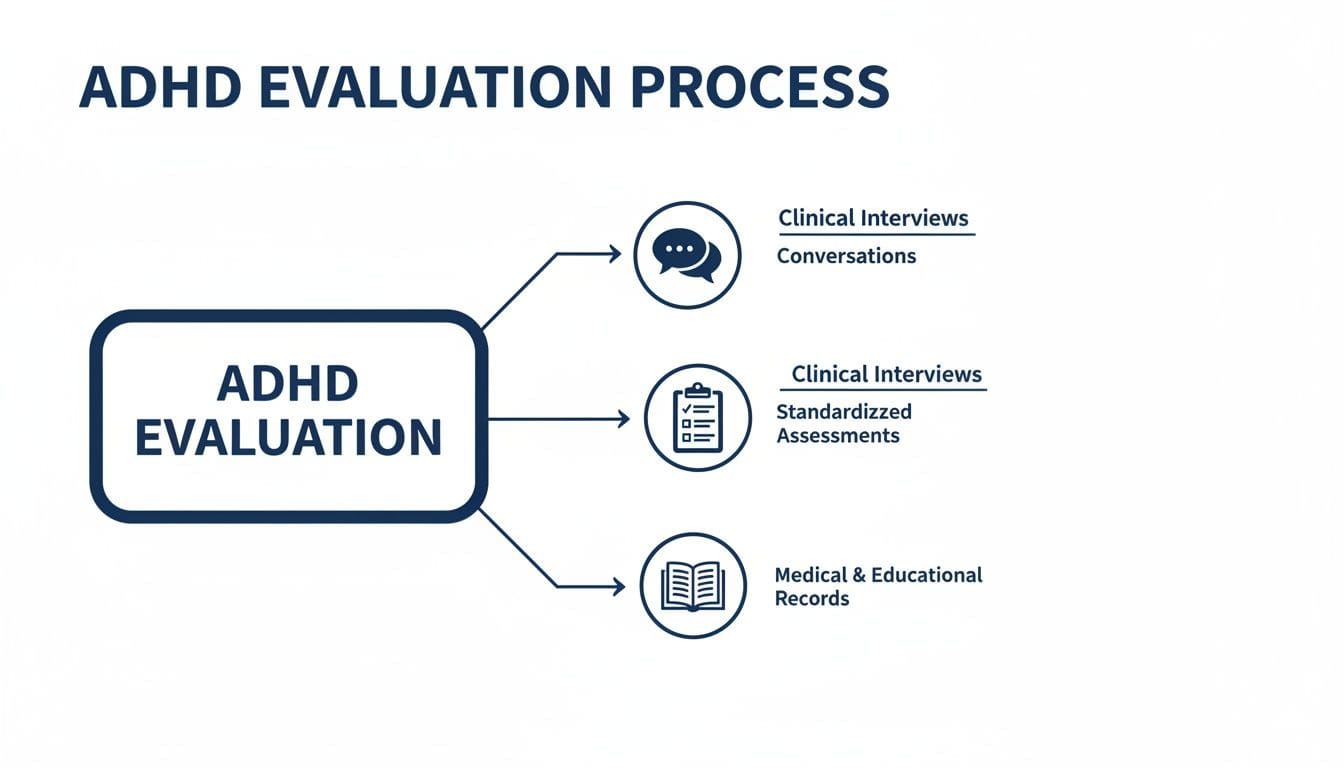
As you can see, a good ADHD evaluation balances your personal story, objective data, and your history. This multi-layered approach ensures we don't rely on a single piece of information that could be misleading.
The Key Components Of An Assessment
A comprehensive ADHD assessment is designed to see the full picture of your symptoms and how they show up in your day-to-day life. It almost always includes these key parts:
- In-Depth Clinical Conversations: This is much more than a simple chat. It’s a guided discussion where our psychiatric nurse practitioner talks with you about your current struggles, but also your developmental history, medical background, and even family history. This is your chance to tell us in your own words how issues with attention, impulsivity, or organization have affected you.
- Validated Rating Scales: These are standardized questionnaires built to measure the severity and frequency of ADHD symptoms. You’ll complete a self-report scale, and we often ask a spouse, partner, or close friend to provide input as well. This gives us a 360-degree view.
- Review of Personal History: We'll look at things like old school report cards, past psychological evaluations, and any other documents that help tell your story. According to the DSM-5 criteria, some symptoms must have been present before age 12, so this historical review is a crucial piece of the puzzle, especially for adults getting diagnosed for the first time.
To give you a clearer idea of what to expect, the table below breaks down the purpose of each component and how we handle it here at Integrative Psychiatry of America.
Key Components of a Comprehensive ADHD Evaluation
| Component | Purpose | What This Looks Like at Integrative Psychiatry of America |
|---|---|---|
| Clinical Interview | To understand your personal story, history, and current challenges in your own words. | A collaborative, in-depth conversation with your psychiatric nurse practitioner about your life, struggles, and goals. |
| Rating Scales | To gather objective, standardized data on the frequency and severity of your ADHD symptoms. | You'll complete validated self-report questionnaires, and we may ask a trusted person in your life to do the same. |
| Records Review | To establish a developmental history of symptoms, as required for an accurate diagnosis. | We review school records, past evaluations, or other relevant documents to see how symptoms have evolved over time. |
By combining these elements, our psychiatric nurse practitioners can confidently determine if ADHD is the right diagnosis and rule out other conditions that might look similar.
An accurate diagnosis is the critical first step toward effective treatment. It ensures that the strategies and support you receive are truly aligned with your needs, rather than addressing symptoms of another condition like anxiety or depression that can mimic ADHD.
Ultimately, the goal of psychological testing isn't just to give you a label. It's to gain a deep understanding of your unique strengths and challenges. This clarity is what allows us to build a personalized and effective action plan together. Deciding when to see a mental health professional is a big step, and knowing what to expect can make it feel much less intimidating.
The Core Tools of an ADHD Psychological Assessment
Getting an accurate ADHD diagnosis isn't about taking a quick quiz. Think of it more like a detective gathering clues. Our psychiatric nurse practitioners use a combination of specialized tools to build a complete and reliable picture of what's going on. Each tool has a specific job, and together, they ensure the final conclusion is one you can trust.

The single most important part of this process is the structured clinical interview. This isn't an interrogation; it's a guided, in-depth conversation with one of our psychiatric nurse practitioners. We'll explore your current challenges, but just as importantly, we’ll dive into your developmental history—all the way from childhood to today. It’s a collaborative effort to understand your life story and the full context of your symptoms.
The Power of Clinical Interviews and Rating Scales
During the interview, our psychiatric nurse practitioner will ask specific questions about how symptoms of inattention, hyperactivity, and impulsivity have appeared in different parts of your life, like school, work, and relationships. This historical view is crucial because ADHD is a neurodevelopmental condition, meaning its roots are almost always found in childhood.
To add another layer of information, we use evidence-based rating scales. These are standardized questionnaires that help us measure the frequency and severity of your symptoms. They give us objective data that we can compare to established norms for your age and gender, adding scientific rigor to the evaluation.
A thorough assessment often includes:
- Self-Report Scales: You’ll fill out a questionnaire like the Adult ADHD Self-Report Scale (ASRS), a trusted and well-researched screening tool.
- Observer Reports: To get a 360-degree view, we might ask a spouse, long-term partner, or parent who knows you well to provide their perspective. This helps us see how your symptoms show up in your daily life from another point of view.
These scales aren’t pass/fail tests. They’re more like a ruler, helping measure the real-world impact of your symptoms. When we combine your personal story from the interview with the objective data from rating scales, we create a much stronger diagnostic foundation. This multi-method approach is the gold standard for a reason.
Clarifying the Role of Performance Tests
You might have heard of computerized "ADHD tests," which are officially called Continuous Performance Tests (CPTs). These are tasks designed to measure specific cognitive skills like sustained attention and impulse control. For instance, a test might ask you to press a button every time you see the number "3" on the screen, but not when you see any other number.
While these tests can offer some useful data about how your brain performs in a controlled setting, they are only one piece of a much larger puzzle.
It’s a common misconception that a CPT can diagnose ADHD all by itself. Leading guidelines and expert consensus are clear: these tests should never be used as a standalone diagnostic tool. They are supplementary, offering just one data point among many, not a definitive yes-or-no answer.
At Integrative Psychiatry of America, our psychiatric nurse practitioners always prioritize the full clinical picture. A CPT result can be thrown off by all sorts of things—anxiety, a bad night's sleep, or even that morning cup of coffee. Relying only on that test would be like a detective trying to solve a crime with a single, unverified clue. It’s just not enough to be certain.
This comprehensive approach is backed by solid research. For example, tools like the Conners Adult ADHD Diagnostic Interview (CAADID) and the ASRS-v1.1 screener are proven to be highly reliable for accurately identifying ADHD in adults. This is especially important since co-occurring conditions can complicate over 50% of adult ADHD cases.
Ultimately, a trustworthy ADHD assessment is a blend of your story, objective data, and a careful process of ruling out other possibilities. In an integrative practice, we might even consider how other biological factors, such as those revealed through genetic testing for mental health, can help inform the complete picture of your well-being. By explaining the "why" behind each tool we use, we aim to empower you and ensure you feel confident in the entire process.
Why an Accurate ADHD Diagnosis Is Crucial
With adult ADHD getting more attention, it’s more important than ever to get the diagnosis right. An accurate diagnosis helps you avoid the frustration of a false positive—getting treated for a condition you don’t actually have.It also prevents the struggle of a missed diagnosis, where you continue to face challenges without the right support. A precise diagnosis is the blueprint for effective care.
Think of it like a detective gathering clues. Our psychiatric nurse practitioners at Integrative Psychiatry of America approach diagnosis with that same level of detail. We work to tell the difference between true ADHD and other conditions with similar symptoms, like anxiety, depression, sleep disorders, or even past trauma.
This careful process is especially important for adult women. Their ADHD symptoms are often less obvious and more internalized. Instead of hyperactivity, they might feel an intense internal restlessness, disorganization, or a constant sense of being overwhelmed. These symptoms are easily mistaken for anxiety or depression, which is why a precise diagnosis is so critical.
The Problem With Casual Screenings
Relying on a quick online quiz or a simple checklist for an ADHD diagnosis is like trying to build a house on sand. It’s an unstable foundation that just won’t hold up.
These quick-and-dirty screenings can't capture the full picture of your life, your history, or the subtle ways your symptoms show up. They often lead to one of two outcomes: a false positive, which gives you a label that doesn’t fit, or a false negative, which dismisses your very real struggles and leaves you without answers.
A comprehensive evaluation, including psychological testing for ADHD, is designed to prevent these errors. It ensures your diagnosis is based on a solid foundation of clinical evidence, not guesswork.
This level of diagnostic precision is more important than you might think. Did you know that recent research has worked to sharpen prevalence estimates for ADHD? A 2022 OHSU study, using the strictest diagnostic criteria, refined the true percentage of people with ADHD to just 3.53%, a significant clarification from looser estimates of 8-10%. For adults, global meta-analyses peg persistent ADHD at 2.58%, highlighting why a thorough approach is critical to avoid misdiagnosis from casual screenings.
Beyond the Label Unlocking the Right Support
An accurate ADHD diagnosis is much more than a label—it’s the key that unlocks a truly personalized and effective treatment plan. Without it, you could spend years trying therapies or medications that only treat surface-level symptoms without ever touching the root cause. This can be an exhausting and discouraging cycle.
When our psychiatric nurse practitioners confirm an ADHD diagnosis, it allows us to:
- Target Core Symptoms: We can choose medications and therapeutic strategies specifically designed to address the executive function challenges tied to ADHD, like problems with focus, organization, and emotional regulation.
- Address Co-occurring Conditions: It is very common for adults with ADHD to also have anxiety or depression. An accurate diagnosis allows us to treat both conditions at the same time, recognizing how they influence each other.
- Provide Validation and Understanding: For many adults, getting a correct diagnosis is a profoundly validating moment. It finally gives a name to lifelong struggles and helps shift self-perception from "I'm lazy" or "I'm not trying hard enough" to "My brain is wired differently, and now I can learn how to work with it."
This clarity is empowering. It paves the way for meaningful support that leads to real, lasting change. To better understand how common this condition is, you might be interested in our article exploring the prevalence of ADHD and why it is a growing concern in mental health.
Your Adult ADHD Testing Experience in Pennsylvania
So, what does psychological testing for ADHD actually feel like for a busy adult in Pennsylvania? At Integrative Psychiatry of America, we’ve designed the entire process around telepsychiatry. We know your time is valuable, and getting answers shouldn't add more stress to your plate.
Your first step is simple: schedule online and fill out intake forms through our secure patient portal. From there, your full assessment is handled by one of our expert psychiatric nurse practitioners, all from the privacy of your home.

What to Expect From Your Telehealth Evaluation
The core of your evaluation is a detailed, one-on-one virtual meeting. Our psychiatric nurse practitioners work hard to create a confidential, non-judgmental space where you can feel safe talking about what’s really going on. We’ll guide the conversation through your personal history, your current struggles, and what you’re hoping to change.
This isn’t just a quick chat. Our psychiatric nurse practitioners use a structured clinical interview, which is the gold standard for accurate diagnosis. We’ll look at the big picture to make sure nothing is missed.
- Developmental History: Since ADHD is a neurodevelopmental condition, we'll talk about your experiences in childhood and school. We’re looking for early patterns of symptoms that may have been overlooked.
- Current Symptoms: You’ll have plenty of time to describe how issues with focus, organization, impulsivity, or emotions are affecting your career, relationships, and day-to-day life right now.
- Co-occurring Conditions: We also carefully screen for other common issues like anxiety, depression, or sleep problems. These can either mimic ADHD symptoms or exist alongside it.
This in-depth conversation is combined with validated tools like the Adult ADHD Self-Report Scale (ASRS-v1.1), which you can complete easily online.
Gender Differences and Diagnostic Nuances
It's important to know that ADHD doesn't always look the same in everyone, and our clinicians are trained to spot these differences. Research shows major gender gaps in ADHD diagnosis during childhood; one survey found a 2:1 ratio of boys to girls (ages 6-12), which jumped to nearly 4:1 in teens.
This strongly suggests that many girls and women are missed by traditional assessments. That's why we rely on structured clinical interviews, not just simple questionnaires, to get a truly accurate picture. In the U.S., about 6% of adults have an ADHD diagnosis, and half of them are identified after childhood.
Telepsychiatry makes it possible for adults all across Pennsylvania to get high-quality ADHD evaluations without the hassle of travel and long wait times. From Philadelphia to Pittsburgh, our mission is to provide care that fits into your life, not the other way around.
Culturally Competent and Inclusive Care
At Integrative Psychiatry of America, we're committed to providing care that respects and understands diverse backgrounds. We know that life experiences and cultural contexts can shape how ADHD symptoms show up and how they're perceived. Our practice is a welcoming space for everyone, including first responders, members of the LGBTQ+ community, and people from all walks of life.
While telehealth is incredibly effective for most adult ADHD evaluations, we’re also transparent about its limits. In very rare cases with a high degree of complexity, an in-person assessment might be suggested to ensure complete accuracy. Your well-being is always our top priority.
If you’re ready to learn more about the process, check out our guide on how to get an ADHD diagnosis as an adult for a step-by-step overview.
Creating Your Post-Diagnosis Action Plan
Getting an official ADHD diagnosis after a full psychological evaluation is a big moment. It’s not the end of the road—it’s the beginning of a new chapter where you finally have a map to understand your own brain.
At Integrative Psychiatry of America, your psychiatric nurse practitioner will walk you through the results, step-by-step. We make sure you understand exactly what the diagnosis means for you. This conversation is the first step in building your personalized action plan.

Think of your diagnosis as the "you are here" marker on a map. The action plan is the route we design together. This isn't a one-size-fits-all approach; your path forward will be as unique as you are, built around your specific symptoms, challenges, and goals.
Building Your Core Treatment Strategy
A solid ADHD action plan usually starts with two core components: evidence-based medication and supportive therapy. These two work in tandem. Medication helps manage the core biological symptoms, while therapy gives you the practical skills to handle daily life.
- Evidence-Based Medication Management: Our psychiatric nurse practitioners will explore all the appropriate medication options together, including stimulants like Adderall or Ritalin and non-stimulants like Strattera or Qelbree. The goal is simple: find what works best to sharpen your focus, curb impulsivity, and manage hyperactivity with the fewest possible side effects.
- Supportive Psychotherapy: Therapy is where you build your toolkit. Cognitive Behavioral Therapy (CBT), for instance, is incredibly effective for adults with ADHD. It helps you reframe unhelpful thought patterns and build real-world strategies for time management, organization, and emotional control.
We always work as a team. Your psychiatric nurse practitioner will explain the pros and cons of any treatment, giving you the power to make an informed choice about your own care. You can learn more about these pathways in our dedicated guide to ADHD treatment options for adults.
Integrating Holistic and Lifestyle Strategies
At Integrative Psychiatry of America, we treat the whole person, not just a list of symptoms. While medication and therapy are incredibly powerful, they’re only part of the puzzle. True, lasting wellness comes from a plan that supports both your mind and your body.
This is where integrative strategies shine. They work alongside your core treatment, making it more effective and promoting your overall well-being.
An integrative action plan recognizes that how you eat, move, and manage stress directly impacts your ADHD symptoms. These strategies aren't just 'add-ons'—they are essential pillars of a strong and sustainable treatment foundation.
Our psychiatric nurse practitioners will help you weave practical, supportive habits into your daily routine, including:
- Nutritional Guidance: Certain ways of eating can help stabilize your energy and improve focus.
- Personalized Exercise Plans: Regular physical activity is a proven way to boost dopamine and improve executive function.
- Mindfulness and Meditation: These practices are like strength training for your attention, helping you manage distractions and regulate your emotional responses.
By building these elements into your plan, we move beyond just managing symptoms. We help you create a lifestyle that allows you to truly thrive.
Creating a Supportive Environment
You don't have to manage ADHD alone—in fact, you shouldn't. Your environment and support system play a massive role in your success. One of the most important steps is building a team around you, which can even include finding an ADHD accountability buddy to help you stay on track with your goals.
Finally, a complete action plan must account for any co-occurring conditions identified during your evaluation. It's very common for adults with ADHD to also have anxiety or depression. Our psychiatric nurse practitioners will make sure your treatment plan addresses every part of your mental health, giving you a clear, supportive, and empowering path forward.
Navigating Costs, Insurance, and Getting Started
Let's talk about the practical side of things. We know that worries about cost and insurance can feel like a huge hurdle when you’re already trying to get answers about your mental health. Our goal is to make the financial piece of psychological testing for ADHD as clear and straightforward as possible for our clients across Pennsylvania.
At Integrative Psychiatry of America, you have a few ways to manage the cost of your evaluation. You can check your insurance benefits right on our online portal. We also have transparent, upfront pricing for our cash-pay and membership plans, so you’ll know exactly what to expect before you even book an appointment.
Verifying Your Coverage
As you get ready for an ADHD evaluation, one of the first questions on your mind is probably about insurance. Many people wonder, "Is Therapy Covered by Insurance?" Understanding how mental health services are typically handled is a critical first step, and this guide on Is Therapy Covered by Insurance offers a great overview of what to expect when it comes to a diagnostic assessment.
We always recommend calling your insurance provider directly before your first appointment. Taking a few minutes to ask the right questions can save you a lot of headaches and unexpected bills down the road.
Knowing what to ask is empowering. It turns a confusing process into a manageable one and ensures you are your own best advocate in getting the care you deserve.
Questions To Ask Your Insurance Provider
When you call your insurance company, it helps to have a list of specific questions ready. Make sure to jot down the name of the person you speak with, the date of the call, and any reference number they give you.
Here are a few key questions to get you started:
- Does my specific plan cover telehealth appointments with a psychiatric nurse practitioner for a mental health evaluation?
- What is my deductible, copay, or coinsurance for outpatient mental health services?
- Do I need a pre-authorization for psychological testing or an ADHD assessment?
- Is Integrative Psychiatry of America considered an in-network or out-of-network provider on my plan?
Once you have a clear picture of your coverage, you can move forward with confidence. From there, you can schedule your initial consultation through our simple online system and take that first important step toward getting answers and support.
Frequently Asked Questions About ADHD Testing
We often hear the same questions from adults considering psychological testing for ADHD. Our psychiatric nurse practitioners have answered the most common ones to give you a clearer picture of the evaluation process.
How Long Does The ADHD Testing Process Take?
A proper ADHD evaluation isn't a one-and-done appointment. It's a careful, multi-step process designed for accuracy.
The journey starts with an initial, in-depth meeting that usually lasts 60 to 90 minutes. After that, you'll complete a few detailed rating scales on your own time. We then schedule a follow-up appointment to go over the findings together and create your personalized treatment plan. We prioritize getting the diagnosis right, not rushing through it.
Do I Need A Referral For An ADHD Evaluation?
No, you don't need a referral from another provider to see us. Integrative Psychiatry of America provides telepsychiatry services to adults anywhere in Pennsylvania, from Philadelphia to Pittsburgh.
You can schedule directly with one of our expert psychiatric nurse practitioners using our online portal. You have the freedom to take that first step whenever you're ready.
Modern telepsychiatry removes the old barriers to getting care. Direct access puts you in control of your health journey, empowering you to find answers without navigating a complicated referral system first.
Can I Get A Diagnosis And Medication In One Visit?
Our goal is always responsible and effective care, which means we don't diagnose and prescribe in a single visit. The initial evaluation is all about building a solid diagnostic foundation and truly understanding your unique situation.
If medication is the right fit for your treatment plan, it's prescribed thoughtfully as one part of a complete strategy we build together. This ensures your safety and lets us monitor your progress through follow-up care, making adjustments as needed.
Is A Telehealth ADHD Evaluation As Good As In Person?
Yes. For most adults, a telehealth evaluation for ADHD is just as effective and reliable as meeting in person. Our psychiatric nurse practitioners use the same gold-standard tools you'd find in a traditional office, including structured clinical interviews and validated rating scales.
Telehealth simply adds a level of convenience, privacy, and accessibility that in-person visits can't match. Only in very rare and complex cases would we suggest an in-person assessment might be needed to gain full diagnostic clarity.
Are you ready to get clarity and take control of your ADHD? At Integrative Psychiatry Of America, our team of compassionate psychiatric nurse practitioners is here to guide you through a complete evaluation from the comfort of your home. Schedule your appointment online today and start your journey toward a more focused and fulfilling life.