
An adult in Philadelphia opens a browser after a rough week, types “Anxiety Treatment Do You Have Cigna?”, and wants a straight answer before another day gets away from them. That search is usually not about curiosity. It is about whether care is affordable, whether a virtual visit will count, and whether booking now is worth the hassle.
The honest answer is this. Cigna can be a workable path to anxiety care, but the issue is not a simple yes or no. Coverage often depends on plan type, in-network status, and virtual-visit eligibility. That is why people get different answers from a directory, an office, and the insurance card in their wallet. Integrative Psychiatry of America is a Pennsylvania-based virtual practice that accepts Cigna, and the smarter move is to verify the details before scheduling.
Pennsylvania adults run into this question in Pittsburgh, Harrisburg, Erie, Scranton, Allentown, Lancaster, and Reading for the same reason. Anxiety care is often needed sooner rather than later. Insurance, however, is built around paperwork, portal searches, and benefit rules that most people do not want to decode while already stressed. This article fills that gap. It offers a practical look at what anxiety treatment involves, how Cigna typically handles behavioral health, and how virtual psychiatry fits into the picture.
Table of Contents
- Why Pennsylvania Adults Ask Do You Have Cigna Before Booking Anxiety Care
- What Anxiety Treatment Looks Like in a Psychiatric Setting
- How Cigna Typically Covers Anxiety Treatment
- Confirming Your Cigna Benefits Before You Book
- In-Person vs Virtual Anxiety Care With Cigna
- How Integrative Psychiatry of America Approaches Anxiety Care
- Common Beliefs That Keep People From Starting Anxiety Treatment
- Your Next Step and Quick Answers About Cigna Anxiety Care
Why Pennsylvania Adults Ask Do You Have Cigna Before Booking Anxiety Care
A working parent in Harrisburg may know they need help for constant worry, poor sleep, or panic, but still freeze when the insurance question comes up. A student in Erie or a commuter near Philadelphia may ask the same thing. The first barrier is often not treatment. It is figuring out whether a visit will be covered without surprise bills. That search phrase is really shorthand for, “Can this be done affordably and without a fight?”
The real question behind the search
Cigna coverage for anxiety care is rarely a single universal rule. The practical answer usually depends on whether the plan covers outpatient behavioral health, whether the provider is in-network, and whether the appointment is virtual care or in person. That is why the simplest search query often turns into a three-part coverage puzzle.
Practical rule: when a patient asks “Do you have Cigna?”, the better follow-up is, “Which Cigna plan, which provider type, and which visit type?”
That matters for readers in smaller Pennsylvania towns as much as for people in the cities. A virtual option can remove travel time, reduce missed work, and make it easier to start care before symptoms get worse. Pennsylvania readers who are trying to sort out access and provider availability can also review the broader mental health provider shortage in Pennsylvania to understand why online access has become such a practical solution.
What to expect from a direct answer
The direct answer is straightforward. Cigna is accepted, but the useful question is whether the specific plan supports the exact visit the patient needs. That means checking the plan document, confirming whether the provider is in-network, and making sure telehealth is included if that is the preferred format.
People usually do better when they stop treating insurance like a yes-or-no gate and start treating it like a checklist. That mindset saves time, reduces back-and-forth, and gets them to the actual care faster.
What Anxiety Treatment Looks Like in a Psychiatric Setting
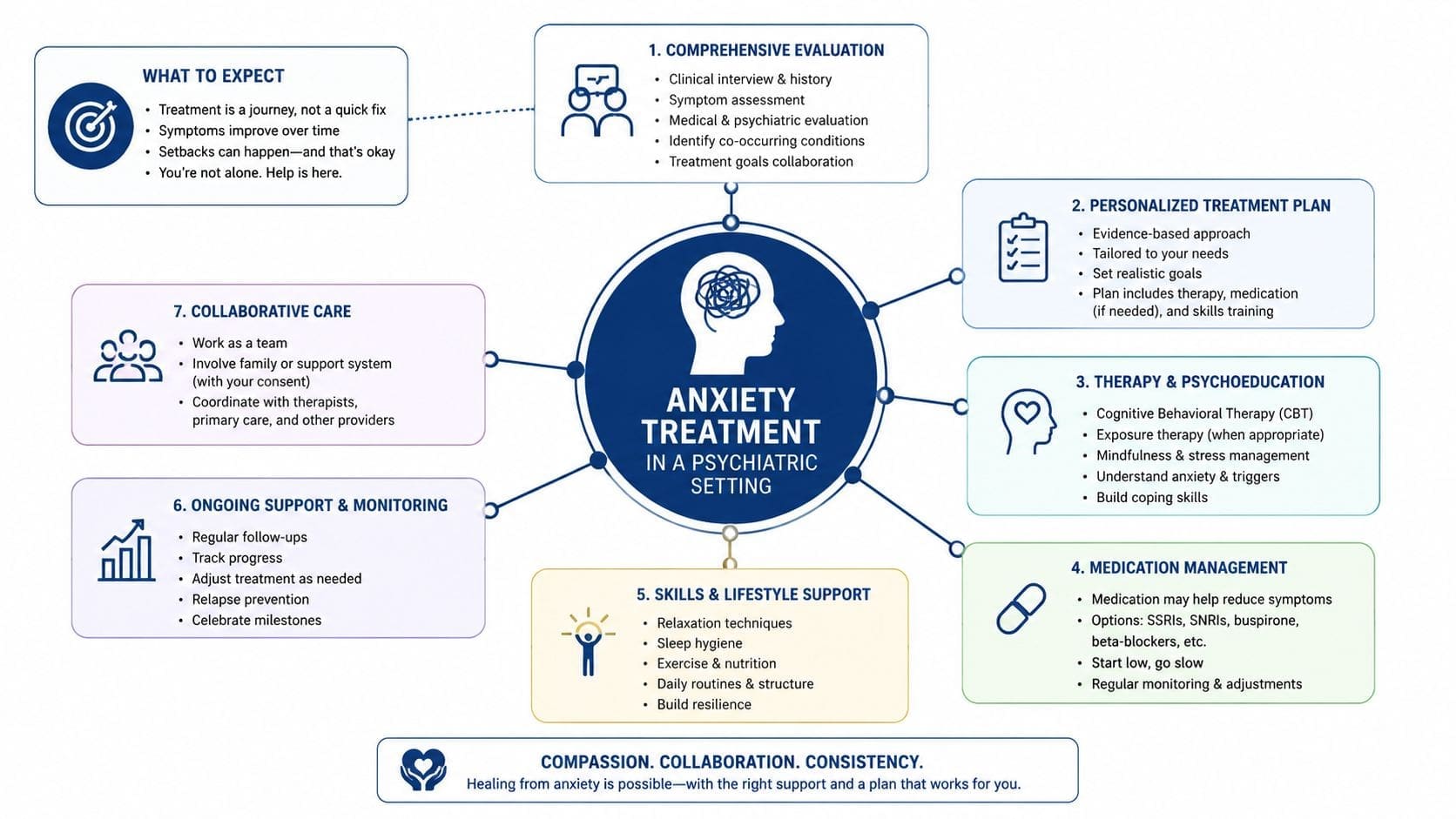
Anxiety treatment in a psychiatric practice is not a quick prescription. It is also not talk therapy without structure. A solid plan usually starts with a psychiatric evaluation, then moves into medication management when appropriate, and often includes therapy skills, lifestyle support, or both. That is the standard path for many people with generalized anxiety, panic symptoms, social anxiety, or anxiety that shows up alongside depression or ADHD.
The first visit should feel structured, not vague
A real evaluation looks at symptoms, triggers, sleep, stress load, medical history, medication history, and safety concerns. It also asks a simple but important question. Is the anxiety isolated, or is it part of a broader picture that includes depression, OCD, PTSD, or ADHD? People often arrive thinking they need to “prove” they are sick enough, but the point of the visit is to map the pattern clearly.
Medication is one tool, not the whole plan. In anxiety care, common medication discussions may include SSRIs and SNRIs. In some cases, other options may enter the conversation when depression symptoms or attention issues are part of the picture. A patient with low energy and anxiety may need a different discussion than someone whose main issue is daily panic or constant muscle tension.
Match the treatment to the symptom pattern
Generalized anxiety often shows up as constant worry, irritability, and muscle tension. Panic disorder is more episodic, with sudden surges of fear, a racing heart, shortness of breath, or a sense that something is very wrong. Social anxiety tends to center on performance, embarrassment, or being judged. That changes how therapy and medication are discussed.
Clinical point: the best first plan is the one that matches the symptom pattern, not the one that sounds strongest on paper.
For a deeper look at the specific modalities, see our guide on anxiety treatment in PA.
People should not wait until they reach a breaking point to book care. The earlier the pattern is identified, the easier it is to build a realistic treatment plan.
How Cigna Typically Covers Anxiety Treatment
Cigna's behavioral health coverage is usually built around outpatient care, not drama and not guesswork. Independent coverage guides describe many Cigna plans as reimbursing outpatient therapy, psychiatric evaluation, and medication management, often as specialist visits after deductible rules apply. In plain terms, the most reliable approval path is usually in-network, medically necessary outpatient treatment. Higher-intensity settings are typically considered only when symptoms require them.
Cigna's own research also tied outpatient behavioral health treatment to lower total medical spending, with savings reaching up to $1,377 per person per year and $3,109 over two years in the study population it examined, according to the report summarized by Fierce Healthcare. That does not mean every member will see those exact numbers. It does reinforce the basic managed-care logic. Treating anxiety earlier often helps avoid bigger downstream costs. For readers comparing therapy, medication visits, and cost exposure, that is the kind of hard reality that matters.
Where to look in the plan documents
The most useful document is the Summary of Benefits and Coverage. Readers should find the row labeled “If you need mental health, behavioral health, or substance abuse services” and then inspect the outpatient-services column for copay, coinsurance, deductible, or “not covered” language. That single row usually tells the truth faster than a generic search result.
Prior authorization is usually more relevant when care rises to a higher level, such as inpatient or intensive outpatient treatment. This is especially true when symptom severity makes medical necessity the issue. For routine outpatient anxiety treatment, the question is usually less about whether care exists and more about whether the plan treats the visit as in-network specialty care.
What that means in practice
If the visit is outpatient, medically necessary, and in-network, the odds are usually better. If the plan is broad, the provider is in-network, and the service is virtual when allowed, the process tends to be smoother. If the plan is narrow or the provider is out-of-network, the math changes fast.
For a closer look at how a practice structures these visits and fees, readers can review insurance and fees.
Confirming Your Cigna Benefits Before You Book
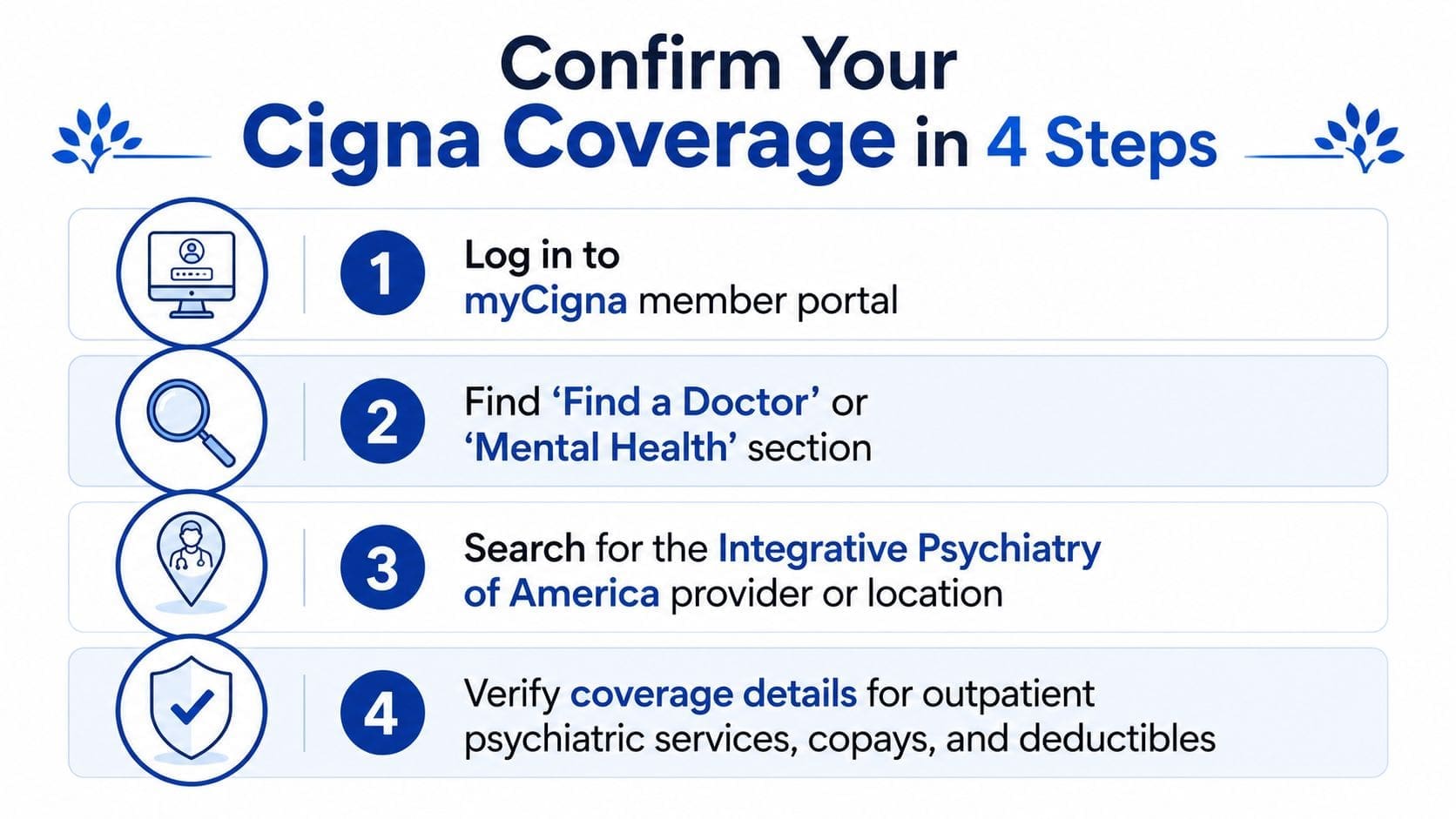
The fastest way to avoid confusion is to verify benefits before scheduling. Cigna members are typically pushed toward the myCigna member portal, and that is the right place to start. The plan itself often decides what is covered, what counts as virtual care, and how the visit will be billed. Members can also use the phone number on the insurance card and ask for a clear answer instead of piecing together clues from a directory.
The portal route is practical because Cigna's member guidance points users to account access, then to “Talk to a doctor” or “Find Care and Costs.” That is the consumer workflow, not an extra detour. It shows patients where Cigna expects them to check care options, including virtual care entry points.
Three questions to ask by phone
A short call can clear up the biggest unknowns:
- In-network status: Ask whether the practice is in-network for the member's specific Cigna plan.
- Virtual visit coverage: Ask whether telehealth psychiatric or therapy visits are covered at the specialist benefit level.
- Authorization rules: Ask whether an initial evaluation needs prior authorization or a referral.
That call is worth making because directory listings can be incomplete, stale, or unclear about visit type. A therapist, a virtual behavioral-health provider, and an office-based clinician may not all be treated the same way under a specific plan.
A quick checklist before the first appointment
The member should write down the plan name, group number, and whether the intended visit is telehealth. They should also save the representative's name or reference number if the insurer gives one. That makes follow-up easier if billing questions come up later. If the plan documents and the phone answer disagree, the plan documents usually win.
Patients who are already using tools to organize symptoms often do better at this stage. The point is not to become an insurance expert. It is to show up with enough information to avoid delays.
In-Person vs Virtual Anxiety Care With Cigna
Cigna recognizes telehealth therapy as an effective treatment for anxiety, and that matters because anxiety care often depends on frequent follow-up, symptom tracking, and medication adjustments. Virtual visits remove travel time, reduce the friction of getting started, and make it easier to keep appointments when life is already overloaded. For many working adults, that difference is not a convenience. It is the reason care happens.
A patient comparing in-person and virtual care should think about the visit rhythm, not just the location. Anxiety treatment often needs regular check-ins early on, especially when a medication is being started or changed. Telepsychiatry tends to fit that cadence well because the follow-up is fast, structured, and easier to fit between obligations.
Here is the plain comparison:
| Care setting | What usually helps | Where it can be harder |
|---|---|---|
| In-person | Hands-on comfort, local familiarity, face-to-face preference | Travel, scheduling, parking, missed work |
| Virtual | Easier follow-up, less disruption, faster access | Requires a private space and a stable internet connection |
Why virtual care fits anxiety especially well
The clinical logic is simple. Anxiety often improves when a patient can check in often enough to adjust the plan before symptoms snowball. A virtual visit makes that easier, and Cigna's own telehealth guidance supports telehealth therapy as an effective anxiety treatment.
For Pennsylvania readers who want online access, a helpful background read is what is telepsychiatry. That matters because the key question is not just whether a provider accepts Cigna, but whether the member can use that benefit without turning care into a logistical mess.
How Integrative Psychiatry of America Approaches Anxiety Care
A Pennsylvania patient with Cigna usually wants two things at once, a plan that is clinically sound and a process that does not waste time. Integrative Psychiatry of America handles that with virtual psychiatric evaluations, follow-up medication management, and a whole-person approach that looks at sleep, stress, nutrition, movement, and coping skills alongside symptoms. Board-certified psychiatric nurse practitioner Christopher Clark, MSN, PMHNP-BC leads that care model, and the visits are designed to work statewide through telehealth.
What the care path actually looks like
The initial evaluation focuses on the symptom picture, the timeline, prior treatment, and whether anxiety is traveling with depression, ADHD, OCD, or PTSD. If medication makes sense, the conversation may include SSRIs, SNRIs, or other medication options depending on the person's history and symptom pattern. If therapy skills, mindfulness, sleep support, or routine changes matter more, those get folded into the plan rather than treated as an afterthought.
The practice also offers free tools that patients can use before the first visit, including the Anxiety Symptom Checker, the Daily Agenda Planner, the Feeling Journal, the Exercise Routine Generator, and the 5-4-3-2-1 Grounding Tool. Those are useful because anxiety gets worse when the day feels unstructured, and people often need something practical before the appointment even starts.
For readers who want a broader explanation of the model, the integrative psychiatry approach shows how evidence-based care can be combined with everyday behavior changes without turning treatment into wellness fluff.
The cash-pay reference point is also clear. The practice's average out-of-pocket cost figures are $450 for an initial evaluation and $275 for follow-ups, which gives patients a real comparison point while they verify Cigna benefits. That is more useful than vague reassurance because it lets a reader gauge whether insurance is likely to help enough to make care manageable.
For people who like to pair medical care with self-directed habits, a general overview like explore natural ways to relieve anxiety can be a useful supplement, as long as it never replaces a proper evaluation.
Common Beliefs That Keep People From Starting Anxiety Treatment
A lot of people wait too long because they assume anxiety has to become a crisis before treatment counts. That belief is wrong. Outpatient behavioral health care is often exactly where anxiety should be treated, and Cigna's own research tied that kind of care to lower total medical spending, which is a practical sign that early treatment is not overreacting, it is smart.
Four common myths, cut down to size
- “It's not bad enough yet.” Anxiety does not have to destroy a job or relationship before it deserves treatment. If sleep, focus, patience, or daily functioning are getting squeezed, that is enough reason to start.
- “A psychiatrist only hands out medication.” Good care does not work that way. Medication is one tool, and a real evaluation also looks at sleep, stress, lifestyle, and therapy needs.
- “Cigna probably won't cover it.” Many plans do cover outpatient therapy, psychiatric evaluation, and medication management when the care is in-network and medically necessary.
- “Virtual care isn't real care.” That is outdated thinking. A virtual psychiatric evaluation is a legitimate clinical encounter, and for anxiety it often fits better than driving across town.
People also get stuck because they assume natural remedies have to be sorted out before they can seek care. That is backwards. If a patient wants background reading on supplements or self-care options, a resource like factors influencing CBD dosage may be interesting, but it should never replace a proper diagnosis or a treatment plan tied to symptoms.
The best time to start is before anxiety shrinks the patient's routine. Waiting for a crisis usually makes the first step harder.
For Pennsylvania adults, the decision is simple. If the question is whether care is worth verifying, the answer is yes.
Your Next Step and Quick Answers About Cigna Anxiety Care
The path is straightforward. Check the myCigna portal or call the number on the insurance card, confirm in-network behavioral health and telehealth coverage, then book a virtual evaluation with a practice that can treat anxiety, medication questions, and overlapping symptoms without making the process harder than it needs to be. Use the free anxiety tools first if that helps get organized.
Quick answers. Does the practice accept Cigna, yes. Are virtual visits covered the same as in-person, sometimes, depending on the plan and benefit rules. What does an evaluation cost without insurance, $450. How soon can a new patient be seen, that depends on scheduling, so the best move is to ask directly when coverage is confirmed.
If anxiety has been dragging on, the next step is to stop guessing and verify the benefit details now. Integrative Psychiatry of America offers virtual psychiatric evaluations, medication management, and practical anxiety care for adults across Pennsylvania, and the first appointment starts with clear insurance and scheduling steps. Visit Integrative Psychiatry of America to check coverage, explore free tools, and book a virtual visit that fits Cigna and fits real life.