
Some adults in Philadelphia start this search after years of feeling capable on paper but scattered in real life. Work gets done, but only under pressure. Emails pile up. Bills are paid late. A SEPTA commute becomes one more place where attention slips, thoughts race, and the day starts behind.
That's often when the phrase ADHD psychiatrist Philadelphia shows up in a search bar.
What matters most, though, isn't only the title. It's the quality of the evaluation, the clinician's ADHD training, and whether the care model fits adult life. For many people, that means looking beyond the traditional office search and considering telepsychiatry, where psychiatric nurse practitioners with ADHD expertise can provide structured assessment, medication management, and whole-person treatment planning. Adults who want convenient virtual care can review options for a Philadelphia mental health provider that offers secure online visits.
Table of Contents
- Your Guide to Finding ADHD Care in Philadelphia
- Recognizing Adult ADHD Symptoms in Your Philly Life
- How to Find Online ADHD Care Across Pennsylvania
- Preparing for Your First Telehealth Appointment
- Evaluating Clinicians and Treatment Approaches
- Starting Your Treatment Journey with IPA
Your Guide to Finding ADHD Care in Philadelphia
Searching for ADHD care in Philadelphia can feel oddly confusing. Some people look specifically for a psychiatrist. Others search for ADHD testing, medication help, executive dysfunction support, or telehealth. Those searches sound different, but they usually reflect the same need. A clinician who can sort out whether ADHD is present and then build a treatment plan that works in daily life.
That distinction matters because adult ADHD care is rarely a one-visit problem. Good care includes a careful interview, a review of how symptoms affect work, school, relationships, and routines, and a realistic plan for follow-up. In practice, that often means adults do well with clinicians who are comfortable managing both attention symptoms and the conditions that commonly overlap with them, such as anxiety, low mood, sleep disruption, or substance use concerns.
What the right search should focus on
A useful search starts by screening for approach instead of assuming one job title guarantees better care. Look for:
- ADHD-specific experience with adult assessment, not only general medication management.
- Telehealth availability that works around work hours, parenting, or commuting.
- Clear follow-up structure so treatment doesn't stop after the first prescription decision.
- Whole-person care that addresses function, not just symptom checklists.
Practical rule: If a provider's website makes ADHD care sound fast and simple, that's usually a reason to look closer, not relax.
Philadelphia already has specialty ADHD resources, and adults benefit when they use that reality to search smarter. The strongest options usually explain how they evaluate ADHD, how medication follow-up works, and what they do when the picture is complicated.
Why telepsychiatry fits adult ADHD
Telepsychiatry helps remove obstacles that often delay treatment. Adults don't have to add traffic, parking, or waiting rooms to a day that already feels overloaded. Virtual care also lets people search across Pennsylvania for clinicians whose training fits the problem, rather than settling for whoever is closest.
For many adults, that's the shift. The search for an ADHD psychiatrist Philadelphia provider often becomes a search for accessible, skilled, structured ADHD treatment. That can absolutely include psychiatric nurse practitioners with focused expertise in adult ADHD and medication management.
Recognizing Adult ADHD Symptoms in Your Philly Life
A lot of adults don't recognize ADHD because they aren't bouncing off the walls or failing out of school. They're employed. They answer texts eventually. They meet deadlines, but at a cost that feels hidden from everyone else.

What adult ADHD can look like day to day
In Philadelphia, adult ADHD might show up as missing a stop on the El because attention drifted, then spending the rest of the commute replaying the mistake. It can look like sitting in a noisy open-plan office in Center City and rereading the same email five times. It can look like putting off laundry, bills, meal planning, and apartment cleanup all week, then feeling crushed by weekend catch-up.
Sometimes the symptom that stands out isn't distractibility. It's chronic overcompensation. A person keeps fifteen browser tabs open, sets multiple alarms, relies on panic to start tasks, and still feels behind. Friends may describe that person as bright but inconsistent. Supervisors may see strong ideas with uneven follow-through.
Other adults notice the emotional side first. They interrupt in conversations, react too fast, lose track of what they meant to say, or feel unusually overwhelmed by ordinary administrative tasks. Many people searching for practical language around this pattern find Jan Kutschera's founder's guide to executive dysfunction useful because it describes how “knowing what to do” and “doing it on time” can become two very different things.
Why adults often get the wrong label first
Adult ADHD is often missed because the surface picture can resemble anxiety, depression, trauma, or burnout. A person may say, “I can't focus,” but the underlying clinical question is why. That's one reason specialized ADHD assessment matters.
In Philadelphia, the need for specialized care is substantial. One local source notes that rates in the city may exceed 15% of school-aged children, with a cited estimate that 15% of Philadelphia public school students have been diagnosed with ADHD, compared with the CDC's national figure of 9.8% for U.S. children, and that symptoms often persist into adulthood where they may be mistaken for anxiety, depression, or trauma, requiring specialized assessment, as described by Integrative Psychiatry of America's review of ADHD prevalence in Philadelphia.
That doesn't mean every distracted adult has ADHD. It means persistent patterns deserve a proper evaluation.
Many adults aren't lazy, careless, or unmotivated. They've been using brute force to manage a condition that was never clearly identified.
If anxiety is part of the picture, it can help to compare the patterns directly. Adults who aren't sure which issue fits better may find it useful to read about whether their symptoms are anxiety or ADD.
How to Find Online ADHD Care Across Pennsylvania
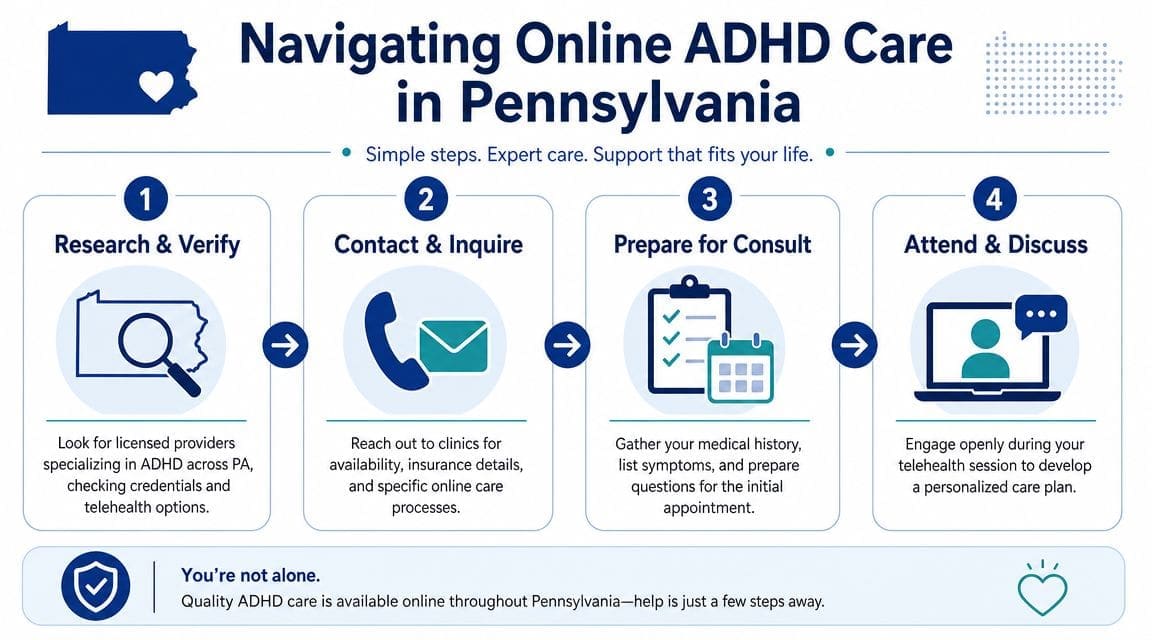
The practical search usually improves once the keyword changes. Instead of looking only for “ADHD psychiatrist Philadelphia,” many adults get better results with terms like online ADHD assessment Pennsylvania, adult ADHD telehealth Pennsylvania, ADHD medication management online, or executive function treatment Philadelphia.
Search for the model, not just the title
A strong online search has two jobs. First, it should identify clinicians licensed to treat patients in Pennsylvania. Second, it should show whether the practice truly understands adult ADHD rather than merely listing it among many conditions.
Philadelphia has a robust ADHD care infrastructure. Penn Medicine operates an Adult ADHD Treatment and Research Program at 3535 Market Street in Philadelphia, PA 19104, with weekday office hours Monday through Friday from 8 a.m. to 5 p.m., and the same page reflects how specialty ADHD care is organized in a major academic setting, as shown on Penn Medicine's adult ADHD program page. Other established practices in the city also report that initial ADHD evaluations are typically 60 to 90 minutes, with follow-ups of 20 to 30 minutes and availability within 2 to 3 weeks, which helps set expectations for what thorough care usually requires.
That matters for telehealth because quality virtual ADHD care should still feel structured and deliberate. It shouldn't feel rushed.
A statewide option for people who want that format is online ADHD care in Pennsylvania, which outlines telepsychiatry assessment and follow-up services delivered remotely.
What a strong telehealth ADHD practice should show you
Before scheduling, scan the website for signs that the practice is doing more than general psychiatry.
Look for:
- Credentials listed clearly such as PMHNP-BC or other prescribing mental health credentials.
- An adult ADHD process that explains intake, diagnostic evaluation, and follow-up care.
- Medication philosophy that discusses stimulants, non-stimulants, and monitoring.
- Functional treatment goals like organization, time management, emotional regulation, and work performance.
- Secure systems such as HIPAA-compliant visits and a patient portal for messaging or refills.
This short video helps make the telehealth process easier to picture before the first appointment.
A good ADHD telehealth visit should reduce friction, not clinical rigor.
Preparing for Your First Telehealth Appointment
The first appointment goes better when preparation is concrete. “I think I have ADHD” is a perfectly reasonable starting point, but the most helpful visit usually includes examples that show where things break down and how long the pattern has been present.
Bring examples, not just labels
A thorough adult ADHD evaluation typically involves confirming persistent impairment, tracking symptoms from childhood forward, ruling out other causes such as anxiety, sleep disorders, substance use, or medical issues, and assessing co-existing conditions, which is why clinicians with specific ADHD training are important, according to this overview of adult ADHD evaluation and treatment.
That means a patient should gather details such as:
- Specific problem areas like missed deadlines, unfinished chores, careless mistakes, lateness, impulsive spending, or poor task initiation.
- Childhood clues including report card comments, teacher concerns, family observations, or long-standing disorganization.
- Current medications and diagnoses so the clinician can review the full psychiatric and medical picture.
- Questions about treatment including how diagnosis is made, what follow-up looks like, and how medication decisions are handled.
A short note on a phone or notepad is often enough. Formal records help when available, but they aren't the only thing that matters.
Set up the visit so the conversation can work
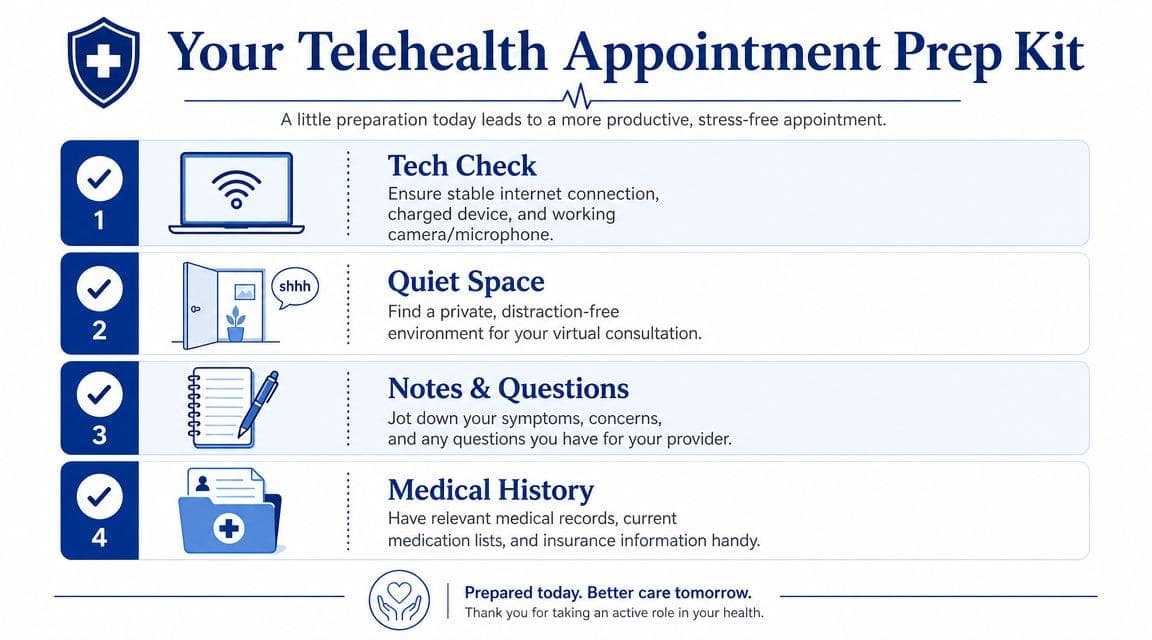
Telehealth has simple logistics, but they matter. ADHD evaluations ask for attention, memory, and examples. A poor internet connection or a noisy room can make that harder than it needs to be.
A practical setup includes:
- Choose a private room where interruptions are unlikely.
- Test the device early so the camera, microphone, and browser permissions work.
- Keep ID, insurance, and medication lists nearby instead of hunting for them mid-visit.
- Silence extra notifications on phones, watches, and laptops.
The first visit isn't a performance. It's a clinical conversation. Messy notes are fine. Honest examples matter more.
Many adults also feel relieved when they stop trying to sound organized in the appointment. If mornings are chaotic, if work tasks take too long, if emotional overwhelm follows simple errands, that's useful clinical information.
Evaluating Clinicians and Treatment Approaches
Once the search produces a few options, the next task is choosing a clinician whose treatment style fits adult ADHD. A medication-only visit can help some patients, but it often leaves functional problems untouched. Adults may focus slightly better and still struggle with planning, prioritizing, emotional reactivity, or follow-through.
Questions worth asking before you commit
The right questions quickly reveal whether a provider understands the condition in adults.
Consider asking:
- How do you evaluate adult ADHD? A strong answer should include symptom history, impairment, childhood patterns, and differential diagnosis.
- How do you decide between stimulant and non-stimulant treatment? The answer should sound individualized, not automatic.
- What do you do if anxiety, depression, sleep problems, or substance use are also present? Adult ADHD rarely exists in isolation.
- Do you recommend therapy, coaching, or skills-based support alongside medication? If the answer is no across the board, the plan may be too narrow.
- How do follow-up appointments work? ADHD care works best when monitoring is consistent.
Best-practice ADHD treatment is usually multimodal, combining medication with psychotherapy such as CBT for ADHD, executive-function coaching strategies, and lifestyle interventions, because medication alone may not fully address functional impairment, as described by Renewing Mindsets' overview of ADHD treatment approaches.
That's the key trade-off. Medication can reduce symptoms. It doesn't automatically build systems, routines, or coping skills.
Comparing ADHD treatment approaches
| Approach | What It Involves | Best For |
|---|---|---|
| Medication-only care | Focused prescribing visits, symptom check-ins, side effect review | Adults with straightforward symptoms who already have strong routines and low complexity |
| Multimodal ADHD care | Medication plus therapy recommendations, executive function strategies, and lifestyle support | Adults whose symptoms affect work, home organization, planning, or emotional regulation |
| Integrative psychiatric care | ADHD treatment with attention to sleep, nutrition, exercise, mood, and co-occurring conditions | Adults who want broader care because attention problems overlap with anxiety, burnout, substance use, or health concerns |
For readers comparing options, psychiatric nurse practitioner vs psychiatrist differences can help clarify training and scope in practical terms.
One example of this broader model is Integrative Psychiatry of America, which provides online psychiatric evaluation and treatment in Pennsylvania through psychiatric nurse practitioners and includes ADHD care among other services. For patients with co-occurring opioid dependence, treatment planning may also involve Suboxone alongside psychiatric care rather than handling each issue in isolation.
Starting Your Treatment Journey with IPA
Starting care is usually easier than people expect once they stop waiting to feel perfectly ready. Many adults put this off because they think they need all their records, a neat life summary, or certainty that ADHD is the answer. They don't.
What to expect from the first steps
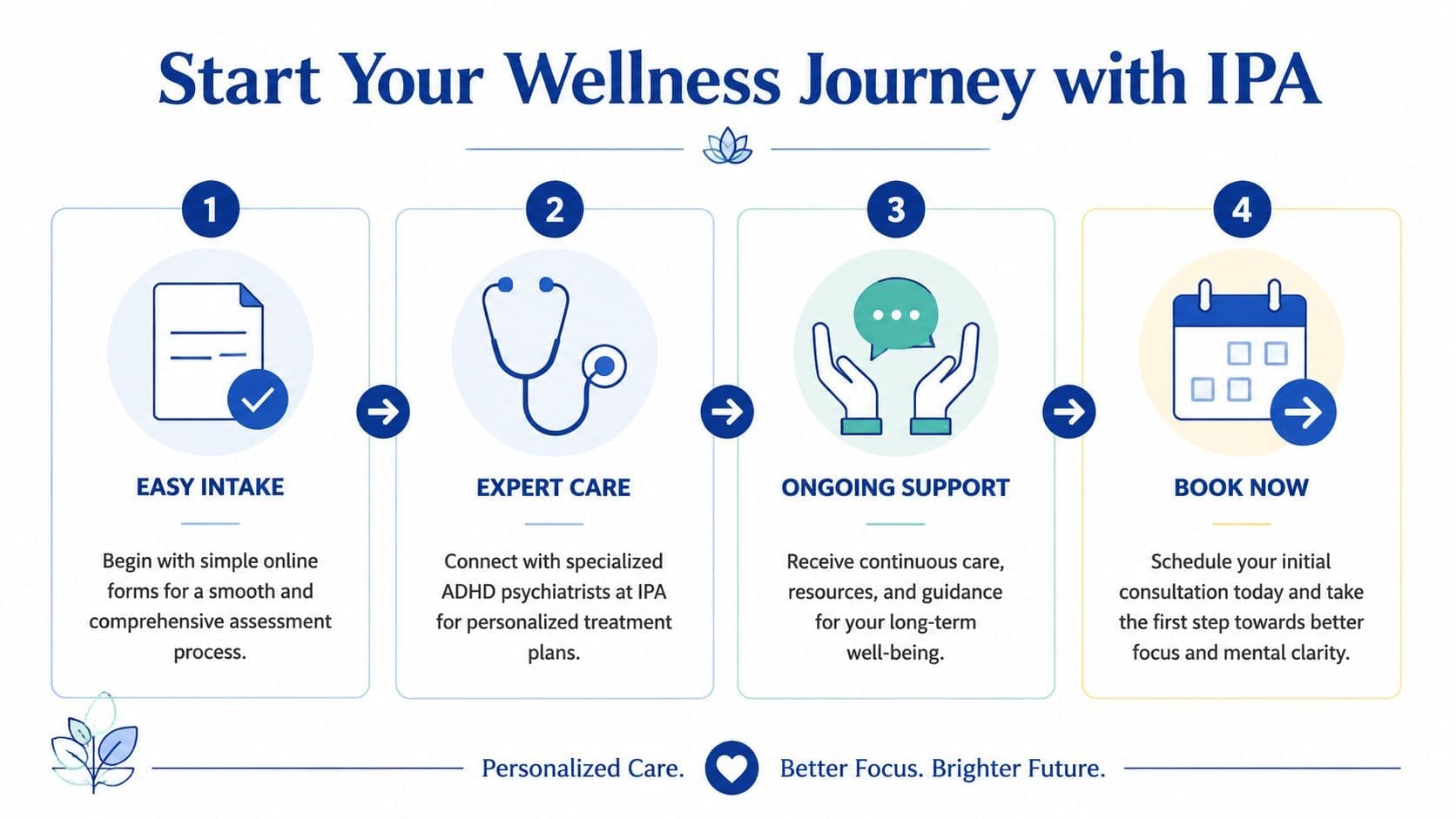
Adults looking for a telehealth option in the Philadelphia area can review integrative psychiatry services in Philadelphia. In practical terms, the onboarding process is usually straightforward: verify insurance, request or schedule an appointment online, complete intake forms, and use the patient portal for communication and follow-up logistics.
That process tends to work well for ADHD because reducing administrative friction matters. If the intake system is confusing, patients with executive dysfunction often delay care before treatment even begins.
A good intake approach should make it easy to:
- Check coverage before the visit.
- Complete forms online without unnecessary back-and-forth.
- Send messages securely about refills, scheduling, or questions.
- Plan follow-up so treatment continues after the initial evaluation.
Why backup plans matter in ADHD care
Adult ADHD remains substantially underdiagnosed, especially in women, and it commonly co-occurs with sleep problems, mood disorders, and substance use. Recent stimulant shortages have also made it important for clinicians to have backup plans that include non-stimulant and integrative options, as discussed by Dr. Dara Psychiatry's overview of adult ADHD care considerations.
That's one reason a modern ADHD search should focus on flexibility. If a medication is unavailable, the plan shouldn't collapse. If sleep is poor, that should be addressed. If attention problems sit next to anxiety, weight concerns, or recovery work, treatment should reflect the whole picture.
The best next step is usually not more self-diagnosis. It's a real evaluation with a clinician who can sort out what's ADHD, what isn't, and what to do next.
Integrative Psychiatry of America offers secure telepsychiatry across Pennsylvania for adults seeking ADHD assessment, medication management, and whole-person mental health care. Patients who want a practical next step can visit Integrative Psychiatry of America to review services, verify insurance, and request an appointment online.