
Work is piling up. Emails get opened and forgotten. A simple task at home turns into six half-finished tasks, and by the end of the day there’s a familiar question: is this stress, burnout, anxiety, or could it be ADHD?
That question drives a lot of searches for adderall prescription near me, especially from adults in Pennsylvania who’ve spent years compensating without realizing how much effort basic focus has required. For many people, the goal isn’t “getting a stimulant.” It’s getting a clear answer, a safe evaluation, and a treatment plan that fits real life.
Table of Contents
- Why Pennsylvanians Are Seeking ADHD Treatment Now
- Finding a Qualified Provider in Pennsylvania
- How Telehealth for Adderall Prescriptions Works in PA
- Your Comprehensive ADHD Assessment Process
- Navigating Insurance Costs and Refill Rules
- A Holistic Path to ADHD Management
Why Pennsylvanians Are Seeking ADHD Treatment Now
Adults across Pennsylvania are recognizing ADHD in a new way. It often shows up less like obvious hyperactivity and more like missed deadlines, chronic disorganization, mental fatigue, difficulty starting tasks, and a long history of being told they “have potential” but don’t seem to work consistently.
In Philadelphia and other busy parts of the state, that pattern can become hard to ignore. Work gets more demanding. Parenting adds more moving parts. Remote work removes structure. People who’ve pushed through for years start looking for answers that are more precise than “try harder.”

Why the search feels urgent
Adderall is the medication many adults know by name, and the demand behind that search is real. Amphetamine/dextroamphetamine formulations like Adderall accounted for 49% of all U.S. stimulant prescriptions in 2023, with particularly high demand among adults ages 31 to 40, according to the IQVIA stimulant trends report.
That matters because people searching for “adderall prescription near me” usually aren’t just asking where to get a prescription. They’re asking where to find a clinician who can separate ADHD from anxiety, depression, sleep disruption, trauma, or overwhelm. Those conditions can overlap, and the wrong shortcut can send treatment in the wrong direction.
A broader look at the growing prevalence of ADHD helps explain why more adults are finally seeking formal evaluation instead of continuing to self-manage.
Practical rule: If a person has struggled for years with attention, follow-through, restlessness, or task paralysis, the safest next step is a full psychiatric assessment, not a medication-only conversation.
Why specialized ADHD care matters
Primary care can be helpful, but adult ADHD often needs more nuance than a quick symptom checklist. A psychiatric nurse practitioner who works regularly with ADHD can look at executive function, past coping patterns, substance use risk, sleep, mood symptoms, and medical history in the same visit.
That matters because Adderall can be appropriate for some patients and a poor fit for others. A careful prescriber won’t treat the search term as the diagnosis. The goal is accurate diagnosis first, then a plan that may include medication, therapy strategies, behavioral supports, nutrition, exercise, and follow-up.
People usually feel relief when they hear that. It means the process is more structured than internet searches make it seem. It also means there’s a path forward even if Adderall isn’t the final answer.
Finding a Qualified Provider in Pennsylvania
The hardest part of the search often isn’t deciding to get help. It’s deciding who should evaluate ADHD when the treatment may involve a Schedule II medication.
A Pennsylvania resident can start with a primary care physician, but many adults do better with a provider who routinely treats ADHD. The difference shows up in the quality of the assessment and in what happens after diagnosis, especially when medication supply issues or side effects complicate the plan.
What to look for in a prescriber
A strong ADHD prescriber should do more than confirm that distraction exists. The provider should take a developmental history, review functioning at work and home, ask about anxiety and depression, examine sleep patterns, and explain how follow-up will work if a stimulant is started.
A few practical signs of a good fit:
- Adult ADHD experience: Ask whether the provider regularly evaluates adults, not just children.
- Clear controlled-substance policies: The office should explain visit requirements, refill timing, pharmacy procedures, and monitoring expectations.
- Structured follow-up: Good ADHD care includes reassessment, not a one-time prescription.
- Comfort with alternatives: A capable prescriber should be able to discuss non-stimulant options and behavioral supports if Adderall isn’t appropriate.
- Help during shortages: This has become a major issue in Pennsylvania and can change treatment plans quickly.
As of 2026, persistent Adderall shortages that began in late 2022 continue to affect patients in Pennsylvania, making it even more important to work with a provider who can help with pharmacy coordination or discuss alternatives when stock is inconsistent, as noted in the U.S. Senate discussion of drug supply challenges.
When patients compare practices, they often also look at reputation, responsiveness, and whether other patients describe the office as organized. That’s one reason resources on online reputation management for doctors can be useful. They show how practices are evaluated publicly, and what often signals reliability versus poor follow-through.
For adults who want a broader psychiatric lens, integrative psychiatry near me is often a better search than focusing only on the medication name.
Choosing Your ADHD Provider
| Factor | Primary Care Physician (PCP) | Psychiatric Nurse Practitioner (PMHNP) |
|---|---|---|
| Diagnostic depth | Often helpful for initial screening and referral | Usually better suited for a fuller psychiatric ADHD evaluation |
| Comfort with overlap conditions | May be limited by time in primary care visits | Typically evaluates ADHD alongside anxiety, depression, trauma, and sleep issues |
| Medication management | Some PCPs prescribe stimulants, some prefer referral | Often manages titration, follow-ups, side effects, and treatment adjustments directly |
| Controlled substance workflow | Varies widely by office | Usually has a more defined process for monthly prescribing and monitoring |
| Shortage navigation | May be difficult in busy general medical practices | More likely to discuss alternatives and coordinate treatment changes when supply shifts |
| Holistic planning | Usually narrower and symptom-focused | More likely to include behavioral, nutritional, and lifestyle supports |
A provider who promises speed is less helpful than one who explains the rules, the trade-offs, and the follow-up plan.
How Telehealth for Adderall Prescriptions Works in PA
For many Pennsylvania adults, “near me” no longer means driving across town. It means finding a licensed provider who can evaluate ADHD thoroughly, prescribe legally when appropriate, and manage the process through secure telehealth.
That model can work well, but it has to follow very specific rules.
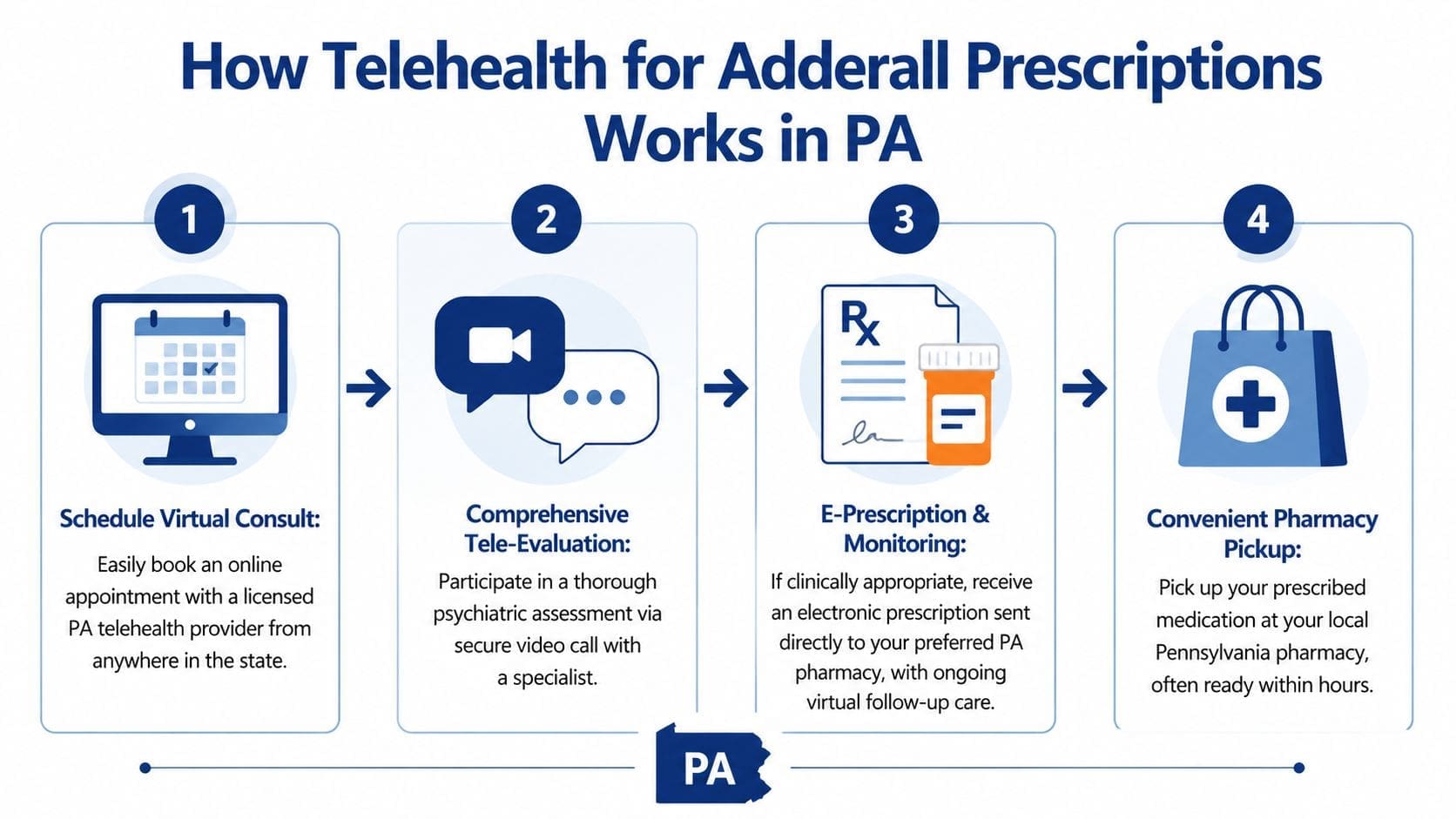
What the process looks like
As of 2026, federal rules permit prescribing Schedule II drugs like Adderall via telehealth after a live video evaluation. In Pennsylvania, that process must use a HIPAA-compliant platform, and Adderall cannot be refilled by phone, which means a new electronic prescription must be sent each month, as described in this telehealth prescribing overview for Adderall XR.
A typical flow looks like this:
- Book a video appointment with a Pennsylvania-licensed psychiatric provider.
- Complete intake forms that cover symptoms, history, medications, and medical concerns.
- Attend a live video evaluation where the clinician assesses whether ADHD is the right diagnosis.
- Receive a treatment plan that may or may not include Adderall.
- Use regular follow-up visits if medication is prescribed, since controlled substances require ongoing review.
Pennsylvania patients often prefer this format because it reduces travel, protects privacy, and expands access to specialists beyond their immediate ZIP code. For many working adults, telehealth also makes it easier to keep appointments consistently.
What makes a telehealth setup workable
Not every virtual practice handles controlled substance care well. The difference is usually operational. Patients need a secure portal, timely messaging, clear refill rules, and a practice that can respond when a pharmacy is out of stock or insurance adds friction.
The importance of back-end systems is often underestimated. Even general tools like healthcare scheduling software show how much reliable scheduling and staff coordination affect patient access. If an office can’t manage its appointments well, monthly ADHD medication management becomes frustrating fast.
Patients seeking online ADHD treatment in the state can review options for online psychiatry in Pennsylvania for ADHD care to understand what a compliant telehealth workflow should look like before booking.
Your Comprehensive ADHD Assessment Process
A proper ADHD evaluation should feel methodical, not rushed. By the end of the appointment, a patient should understand what the clinician is considering, what still needs clarification, and whether medication makes sense at all.
That process often lowers anxiety because it replaces guessing with structure.

What happens during the evaluation
A thorough adult ADHD assessment usually includes a detailed symptom history, a review of school and work patterns, current functioning, sleep, mood, anxiety, and medical history. The provider is also looking for conditions that can mimic ADHD, including chronic stress, depression, trauma-related symptoms, and poor sleep.
Many clinicians also use rating scales and collateral information when available. That doesn’t replace clinical judgment, but it helps organize the picture. If a patient wants a more formal testing pathway, psychological testing for ADHD can sometimes add clarity, especially when the history is mixed or the diagnosis is uncertain.
A key part of the visit is expectation setting. A responsible prescriber doesn’t guarantee Adderall at intake. The job is to determine whether ADHD is present and then recommend the safest treatment plan.
Some patients are relieved to hear that a prescription isn’t automatic. It means the evaluation is real.
How medication decisions are made
If Adderall is clinically appropriate, dosing shouldn’t begin aggressively. A proper titration methodology starts with a low dose and adjusts weekly over 4 to 6 weeks, achieving 70% to 80% symptom reduction in adults, while starting too high can increase side effects such as insomnia or hypertension by 2 to 3 times, according to this guidance on Adderall dosage and medication mistakes.
That matters because many medication problems don’t come from the medication itself. They come from rushed prescribing, poor follow-up, or a mismatch between the drug and the diagnosis.
Useful questions during this stage include:
- What symptoms are the target? Trouble starting tasks, distractibility, impulsive speech, forgetfulness, or all of the above.
- What side effects need close watching? Sleep changes, appetite changes, irritability, blood pressure concerns, or worsening anxiety.
- How will progress be measured? Not just “feels better,” but whether work, household tasks, and consistency improve.
- What’s the backup plan if it doesn’t work? A strong clinician discusses that early.
A brief visual overview can help clarify what thoughtful ADHD care should look like before treatment starts.
Navigating Insurance Costs and Refill Rules
A common Pennsylvania scenario looks like this. An adult finally completes an ADHD evaluation, treatment is discussed, and then the actual delays start. The insurer wants prior authorization, the pharmacy is out of stock, or the refill request comes in too close to the fill date for a Schedule II stimulant.
These issues are frustrating, but they are usually manageable with planning.
Where delays usually happen
Insurance coverage for ADHD treatment in Pennsylvania can be inconsistent from one plan to the next. Some plans cover telepsychiatry visits. Others place limits on out-of-network care, require prior authorization for stimulant medication, or prefer one formulation over another. I tell patients to verify benefits before the first prescribing visit if possible, because a ten-minute call to the insurer can prevent days of back-and-forth later.
Ask the health plan specific questions:
- Are telepsychiatry visits for ADHD covered under my plan?
- Does Adderall or its generic require prior authorization?
- Is there a deductible that applies before psychiatric visits or prescriptions are covered?
- Which local and mail-order pharmacies are in network?
- Are there quantity limits or step-therapy rules for stimulant prescriptions?
Cost questions also come up early, especially for adults who are paying out of pocket or have high-deductible plans. A clearer estimate of ADHD testing costs and related evaluation expenses can help patients decide how to proceed.
How to stay ahead of refill problems
Refills for Adderall follow stricter rules than many other psychiatric medications because it is a Schedule II controlled substance. In Pennsylvania, that means patients should expect closer timing rules, fewer shortcuts, and more pharmacy scrutiny, especially during periods of medication shortage. Telehealth can make follow-up more convenient, but it does not remove controlled-substance requirements.
A practical refill routine usually includes a few habits:
- Track the run-out date on the bottle or calendar
- Schedule follow-up visits on time, not after the medication is nearly gone
- Check pharmacy stock before the prescription is sent
- Keep one regular pharmacy and one realistic backup
- Watch the patient portal and reply quickly if the office needs confirmation
- Expect extra processing time if insurance approval is still pending
The shortage issue has made this harder across Pennsylvania. A pharmacy may have one strength available but not another, or may be able to fill only part of a prescription depending on current supply and store policy. That does not always mean the treatment plan is wrong. It often means the prescriber, patient, and pharmacy need tighter coordination.
Patients usually do better when they treat refill management as part of treatment, not as an afterthought.
Key takeaway: For Adderall in Pennsylvania, insurance rules, pharmacy stock, and refill timing all affect continuity of care. Good symptom control depends on good planning.
A Holistic Path to ADHD Management
Medication can help. It can also be over-relied on when the rest of the treatment plan is thin.
That matters because prescription stimulant misuse affects 4.8% of Americans annually, and a significant share comes from friends or family, according to this review of prescription drug misuse statistics. Safe treatment requires more than writing the prescription correctly. It requires building a plan that reduces the urge to depend on medication alone.
Why medication alone usually isn’t enough
A stronger ADHD plan combines symptom relief with skills and supports. That can include sleep work, exercise, nutrition, mindfulness, calendar systems, therapy, and review of medical contributors that worsen concentration.
Behavioral structure matters because stimulants don’t automatically create routines. They can improve attention, but patients still need systems for task initiation, planning, and follow-through. That’s one reason many adults do better when medication is paired with a broader approach such as nutrition in integrative psychiatry for ADHD, depression, and anxiety.
The most sustainable path usually looks like this:
- Medication when appropriate
- Behavioral strategies that reduce chaos
- Lifestyle changes that support focus
- Regular follow-up that catches problems early
People searching for adderall prescription near me often start with a narrow question. The better outcome usually comes from asking a broader one: what combination of diagnosis, medication, monitoring, and daily supports will improve life over time?
If ADHD symptoms are affecting work, relationships, or daily functioning in Pennsylvania, Integrative Psychiatry of America offers confidential telepsychiatry with psychiatric nurse practitioners who evaluate ADHD, prescribe medication when appropriate, and build treatment plans that include behavioral and lifestyle support alongside medication management.