
The day often starts before there's been a single quiet thought. An email needs a reply. A child needs a form signed. A meeting starts in an hour, but the coffee has gone cold because attention drifted into five unfinished tasks. From the outside, this can look like a capable woman managing a full life. Inside, it can feel like mental gridlock, shame, and exhaustion.
Many adult women reach a point where they stop asking, “Why can't this be easier?” and start asking a better question. Could this be ADHD rather than a character flaw, laziness, or “just stress”? That question matters, especially because women are often overlooked when they seek help for attention problems, executive dysfunction, emotional overload, or chronic disorganization. Some are told it's anxiety. Some assume it's burnout. Some have both, along with ADHD.
For women who relate to that pattern, add in women treatment isn't about becoming a different person. It's about understanding how the brain works, how hormones can shift symptoms, and how treatment can be adapted to real life. For readers sorting through overlap with anxiety, this guide on ADHD versus anxiety symptoms in adults can help clarify where those patterns start to separate.
Table of Contents
- Introduction Is It ADHD or Just Adulting
- Why ADHD in Women Is So Often Missed
- How Hormones Influence ADHD Symptoms
- A Complete Treatment Plan for Women with ADHD
- Integrative Strategies for Whole-Person Wellness
- Accessing ADHD Care Online in Pennsylvania
- Your Practical Action Plan for Seeking Help
Introduction Is It ADHD or Just Adulting
A woman can be high functioning and still be struggling. She may hit deadlines by staying up too late, remember appointments only because her phone carries the full weight of her executive function, and look “put together” while feeling chronically behind. That mismatch is common in adult ADHD.
Women are often socialized to compensate early. They become list-makers, over-preparers, perfectionists, or people-pleasers. Those strategies can hide symptoms for years, but they usually come at a cost. The cost is often anxiety, emotional exhaustion, inconsistent performance, and the private belief that everyone else has figured out how to do ordinary life better.
Clinical reality: ADHD in women often hides behind competence.
The question isn't whether life is hard. Adult life is hard. The question is whether the same patterns have been repeating for years in a way that suggests a treatable neurodevelopmental condition. That includes trouble starting tasks, finishing tasks, prioritizing, managing time, regulating emotion, keeping routines, and recovering when plans change.
A proper evaluation looks beyond surface productivity. It asks what things cost internally, how long they've been happening, and whether coping systems are holding life together by sheer force. For many women, the relief starts with being accurately seen.
Why ADHD in Women Is So Often Missed
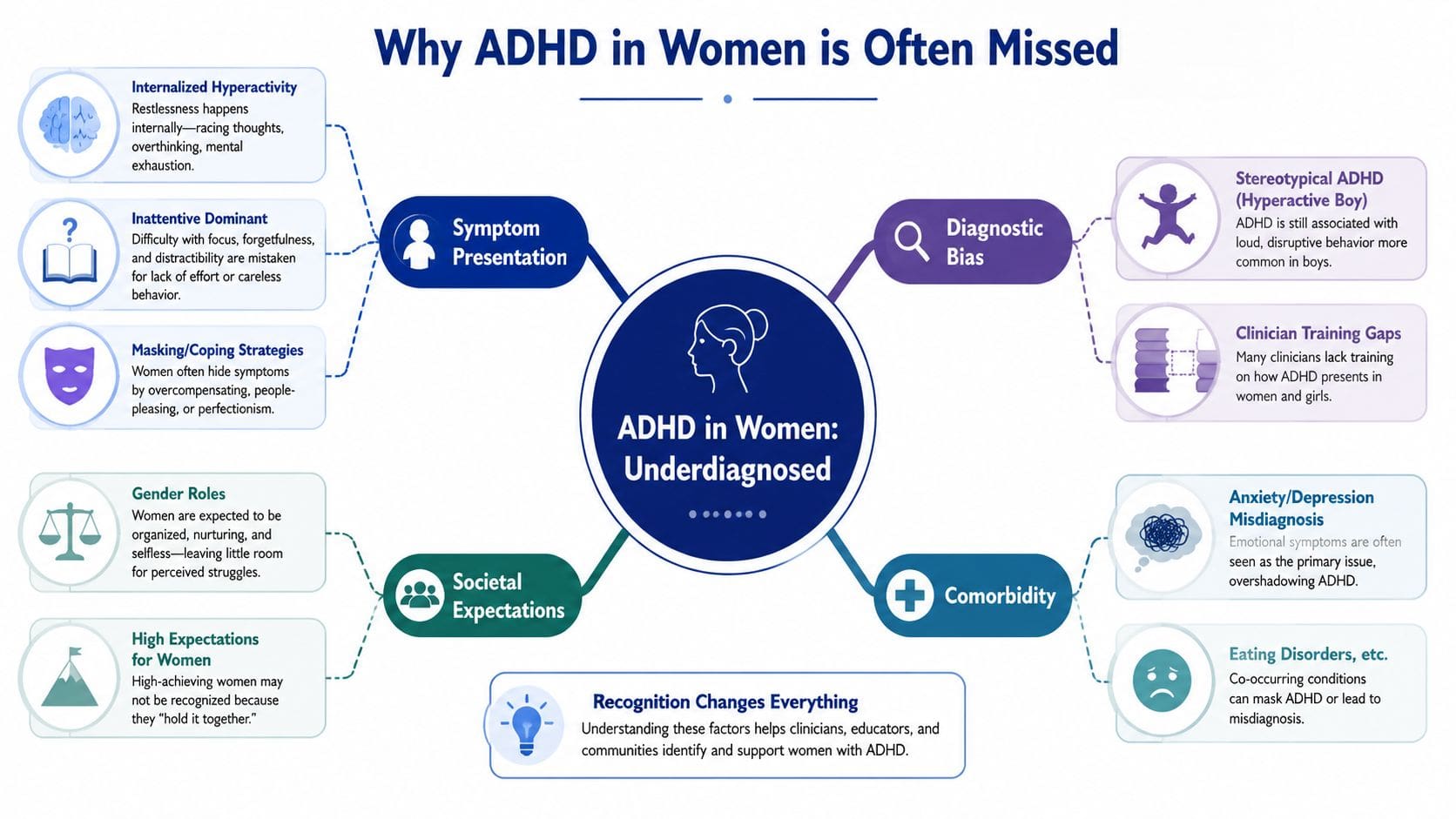
A woman may sit in my office describing years of anxiety treatment, chronic overwhelm, and the feeling that ordinary tasks take far more effort than they should. She may have good grades in her history, a demanding job, or a family depending on her. Because she has kept going, ADHD was never seriously considered.
That pattern is common. Women and girls are often missed in ADHD care, especially when symptoms are inattentive, internal, or hidden by strong coping skills, as described in ADDitude's overview of ADHD in women and hormonal stages. The result is often a long delay before someone gets an explanation that actually fits.
The stereotype still shapes who gets referred
The outdated picture of ADHD is still loud and disruptive. Many clinicians, teachers, and family members were trained to spot external hyperactivity first. Women often present differently, so the impairment gets misread as stress, disorganization, personality, or lack of follow-through.
In practice, I see several patterns repeatedly:
- Quiet inattention that looks like daydreaming, missed details, mental drifting, or trouble holding steps in mind
- Internal hyperactivity that feels like a racing mind, constant self-talk, or difficulty relaxing, even when the body appears calm
- Compensation that hides impairment through excessive planning, overpreparing, perfectionism, and dependence on reminders
- Emotional intensity that gets labeled as anxiety, depression, or “being too sensitive”
- Uneven performance with strong results in high-interest or urgent situations and much more difficulty with routine demands
This is one reason women are often diagnosed later. Their symptoms may be less visible to other people, but not less impairing.
Misdiagnosis is common, especially when anxiety is front and center
Many women seek help because they feel overwhelmed, ashamed, irritable, or emotionally flooded. Those symptoms are real, and anxiety or depression may also be present. But if ADHD is underneath the picture, treatment aimed only at mood can leave the core problem untouched.
A careful evaluation looks at function across settings and over time. It asks about task initiation, follow-through, time blindness, forgetfulness, emotional regulation, and the effort required to appear organized. It also helps to ask whether symptoms shift around the menstrual cycle or worsen in perimenopause, since those patterns can make ADHD look inconsistent rather than biologically influenced. I often encourage women to track these changes, and this guide to hormones, ADHD, yoga, and telepsychiatry in Pennsylvania gives useful context for that conversation.
What often gets missed in real life
Women commonly describe a history like this:
- They start tasks late, even ones they care about
- They switch between tabs, chores, or priorities without meaning to
- They forget routine responsibilities but can perform well under pressure
- They feel disproportionate shame after small mistakes
- They burn out from working so hard to look functional
Research reviewed by the CDC's ADHD in women resource page also notes that girls and women may show less overt hyperactivity and more patterns that are easier to overlook. That matters clinically. If the presentation is quieter, the assessment has to be more thoughtful.
The absence of visible hyperactivity does not rule out ADHD. In women, ADHD often hides inside overfunctioning, anxiety, and exhaustion.
How Hormones Influence ADHD Symptoms
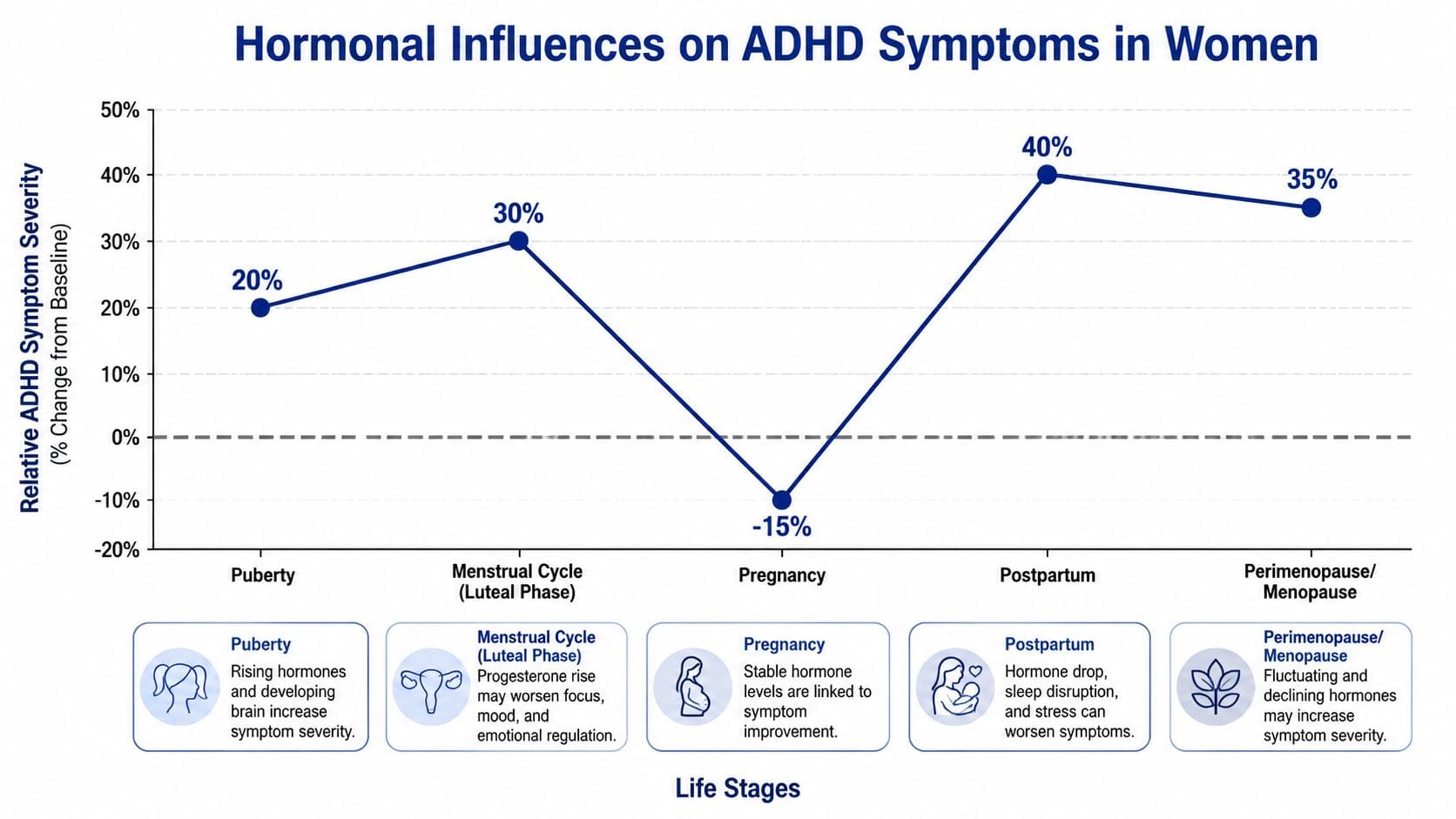
Hormones matter in ADHD care for women. They don't create ADHD, but they can change how strongly symptoms show up and how effective treatment feels from one phase of life to another. This is one of the most clinically important and most overlooked parts of ADD in women treatment.
Why symptom patterns can feel cyclical
Many women notice that their focus, motivation, or emotional regulation isn't equally difficult every day. That pattern is often dismissed as inconsistency or poor self-discipline. In reality, symptom intensity may shift with hormonal changes across the menstrual cycle, pregnancy, postpartum, and perimenopause.
A major underserved area in care is how ADHD treatment changes across these hormonal stages, especially the menstrual cycle, pregnancy, postpartum, and perimenopause. Existing coverage often notes that symptoms can worsen in the second half of the menstrual cycle and that hormone replacement therapy may improve symptoms in postmenopausal women, but it rarely answers the practical question women ask most: how should medication timing or dose be adjusted across life stages? That treatment gap is described in this ADHD and women's hormones resource.
This short video gives a helpful overview before a patient brings observations into an appointment.
What to track before changing treatment
Symptom tracking is often more useful than guessing. Before assuming a medication has stopped working, it helps to look for patterns.
A practical tracking list may include:
- Cycle phase and whether symptoms worsen in the second half of the cycle
- Sleep quality because poor sleep can mimic a medication problem
- Appetite and hydration especially if stimulant side effects are possible
- Emotional shifts such as irritability, tearfulness, or lower frustration tolerance
- Life stage changes including pregnancy, postpartum recovery, or perimenopause
Practical rule: If focus seems to disappear only at certain times of the month, that's a treatment clue, not a personal failure.
Women in perimenopause often describe a sudden loss of systems that used to work. Calendars stop being enough. Mental flexibility drops. Word-finding becomes harder. The right next step isn't always “increase medication.” Sometimes it's reassessing hormones, sleep, stress load, and whether the treatment plan still fits the current stage of life.
A Complete Treatment Plan for Women with ADHD
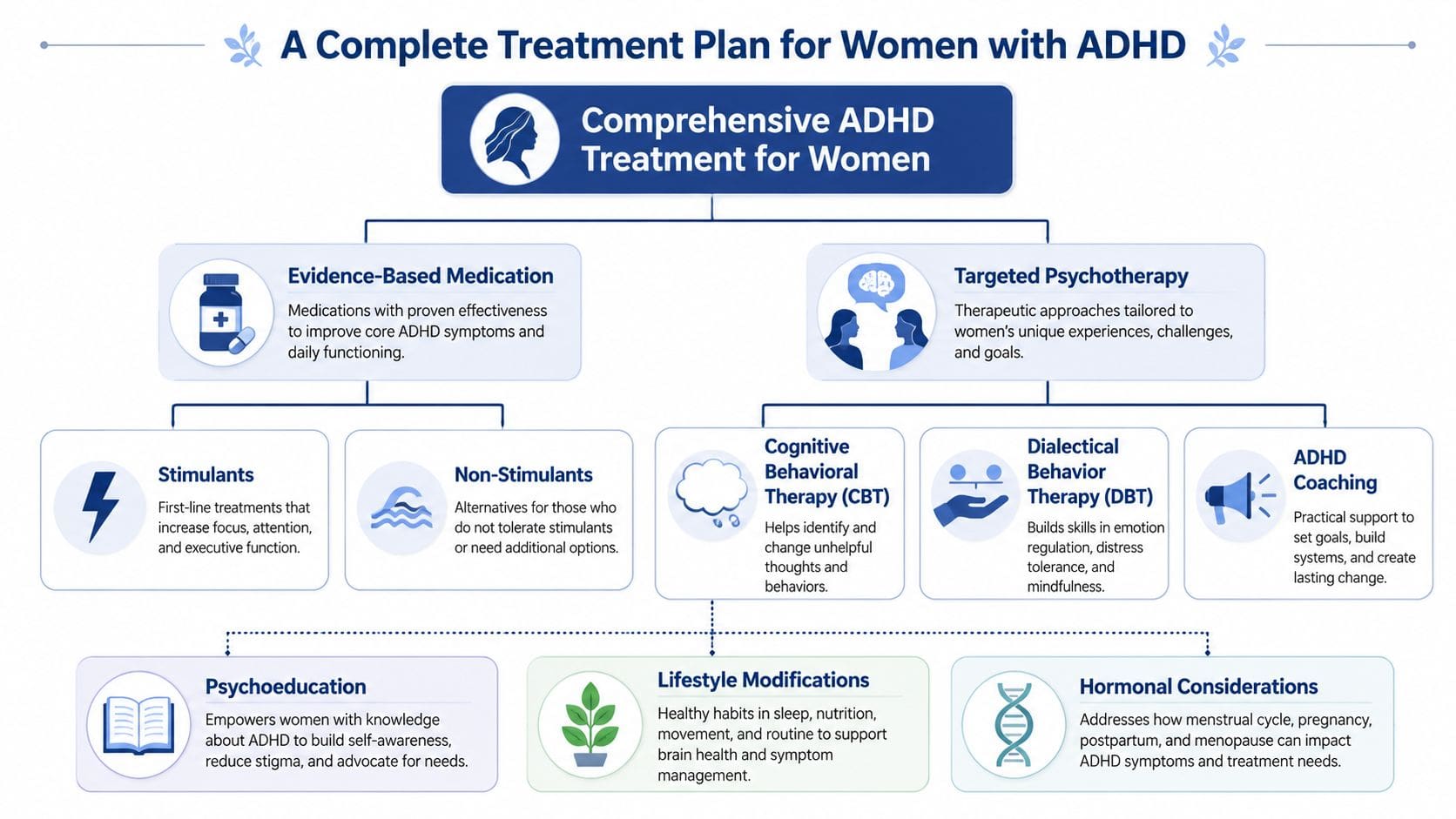
A woman may tell me, “My medication helped for months, and now I'm back to feeling scattered, behind, and ashamed.” That does not automatically mean treatment failed. It often means the plan needs to fit her actual life more closely, including work demands, parenting load, sleep, anxiety, and hormonal shifts that can change how ADHD shows up across the month or during perimenopause.
The strongest treatment plans for adult women usually use more than one tool. Medication can lower the effort it takes to focus and initiate. Therapy and skills work help turn that symptom relief into routines, boundaries, and systems that hold up in real life.
Medication is one part of treatment
Medication can improve attention, working memory, task initiation, and mental stamina. It can also bring trade-offs. Some women feel calmer and clearer. Others notice appetite loss, sleep disruption, irritability, or a sharp drop-off when the dose wears off. Good prescribing is not just picking a medication. It is adjusting the plan until benefits outweigh the downsides.
A prescriber usually works through questions like these:
| Treatment question | Why it matters |
|---|---|
| Does the patient need all-day coverage or targeted coverage? | Work schedules, caregiving, and evening responsibilities are different from one woman to the next. |
| Are anxiety, depression, trauma, or sleep problems also present? | Coexisting conditions can change medication choice, dose timing, and what needs treatment first. |
| Do symptoms shift with the menstrual cycle or perimenopause? | If focus worsens at certain times of the month, the plan may need adjustment rather than a higher standing dose. |
| Are side effects tolerable? | Better focus is not enough if the medication causes insomnia, appetite suppression, or more irritability. |
For patients who want a plain-language overview before discussing options with a prescriber, FindMyScript's ADHD medication guide is a practical reference.
Therapy and skills work change daily life
Women with ADHD often carry years of being labeled careless, dramatic, lazy, or inconsistent. Treatment works better when it addresses that history directly. Therapy for ADHD should teach usable skills and help reduce shame, because shame subtly interferes with follow-through.
Useful targets often include:
- Task initiation with lower-friction start routines and simpler first steps
- Time management using visible calendars, timers, and realistic planning instead of wishful planning
- Emotional regulation for rejection sensitivity, frustration, and overwhelm
- Cognitive restructuring so executive dysfunction is recognized for what it is, instead of being misread as a character flaw
- Home and work accommodations that reduce overload and support memory, transitions, and focus
In clinical practice, the plan works best when someone is looking at the whole picture. A psychiatric nurse practitioner may prescribe and adjust medication, monitor side effects, screen for anxiety or depression, and notice when symptom changes line up with cycle patterns or perimenopause rather than simple “nonresponse.” For adults exploring structured online ADHD treatment options for adults, that kind of coordinated care is often more realistic and sustainable than relying on medication alone.
A good treatment plan should make daily life easier to manage, steadier, and less punishing.
Integrative Strategies for Whole-Person Wellness
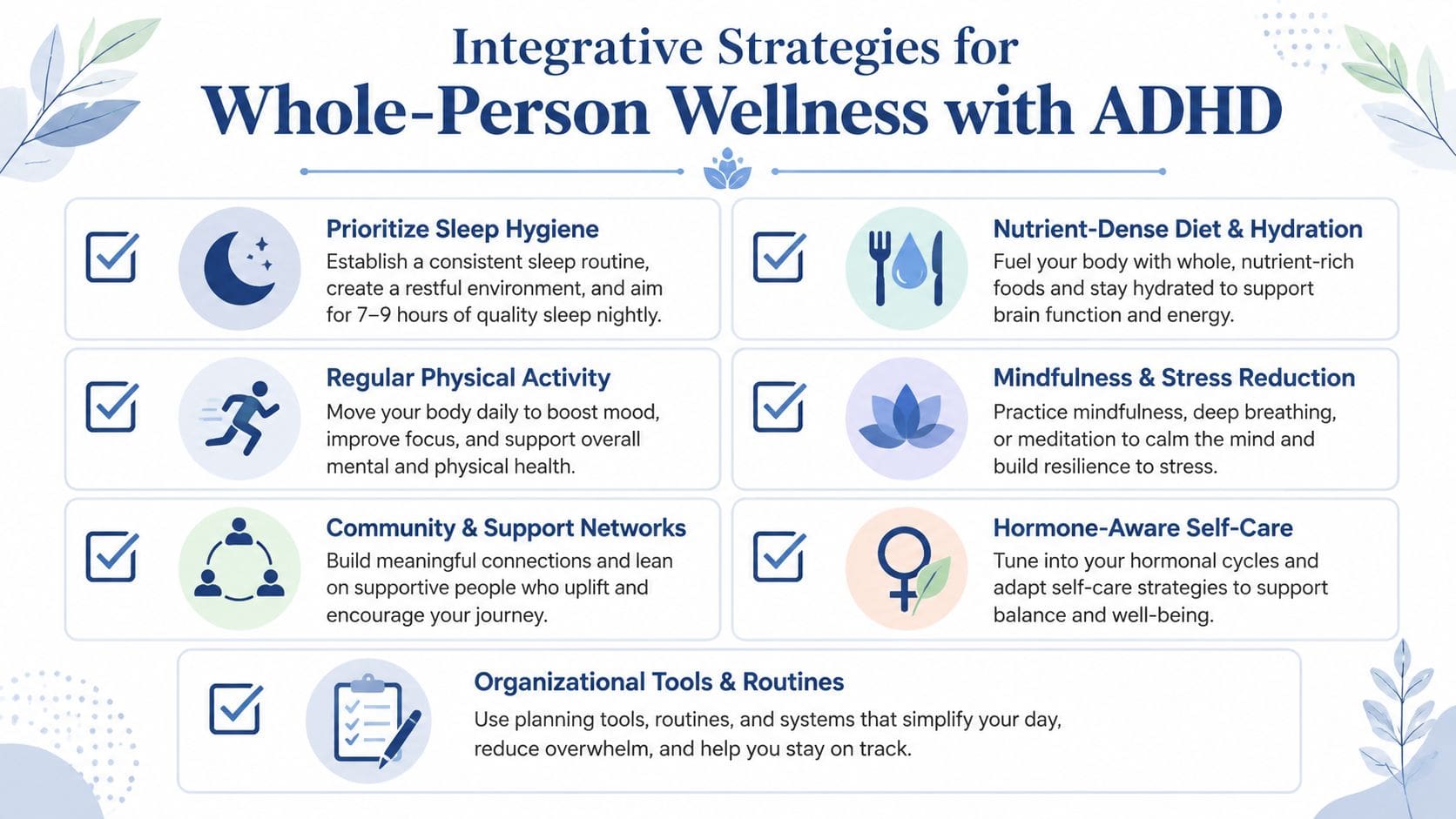
A woman may tell me her medication helps for two weeks, then suddenly feels weaker before her period, or that her routines fall apart during perimenopause even though nothing else has changed. That pattern matters. Whole-person ADHD care includes the body, the cycle, sleep, nutrition, stress load, and the practical systems that make daily life more manageable.
Medication and therapy are often the core of treatment. Daily supports can make those treatments work more consistently. They are not replacements for clinical care. They help reduce the background strain that can worsen inattention, irritability, and overwhelm.
What supports treatment in real life
The goal is not perfection. The goal is to make symptoms less reactive to preventable stressors.
Sleep is often the first place to start. Many women with ADHD run on delayed bedtimes, revenge scrolling, or second-wind energy late at night, then wonder why focus is worse the next morning. A consistent sleep window, less screen exposure before bed, and a short repeatable wind-down routine can improve attention and mood.
Food matters too. Skipped meals can look like worsening ADHD but may be low energy, shakiness, irritability, or a harder medication day. Protein at breakfast, regular meals, and hydration are simple supports that often make the day steadier.
Movement helps many patients regulate restlessness and stress. It does not need to be intense. A walk, short strength session, stretching between tasks, or any routine that happens often enough to stick is usually more useful than an ambitious plan that disappears after a week.
Mindfulness can help, especially for women who feel reactions build fast. The benefit is not “clearing the mind.” The benefit is catching the moment before an impulsive yes, an angry text, or a shutdown spiral.
Low-friction systems usually work best
The strategies that last are usually visible, simple, and easy to repeat, especially during hormonal shifts when executive function gets less reliable.
Useful examples include:
- A paper planner left open in the same spot every day
- A digital calendar with alerts for prep time and transition time
- Medications paired with an existing routine, such as coffee or brushing teeth
- A short weekly reset for meals, laundry, and schedule review
- Body-doubling for paperwork, email, or other tasks with a high start-up barrier
- Symptom tracking that includes menstrual cycle timing or perimenopausal changes
That last point is easy to miss. If symptoms spike predictably at certain points in the cycle, or become more erratic in perimenopause, the answer is not always “try harder.” It may mean the treatment plan needs adjustment, the routine needs more support on vulnerable days, or both.
Some patients also want care that addresses mood, stress, sleep, and lifestyle alongside medication management. For readers interested in that broader approach, this page on treatment for depression and whole-person psychiatric care reflects the same principle.
Supportive routines do not need to look impressive. They need to work on hard days.
Accessing ADHD Care Online in Pennsylvania
Getting evaluated for ADHD shouldn't require extra executive function that a patient may not have. Telepsychiatry can lower that barrier. For adults in Pennsylvania, online care often makes it easier to seek assessment and follow-up without losing hours to travel, parking, or waiting rooms.
What the process usually looks like
A typical path is straightforward:
- Schedule an appointment online. The first step is choosing a time for a secure video visit through a platform designed for healthcare.
- Complete intake paperwork. This usually includes symptom history, medical background, current medications, and consent forms.
- Attend a thorough evaluation. The clinician reviews current symptoms, childhood patterns, functional impact, and possible overlap with anxiety, depression, trauma, sleep problems, or hormonal factors.
- Discuss a treatment plan. That may include diagnostic clarification, medication options, therapy recommendations, skills support, and follow-up timing.
- Use follow-up visits for adjustment. ADHD treatment often improves through measured changes, not one appointment.
For adults seeking online ADHD medication management in Pennsylvania, telehealth can support evaluation, ongoing monitoring, and practical treatment adjustments.
Why telepsychiatry works well for many adults
Online care fits the lived reality of ADHD. Many women are balancing work, caregiving, commuting, and fluctuating energy. A virtual appointment from home or a private office can be more realistic than carving out half a day for an in-person visit.
It also helps with consistency. Follow-up matters in ADHD treatment because plans often need refinement. A patient may need to report that focus improved but sleep worsened, that symptoms spike premenstrually, or that a medication helps at work but drops off during family responsibilities in the evening. Those details are easier to address when access is simpler.
Integrative Psychiatry of America provides telepsychiatry across Pennsylvania, including Philadelphia, with psychiatric nurse practitioners who evaluate and treat ADHD as part of broader adult mental health care.
Your Practical Action Plan for Seeking Help
If ADHD has been hiding behind overwhelm, anxiety, perfectionism, or burnout, it's worth taking that possibility seriously. Women are often taught to interpret persistent struggle as a motivation problem. It often isn't.
A practical next step looks like this:
- Write down current symptoms that interfere with work, parenting, relationships, finances, or routines.
- Note patterns over time including childhood signs, school history, and whether symptoms change with the menstrual cycle or perimenopause.
- List prior diagnoses and treatments especially if anxiety or depression treatment only partly helped.
- Book a formal evaluation with a clinician who understands adult ADHD in women.
- Expect a plan, not a label. A good assessment should lead to options.
There's nothing weak about seeking clarity. It's a form of self-advocacy. The right diagnosis can change the story from “not trying hard enough” to “finally treating the actual problem.”
Women with ADHD often spend years compensating before they get help. Treatment can reduce that burden. It can make daily life less chaotic, relationships less strained, and self-talk less punishing. That's the true goal of add in women treatment.
If persistent overwhelm, disorganization, emotional reactivity, or hormone-linked shifts in focus sound familiar, Integrative Psychiatry of America offers online psychiatric care for adults in Pennsylvania. A thoughtful ADHD evaluation can help determine whether these symptoms reflect ADHD, anxiety, or a combination of both, and what treatment approach fits real life.