
A Harrisburg parent opens a work document, understands the assignment, and still can't begin. An unpaid bill sits beside the laptop. By school pickup, the deadline has slipped again, even though the day felt busy from start to finish.
That gap between knowing and doing deserves more than another productivity app. Executive dysfunction treatment for adults starts by identifying the skill that's failing, checking what's causing the difficulty, and building care that remains usable on a disorganized week.
Table of Contents
- Match the Broken Skill to a Treatment
- Causes and a Proper Adult Evaluation
- Medication and Skills Therapy Side by Side
- Sleep Food Movement and Mindfulness Supports
- A Week Built for Missed Steps
- When the First Plan Is Only Partial
- Start Care When Daily Function Stays Down
Match the Broken Skill to a Treatment
The starting point is the impairment causing daily disability, not a general wish to focus better. Planning, working memory, time estimation, initiation, emotional control, and follow-through require different supports. A missed deadline alone doesn't reveal which support belongs in the treatment plan.
Which executive problem gets which treatment
| Impairment | First target | Typical intervention | Track this |
|---|---|---|---|
| Planning and prioritization | Break work into a written sequence | CBT task decomposition and a one-page plan | Deadlines met this week |
| Time estimation | External time cues | Timers, buffers, and implementation intentions | Arrivals or logins on time |
| Working memory | Move steps out of memory | Checklists, visible cues, and repeating the next step aloud | Steps skipped on routine tasks |
| Task initiation | Lower the start barrier | Behavioral activation or a short body-double session | Tasks started within a chosen window, such as 10 minutes after the cue |
| Emotional impulsivity | Regulate before organizing | DBT emotion skills, mindfulness, or CBT response delay | Tasks abandoned after frustration |
| Follow-through | Support the last steps | Calendar prompts, accountability, and a weekly review | Bills, chores, or work items finished |
The table offers starting targets, not a diagnosis or a prescription. Executive dysfunction isn't laziness. Someone may care a lot about a task while struggling to sequence its steps or tolerate the frustration involved.
For the Harrisburg parent, the useful question is what happened immediately before work stopped. Was the assignment too large to organize? Did a message interrupt the next step? Did fear of submitting imperfect work lead to avoidance?
Name the failure point precisely
A planning problem calls for a visible sequence: open the file, gather the needed figures, draft the summary, then check the submission requirements. An initiation problem may need a smaller opening action, such as typing a rough heading. Adding more detail to the plan won't necessarily help someone whose main barrier is starting.
An implementation intention connects an action to a cue. For example, after the morning meeting ends, the employee opens the draft before checking messages. A body double is another person working nearby or online, providing a practical starting cue rather than delivering psychotherapy.
The distinction matters because improvement on a thinking exercise doesn't automatically improve home life. A systematic review of adult interventions found occupation-focused skills training produced the most consistent gains among reviewed adult ADHD interventions, while evidence that cognitive training or executive coaching reliably improved daily functioning remained limited. The review also supports considering emotion-regulation approaches alongside executive-skills work.
Choose an outcome that matters
A useful metric describes something observable. For example, submitting the report matters more than feeling somewhat more organized. Completing a bill payment matters more than downloading a budgeting tool.
Practical rule: One impairment and one real-world metric usually make a clearer starting point than a complete personal overhaul.
A reader can circle the relevant table row and choose its matching measure before adding another strategy. The clinician can then help determine whether the selected problem reflects ADHD, another condition, environmental demands, or a combination.
Causes and a Proper Adult Evaluation
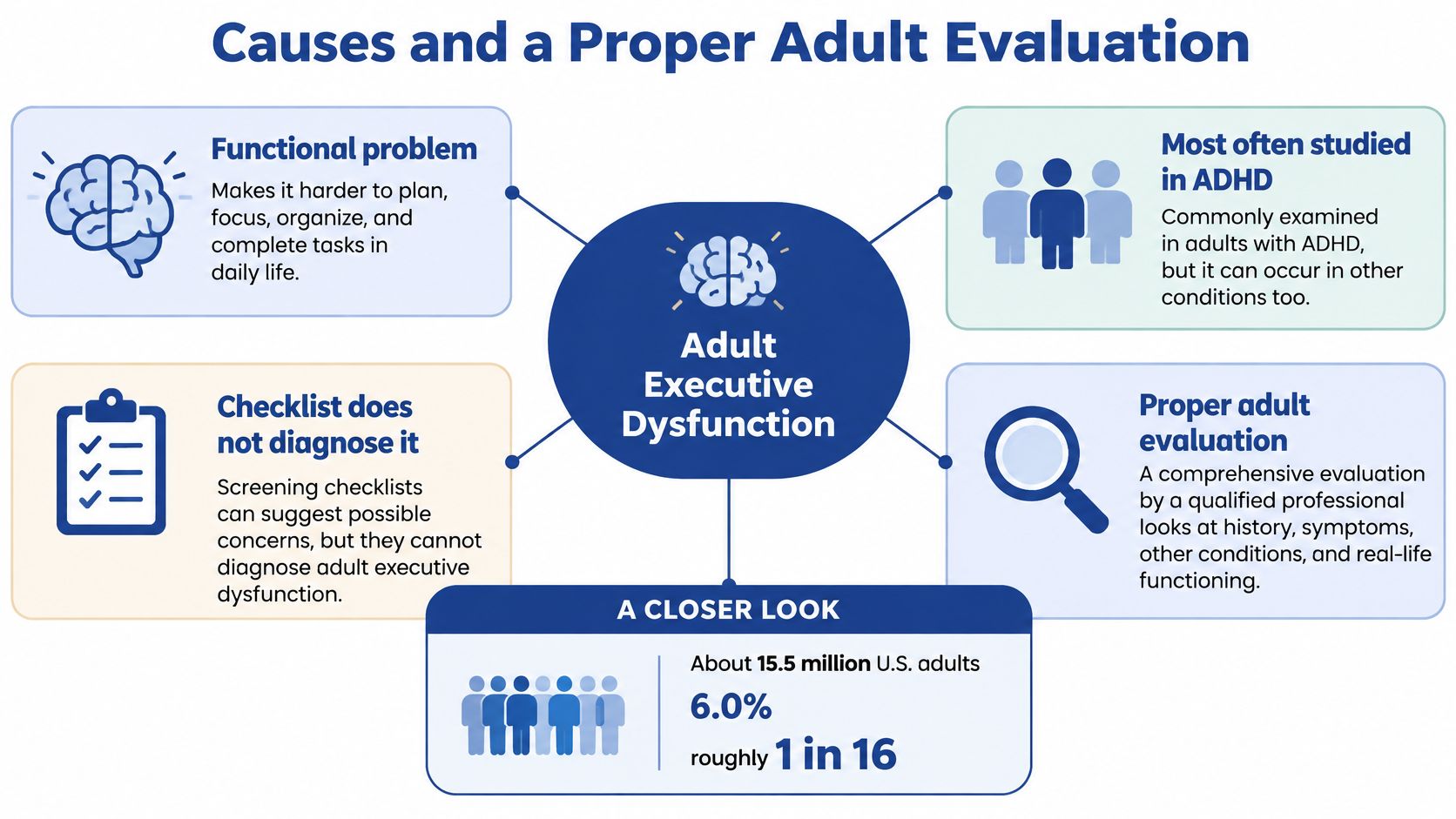
Adult executive dysfunction describes a functional problem, not a diagnosis established by a checklist. ADHD is a major context for studying it, but difficulty organizing or starting tasks doesn't establish ADHD.
The CDC's report on adult ADHD estimated that 15.5 million U.S. adults, 6.0% or approximately 1 in 16, reported a current ADHD diagnosis in 2023. Among adults with current ADHD, 55.9% received their diagnosis at age 18 or older, and 36.5% were receiving no treatment during the survey period.
The relationship between symptoms and evaluation is summarized below.
What a clinician needs to distinguish
Adult demands can expose difficulties that earlier routines concealed. College removes some external structure. Parenting adds competing schedules, while work may require independent planning without frequent reminders.
An evaluation should examine several possible contributors:
- ADHD: A longstanding pattern affecting attention, inhibition, organization, or activity level.
- Depression and anxiety: Low energy, rumination, worry, or avoidance that interrupts action.
- Trauma and sleep problems: Shutdown, heightened alertness, insomnia, or disrupted sleep.
- Other contributors: Substance use, learning disabilities, medication effects, and medical illness.
A detailed history establishes when problems began, where they occur, and what consequences follow. Examples from work and home help separate an occasional bad day from persistent impairment.
According to the CDC's adult ADHD guidance, evaluation considers childhood symptoms, including their presence before age 12, current functioning, and other explanations. Clinicians may use tools such as the Adult ADHD Self-Report Scale or Conners scales to organize information, but scores don't replace clinical judgment.
Screening sounds the alarm
A checklist is like a smoke alarm. It identifies a reason to investigate; the evaluation determines which room is burning.
Childhood records and observations from someone familiar with the adult can clarify the history. Neuropsychological testing may help when records are missing, another condition complicates interpretation, or the clinician needs to assess the validity of reported difficulties. It isn't automatically necessary for every adult.
Pennsylvania adults can use IPA's adult ADHD screening and testing information to understand the next step, including the Adult ADHD Symptom Checker. Screening never equals a diagnosis or a prescription. A clinician visit connects symptoms to their likely causes and an appropriate care plan.
Medication and Skills Therapy Side by Side
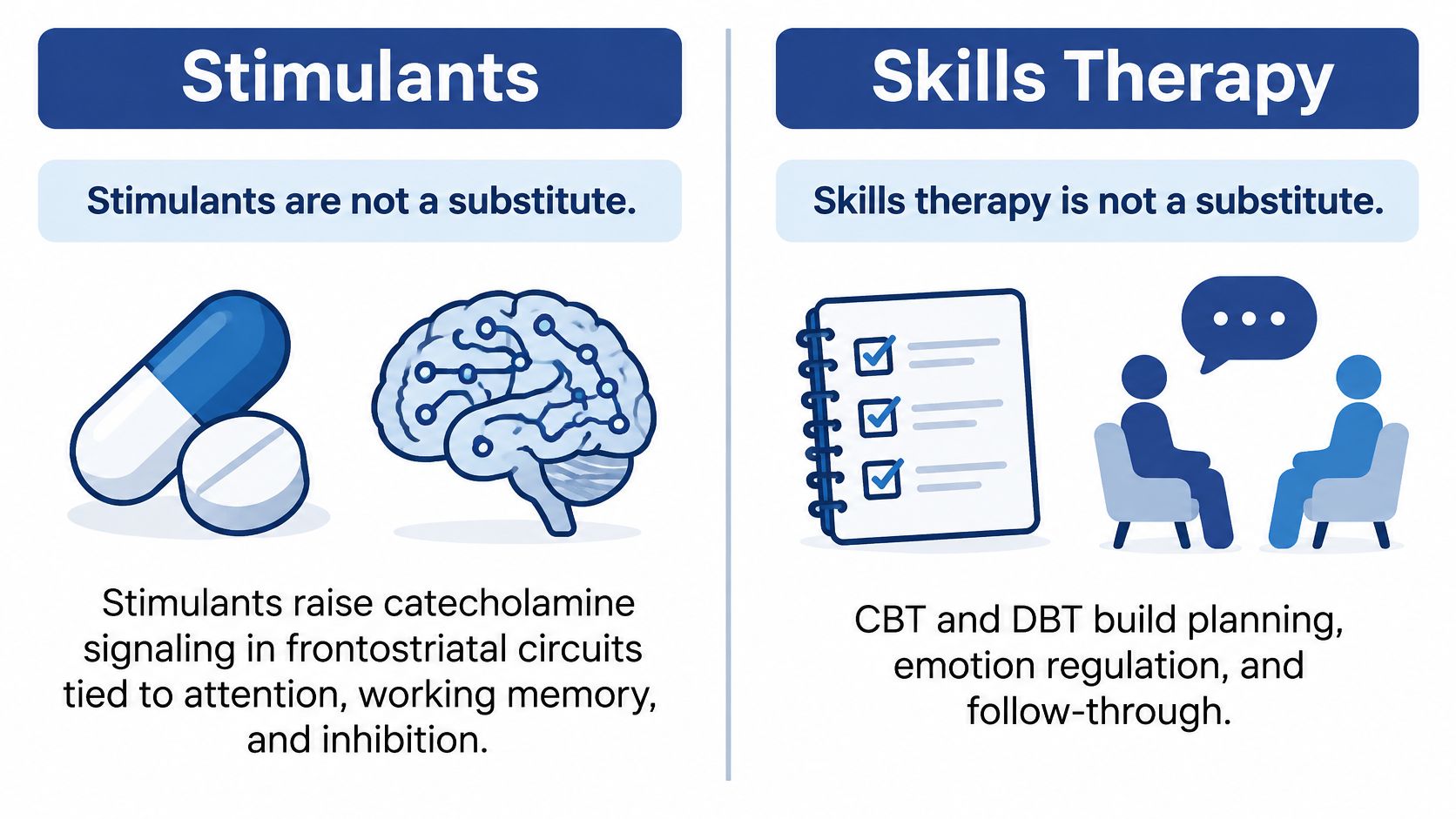
Medication and skills therapy address different treatment targets; neither automatically replaces the other. Stimulants increase catecholamine signaling in frontostriatal brain circuits involved in attention, working memory, and inhibition. CBT teaches compensatory strategies such as task breakdown, external reminders, time estimation, and pausing before responding, as described in the American Academy of Family Physicians' adult ADHD review.
Adult treatment options and their limits
| Option | When it is considered | Main change | Limit |
|---|---|---|---|
| Methylphenidate or amphetamine stimulants, including lisdexamfetamine | ADHD impairment remains after environmental changes | Attention, working memory, and inhibition | Full relief from medication alone isn't assured |
| Atomoxetine, viloxazine, or bupropion | Stimulants fail, aren't tolerated, or are unsuitable | Core ADHD symptoms, sometimes with a slower onset | Doesn't replace skills for residual disorganization |
| CBT focused on ADHD | Planning or procrastination remains, or medication isn't used | Task breakdown, reminders, and time estimates | Requires practice; benefit isn't uniform |
| DBT-based skills group | Emotional impulsivity and task-start problems remain impairing | Emotion regulation, distress tolerance, and problem-solving | Structured treatment, not a single workshop |
| Coaching or cognitive training alone | Often offered as a focus solution | Some task, test, or goal measures | Daily-life benefit remains uncertain |
Medication selection needs an individualized review
NICE ADHD guidance recommends lisdexamfetamine or methylphenidate as first-line medication options for adults whose significant impairment persists after environmental modifications. Its switching pathways generally involve an adequate trial of about six weeks, with the next choice based on response and tolerability. Atomoxetine and dexamfetamine have distinct roles, rather than serving as interchangeable next steps.
Other options include viloxazine or bupropion when stimulants aren't suitable. Clinicians consider co-occurring anxiety or depression, contraindications, side effects, and treatment goals. Bupropion's use for ADHD is off-label.
An AAFP medication-management handout reports that only about 50% of patients achieve full symptom improvement with monotherapy. That isn't a forecast for an individual patient, but it supports checking what remains impaired rather than assuming medication should solve everything.
The visual comparison highlights the different treatment roles.
Combined treatment isn't mandatory for every adult. Selection depends on diagnosis, preference, tolerability, access, and remaining impairment.
Structured therapy changes the response to a stuck moment
For adults who decline medication, can't take it, or gain insufficient benefit, structured ADHD-focused psychological support with follow-up offers more than a one-time advice visit. CBT is also worth considering when attention improves but procrastination persists.
In a randomized trial of DBT-based group treatment, adults completing 14 weeks improved 12.8 points on the BRIEF-A executive-function measure versus 0.37 points with usual care, an effect size of 0.64, with benefits maintained at six-month follow-up. These results support structured skills treatment without guaranteeing the same response for everyone.
IPA's explanation of how a psychologist can help with adult ADHD clarifies the psychotherapy role. Follow-up should examine missed deadlines, driving safety, medication adherence, household organization, and work output, not symptom scores alone.
Sleep Food Movement and Mindfulness Supports
Sleep, meals, movement, and mindfulness can support participation in treatment, but they don't diagnose ADHD or replace indicated care. A battery analogy helps: everyday habits provide charge, while medication and therapy address the treatment targets. Neither a charged battery nor repaired wiring solves every problem alone.
Everyday supports should remain manageable rather than becoming another unfinished project.

Protect sleep before demanding more focus
A timed wind-down and consistent wake time provide a practical starting structure. Snoring, persistent insomnia, or marked daytime sleepiness warrant clinical attention rather than another reminder system.
For example, a Pittsburgh night-shift worker might protect a fixed daytime sleep block before adding a morning-style productivity routine. A plan that ignores the worker's actual sleep schedule won't be usable.
The commercial HempWell USA guide to sleep support may prompt questions for a clinical visit, but it isn't independent evidence that CBD treats insomnia or executive dysfunction. Supplements shouldn't substitute for evaluating sleep problems, and potential interactions belong in the medication review.
Keep each support small enough to repeat
- Meals: Regular, protein-containing meals create a predictable eating routine. Afternoon fatigue shouldn't automatically become a judgment about willpower, and no miracle ADHD diet belongs in the plan.
- Movement: A brief walk placed on the calendar may be more usable than an elaborate gym program. IPA's discussion of exercise and ADHD benefits offers additional context.
- Mindfulness: A brief scheduled pause can involve noticing frustration, relaxing the shoulders, and choosing the next action. It doesn't require prolonged silent sitting.
A video can serve as an optional discussion aid alongside these practical habits.
Mindfulness and acceptance strategies can target emotional reactions even when core symptoms change modestly. A clinical review of multimodal adult ADHD care places self-management and emotional-regulation support alongside medication and skills-based treatment.
At follow-up, the relevant question is whether these habits support daily function. Persistent or concerning symptoms still need clinical evaluation.
A Week Built for Missed Steps
Care works better when it anticipates missed steps instead of assuming perfect patient reliability. Appointment reminders, written instructions, and accessible refill processes belong in the plan when remembering and sequencing are part of the impairment.
A Healthwatch public survey described a double barrier: service delays, communication problems, and inconsistent care compounded ADHD-related difficulties with organization and self-expression. That finding concerns healthcare access, not personal motivation.
The following hypothetical week shows how an adult might practice supports without building an elaborate new system.
A workable week rather than a perfect week
Monday begins with a short planning appointment. In this example, the adult reserves 10 minutes, chooses three tasks, and writes the first two-minute action for the most important task. Preparing the report becomes opening the document and inserting its headings.
On Tuesday, a phone timer signals the transition from email to project work. Keys sit on top of the work bag, providing a visible departure cue. The adult doesn't have to remember a reminder hidden inside another app.
Wednesday includes a one-hour coworking session. A colleague works on a separate task while the adult begins an avoided form. The arrangement supplies company and accountability, not therapy or a claim of proven benefit.
The weekly structure can remain visible between appointments.
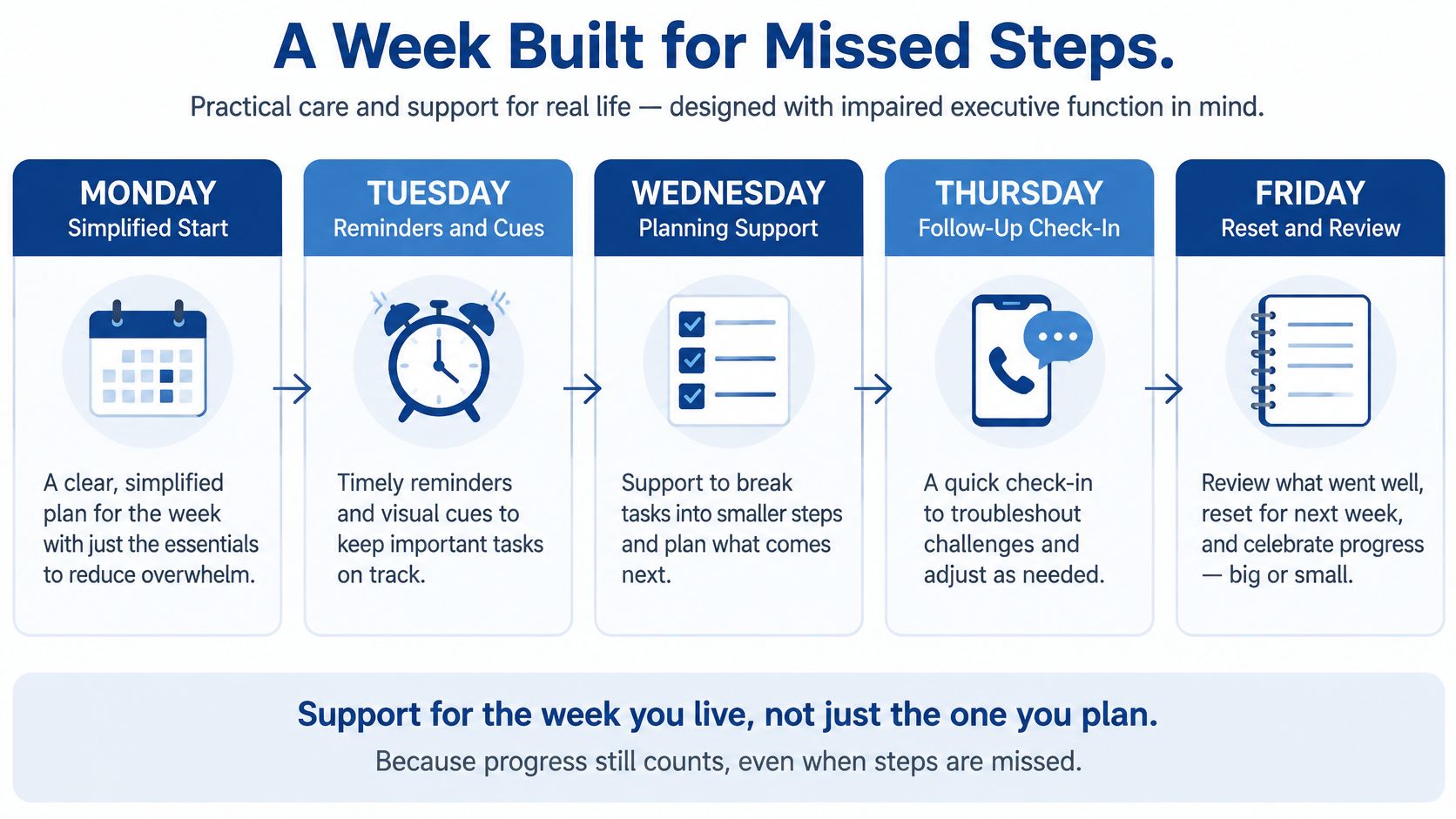
Thursday is reserved for bills or the patient portal. A password manager holds the login, and a short checklist names the item, the required action, and confirmation of completion. For a refill request, the adult checks the practice's timing rules rather than waiting until medication runs out.
On Friday, a 15-minute review examines the chosen functional metric. The adult records what finished, what stalled, and the point where the process broke down. Those observations give the psychiatric provider something more useful than a general report that the week went badly.
Make healthcare easier to complete
Telehealth removes the trip to a clinic, whether an adult lives in Philadelphia or a distant Pennsylvania county. It doesn't remove the need for a private space, reliable connection, required assessments, or timely follow-up.
Useful continuity supports include:
- Appointment prompts: Calendar entries and reminders that identify the visit format.
- Written plans: A brief summary of medication instructions, practice tasks, and the next review.
- Refill clarity: A documented request process and expected response window.
- Portal communication: A place to report side effects or clarify instructions without relying on memory at the next visit.
A missed appointment should trigger a workable recovery process, not another layer of shame.
IPA's daily mental health agenda planner can organize time blocks and goals. The sample week is a practice aid, not treatment, and should become simpler if maintaining it becomes another barrier.
When the First Plan Is Only Partial
Persistent disability calls for reassessment, not an automatic increase in medication or another collection of apps. The psychiatric provider needs to identify whether the remaining problem reflects the diagnosis, treatment tolerability, inconsistent access, or a skill that hasn't received enough support.
Different conditions can produce similar-looking unfinished work. Treatment should follow the underlying pattern rather than the appearance of procrastination.
Similar problems can require different care
Consider a Lehigh Valley adult whose low mood and disrupted sleep began after a loss. A clinician may prioritize assessment for depression and sleep problems before changing ADHD medication. A longstanding attention history still matters, but the recent change deserves its own explanation.
A Pittsburgh college student may spend evenings worrying and repeatedly checking assignments. Organization skills could help, but anxiety or OCD treatment may also be necessary. A planner alone doesn't address repeated checking.
An adult with trauma-related shutdown may understand every item on a checklist yet become overwhelmed by a routine message. Emotional regulation, grounding, and safety-focused care may need attention before more demanding task practice.
The clinical framework for adult ADHD care supports monitoring treatment effectiveness and adverse effects. A review should include medication dose, side effects, actual use, sleep, substance use, and whether CBT or DBT skills fit the remaining impairment.
Keep emerging treatments in proportion
Digital neurorehabilitation and neuromodulation remain emerging adjuncts, not substitutes for thorough assessment. Preliminary multimodal work has described improvements in planning, flexibility, visual working memory, and inhibition, without corresponding improvement in sustained attention or processing speed. Such findings don't establish which component helped or predict an individual response.
Digital attention tests also shouldn't stand alone as adult diagnostic tools. A promising interface, cognitive score, or device doesn't establish a diagnosis or demonstrate better everyday functioning.
A routine appointment shouldn't be the only response when safety or basic stability is deteriorating. Warning signs include:
- Safety problems: Unsafe driving, suicidal thoughts, or psychosis.
- Loss of stability: Job loss or inability to manage essential bills.
- Substance reliance: Using alcohol, nonprescribed medication, or other substances to focus or calm down.
Suicidal intent, inability to remain safe, or psychosis with dangerous behavior requires emergency assessment rather than a routine portal message.
For a reassessment visit, a useful preparation packet includes a week of the selected metric, a current medication and supplement list, and specific examples from work and home. The aim is to locate the remaining obstacle, not prove that the adult tried hard enough.
Start Care When Daily Function Stays Down
Seek care when the same impairment repeatedly disrupts work, home, or driving over months, or when self-built systems keep collapsing. Safety concerns warrant earlier assessment.
An online symptom checker can help organize concerns, but it isn't a diagnosis. Adults who remain unsure can complete the Adult ADHD Symptom Checker, identify the main impairment, and bring a practical outcome measure to a clinical visit.
Virtual care across Pennsylvania
IPA provides secure statewide telehealth with board-certified psychiatric mental health nurse practitioners, including Christopher Clark, MSN, PMHNP-BC. An appointment can address adult ADHD evaluation, medication management when indicated, and integrative planning around sleep, movement, and skills.
The practice's adult ADHD clinic is a relevant starting point for Pennsylvania adults seeking assessment and treatment. Medication-management needs can also be discussed during the appointment request rather than assumed from a screening result.
Check access before the visit
Cigna, Aetna, UnitedHealthcare, and BCBS or IBX may participate, but coverage is never guaranteed. Benefits, copays, deductibles, network status, and prior authorization requirements vary by plan and service.
- Verify Insurance: Confirm the specific clinician, telehealth benefit, evaluation coverage, and likely out-of-pocket responsibility.
- Request Appointment: Describe the main functional problem and ask what records or forms the practice needs.
- Prepare a clear target: Bring the impairment, its metric, and examples that show how it affects daily life.
An appropriate treatment goal might be reliable work submissions, completed household responsibilities, or safer daily routines. The next step is a care plan built around that function, not a promised cure.
Integrative Psychiatry of America offers virtual psychiatric evaluation and medication management across Pennsylvania, with individualized planning for executive-function difficulties and related conditions. Adults seeking help with repeated missed deadlines, stalled tasks, or disrupted routines can visit Integrative Psychiatry of America to verify insurance and request an appointment.