
Trouble with focus rarely shows up as a single dramatic problem. More often, it looks like missed deadlines, unfinished tasks, chronic lateness, mental clutter, or the feeling that everyday life takes more effort than it should. In Philadelphia County, many adults start looking into ADD testing only after years of compensating at work, at home, or in school.
That search can get confusing fast. Some clinics offer brief screenings, others advertise full evaluations, and many people aren't sure whether telehealth ADHD care is enough or whether they need in-person testing. A clear answer starts with understanding what a real assessment includes, what it doesn't, and how to choose a provider who can help after the evaluation is over.
Table of Contents
- Your First Step Toward Clarity with ADD Testing
- How to Prepare for Your ADHD Evaluation
- Choosing Your Provider Telehealth vs In-Person Care
- What Happens During an ADHD Assessment
- Navigating Insurance Coverage and Costs
- After the Diagnosis Your Path Forward
Your First Step Toward Clarity with ADD Testing
You may be here after another missed deadline, another argument about not listening, or another night spent wondering why simple tasks keep turning into uphill climbs. That is a common starting point for ADD testing in Philadelphia County, especially for adults who have spent years getting by with reminders, last-minute pressure, and sheer effort.
In practice, we often meet people who have been called bright but inconsistent for most of their lives. They describe losing track of bills, reading the same paragraph three times, arriving late even with good intentions, or feeling mentally scattered during work meetings and family conversations. By the time they seek an evaluation, they are usually not looking for an excuse. They want a clear answer and a plan that fits real life.
A strong first step is a clinical evaluation that looks at the full pattern, not just a symptom checklist. If you are considering an online ADHD evaluation with a psychiatric provider, the goal is to figure out whether ADHD explains what is happening, whether something else is contributing, or whether both are true.
What this first step should accomplish
The first appointment should clarify four practical questions:
- What is getting in the way right now: missed details, trouble starting tasks, unfinished projects, impulsive spending, chronic lateness, or emotional overwhelm.
- How far back the pattern goes: ADHD symptoms usually have roots earlier in life, even if no one recognized them at the time.
- Where the problems show up: work, school, home, parenting, relationships, driving, or money management.
- What else needs to be ruled in or ruled out: anxiety, depression, trauma, sleep problems, burnout, substance use, or medical issues that can affect concentration.
Here is the rule I use clinically. If attention, follow-through, or impulsivity are causing problems in more than one setting, an ADHD evaluation is reasonable to pursue.
What tends to work better than random online quizzes
Online screeners can help you notice a pattern. They cannot tell you why the pattern is happening.
The better approach is to work with a clinician who asks about your history, daily functioning, coping habits, and other conditions that can look like ADHD. That distinction is important in adult care. Many people in Philadelphia come in thinking they have ADHD, then learn the full picture includes untreated anxiety, poor sleep, a learning disorder, or years of overcompensating for symptoms that started much earlier. A careful assessment replaces guessing with a structured process and gives you a sound place to begin.
How to Prepare for Your ADHD Evaluation
Preparation can make an evaluation more accurate and less stressful. ADHD diagnosis doesn't come from a single lab test or one checklist. It depends on a detailed clinical picture, so the more organized background information someone can bring, the more useful the appointment becomes.
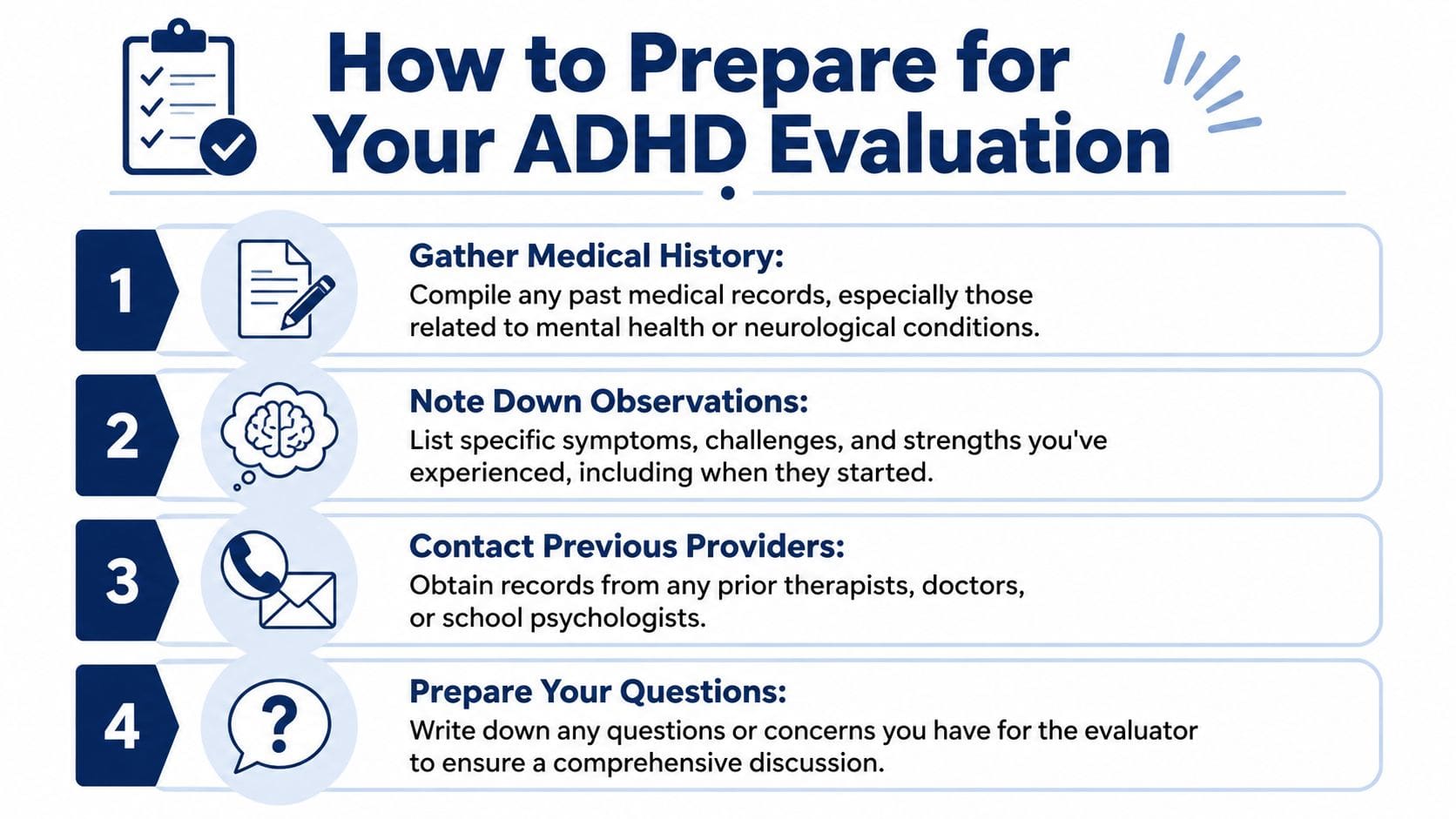
A high-quality assessment also needs to separate ADHD from conditions that can look similar. Children's Hospital of Philadelphia emphasizes a multimodal approach and notes the importance of evaluating look-alike conditions such as anxiety, sleep problems, and learning disorders because symptom overlap is common and treatment changes when ADHD isn't the only issue (CHOP Center for Management of ADHD).
What to gather before the appointment
Some records are more useful than people expect. Old school comments about daydreaming, careless mistakes, talking too much, underperformance, or inconsistent effort can provide helpful historical context.
Bring or request:
- School records: report cards, teacher comments, IEPs, 504 plans, or past psychoeducational evaluations.
- Medical history: prior mental health diagnoses, medication trials, sleep concerns, head injuries, and substance use history.
- Work patterns: performance reviews, disciplinary notes, or examples of repeated organizational problems.
- Personal symptom notes: a brief list of current struggles, when they began, and what settings they affect.
- Collateral input: observations from a parent, partner, sibling, or trusted person who has seen long-term patterns.
For readers who want a fuller sense of what clinicians look for, this overview of an online ADHD evaluation process shows how history, symptoms, and clinical judgment come together.
How to organize your information
A long narrative isn't necessary. A timeline is usually more useful.
A simple format works well:
| Area | Useful details to note |
|---|---|
| Childhood | distractibility, behavior comments, homework struggles, forgetfulness |
| Teen years | grades vs ability, procrastination, impulsive choices, inconsistent performance |
| Adulthood | work errors, missed deadlines, relationship strain, clutter, financial disorganization |
| Health | anxiety, mood symptoms, sleep issues, medical problems, prior treatment |
Bring examples, not conclusions. "I missed three bill payments and forgot two meetings this month" is more clinically useful than "I definitely have ADHD."
Questions worth writing down
It's smart to arrive with questions rather than trying to remember them in the moment.
Examples include:
- What kind of testing is included
- Whether rating scales or computerized tests are used
- How childhood history is reviewed
- What happens if symptoms overlap with anxiety or depression
- Whether the provider also offers treatment and follow-up
This preparation isn't about proving a diagnosis. It's about giving the evaluator enough context to make a careful one.
Choosing Your Provider Telehealth vs In-Person Care
The biggest decision for many people isn't whether to get tested. It's where to get tested. In Philadelphia County, that usually means comparing telehealth ADHD assessment with in-person evaluation.
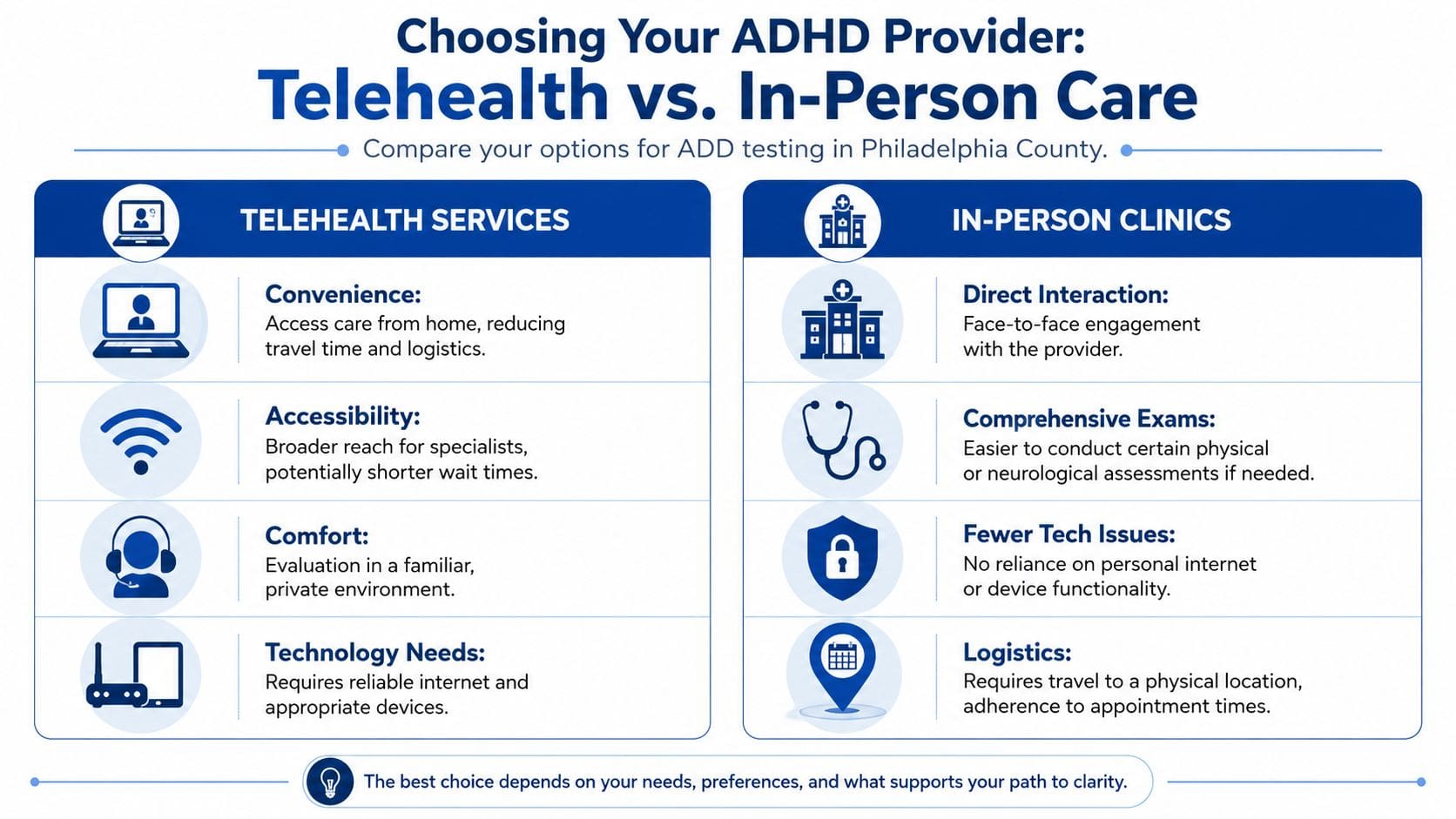
The practical question patients now ask most often is about continuity. A regional review of ADHD diagnosis and accommodations notes that the market has shifted toward remote and hybrid care, and that many patients want a path from evaluation to long-term management, documentation, and follow-up rather than a one-time testing visit (telehealth continuity and documentation needs).
Telehealth and in-person compared
Both models can be appropriate. The right fit depends on the person's needs, comfort with technology, and whether the provider can deliver thorough follow-up.
| Option | Often works well for | Trade-offs |
|---|---|---|
| Telehealth | busy adults, parents, people seeking privacy, those with transportation barriers | requires stable internet, quiet space, and a provider with a strong remote workflow |
| In-person care | people who prefer face-to-face visits or may need physical or neurological assessment | travel time, parking, schedule disruptions, and sometimes more limited specialist access |
Telehealth can be especially helpful for ADHD diagnosis online Pennsylvania because the barrier to getting started is lower. People can complete visits from home, which often makes it easier to attend consistently. That matters because ADHD care doesn't stop at diagnosis.
What to look for in the clinician
Not every provider offering ADD testing Philadelphia County is set up for the full process. Some only screen. Others diagnose but don't manage medication or write ongoing documentation.
A stronger fit usually includes:
- Diagnostic expertise: someone trained to evaluate ADHD and differentiate it from similar conditions
- Treatment capability: medication management when clinically indicated
- Follow-up structure: ongoing visits, monitoring, and adjustment rather than a one-time report
- Documentation clarity: support for work or school when appropriate
For people comparing clinician types, this explanation of a psychiatric NP vs psychiatrist can help clarify scope of practice and what each role can do in ADHD care.
One telehealth option in Pennsylvania is Integrative Psychiatry of America, which provides online psychiatric evaluation, diagnosis, and medication management through psychiatric nurse practitioners. For many adults, the deciding factor isn't whether a visit is virtual or in person. It's whether the provider can stay involved after the answer becomes clear.
A good ADHD provider doesn't just identify symptoms. The provider helps translate findings into a workable care plan.
What Happens During an ADHD Assessment
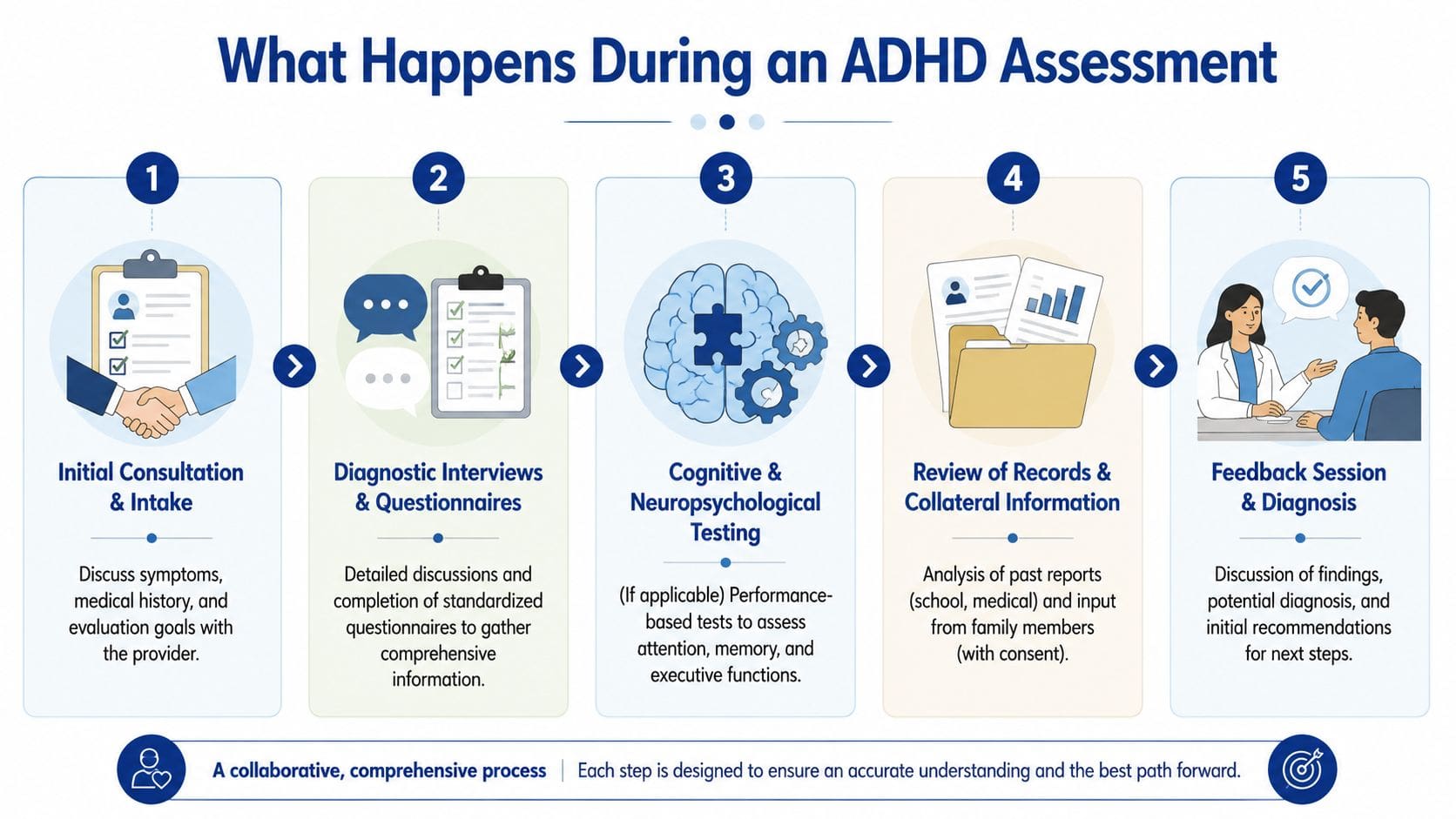
Many people expect ADHD testing in Philadelphia County to be a single exam with a pass-or-fail result. That's not how a credible assessment works. There is no single definitive test that confirms ADHD. Diagnosis relies on a thorough clinical evaluation that includes background history, symptoms, functioning, and often input from more than one source (clinical evaluation and QbTest overview).
A staged assessment is often easier to understand when broken into parts.
The interview comes first
The clinical interview usually does the heaviest lifting, with the provider asking about childhood patterns, school history, work functioning, medical history, family history, relationships, sleep, mood, and substance use.
A robust telehealth workflow often follows staged steps and may take about 60 to 90 minutes, combining consultation, history review, and testing when clinically appropriate. That same regional benchmark also notes that abnormal results on objective testing alone don't establish ADHD because anxiety and other factors can influence performance (telehealth ADHD assessment workflow).
Rating scales and objective tools
Standardized questionnaires add structure to the process. They help compare symptom patterns against recognized diagnostic criteria and can highlight impairment across settings.
Some practices also use computerized attention testing. Tools such as QbTest are designed to measure inattention, impulsivity, and activity during a standardized task. Some implementations interpret scores beyond about +1.5 standard deviations from age- and sex-matched norms as clinically significant, but that still doesn't make the diagnosis by itself. Poor sleep, low effort, anxiety, or another condition can skew results.
This short video gives a general look at the broader assessment process:
What patients often misunderstand
The most common misunderstanding is that "normal" objective testing means no ADHD, or that an "abnormal" computerized result proves it. Neither is true.
A fuller evaluation often includes:
- Clinical history across the lifespan
- Current impairment in daily life
- Rating scales
- Collateral reports when available
- Objective testing if appropriate
- Assessment of other possible explanations
For readers comparing testing options, this page on psychological testing for ADHD outlines how testing fits into diagnosis rather than replacing it.
The most reliable ADHD assessment combines data streams. It doesn't reduce the diagnosis to a single score.
Navigating Insurance Coverage and Costs
Cost questions are reasonable, especially when different clinics describe ADHD evaluation in very different ways. Some bill a diagnostic intake. Others separate rating scales, computerized testing, report writing, or follow-up interpretation. The important point is to ask what the quoted price includes.
In-depth evaluations tend to be more accurate because they draw from multiple data streams, and that depth matters when co-occurring conditions are common. One Philadelphia-area source notes that nearly 78% of children with ADHD have co-occurring conditions, which is one reason a simple checklist can miss meaningful clinical complexity (Blackbird Health on comprehensive ADHD evaluation).
Questions to ask before booking
Insurance coverage for mental health visits may not match coverage for specialized testing. It's worth calling both the insurer and the testing provider.
Ask questions such as:
- Is this visit billed as a psychiatric evaluation, psychological testing, or neuropsychological testing
- Is prior authorization required
- What portion applies to deductible, copay, or coinsurance
- Is computerized testing billed separately
- Is a written diagnostic report included
- Are follow-up visits for medication management covered
- Can documentation for workplace or school accommodations be provided
When denials or billing confusion happen
Behavioral health claims can get denied for coding, authorization, or documentation reasons even when the service itself was appropriate. For patients trying to understand those administrative roadblocks, this guide to solutions for behavioral health claim denials gives a practical overview of common issues and how they can be addressed.
Self-pay can also make sense for some adults. It may offer simpler scheduling, fewer billing surprises, and more privacy around mental health treatment. A transparent breakdown of how much ADHD testing can cost can help patients compare what different practices include.
The lowest advertised price isn't always the best value. If a cheaper visit doesn't include a meaningful history, comorbidity review, or a plan for treatment, patients often end up paying twice by needing a second evaluation elsewhere.
After the Diagnosis Your Path Forward
You have an answer. The next question is usually more personal. What do I do with this now?
For many adults, diagnosis brings relief and a little grief at the same time. You may recognize old patterns in school, work, money management, parenting, or relationships. That kind of clarity matters, but day-to-day improvement comes from a treatment plan you can effectively use.
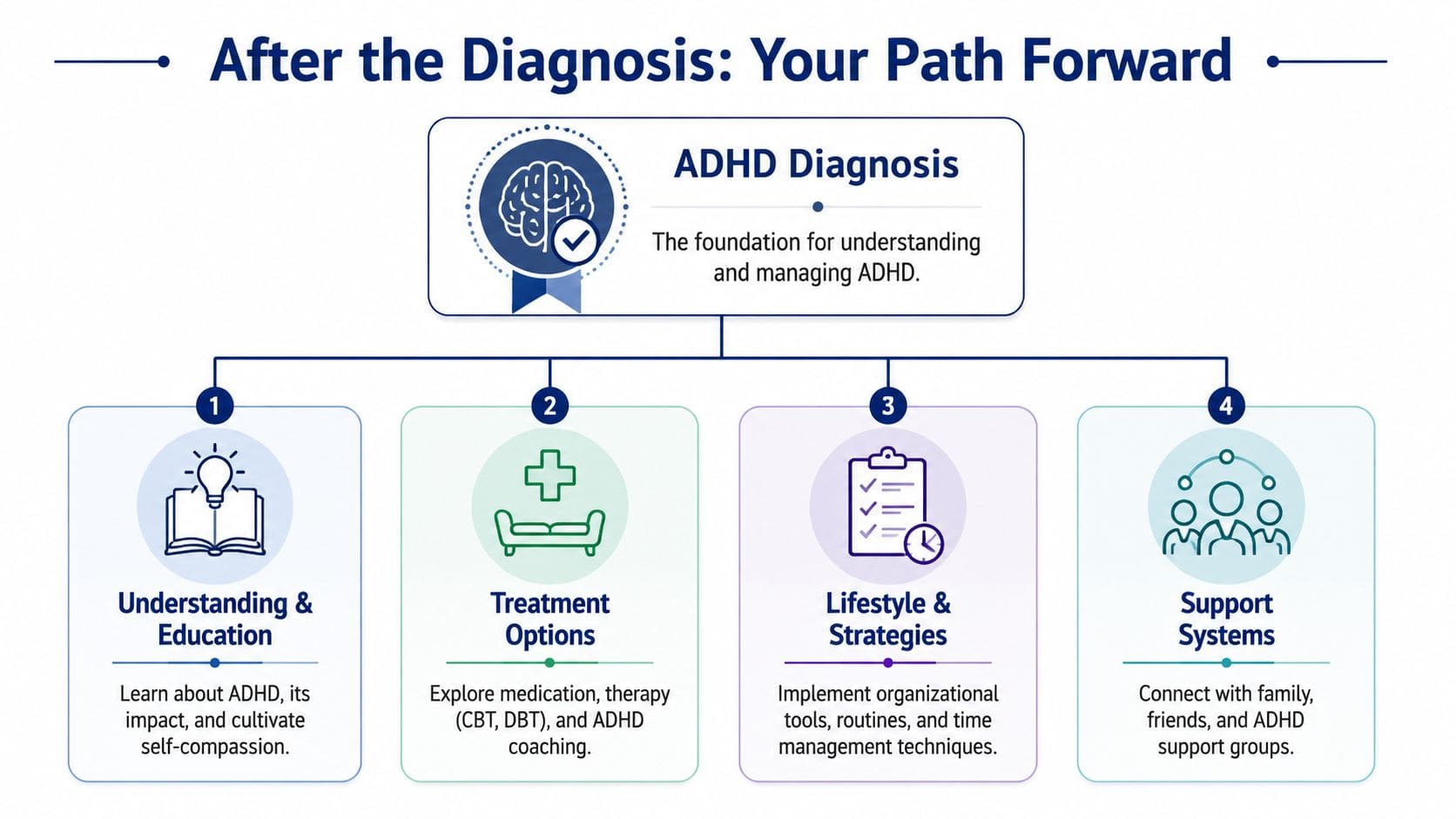
The first plan does not need to do everything
In practice, the best next step is usually a workable one, not an overly ambitious one. Some patients want medication as soon as possible because work is slipping. Others need help with sleep, anxiety, burnout, or routines before they can tell what symptoms are truly ADHD. Both approaches can be reasonable.
A strong treatment plan often includes several parts that build on each other:
- Education: learning how ADHD affects attention, planning, follow-through, and emotional regulation
- Medication review: deciding whether stimulant or non-stimulant treatment fits your history, goals, and risk factors
- Skills support: using therapy, coaching, or structured habit work to improve time management, task initiation, and organization
- Daily foundations: stabilizing sleep, reducing overstimulation, eating regularly, and building routines that lower friction
- Documentation needs: planning for school or workplace accommodations if they apply to your situation
I often tell patients that medication can reduce the noise, but it does not automatically build systems. You still need reminders, calendars, environmental changes, and realistic expectations about how fast habits change.
What treatment looks like in real life
Good follow-up is where a diagnosis starts to help. We monitor whether focus improves, whether side effects show up, and whether other issues such as anxiety, depression, trauma, or substance use need attention too. Telepsychiatry can make that process easier to maintain because shorter check-ins are often more practical than trying to fit repeated office visits into a packed week.
Here is what a layered plan usually aims to do:
| Focus area | Real-world goal |
|---|---|
| Medication follow-up | improve focus while tracking sleep, appetite, mood, blood pressure concerns, and side effects |
| Skills work | build systems for planning, reminders, task initiation, and prioritizing what actually needs to get done |
| Emotional support | address shame, frustration, perfectionism, and burnout that often build up over years |
| Ongoing reassessment | adjust care when job stress, parenting demands, academic pressure, or other symptoms change |
For a clearer overview of how these pieces fit together, our guide to ADHD treatment options for adults explains how medication and non-medication care can work side by side.
Diagnosis explains the pattern. Consistent treatment is what changes daily life.
If you're looking for clear answers about ADD testing in Philadelphia County, Integrative Psychiatry of America offers telepsychiatry across Pennsylvania with psychiatric nurse practitioners who evaluate ADHD, manage medication when appropriate, and provide ongoing care through a secure online platform.