
The tab stays open all week. A Philadelphia professional keeps meaning to book an evaluation, then misses another deadline, forgets a follow-up email, and wonders whether this is stress, burnout, anxiety, poor sleep, or ADHD that was never identified. That uncertainty is common, especially for adults who've learned to function well enough on the outside while feeling disorganized and mentally overextended on the inside.
Searches for ADD psychiatric evaluations in Philadelphia often start at that exact point. Someone wants clarity, not guesswork. They don't just want a checklist score. They want to know what a real telehealth evaluation includes, what can be done remotely, and whether a psychiatric nurse practitioner can help sort out attention symptoms from everything that can look similar.
Table of Contents
- Is It ADHD An Introduction for Philadelphia Adults
- How to Schedule Your Telehealth Evaluation with IPA
- Your Pre-Evaluation Documentation Checklist
- What Happens During Your In-Depth ADHD Evaluation
- Your Personalized Treatment Plan After Diagnosis
- Frequently Asked Questions About ADHD Care in PA
Is It ADHD An Introduction for Philadelphia Adults
A common adult presentation isn't dramatic hyperactivity. It's the person who's bright, capable, and chronically behind. Bills get paid late, tasks pile up, meetings are survived through last-minute compensation, and evenings disappear into mental exhaustion. Friends may call it being scattered. Employers may read it as inconsistency. The person living it usually feels frustrated and ashamed.

That's why a proper diagnostic process matters. Many people seeking an evaluation want to know if they need a full diagnostic workup or a brief medication-focused assessment. The confusion is understandable because inattention can overlap with anxiety, depression, or sleep problems, which is why a thorough psychiatric evaluation is the better starting point for diagnostic clarity, as noted by Philadelphia Integrative Psychiatry on psychiatric evaluations.
Why a quick screen often misses the real issue
Brief screeners can be useful as a starting point, but they don't establish the whole picture. An adult may endorse distractibility and procrastination, yet the underlying driver could be panic, trauma-related hyperarousal, irregular sleep, depression, substance use, or a combination of several factors.
A stronger evaluation asks different questions. When did the symptoms start. Were similar patterns present in childhood. Do problems show up at work, at home, in relationships, or only under heavy stress. Did the difficulty with attention appear before the mood symptoms, or after them.
Clinical reality: Adults rarely seek help because they “feel inattentive.” They usually seek help because life has become harder to manage.
For people comparing options for adult ADHD assessment Philadelphia, telehealth ADHD evaluation Pennsylvania, or online ADD diagnosis Philadelphia, the most useful first step is often a side-by-side look at overlapping symptoms. This can help frame the right questions before the appointment. A practical example appears in this anxiety versus ADD guide.
Why telehealth fits many Philadelphia adults
Telepsychiatry works well for busy adults because it removes commute time, waiting rooms, and the friction that often delays care. It also gives clinicians a chance to focus on the parts of the visit that matter most. Symptom history, functional impairment, family patterns, and treatment goals.
For many adults searching ADHD diagnosis Philadelphia adults, virtual psychiatric evaluation Philadelphia, or private ADHD evaluation online, the key point is simple. A confidential video visit can still be thorough. What matters isn't whether the conversation happens in an office or through a secure screen. It's whether the evaluation is structured enough to answer the right question.
How to Schedule Your Telehealth Evaluation with IPA
The scheduling part should feel easier than the months of indecision that usually come before it. For most adults, the practical goal is to move from “I should do this” to “my visit is booked” in one sitting.
What to do first
Start with the dedicated online ADHD evaluation page. That's usually the clearest route for adults looking for ADHD telepsychiatry Philadelphia, ADD screening Philadelphia, mental health evaluation Philadelphia, or executive function assessment adults.
Then work through the basics:
- Choose the visit type that matches the concern. If the question is diagnostic clarity, book an evaluation rather than a narrow medication check.
- Review insurance and self-pay options before confirming. That prevents surprises and helps set expectations.
- Select a time with enough margin around it. A rushed intake is rarely productive.
- Complete portal forms promptly so the clinician has usable background information before the visit.
A lot of telehealth frustration comes from process gaps, not clinical care. Missing forms, unclear insurance details, and incomplete intake histories create delays. Strong telepsychiatry practices usually solve those issues with organized billing and intake workflows. For readers interested in the operational side of virtual care, Happy Billing has a useful piece on how practices optimize mental health practice revenue by reducing avoidable administrative friction.
What makes booking easier than older care models
Traditional outpatient psychiatry often creates drop-off points. Phone tag. Limited office hours. Long drives. Paper packets. Telehealth removes many of those barriers, especially for adults who are already overloaded.
Secure online scheduling works best when the patient can handle insurance review, forms, and appointment selection in one session, rather than spreading it across several calls.
Later in the process, a short walkthrough can help patients know what the portal and virtual intake flow look like before they commit:
Before clicking confirm
A few small decisions make the first visit much better:
- Pick a private setting: A parked car between errands isn't ideal for a diagnostic interview.
- Use a stable device: Laptop or tablet is usually easier than a phone for reviewing forms and staying focused.
- Protect uninterrupted time: If possible, avoid scheduling right before work calls or school pickup.
- Write down the top concerns: Even a short note helps organize the visit.
Adults searching Philadelphia ADHD nurse practitioner, behavioral health assessment Philadelphia, or online psychiatry Pennsylvania often think the hard part is finding an appointment. It usually isn't. The hard part is deciding to book a visit that's thorough enough to be useful.
Your Pre-Evaluation Documentation Checklist
Preparation matters because ADHD isn't diagnosed from one symptom alone. It's identified through pattern, context, and functional impact over time. In Philadelphia, one estimate says about 20% of residents experience some form of mental illness each year, with about 8% reporting anxiety disorders and about 10% reporting depression symptoms, which can overlap with or mimic ADHD symptoms, according to Philadelphia mental health statistics compiled here. That overlap is one reason detailed historical information improves differential diagnosis.
What to gather before the visit
A strong intake doesn't require perfect records. It requires useful clues. Adults often worry that they need old report cards, formal testing, or childhood paperwork to be taken seriously. Those documents can help, but they aren't the only evidence that matters.
The more practical goal is to collect examples that show whether attention problems are longstanding, situational, or linked to another issue.
| ADHD Evaluation Preparation Checklist | |
|---|---|
| Information to Gather | Why It's Important |
| Current medication list | Helps the clinician distinguish untreated symptoms from medication effects, side effects, or interactions. |
| Supplements and over-the-counter products | Sleep aids, caffeine products, and wellness supplements can affect attention, energy, anxiety, and sleep. |
| Brief symptom timeline | Clarifies onset, duration, triggers, and whether symptoms changed with life stages, stress, or work demands. |
| Work examples | Specific patterns such as missed deadlines, trouble prioritizing, or task switching show functional impact in adult life. |
| Home and relationship examples | ADHD often appears in daily routines, communication, forgetfulness, and follow-through, not just at work. |
| School history if available | Old report cards, teacher comments, or memories of chronic disorganization can support a longstanding pattern. |
| Family mental health history | Gives diagnostic context and helps identify broader patterns relevant to mood, anxiety, and attention. |
| Past treatment records | Prior therapy, medication trials, or earlier diagnoses can clarify what has or hasn't helped. |
| Sleep pattern notes | Poor sleep can mimic inattention and must be separated from primary ADHD symptoms. |
| Substance use history | Important for safety, diagnostic accuracy, and treatment planning. |
| Medical history | Thyroid problems, hormonal issues, chronic pain, and other conditions can affect concentration and energy. |
| Questions for the visit | Keeps the evaluation focused on what the patient actually needs. Diagnosis, treatment, documentation, or accommodations. |
How to organize it without getting overwhelmed
A simple method works best. Use one document or note on a phone and sort information into three buckets:
- Past patterns: childhood, school, family observations
- Current symptoms: distractibility, time blindness, impulsivity, procrastination, mental restlessness
- Functional consequences: work errors, unfinished tasks, relationship strain, missed appointments
For adults exploring how to get diagnosed with ADHD as an adult, this step often turns confusion into something much clearer. This adult ADHD diagnosis guide can help frame what history is most useful to gather.
Preparation tip: The best notes are concrete. “I struggle at work” is less useful than “I miss small details, lose track of multi-step tasks, and need last-minute pressure to finish reports.”
What not to worry about
No one should delay care because their records aren't perfect. Many adults don't have school files, childhood testing, or relatives who can provide collateral history. A good clinician can still do meaningful diagnostic work using current symptoms, developmental recollection, medical review, and functional examples.
That's especially relevant for people searching adult ADD help Philadelphia, ADHD symptoms adults Pennsylvania, or telehealth mental health intake. The goal isn't to build a flawless archive. It's to give the evaluation enough texture to separate ADHD from look-alike conditions.
What Happens During Your In-Depth ADHD Evaluation
A Philadelphia adult often reaches this visit after years of forcing things to work. Deadlines get met at the last minute, routines keep falling apart, and it becomes hard to tell whether the problem is ADHD, burnout, anxiety, poor sleep, or some mix of all three. A good telehealth evaluation sorts that out carefully and without rushing.
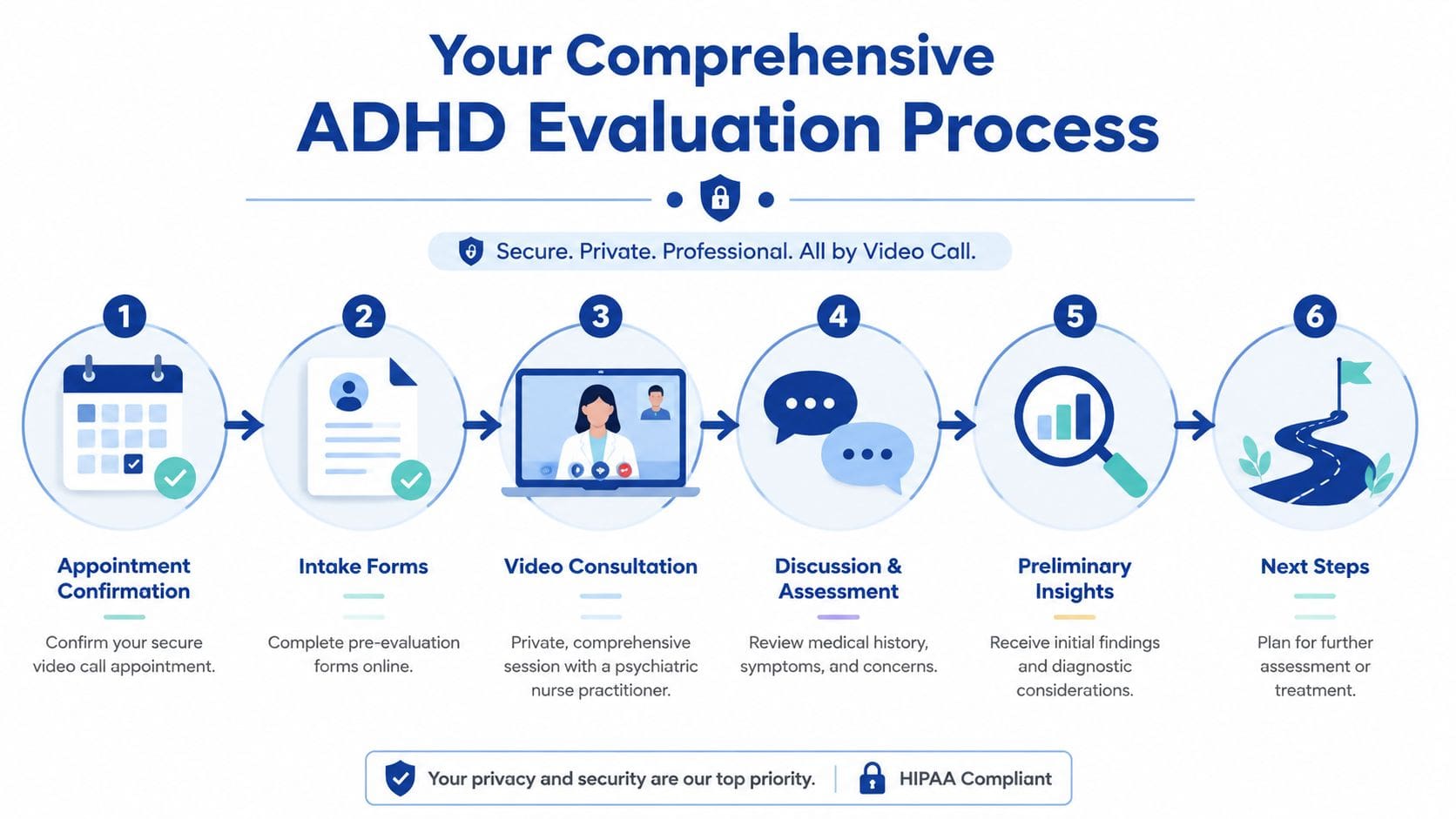
The visit is usually done by secure video, but the standard should still be thorough. From a nurse practitioner's perspective, the goal is straightforward. Identify whether ADHD fits the full pattern of symptoms and impairment, and rule out other explanations that can look similar in adult life.
The evaluation goes beyond symptom boxes
An ADHD assessment should feel like a clinical conversation with structure. Patients are often surprised by how much of the visit focuses on timing, context, and function, not just whether they relate to a list of symptoms.
The interview often covers:
- How symptoms have shown up over time: childhood traits, school patterns, early coping habits, and when problems became harder to manage
- Where impairment is happening now: work performance, home responsibilities, finances, relationships, driving, and follow-through
- What affects symptom severity: sleep, stress, mood shifts, substance use, medical issues, and environmental demands
- What points away from ADHD: sudden onset, symptoms that only appear during mood episodes, or concentration problems better explained by trauma, anxiety, or depression
In practice, that distinction matters. Adults seeking ADD psychiatric evaluations in Philadelphia sometimes expect a quick yes-or-no screen. A solid evaluation asks a harder question. Does ADHD explain the pattern better than the alternatives?
Rating scales can support the diagnosis
Standardized tools are useful, especially in telehealth, because they add structure and can highlight patterns that are easy to miss in a single conversation. They help organize symptom severity, consistency, and functional impact.
They do not make the diagnosis by themselves.
Clinical judgment still matters because adults can overidentify with online ADHD content, underreport symptoms out of shame, or describe years of stress that blur the picture. The most reliable process combines rating tools, developmental history, present-day impairment, psychiatric review, and medical context. If the picture is unusually complex or formal documentation is needed, broader psychological testing for ADHD may also be appropriate.
Medical and psychiatric review are part of doing this well
Attention problems are not exclusive to ADHD. Sleep apnea, thyroid problems, medication side effects, cannabis use, depression, anxiety disorders, trauma, and bipolar spectrum conditions can all affect focus, motivation, and task completion. A telehealth-first model works well for sorting through that history, but it does not cut corners on medical thinking.
At IPA, this part of the visit often includes questions about sleep quality, physical health, past medication response, family psychiatric history, and safety concerns. Some adults also need lab work, records, or coordination with other clinicians before the diagnosis is finalized. That is not a delay for the sake of delay. It is how careful psychiatric care avoids oversimplifying a very common set of symptoms.
Telehealth changes the logistics, not the standard
For many Philadelphia adults, virtual care makes it easier to get evaluated without taking half a day off work, sitting in traffic, or waiting weeks for an in-person opening. That convenience matters, especially for people whose symptoms already make scheduling and follow-through harder.
The trade-off is that telehealth works best when the patient is in a private setting, has a stable connection, and can stay engaged for the full visit. When those basics are in place, a virtual ADHD evaluation can be detailed, personal, and clinically sound. The format is remote. The care should still feel thoughtful, careful, and specific to your life.
Your Personalized Treatment Plan After Diagnosis
A diagnosis helps only when it changes what happens next. Some adults need medication management. Others need therapy, behavioral systems, coaching, sleep repair, or a mix of several supports. The right plan depends on the person's actual impairment, health history, preferences, and risk profile.

What a practical treatment plan often includes
An adult with newly confirmed ADHD may need support in several areas at once. Treatment is often stronger when it matches the actual friction points that brought the person to care in the first place.
Common components include:
- Medication management: when clinically appropriate, this may help with sustained attention, impulsivity, and task initiation
- Therapy or skills-based work: especially useful for emotional regulation, shame, perfectionism, and long-standing coping patterns
- Lifestyle review: sleep, exercise, routines, and substance use all affect symptom control
- Work or school strategy planning: systems for deadlines, transitions, reminders, and environmental changes
- Follow-up monitoring: response, tolerability, and diagnosis refinement over time
For readers considering medication, this overview of ADHD medication options is a useful starting point for questions to bring into follow-up care.
Why holistic care matters
Adults often arrive assuming treatment equals a prescription and a short follow-up. That can work for some cases, but it falls short when ADHD sits alongside anxiety, trauma history, sleep disruption, or burnout. A better plan treats the person's functioning, not just the label.
One example of broader curiosity in this space is the discussion around complementary and emerging approaches. Some patients like to review outside perspectives on topics such as laser therapy benefits for stroke, ADHD, autism. Resources like that can spark questions, but they shouldn't replace individualized psychiatric care, medical review, and evidence-based follow-up.
Next-step mindset: The goal after diagnosis isn't to chase every possible intervention. It's to build a treatment plan that is safe, realistic, and sustainable.
Within telehealth care, Integrative Psychiatry of America is one option that provides online psychiatric evaluation and follow-up across Pennsylvania, combining medication management with broader supports such as lifestyle guidance, lab screening when clinically indicated, and psychotherapy-informed care.
Frequently Asked Questions About ADHD Care in PA
Can adults outside Philadelphia still use telehealth psychiatric care in Pennsylvania
Yes, many adults across the state use telehealth because access is uneven. Pennsylvania's mental health provider ratio has been reported at about 350 residents per provider, which is one reason telehealth helps bridge access gaps for people facing transportation, cost, or local provider shortages, according to Pennsylvania mental health statistics summarized here.
Can a psychiatric nurse practitioner diagnose and treat ADHD in Pennsylvania
Yes. Psychiatric nurse practitioners evaluate mental health symptoms, diagnose conditions within their scope, and provide treatment planning, including medication management when appropriate. For adults looking for Pennsylvania ADHD telehealth, the key question isn't title alone. It's whether the clinician performs a structured evaluation and considers overlapping diagnoses carefully.
What if there are no old school records
That's common. Adults can still be evaluated using developmental recollection, current impairment, treatment history, family history, and specific examples from work and home life. Missing records may limit some kinds of formal documentation, but they don't make evaluation impossible.
Is telehealth enough for a full ADHD evaluation
Often, yes. A secure video visit is well suited for psychiatric interview, symptom review, functional assessment, and treatment planning. If the case is unusually complex, the clinician may recommend added records, collateral history, lab work, or formal testing.
If attention problems, chronic disorganization, or mental overload have been building for a while, the next step doesn't have to be confusing. Integrative Psychiatry of America offers secure online psychiatric care for adults in Pennsylvania, including in-depth evaluations and follow-up treatment planning delivered through telehealth.