
A lot of adults start looking for an ADHD evaluation in Philadelphia after months or years of trying to explain away the same pattern. Work gets done, but only under pressure. Emails pile up. Bills get paid late even when money isn't the issue. Small tasks feel strangely hard to start, yet hours can disappear on the wrong thing. By the time someone searches for help, they're often asking a more loaded question: is this ADHD, or is it stress, anxiety, poor sleep, burnout, or just a lack of discipline?
That confusion makes sense. ADHD doesn't show up as a single test result. It shows up in daily life, in patterns of attention, organization, impulsivity, and follow-through that keep repeating across settings. A good evaluation should bring clarity to that pattern, not add more noise.
In Philadelphia, the options can feel scattered. Some services offer a brief virtual diagnostic visit. Others use computerized attention testing. Others provide full psychoeducational or neuropsychological assessments that are more detailed, more expensive, and often necessary only for specific documentation needs. The right path depends on what the person needs from the evaluation.
Table of Contents
- Is It Just Burnout or Could It Be ADHD
- What an ADHD Evaluation Actually Involves
- The Diagnostic Process Step-by-Step
- Telehealth vs In-Person Evaluations in Philadelphia
- Navigating Costs Insurance and Timelines
- After the Diagnosis Your Treatment Options
- How to Choose a Trusted Philadelphia ADHD Provider
Is It Just Burnout or Could It Be ADHD
A common Philadelphia story looks like this. An adult professional holds a job, meets most deadlines eventually, and seems capable from the outside. Inside, the day feels chaotic. Meetings are forgotten unless they're on multiple calendars. Simple admin tasks get postponed until they become urgent. Focus comes and goes unpredictably. Emotional reactions feel bigger than they should.
That person often assumes burnout first. Sometimes anxiety gets blamed next. Sometimes a partner says, “You never listen,” while the person is thinking, “I'm trying harder than anyone knows.” An adult who has lived this way for years may have built impressive coping strategies, but the cost is high. There's constant effort behind basic routines.
A useful evaluation doesn't hand out a label. It separates long-standing ADHD patterns from stress-driven attention problems and from other conditions that can look similar.
That distinction matters because adult ADHD is often missed in people who are intelligent, motivated, or outwardly successful. They may not look impaired in the stereotypical way. Instead, they look overwhelmed, chronically behind, mentally cluttered, and frustrated that effort never seems to match results.
Signs that deserve a closer look
Some patterns raise clinical suspicion more than others:
- Task initiation problems: Knowing exactly what needs to be done but feeling unable to start.
- Inconsistent attention: Being capable of intense focus in one context and nearly no focus in another.
- Forgetfulness under normal stress: Missing details, appointments, or follow-up steps despite real effort.
- Emotional spillover: Irritability, shame, or fast frustration after what seem like small mistakes.
- Lifetime pattern: Similar struggles showing up in school, work, relationships, or home systems over time.
Adults who are sorting through that question often also need help teasing apart anxiety and attention symptoms. A related discussion of that overlap appears in this guide on anxiety or ADD symptoms.
Why people wait too long
Many adults don't seek an ADHD evaluation Philadelphia providers offer because they assume a diagnosis would only matter if they wanted medication. That's too narrow. A careful evaluation can clarify why certain workarounds haven't worked, why stress keeps amplifying the same weak points, and what kind of treatment plan is appropriate.
Philadelphia has seen growing demand for ADHD care for years. In the Philadelphia region, the number of commercially insured children diagnosed with ADHD increased 33 percent from 2010 to 2017, and the Blue Cross Blue Shield Association report noted that national trends rose as well, with nearly 2.4 million commercially insured children diagnosed in 2017, a 31 percent increase from 2010 levels, according to the Blue Cross Blue Shield Association Health of America Report summary. That doesn't prove any one adult has ADHD, but it does show how widespread recognition of the condition has become.
What an ADHD Evaluation Actually Involves
Many adults assume an ADHD evaluation is one thing. It isn't. In Philadelphia, the phrase can refer to a clinical diagnostic interview, a computer-based attention test, or a full psychoeducational or neuropsychological assessment. Those are not interchangeable.
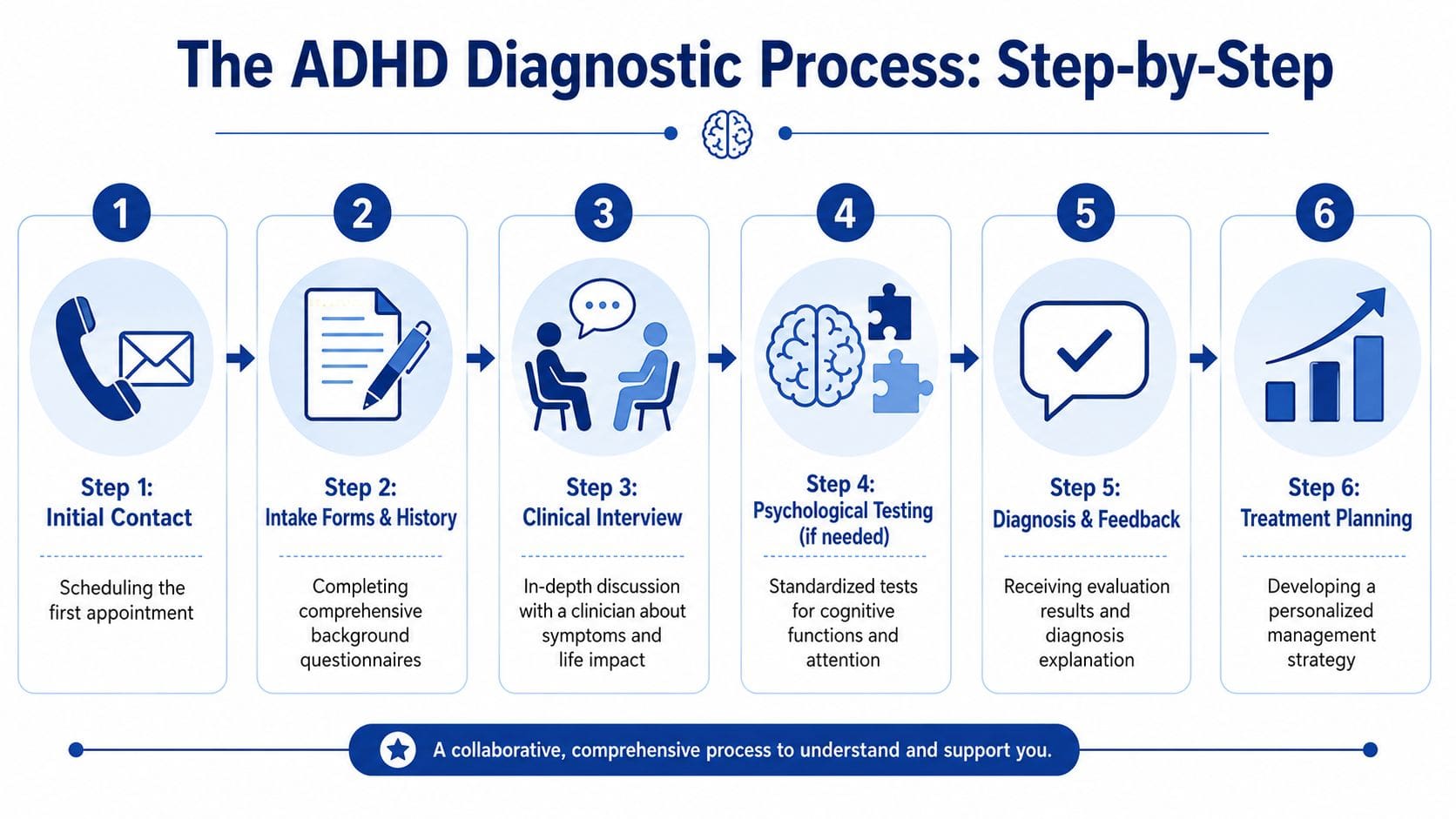
A quick visual helps clarify the sequence one can generally expect.
Three very different types of evaluation
The most common option for adults is the structured diagnostic evaluation. This is usually the right starting point when the main goal is diagnostic clarity and treatment planning. It relies on a detailed interview, symptom review, functional history, and screening for other causes of poor concentration.
A second option is objective performance testing. This can add data when the history is mixed or uncertainty remains. It's not the same as a full psychological battery.
The third option is a detailed psychoeducational or neuropsychological assessment. That's more extensive and may be necessary when someone needs formal accommodation documentation, or when learning disorders, autism, cognitive issues, or complicated diagnostic questions are also in play.
Practical rule: If the goal is medication management and diagnostic clarification, a structured clinical evaluation is often enough. If the goal is school or workplace accommodations, a more detailed report may be necessary.
That distinction lines up with how local services describe their offerings. As noted by Bellelite Health's overview of ADHD evaluation options, a key confusion for patients is whether an ADHD evaluation is a diagnostic interview, a computer test, or a full psychoeducational assessment. Those services vary widely in purpose and scope, and a structured diagnostic evaluation is often sufficient for medication management, while a more extensive report may be needed for official accommodations.
For readers comparing formats, this overview of psychological testing for ADHD is also useful because it separates diagnostic needs from documentation needs.
How to choose the right format
Here's a simple way to consider it:
| Goal | Most likely fit |
|---|---|
| Diagnostic clarity and treatment planning | Structured psychiatric evaluation |
| Added objective data when history is unclear | Computer-based performance testing |
| School or work accommodations | Comprehensive psychoeducational or neuropsychological assessment |
Another useful resource is the short video below, especially for adults who are still expecting a single pass-fail ADHD test.
What doesn't work well is jumping straight to the most expensive testing without asking what the report is for. That can waste time and money. The opposite mistake also happens. Some adults book the fastest possible visit, then feel frustrated later when that format doesn't provide the documentation an employer or school requires.
The Diagnostic Process Step-by-Step
A proper ADHD evaluation should feel deliberate, not rushed. The clinician's job isn't to confirm a hunch as fast as possible. It's to determine whether ADHD is the best explanation for the symptoms, whether something else explains them better, or whether both are present.
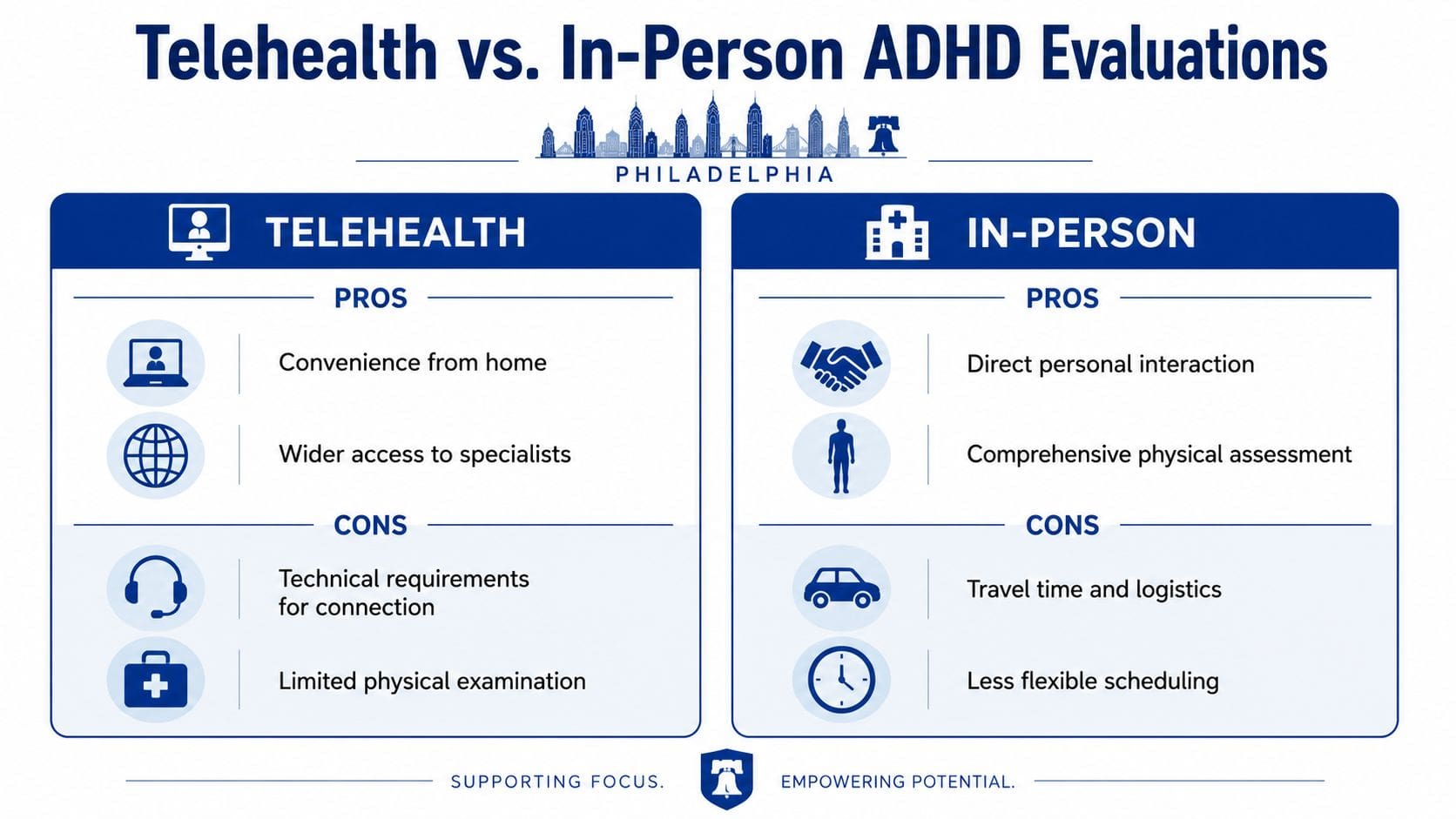
What happens before the diagnosis
Most adult evaluations begin with intake forms and a detailed symptom history. Those forms matter, but they're only the start. A strong evaluation asks when the symptoms began, how they affected school or early work life, what strategies the person has used to compensate, and where current impairment shows up now.
The clinical interview usually covers:
- Current symptoms: Inattention, impulsivity, restlessness, disorganization, time blindness, and follow-through.
- Developmental history: Whether similar patterns were present earlier in life, even if they weren't diagnosed.
- Functional impact: Work performance, relationships, finances, driving, home routines, and emotional regulation.
- Medical and psychiatric history: Sleep problems, anxiety, depression, trauma, substance use, and medication history.
- Family context: Patterns that may suggest a longstanding neurodevelopmental picture.
Rating scales can help organize this information. They are useful tools, but they aren't stand-alone proof.
Why differential diagnosis matters
What often surprises many people is that plenty of conditions can produce executive function problems that look like ADHD. Anxiety can scatter attention. Depression can slow initiation and concentration. Sleep disorders can wreck memory and focus. Trauma can make someone look distractible or emotionally reactive. Substance-related problems can do the same.
According to CHOP's ADHD clinical pathway, a rigorous ADHD evaluation prioritizes a thorough history, physical review, and screening for comorbidities over simple symptom checklists. The same pathway also notes that neuropsychological testing is not strictly required for a routine diagnosis. That point is important for adults who think diagnosis only counts if it comes after an expensive testing battery.
Good ADHD diagnosis is less about spotting attention problems and more about ruling in the right explanation for those problems.
A careful process often includes these decision points:
Does the symptom pattern fit ADHD?
Not every focus complaint does.Is there evidence of a longstanding pattern?
Adult ADHD usually has roots earlier in life, even if it wasn't recognized then.Could another condition explain this better?
Sleep, mood, trauma, and anxiety deserve real attention.Are both ADHD and another condition present?
That's common, and treatment planning changes when both need care.
In practice, the most reassuring part of the process for many adults isn't the diagnosis itself. It's hearing a clinician explain why the diagnosis does or doesn't fit.
Telehealth vs In-Person Evaluations in Philadelphia
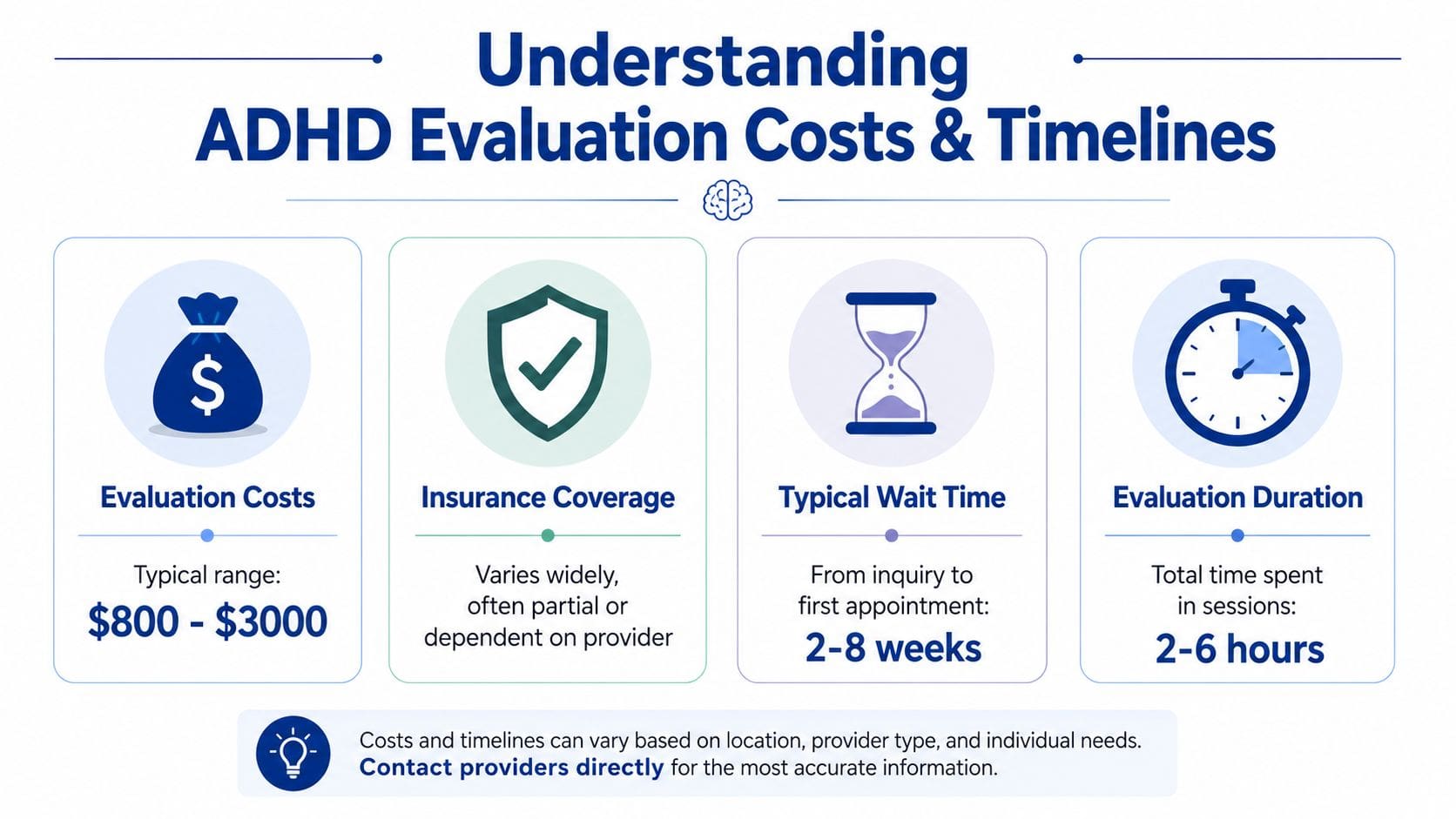
Philadelphia adults now have two realistic paths for ADHD care. They can pursue a traditional in-person evaluation, or they can choose a telehealth-first model. Neither is automatically better. The right fit depends on complexity, logistics, and what kind of follow-up care is needed.
Where telehealth works well
For many adults, telehealth is the more practical option. It removes commuting, parking, waiting rooms, and the friction that often causes people with ADHD to postpone care in the first place. It also expands access across Pennsylvania, which matters when local in-person specialists have long waits or limited scheduling.
Telehealth can still be rigorous. The key is whether the clinician conducts a full diagnostic interview, gathers a meaningful history, and screens for competing explanations. Some practices also add objective testing when appropriate. One Philadelphia-area provider describes QbTest as a 15 to 20 minute continuous performance task with motion tracking that measures attention, impulsivity, and activity compared with age- and gender-matched norms, as outlined in this QbTest overview from Complete Mind Care of Pennsylvania. Used appropriately, that kind of tool can complement the interview rather than replace it.
Adults who want statewide virtual access can compare models such as online ADHD care in Pennsylvania, which outlines what telepsychiatry-based evaluation and follow-up typically involve.
When in-person may make more sense
In-person care still has advantages in some cases. It may be preferred when the presentation is unusually complex, when someone wants a traditional office setting, or when a broader medical assessment is part of the picture. Some people communicate better face to face, and that matters.
A side-by-side view helps:
Telehealth often fits best for
- Busy schedules: Less disruption to work and family responsibilities
- Privacy concerns: No waiting room exposure
- Ongoing treatment: Easier follow-up once diagnosis is established
In-person may fit better for
- Complex presentations: Multiple overlapping concerns that may need broader in-office assessment
- Documentation-heavy cases: When the referral path leads toward formal testing
- Personal preference: Some adults feel more focused in a clinic environment
The weak approach is choosing based only on speed. The stronger approach is choosing based on what the evaluation needs to accomplish.
Navigating Costs Insurance and Timelines
For many adults, the hardest part of getting evaluated isn't the diagnosis. It's sorting out cost, coverage, and how long the process will take. Philadelphia options vary a lot, and that variation usually reflects scope.
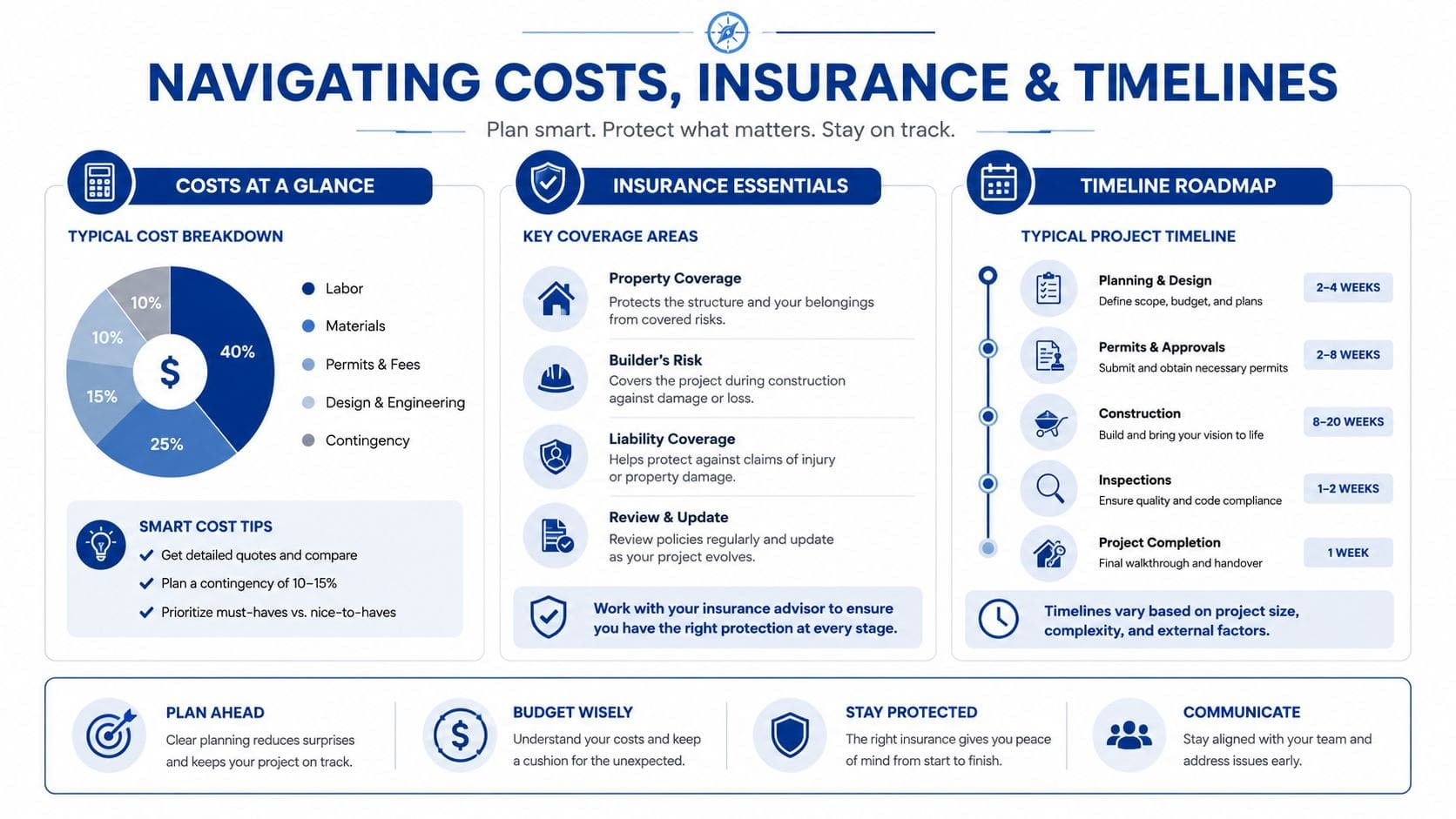
What people are really paying for
Adults are often comparing two very different services without realizing it. A focused telehealth diagnostic visit is designed to determine whether ADHD is present and whether treatment planning can begin. An in-depth assessment is built to generate deeper documentation, often for accommodations or more complicated questions.
Local pricing reflects that split. For adults in Philadelphia, ADHD evaluation cost and wait time can range from around $300 for a focused virtual visit to over $5,000 for an in-depth assessment with a multi-week wait, according to this Philadelphia ADHD testing cost overview from the Sachs Center. That's a major gap, and it's one reason adults should decide early whether they need diagnosis and treatment, accommodation paperwork, or both.
The cheapest option isn't always enough. The most expensive option isn't always necessary.
Insurance adds another layer. Some plans cover psychiatric evaluation differently than formal testing. Some cover out-of-network services with reimbursement. Some apply benefits only after the deductible. Adults who don't verify this ahead of time often feel blindsided.
Questions to ask before booking
A short checklist can save a lot of frustration:
- What type of evaluation is this? Ask whether it's a psychiatric diagnostic evaluation, computer-based testing, or full psychoeducational or neuropsychological testing.
- What documentation is included? A diagnosis note and a formal accommodation report are not the same thing.
- Is the provider in-network or out-of-network? That changes the actual cost.
- How many visits are usually required? Some evaluations happen quickly. Others unfold over several appointments.
- What is the timeline from intake to feedback? Fast access matters, but so does completeness.
Some adults prefer a transparent cash-pay model because it removes insurance uncertainty. One telehealth option in Pennsylvania is this ADHD testing cost guide, which discusses practical pricing considerations and service scope in plain language.
The best financial decision is usually the one that matches the actual purpose of the evaluation. Paying for the wrong level of assessment often costs more than paying for the right one.
After the Diagnosis Your Treatment Options
An ADHD diagnosis should lead to a plan, not just a prescription. Adults often feel relief once they understand the pattern, but insight alone doesn't improve missed deadlines, forgotten tasks, or emotional overload. Treatment has to translate into daily functioning.
National data shows how often care remains incomplete. According to the 2022 National Survey of Children's Health summarized by the CDC, an estimated 7 million U.S. children ages 3 to 17, or about 11.4 percent, have ever been diagnosed with ADHD, and about 30 percent of children with ADHD received neither medication nor behavior treatment, as described by the CDC's ADHD data summary. That figure applies to children, not adults, but it highlights a broader care gap. Diagnosis without complete follow-up remains common.
Medication is only one part of treatment
Medication management can be effective for many adults, but it isn't the whole plan. The most useful treatment model usually combines several elements based on symptom pattern, coexisting conditions, and real-life demands.
Core components often include:
- Medication management: When appropriate, stimulant or non-stimulant options can be adjusted based on focus, side effects, sleep, appetite, and daily function.
- Therapy for ADHD-related patterns: This may include work on shame, procrastination, perfectionism, emotional regulation, and habit loops.
- Support for coexisting conditions: Anxiety, depression, trauma, or sleep problems often need treatment alongside ADHD.
- Behavioral structure: Calendars, reminders, simplified workflows, and external accountability matter more than people expect.
One telehealth-based option in Pennsylvania is Integrative Psychiatry of America, which offers psychiatric evaluation and ongoing medication management within a broader whole-person model that can also address anxiety, depression, sleep, and lifestyle factors when clinically relevant.
Daily systems matter more than people expect
Adults with ADHD often hear advice that is technically correct but practically useless. “Use a planner” doesn't help if the system is too complicated to maintain. Treatment works better when it reduces friction.
That usually means building tools around how the brain already behaves:
- Shorter task capture: One trusted place for reminders instead of scattered notes
- Visible planning: External cues instead of relying on memory
- Transition support: Buffers between tasks so the day doesn't derail after one interruption
- Time realism: Estimating based on actual history, not optimistic intention
For adults who need concrete workflow ideas, this piece on practical time management for ADHD adults is a useful companion because it focuses on day-to-day execution rather than abstract motivation.
Treatment is working when daily life becomes less fragile. There's less scrambling, less shame, and fewer preventable crises.
How to Choose a Trusted Philadelphia ADHD Provider
A strong provider should make the process clearer, not more confusing. Adults looking for an ADHD evaluation Philadelphia services offer should check the basics first, then the details.
A short screening list helps:
- Credentials matter: Look for a qualified mental health clinician such as a board-certified psychiatric mental health nurse practitioner with experience evaluating adult ADHD.
- Process matters: The provider should explain how diagnosis is made, what history is reviewed, and how other conditions are ruled out.
- Scope matters: Ask whether the service is for diagnosis, treatment, formal testing, accommodations, or some combination.
- Transparency matters: Cost, insurance policy, and expected timeline should be explained before booking.
- Follow-up matters: A diagnosis is only useful if treatment and monitoring are available afterward.
Adults comparing provider types may also benefit from this explanation of psychiatric NP vs psychiatrist roles, especially when deciding who can evaluate, diagnose, and manage treatment.
The right provider is usually the one whose evaluation process matches the patient's actual goal, whose communication is clear, and whose care model can continue beyond the intake visit.
If getting evaluated has been sitting on a mental to-do list for too long, Integrative Psychiatry of America offers secure telehealth psychiatry across Pennsylvania, including Philadelphia, with ADHD evaluation, medication management, and whole-person follow-up care. Adults who want a practical next step can review services, verify fit, and request an appointment online.