
Searching for mental health care in Philadelphia often starts the same way. A person opens three browser tabs, compares provider profiles, wonders who prescribes medication, and tries to figure out whether an office across town is worth the commute. By the time the search reaches page two, the process can feel harder than the appointment itself.
That confusion makes sense. Philadelphia has a large, busy behavioral health ecosystem, and many listings for Philadelphia psychiatrists read like directories instead of practical guidance. People usually aren't just looking for a name and phone number. They're trying to answer more specific questions. Who treats adult ADHD well? Who offers telehealth? Who explains medication clearly? Who feels like a good fit?
This guide is written from the perspective of psychiatric nurse practitioners who work in modern outpatient care. The goal is simple: make the search easier, explain the trade-offs clearly, and help readers choose care that fits real life.
Table of Contents
- Navigating the Search for Mental Healthcare in Philadelphia
- Understanding Your Provider Options from Psychiatrists to PMHNPs
- Common Conditions That Prompt a Search for Psychiatric Care
- The Rise of Telepsychiatry in the Philadelphia Area
- How to Choose the Right Provider for Your Needs
- Your Next Steps to Getting Mental Health Care
Navigating the Search for Mental Healthcare in Philadelphia
A typical Philadelphia search starts with urgency and quickly turns into sorting. One listing says “medication management,” another says “therapy,” a third mentions telehealth without saying how follow-up works. Many people end up comparing office locations, insurance notes, and provider credentials while still feeling unsure about what kind of care they need.
Philadelphia's system is large enough to make that confusion understandable. The city's public behavioral health system serves over 180,000 residents annually, according to Philadelphia DBHIDS research and data reports. That scale tells readers two things at once. Demand is substantial, and getting matched efficiently matters.

What makes the search feel harder than it should
The first problem is information overload. A long directory of names doesn't answer whether a provider treats panic attacks, adult ADHD, trauma, or depression in a way that fits daily life.
The second problem is format mismatch. Many people want flexible care, but listings often still center office addresses and phone numbers rather than access details like virtual intake, refill workflows, or messaging systems.
Practical rule: A useful provider profile should tell a reader what conditions are treated, how visits happen, and what follow-up looks like.
A third issue is emotional. People often begin this search when they're already exhausted, distracted, discouraged, or overwhelmed. That means a complicated intake process can become one more barrier.
A better way to approach the search
It helps to stop searching for “the best” provider and start searching for the right care model. For some adults, that means medication evaluation plus ongoing follow-up. For others, it means therapy first, or a combined plan. For many, it means prioritizing telehealth because the main obstacle isn't willingness. It's time, transportation, or privacy.
Readers who are still deciding whether symptoms rise to the level of specialist care may find it helpful to review when to see a psychiatric specialist for evaluation and treatment. Outside Pennsylvania, the same principle applies. A person trying to find professional therapy in Penticton often faces the same challenge of matching symptoms, provider style, and access method rather than merely picking the first listing available.
The search gets easier once the goal changes from “find a name” to “find a system that can support ongoing care.”
Understanding Your Provider Options from Psychiatrists to PMHNPs
Many searches for Philadelphia psychiatrists are really searches for a prescribing mental health clinician. That distinction matters because psychiatrists aren't the only licensed professionals who provide psychiatric evaluation, diagnosis, treatment planning, and medication management.
Healthgrades lists nearly 1,600 specialists practicing psychiatry near Philadelphia, which makes provider type even more important when comparing options in a crowded market, as shown in Healthgrades psychiatry listings for Philadelphia. If a reader doesn't know the difference between an MD and a PMHNP, the directory won't do much of the decision-making for them.
Why provider type matters
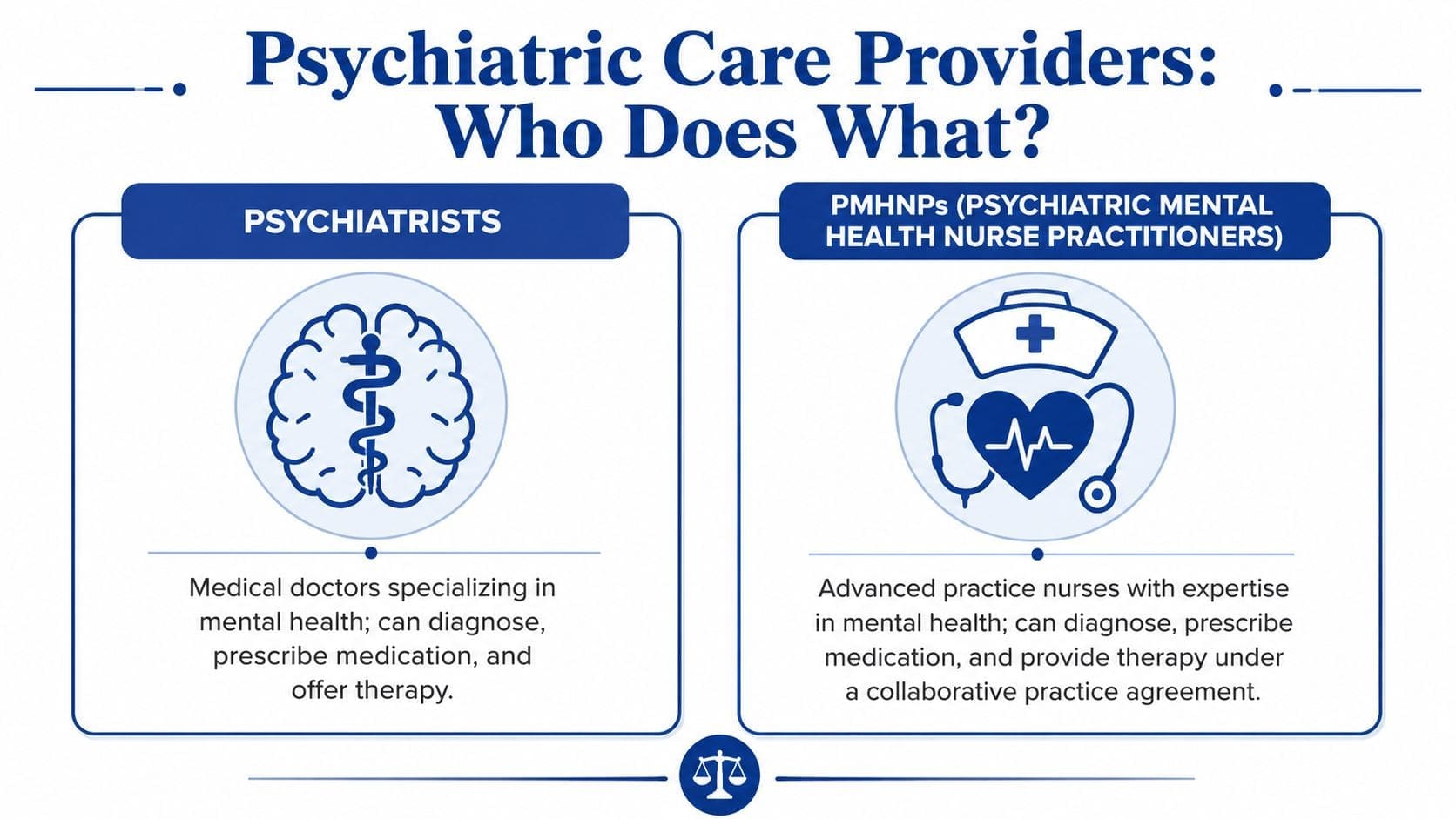
A psychiatrist is a medical doctor, either MD or DO, with specialty training in mental health. A Psychiatric Mental Health Nurse Practitioner, or PMHNP-BC, is an advanced practice registered nurse with graduate-level psychiatric training.
Both can evaluate symptoms, diagnose mental health conditions, prescribe medication, and provide elements of therapeutic support depending on practice structure and state rules. The difference is often in training pathway and clinical style, not in whether one person is “real” psychiatric care and the other isn't.
Many PMHNPs practice from a nursing framework that pays close attention to the whole person. That often includes sleep, stress load, medical history, daily routine, substance use, therapy readiness, and the practical realities that affect whether a treatment plan will succeed.
A side by side comparison
| Credential | Psychiatrist (MD/DO) | Psychiatric Nurse Practitioner (PMHNP-BC) |
|---|---|---|
| Education path | Medical school and psychiatry residency | Nursing training, advanced graduate education, psychiatric specialization |
| Can diagnose mental health conditions | Yes | Yes |
| Can prescribe medication | Yes | Yes |
| May provide therapy or supportive counseling | Yes, depending on practice | Yes, depending on practice |
| Typical lens | Medical psychiatric model | Nursing and whole-person psychiatric model |
| Good fit for | Complex diagnosis, medication management, specialty psychiatric care | Medication management, diagnostic evaluation, integrative outpatient care, ongoing follow-up |
The most useful question isn't “psychiatrist or PMHNP?” It's “Who can assess this problem carefully, explain options clearly, and follow the treatment over time?”
Readers comparing training paths in more detail can review PMHNP versus psychiatrist differences in outpatient psychiatric care.
What usually works best is less about title alone and more about fit, access, communication style, and continuity. A strong outpatient psychiatric relationship depends on whether the provider listens well, tracks change over time, and adjusts treatment thoughtfully.
Common Conditions That Prompt a Search for Psychiatric Care
Most adults don't begin by searching for a diagnosis. They search for a problem they can't keep absorbing into normal life. Trouble concentrating. Constant dread. A mood that won't lift. Sleep disruption after trauma. Rituals that consume too much time.
Philadelphia provider data reflects those common reasons for reaching out. In Psychology Today's Philadelphia psychiatry listings, providers show a high concentration of services for anxiety (96%), depression (93%), ADHD (72%), and PTSD (74%). That pattern means many people looking for psychiatric care in the city are dealing with the same core symptom clusters.

What these conditions look like in daily life
Anxiety isn't always obvious panic. It may look like relentless overthinking, muscle tension, irritability, avoidance, or spending the whole workday mentally bracing for something bad.
Depression doesn't always present as visible sadness. Many adults describe low motivation, emotional flatness, fatigue, guilt, loss of interest, or the sense that ordinary tasks have become heavier than they used to be.
ADHD in adults is frequently missed because people assume it would've been identified earlier. In practice, it can show up as chronic procrastination, poor task completion, disorganization, forgetfulness, time blindness, or the inability to sustain attention on routine work.
When symptoms justify an evaluation
PTSD and trauma-related symptoms can look like hypervigilance, sleep disruption, flashbacks, irritability, emotional shutdown, or feeling unsafe even in non-dangerous settings. OCD may involve intrusive thoughts, checking, reassurance seeking, contamination fears, or mental rituals that consume attention and time.
A psychiatric evaluation makes sense when symptoms are persistent, impairing, or increasingly hard to manage without help. That doesn't require a crisis. It requires recognizing that coping strategies aren't holding the line anymore.
Some of the clearest signs are practical ones. Work performance drops, relationships feel strained, sleep gets worse, or basic tasks start taking unusual effort.
Readers specifically wondering whether attention symptoms fit an ADHD pattern can review adult ADHD treatment considerations in Philadelphia psychiatric care.
The key point is that these conditions are treatable, but treatment works better when the evaluation is specific. “Stress” may be anxiety. “Burnout” may include depression. “Lack of discipline” may be untreated ADHD. Precision matters because treatment plans differ.
The Rise of Telepsychiatry in the Philadelphia Area
Psychiatric care fits telehealth better than many people expect. Much of outpatient psychiatry depends on conversation, symptom history, pattern recognition, medication review, side effect tracking, and follow-up. Those functions can translate well to secure video when the process is organized properly.
That matters in Philadelphia because many directories still present psychiatric care as an office-based search. As noted by Rittenhouse Psychiatric Associates' Philadelphia page, many provider listings focus on in-person visits and don't explain how telehealth works for initial appointments or ongoing medication management. For patients, that creates uncertainty right where clarity is most needed.
Why telehealth fits psychiatric care well
Telepsychiatry often reduces the exact barriers that keep treatment inconsistent. There's no commute, no parking issue, and no need to build an entire afternoon around a short follow-up. For working adults, caregivers, students, and people who feel drained by travel, that difference can determine whether care becomes consistent.
It can also improve privacy. Some patients are more comfortable speaking from home than sitting in a waiting room, especially when discussing trauma, panic symptoms, depression, or medication side effects.
One Pennsylvania option in this model is virtual integrative psychiatry services across the state, which offers online psychiatric care through secure telehealth. The broader point is that the best telepsychiatry systems explain the workflow clearly instead of expecting patients to guess.
What a telepsychiatry workflow usually includes
A strong telepsychiatry setup should make logistics straightforward:
- Initial evaluation with symptom review, history, goals, and diagnostic clarification.
- Medication planning when clinically appropriate, including a discussion of benefits, risks, and alternatives.
- Follow-up visits focused on response, side effects, adherence, and next adjustments.
- Patient portal support for forms, scheduling, refill requests, and routine communication.
Telehealth works well when the practice treats it as a full care model, not a video substitute for an office that still runs on office-only assumptions.
What doesn't work is vague messaging. If a provider says they offer telehealth but doesn't explain appointment flow, refill processes, or follow-up cadence, patients often end up uncertain about what happens after the first visit.
How to Choose the Right Provider for Your Needs
Choosing among Philadelphia psychiatrists and other psychiatric prescribers gets easier when the decision is based on care fit, not just availability. A fast opening is helpful, but it shouldn't be the only filter. Patients usually do better when they choose a provider whose treatment style, communication approach, and logistics match the problem they want solved.

A major issue in Philadelphia is that affordability and identity-safe access strongly shape real-world decisions, yet many general search results don't explain how to find care that fits those needs. The Philadelphia Citizen's mental health resource guide highlights that gap, especially for people who need culturally responsive or lower-cost pathways rather than a standard private-practice model.
Questions that actually help narrow the list
A practical search often starts with a short checklist:
What problem needs attention first
Someone with possible ADHD may need diagnostic clarity and structured follow-up. Someone with panic symptoms may need medication discussion plus therapy coordination.How should appointments happen
If travel, work hours, parenting, or privacy are barriers, telehealth may matter more than office location.What kind of communication feels workable
Some patients want a direct, medication-focused visit. Others want a more collaborative style with room for education and questions.Is the practice transparent about cost and insurance
Hidden administrative friction often becomes treatment friction later.
What integrative care changes in practice
Integrative psychiatric care doesn't mean replacing evidence-based treatment with vague wellness language. It means medication and diagnosis are handled seriously while also paying attention to sleep, nutrition, movement, substance use, therapy alignment, and patterns that worsen symptoms.
For example, a patient with anxiety and insomnia may need more than a prescription decision. Caffeine intake, evening routine, trauma triggers, work stress, and existing therapy support can all affect whether medication helps, partially helps, or creates new problems. An integrative approach looks at those variables early.
Readers exploring this style of treatment can compare integrative psychiatry options for modern outpatient mental health care.
A short video can also help clarify what to look for during the selection process.
Other decision points matter too:
| What to check | Why it matters |
|---|---|
| Clinical focus | A provider may be excellent generally but not especially aligned with trauma, ADHD, OCD, or mood disorders. |
| Follow-up structure | Good care depends on what happens after the first visit, not just the intake itself. |
| Cultural fit | Patients are more likely to engage honestly when care feels respectful, affirming, and safe. |
| Administrative ease | Scheduling, forms, refills, and portal messaging affect continuity more than most people expect. |
The right provider should feel clinically competent and operationally usable. If the process is too hard to maintain, treatment often stalls.
Your Next Steps to Getting Mental Health Care
The search becomes more manageable once it turns into a sequence of decisions instead of a giant open-ended project. Many individuals don't need to know everything before booking. They need to know enough to make a sound first move.
A practical next-step process looks like this:
Name the main concern clearly
Is the issue anxiety, depression, focus problems, trauma symptoms, compulsive thoughts, or medication review after previous treatment? Specificity helps match the right clinician.Decide what access model fits daily life
If consistency would be easier from home, prioritize telepsychiatry. If in-person care feels necessary, search accordingly.Compare providers by fit, not branding
Look for clarity on conditions treated, prescribing approach, follow-up structure, and whether the practice explains logistics in plain language.Prepare a few useful questions
Ask how the first evaluation works, how medication decisions are made, what follow-up intervals look like, and how refill requests are handled.Schedule before the search becomes another avoidance loop
Many people stay in research mode because committing feels harder than comparing. Progress usually begins when the appointment is on the calendar.
A first appointment doesn't lock anyone into a lifelong treatment path. It starts an assessment. Good psychiatric care is collaborative, and plans can be adjusted as the picture becomes clearer.
Integrative Psychiatry of America offers online psychiatric care in Pennsylvania through psychiatric nurse practitioners, with telehealth-based evaluation, medication management, and integrative treatment planning for adults seeking a more accessible path to care in and around Philadelphia.