
Somewhere between missed deadlines, unopened email, forgotten appointments, and the constant feeling of working twice as hard as everyone else, many adults in Philadelphia start typing the same search into Google: adhd diagnosis philadelphia. They’re not looking for a label. They’re trying to understand why life feels harder than it should.
That search often leads to more confusion. One practice offers therapy only. Another does testing but not medication. A hospital clinic has a long wait. A telehealth service seems easier, but it’s not always clear whether the evaluation will be thorough enough to trust. For adults who’ve spent years compensating, masking, or blaming themselves, the process can feel like one more obstacle.
Philadelphia has a real need for accessible ADHD care. In the city, 15% of public school students have an ADHD diagnosis, compared with the national average of 9.8%, according to local ADHD prevalence data reviewed here. That matters for children, but it also matters for adults who were never evaluated, were dismissed, or learned to push through symptoms without support.
For people who want a practical path forward, online ADHD care across Pennsylvania has changed the equation. A good telehealth evaluation can be structured, evidence-based, and far easier to access than the traditional wait-listed route.

Table of Contents
- Navigating the Path to an ADHD Diagnosis in Philadelphia
- Who Can Provide an ADHD Diagnosis in Pennsylvania
- The Adult ADHD Evaluation Process Explained
- How to Prepare for Your ADHD Assessment
- Navigating Costs Insurance and Timelines
- After the Diagnosis What Are the Next Steps
Navigating the Path to an ADHD Diagnosis in Philadelphia
An adult seeking an ADHD evaluation in Philadelphia usually arrives at the same crossroads. Symptoms have been present for years, but life has become less forgiving. Work demands more planning. Parenting requires more consistency. Relationships strain under forgotten tasks and emotional reactivity. What once looked like “being scattered” starts to look more like a treatable condition.
The local system can be tough to get through. Large institutions may offer excellent evaluations, but many patients run into delays, referral loops, and unclear next steps. That’s one reason telehealth has become such a practical option for adult ADHD assessment in Pennsylvania. It removes travel, reduces scheduling friction, and gives adults a way to start the process from home.
What tends to work
A reliable path usually has three features:
- Clear intake expectations so patients know what records, symptom history, and collateral information to gather
- A clinician who evaluates more than attention problems because anxiety, depression, trauma, sleep issues, and substance use can complicate the picture
- A plan after the diagnosis so the assessment doesn’t end with a document and no follow-through
Practical rule: The right evaluation should answer two questions at once. Is this ADHD, and what else needs attention before treatment starts?
Many adults delay seeking care because they worry they’ll be judged, dismissed, or told they’re “just stressed.” That fear is understandable. But a careful online ADHD assessment doesn’t rely on a quick checklist or a single symptom screener. It looks at the whole pattern across childhood, school, work, home life, and daily functioning.
What usually slows people down
Several barriers show up again and again in Philadelphia:
- Fragmented care where testing, diagnosis, therapy, and medication all happen in different places
- Long waits for traditional in-person evaluations
- Overreliance on self-diagnosis from social media clips or symptom lists without formal assessment
That last point matters. ADHD content online can help people recognize themselves, but it can’t confirm a diagnosis. Formal evaluation is what turns suspicion into a workable treatment plan.
Who Can Provide an ADHD Diagnosis in Pennsylvania
Not every mental health professional fills the same role, and that’s where many patients get stuck. Someone may search for an ADHD doctor Philadelphia, book the first available appointment, and only later learn that the clinician doesn’t diagnose adult ADHD, doesn’t prescribe, or doesn’t provide the documentation needed for work accommodations.
In Pennsylvania, several types of professionals may be involved in ADHD testing Philadelphia and diagnosis. The right fit depends on what the patient needs most: detailed psychological testing, diagnostic clarification, medication management, therapy, or some combination of those.
Psychologists psychiatrists and PMHNPs
A psychologist often focuses on testing and diagnostic assessment. That can be useful when the picture is complex, especially if learning issues, autism traits, or executive functioning problems need deeper exploration.
A psychiatrist may diagnose ADHD and manage medication, often with a stronger medical focus.
A board-certified psychiatric-mental health nurse practitioner can also evaluate ADHD, diagnose, prescribe when appropriate, and manage treatment over time. For many adults, that model is efficient because the same clinician can assess symptoms, review medical and psychiatric history, discuss therapy options, and continue medication follow-up without handing the patient off elsewhere. Patients comparing roles can review the differences between a psychiatric NP and other prescribers.
Why differential diagnosis matters
ADHD rarely shows up in a vacuum. A careful diagnostician has to sort out what belongs to ADHD and what may reflect another condition, or several at once. That’s especially important in adults who’ve spent years untreated.
A recent CHOP-led study found that 27% of autistic adults without intellectual disability had co-occurring ADHD, a 10-fold increase over the general population, based on a cohort of more than 3.5 million adults, as reported in CHOP’s summary of the study. That kind of overlap is exactly why rushed evaluations miss people.
The strongest evaluator isn’t the one who says yes the fastest. It’s the one who can explain why the diagnosis fits, what doesn’t fit, and what still needs monitoring.
A practical way to choose
When comparing providers, adults should ask:
- Will this clinician diagnose adult ADHD directly
- Can this provider prescribe if treatment is appropriate
- Will the report support workplace or school documentation if needed
- How does the clinician rule out anxiety, depression, trauma, sleep disorders, and substance-related causes
Those questions usually reveal whether the practice is built for quick throughput or careful care.
The Adult ADHD Evaluation Process Explained
Most adults feel less anxious once the process is concrete. A high-quality adult ADHD diagnosis isn’t a vague conversation. It usually follows a structured sequence designed to answer one core question: do the symptoms match ADHD well enough, across enough settings and over enough time, to support a diagnosis?
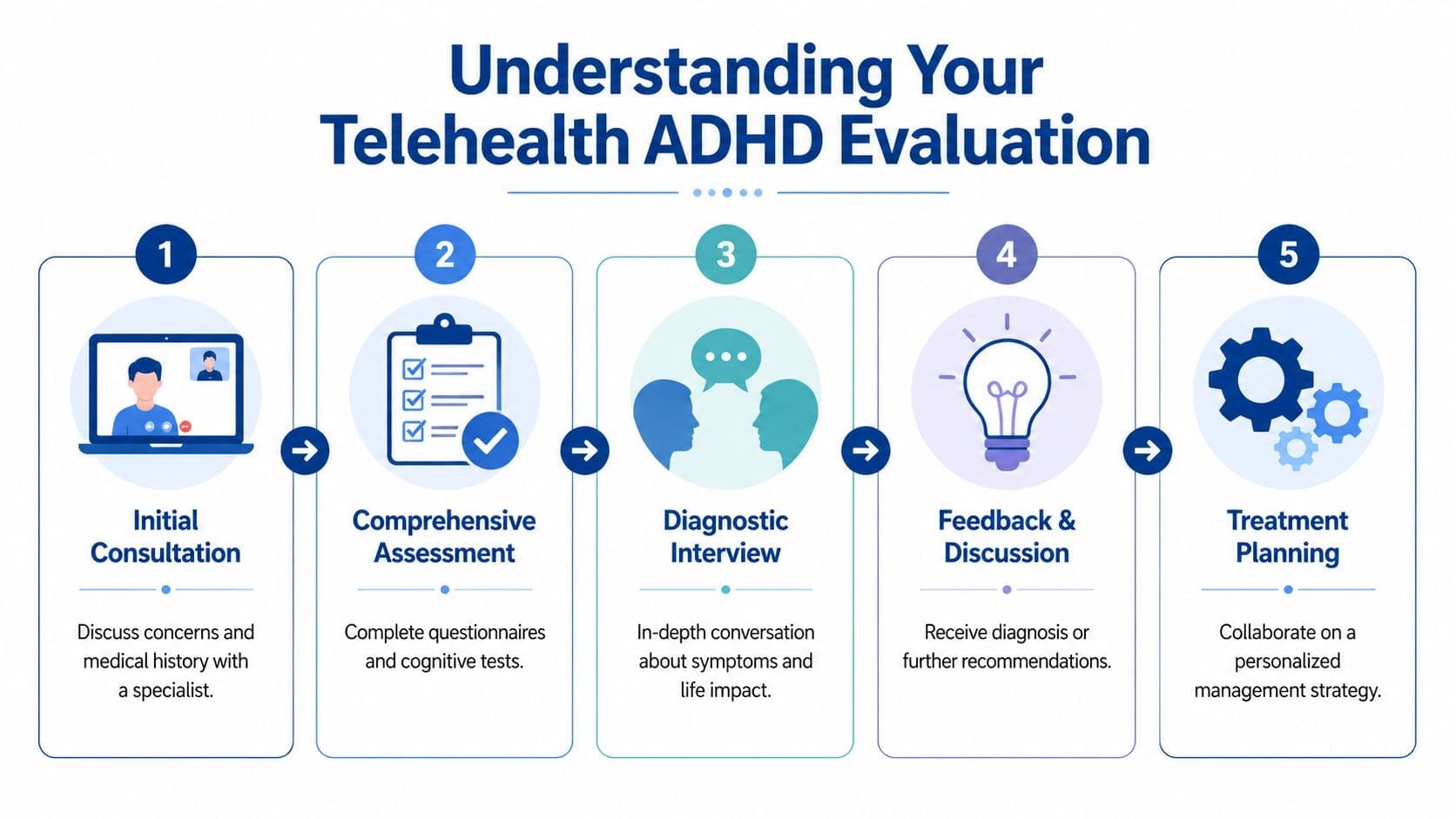
Phase one clinical interview
A standard evaluation begins with a 45 to 60 minute clinical interview, followed by objective computerized testing such as T.O.V.A., which has 87% sensitivity for detecting ADHD, according to this overview of adult ADHD testing methods. The interview covers far more than “Do you have trouble focusing?”
A good clinician asks about:
- childhood patterns, including whether symptoms were present before age 12
- school history, report cards, behavior notes, or patterns of underperformance
- work performance, missed deadlines, disorganization, procrastination, and distractibility
- driving history, financial management, relationship strain, and home routines
- sleep, anxiety, depression, trauma history, substance use, and medical issues
This phase matters because ADHD is a developmental disorder. If attention problems appeared only recently, the evaluator has to consider other explanations.
Phase two objective testing
The second phase often includes a computerized attention measure such as T.O.V.A. or QBTest. These tools don’t diagnose ADHD by themselves, but they add objective data to the clinical picture. That helps reduce the risk of relying only on self-report.
Some patients worry that testing will feel like an exam they can fail. It’s better to think of it as measurement. The goal isn’t to “perform well.” The goal is to capture patterns in attention, impulsivity, and consistency.
For people who like to review a plain-language overview before an appointment, Maeve's comprehensive ADHD summary gives a helpful primer on symptoms and common presentations.
Clinical reality: Self-awareness helps, but it isn’t enough on its own. Adults often underreport, overreport, or misattribute symptoms, especially when burnout or anxiety is also present.
What telehealth changes and what it doesn’t
Telehealth changes the setting, not the standard. Patients complete forms online, attend the interview by secure video, and may receive instructions for objective testing through a digital portal. That can make ADHD testing online much more manageable for adults who already struggle with commuting, parking, time off work, or waiting rooms.
What doesn’t change is the need for rigor. A credible online ADHD diagnosis still requires symptom history, diagnostic interview, objective measures when indicated, and a review of alternative explanations. Adults looking for more detail on formal assessment options can compare approaches to psychological testing for ADHD.
What doesn’t work well
The least helpful evaluations tend to have one of two problems:
- They’re too shallow. A short symptom checklist without developmental history leaves too much uncertainty.
- They’re too disconnected. The testing may be thorough, but there’s no treatment plan, no medication follow-up, and no practical guidance afterward.
Patients deserve both clarity and continuity.
How to Prepare for Your ADHD Assessment
Preparation makes the evaluation smoother and more accurate. It also lowers the stress level going into the appointment. Many adults worry they’ll forget key details once the conversation starts, and that concern is valid. ADHD symptoms often interfere with recall, organization, and sequencing.

What to gather before the visit
A simple prep file is often enough. It doesn’t need to be polished.
- Early evidence: Old report cards, teacher comments, prior evaluations, or family observations that suggest long-standing attention or impulsivity issues
- Current examples: Specific work errors, missed tasks, calendar problems, unfinished projects, or relationship conflicts tied to distractibility or disorganization
- Mental health history: Past diagnoses, therapy records, medication trials, and any side effects or reasons medications were stopped
- Medical background: Sleep problems, thyroid issues, head injuries, substance use concerns, or anything else that could affect concentration
A better way to describe symptoms
Broad statements like “can’t focus” don’t help as much as real examples. Strong evaluations rely on functional impact.
Instead of saying “work is hard,” it helps to note things like:
- forgetting meetings unless multiple reminders are set
- rereading the same paragraph several times
- starting tasks quickly but not finishing them
- losing track of bills, forms, or email threads
- feeling mentally overloaded by routine planning
Bring examples from more than one setting. ADHD should show up as a pattern, not only in one stressful environment.
A written symptom timeline also helps. Patients can make a brief list with three columns: childhood, teen years, and adult life. That format often reveals continuity that’s harder to explain out loud during a live appointment.
Questions worth writing down
Adults often leave an evaluation wishing they’d asked more. A short question list keeps the visit focused.
Consider asking:
- How do you distinguish ADHD from anxiety or burnout
- Will I receive documentation if accommodations are needed
- If ADHD is confirmed, what are the treatment options
- If it isn’t ADHD, what conditions are still being considered
For patients who want a non-diagnostic resource to organize symptoms before an appointment, CHADD’s ADHD information library can be a useful starting point. It won’t replace an assessment, but it can help patients arrive better prepared.
Navigating Costs Insurance and Timelines
Practical barriers stop a lot of adults before they ever schedule an evaluation. Cost matters. Insurance matters. Timing matters just as much. In Philadelphia, the difference between traditional in-person routes and telehealth often comes down to how much friction a patient can tolerate before giving up.
Traditional pathways can still be the right choice, especially when someone needs a very broad neuropsychological workup or has multiple unanswered diagnostic questions. But many adults aren’t looking for an academic battery. They want a credible ADHD diagnosis Philadelphia process that starts soon, fits around work, and leads to treatment.
ADHD diagnosis in Philadelphia compared
| Factor | Telehealth (e.g., Integrative Psychiatry of America) | Traditional In-Person Practice |
|---|---|---|
| Scheduling | Often easier to coordinate from home | May involve referral chains and fewer open slots |
| Travel | No commute, parking, or waiting room logistics | Travel time can add stress and missed work time |
| Format | Secure video visits and digital paperwork | Office visits, paper forms, and in-person check-in |
| Best fit | Adults who want convenience and continuity | Patients who prefer face-to-face visits or need broader testing |
| Follow-up | Often streamlined for ongoing medication and therapy planning | May require separate providers depending on the practice |
Philadelphia patients also run into long waits through major hospital systems. Some evaluation pathways take months, particularly when they depend on specialty referrals. Telehealth can shorten that path for adults who are ready to move forward now.
Insurance questions to ask before booking
Before scheduling any ADHD testing near Philadelphia, patients should verify:
- Whether the visit is billed as a psychiatric evaluation or psychological testing
- Whether follow-up medication visits are covered separately
- Whether documentation for accommodations carries any additional fee
- Whether out-of-network reimbursement is available
For adults paying out of pocket, it helps to review a transparent breakdown before the first appointment. One place to start is this overview of ADHD testing costs.
The real trade-off
The main trade-off isn’t telehealth versus in-person. It’s access versus complexity.
If the clinical picture is relatively straightforward, telehealth often works well and saves time. If the picture includes major learning concerns, legal documentation needs, or overlapping neurological questions, a more extensive in-person battery may still be appropriate.
That distinction matters because many adults don’t need the biggest evaluation available. They need the right one.
After the Diagnosis What Are the Next Steps
A diagnosis should create traction. It shouldn’t leave the patient holding a report with no roadmap. The most useful next steps combine symptom relief with practical changes at work, at home, and in daily routines.

Treatment usually works best when it is layered
For adults with confirmed ADHD, treatment may include medication, therapy, coaching strategies, or a mix of all three. Stimulants help some patients. Non-stimulants are a better fit for others. Therapy can help with planning systems, emotional regulation, and the shame that often builds after years of untreated symptoms.
A treatment plan is stronger when it addresses the rest of the person’s life too. Sleep quality, exercise, nutrition, and stress load all affect executive functioning. In practice, that’s why some adults benefit from care models that combine psychiatric evaluation with broader support. Integrative Psychiatry of America’s adult ADHD treatment options are one example of a telehealth model that includes medication management alongside psychotherapy and integrative services.
Workplace support is often missed
One of the most important steps after diagnosis has nothing to do with medication. It has to do with documentation. A detailed diagnostic report can support requests for ADA workplace accommodations, such as a quieter workspace or flexible scheduling, as explained in this discussion of ADHD testing and accommodations.
That matters for adults in fast-paced Philadelphia work settings where distraction, interruptions, and shifting priorities can make symptoms worse.
Useful accommodations may include:
- Environmental changes: quieter workspace, noise reduction tools, or remote work flexibility when appropriate
- Scheduling support: protected focus blocks, written task lists, or more structured deadlines
- Communication adjustments: follow-up instructions in writing instead of verbal-only directions
A diagnosis has practical value when it changes the environment, not just the chart.
Personalization matters after the diagnosis
Not every patient responds to the same medication, and not every concentration problem is purely psychiatric. Some practices now incorporate lab review and, when clinically appropriate, genetic screening to help guide treatment decisions and rule out contributors that can mimic or complicate ADHD. That’s especially useful for adults with mixed symptoms, medication sensitivity, or several prior treatment failures.
Patients also need day-to-day systems they can maintain. For readers looking for simple behavior strategies between appointments, Fluidwave's insights for ADHD productivity offer practical ideas for time management and task structure.
A short video can also help patients understand how treatment fits into everyday life:
The goal after diagnosis isn’t perfection. It’s less chaos, more consistency, and a plan that makes daily life feel manageable again.
If getting clear answers has been delayed by long wait lists, uncertainty, or the sheer effort of starting, Integrative Psychiatry of America offers secure telehealth psychiatric care across Pennsylvania, including ADHD evaluations and ongoing treatment planning for adults who want a structured, practical next step.