
A common Pennsylvania search starts late at night, after another hard day. Someone in Philadelphia, Pittsburgh, the Main Line, or a smaller town opens a laptop and types Integrative psychiatry near me because standard care hasn't felt complete. Medication may have helped only partly. Therapy may have helped, but sleep is still broken, focus is still poor, weight has changed, stress remains high, or side effects have made treatment harder to continue.
That search usually isn't really about geography. It's about finding a mental health clinician who looks at the full picture and can still make treatment practical. For many adults in Pennsylvania, that means remote care from a licensed psychiatric provider who can diagnose, prescribe when appropriate, monitor symptoms carefully, and build a plan that includes lifestyle drivers of mental health instead of treating them as an afterthought.
Table of Contents
- The Search for Better Mental Health Care in Pennsylvania
- What Is Integrative Psychiatry Really
- Common Treatments and Approaches You Can Expect
- Near Me in 2026 Why Telepsychiatry Is Your Best Local Option
- Choosing a Provider What to Ask Your Integrative Clinician
- Navigating Insurance and Affordability for Integrative Care
- Your Journey with Integrative Psychiatry of America
The Search for Better Mental Health Care in Pennsylvania
In Pennsylvania, many adults start with a simple hope. They want treatment that does more than refill a prescription every few months. They want someone to ask why anxiety worsens at night, why depression comes with exhaustion, why ADHD symptoms get worse with poor sleep, or why trauma treatment stalls when stress stays high.
That's part of why the search term integrative psychiatry near me keeps making sense to people who feel underserved by rushed care. Access is still a real issue across the state, especially when specialist appointments are limited. Pennsylvania's clinician shortage shapes what people can find, not just what they need, as discussed in this overview of the mental health provider shortage in Pennsylvania.
A local office may be close by, but it still might not offer the right level of specialization. A whole-person approach matters when symptoms are tied to daily patterns, physical health, medication response, and stress load.
Many adults aren't looking for “alternative” psychiatry. They're looking for psychiatry that feels complete.
A psychiatric nurse practitioner often plays a central role. A board-certified psychiatric nurse practitioner can evaluate symptoms, diagnose mental health conditions, prescribe and monitor medication when appropriate, and build a treatment plan that includes psychotherapy-informed care, symptom tracking, and practical changes involving sleep, nutrition, movement, and stress regulation.
For Pennsylvanians, telepsychiatry has changed what “near me” means. Instead of settling for the nearest clinic with an opening, patients can look for a Pennsylvania-licensed clinician whose care model fits their needs.
What Is Integrative Psychiatry Really
Integrative psychiatry is best understood as a stepped, measurement-informed model that combines standard psychiatric care with interventions aimed at modifiable drivers of symptoms such as sleep, diet, physical activity, substance use, and stress physiology, as explained by Integrative Psychiatry of America's overview of integrative psychiatry.
A whole-system check-up, not a wellness add-on
The easiest way to understand this approach is to think of it as a whole-system check-up for mental health. Traditional diagnosis and medication management remain part of care when they're indicated. But they aren't treated as the entire plan by default.
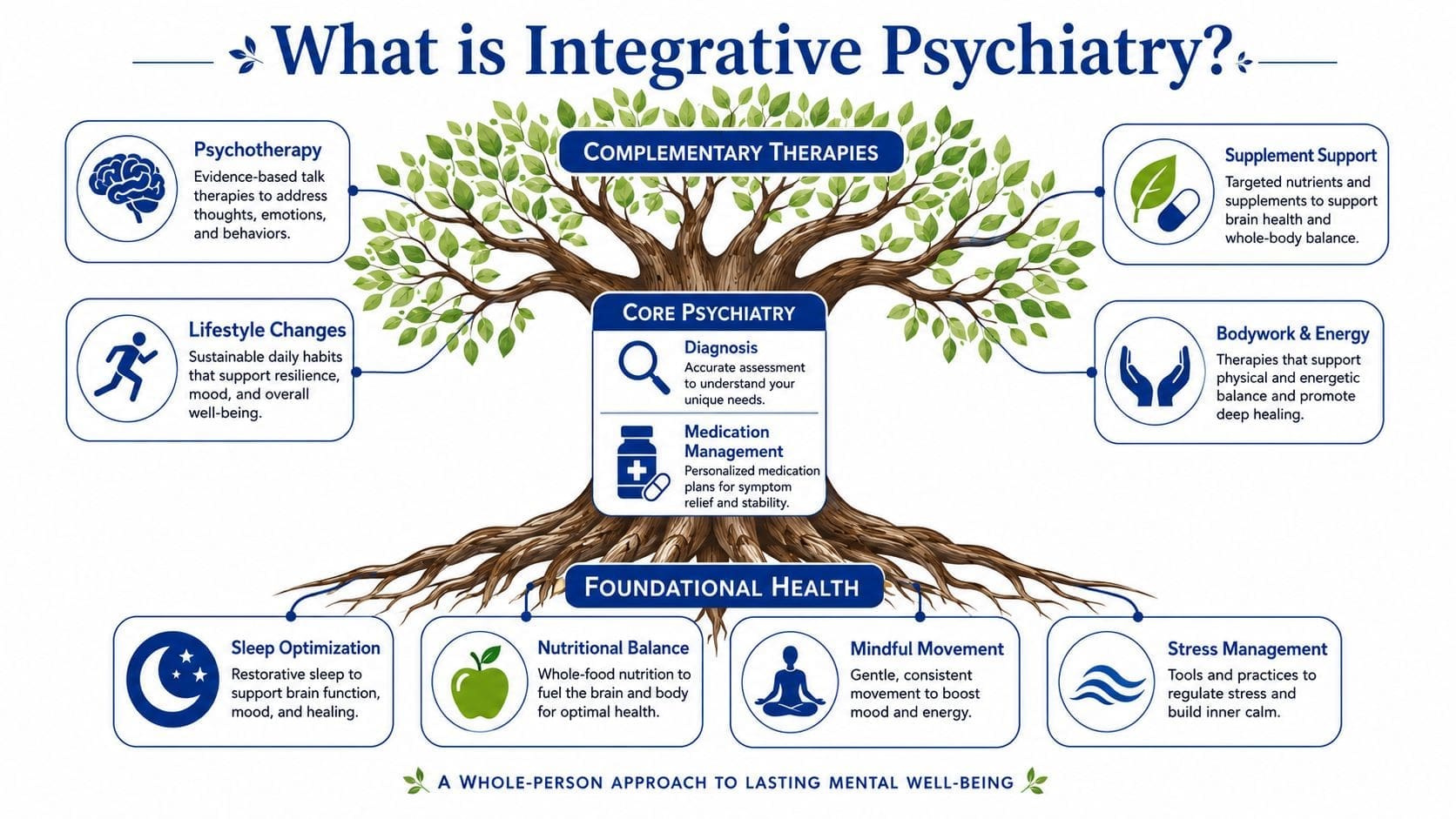
Clinical reviews support combination care. The same source notes that pairing medication or psychotherapy with lifestyle interventions improves outcomes for conditions such as depression, anxiety, and ADHD more reliably than using either path in isolation. That matters because symptoms often persist for reasons that aren't solved by a single tool.
A patient may say depression is the main problem. In practice, the maintaining factors may include circadian disruption, inactivity, poor nutrition, alcohol use, metabolic side effects, avoidance, or chronic overactivation of the stress response. Treating only the label often leaves those drivers in place.
What gets addressed in actual care
A real integrative plan usually looks less glamorous than online wellness marketing. It often starts with basics.
- Sleep and timing: bedtime drift, fragmented sleep, oversleeping, shift-work disruption, and morning light exposure all affect mood and attention.
- Nutrition quality: not as a fad diet, but as brain and body support. For patients trying to improve energy and digestion alongside mental health care, practical resources on nutrition for a healthy gut can help frame food choices in a realistic way.
- Movement: exercise isn't a punishment plan. It's a symptom intervention that can support mood, focus, and anxiety regulation.
- Stress physiology: breathwork, mindfulness, therapy skills, and schedule changes can reduce the constant “on” state many adults normalize.
A useful way to think about integrative care is that it's an and model, not an instead-of model. Medication can still be appropriate. Therapy can still be essential. Lab work may matter in one case and not in another. The clinician's job is to sort what's relevant from what's optional.
For a deeper look at that framework, this article on the integrative psychiatry approach lays out how whole-person psychiatric treatment is built.
Practical rule: If a treatment plan sounds broad but doesn't explain what will actually be measured, adjusted, or followed over time, it isn't very integrative. It's just vague.
Common Treatments and Approaches You Can Expect
An integrative practice uses a toolkit, not a script. The point isn't to give everyone the same blend of interventions. The point is to match treatments to the person's condition, history, goals, and barriers.
Medication management with context
Medication management in this model should never be reduced to “take this and report back.” It includes diagnosis, discussion of expected benefits and side effects, interaction review, and follow-up based on how symptoms change in real life.
For some people, medication is central. For others, it's one part of a broader plan. Integrative Psychiatry of America provides telehealth-based medication management alongside psychotherapy, nutritional education, exercise counseling, mindfulness support, and screening options for adults across Pennsylvania.
Medication decisions also work better when lifestyle factors are openly discussed. If sleep is severely disrupted, caffeine use is high, meals are erratic, or alcohol is being used to come down at night, those factors can blur whether a medication is helping.
Therapy, behavior change, and body-based support
Psychotherapy remains one of the strongest tools in psychiatric care. Depending on the person's needs, that may include CBT-informed strategies, trauma-focused work, behavioral activation, exposure-based principles, or skills for emotional regulation and obsessive thinking.
Lifestyle counseling isn't a side note. It often addresses the friction points patients feel every day.
- Nutritional counseling for mood and energy: useful when appetite changes, fatigue, binge-eating patterns, or inflammation-related complaints overlap with anxiety or depression. This article on how nutrition affects mental health gives a practical overview.
- Exercise planning for attention and stress: helpful for ADHD, low motivation, and anxious restlessness when generic advice like “work out more” hasn't translated into action.
- Mindfulness and nervous system regulation: techniques like paced breathing, grounding, and body awareness can be useful additions. Patients interested in practical somatic tools sometimes benefit from resources on vagus nerve stimulation techniques, especially when stress symptoms feel physical as much as mental.
Some interventions are simple without being small. Better sleep timing, steady meals, less alcohol, and structured movement can change the baseline that every other treatment is working against.
Labs, screening, and hormone-related questions
Some cases call for more investigation. The verified guidance for tele-integrative care notes that structured follow-up can include lab or genetic screening when indicated, especially when symptoms are heterogeneous or a clinician suspects contributing issues such as thyroid problems, B12-related mood symptoms, or medication-related metabolic risk.
That doesn't mean every patient needs every test. It means screening should be tied to a reason.
Questions around TRT, weight management, fatigue, libido, and concentration also need careful handling. A responsible approach pairs hormone or metabolic evaluation with attention to sleep apnea risk, cardiometabolic issues, and medication interactions before changing therapy. In psychiatric care, these aren't side topics. They can directly affect mood, cognition, and overall treatment response.
Near Me in 2026 Why Telepsychiatry Is Your Best Local Option
The old version of “near me” meant driving distance. For specialized mental health care, that definition often doesn't serve patients well anymore.

Near me now means licensed in Pennsylvania and accessible
For adults in Pennsylvania, the stronger question is this. Which licensed provider can deliver specialized care consistently, privately, and with enough follow-up to keep treatment moving?
That's where telepsychiatry stands out. According to Integrative Psych's discussion of remote personalized care, telepsychiatry is most effective when clinics use structured follow-up tools such as symptom rating scales, medication reconciliation, and lab screening when indicated. The same guidance explains that this helps personalized care for conditions like ADHD and depression be delivered remotely across large markets like Pennsylvania while preserving clinical rigor.
A patient in Center City and a patient in a rural county may both want the same thing. They want a clinician who's available, thoughtful, and able to manage care without turning every appointment into a travel project.
A closer look at online psychiatry in Pennsylvania makes that shift clear. Local no longer has to mean physically nearby. It can mean available where the patient lives.
What telehealth handles well and where it needs coordination
Telehealth works especially well for several core parts of psychiatric care.
| Care need | Often works well by telehealth | May need added coordination |
|---|---|---|
| Follow-up visits | Yes | Sometimes |
| Therapy and counseling | Yes | Rarely |
| Medication management | Yes | Sometimes |
| Lifestyle counseling | Yes | Rarely |
| Labs and vitals | Not directly | Yes |
| Controlled-substance monitoring | Case dependent | Often |
| Urgent risk assessment | Limited | Often |
That tradeoff matters. Convenience alone isn't enough. The better model is telehealth plus smart coordination.
The following video gives a useful snapshot of how virtual psychiatric care fits modern treatment expectations.
As the verified guidance notes, tele-mental health use has remained well above pre-pandemic levels, while some patients still face barriers such as broadband reliability, private space, or continuity of care. That's why good remote care includes realistic planning. If a patient needs labs, injections, vitals, or urgent in-person assessment, the clinician should say so clearly and arrange the next step instead of pretending everything belongs on a screen.
Choosing a Provider What to Ask Your Integrative Clinician
A polished website doesn't tell a patient how a clinician practices. Better questions do.
Questions that reveal how a clinician actually practices
The most important question may be the simplest one. Which parts of your integrative care are evidence-based for my condition, and which are optional? That question helps separate trial-supported treatment from general wellness language, as noted in Psychology Today's discussion of integrative care comparisons.
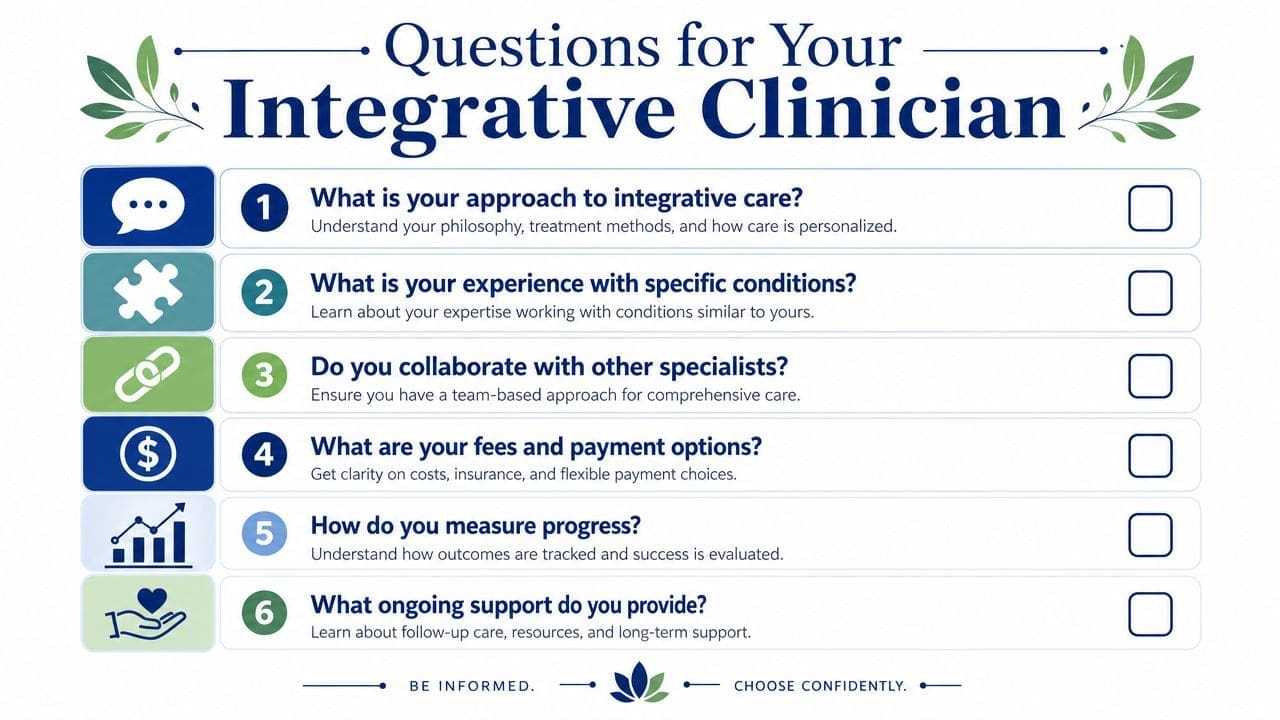
Patients searching for integrative psychiatry near me should also ask:
- How do you diagnose before recommending treatment? A provider should explain the assessment process, not just the menu of services.
- How do you measure progress? Symptom check-ins, side effect review, goal tracking, and functional changes matter more than a vague “How are you doing?”
- When do you use labs or genetic testing, and when don't you? This shows whether testing is clinically reasoned or packaged into the brand.
- How do you handle complex cases? ADHD, PTSD, OCD, substance use, and weight-related concerns often require extra coordination.
- What happens if telehealth isn't enough for one part of my care? A good answer includes referral or local coordination, not avoidance.
A clinician doesn't need to offer every trendy add-on. A clinician does need to explain why each recommendation belongs in the plan.
Why many patients choose a psychiatric nurse practitioner
A board-certified psychiatric mental health nurse practitioner is trained to evaluate symptoms, diagnose mental health conditions, provide medication management, and support psychotherapy-informed treatment. In integrative care, that can be especially valuable because patients often need both medical and behavioral thinking in the same visit.
For people comparing credentials, this breakdown of a psychiatric NP vs psychiatrist can help clarify roles and scope. The goal isn't to chase a title. It's to find a clinician who listens carefully, monitors treatment well, and can translate complex options into a clear plan.
Navigating Insurance and Affordability for Integrative Care
Cost stops many people before care even starts. That's understandable, especially when “integrative” sometimes sounds like a label for services that won't be covered.

How to think about payment without getting stuck
The most practical approach is to separate the visit itself from every possible add-on. Telepsychiatry appointments, follow-ups, and medication management may fall under mental health benefits depending on the plan. Some supportive services or external testing may be handled differently.
Patients usually benefit from asking for clarity on three fronts:
- What the appointment includes: evaluation, medication management, therapy-informed support, portal messaging, and follow-up structure.
- What insurance may cover: telehealth behavioral health visits, depending on plan rules.
- What might be separate: outside labs, supplements, or other services not included in a standard psychiatric visit.
Cash-pay and membership options can also make treatment more predictable for people who don't want to manage insurance uncertainty at every step. The right question isn't just “What does it cost?” It's “What care is included, and how often will I realistically need it?”
What to confirm before the first appointment
Before booking, patients should confirm benefits, visit type, refill policies, cancellation terms, and how testing or referrals are handled if needed later. That reduces surprise bills and helps compare options fairly.
Transparent practices make this easier by offering online insurance verification, straightforward scheduling, and written details about self-pay options. When affordability is discussed early, treatment tends to feel more manageable and less stressful.
Your Journey with Integrative Psychiatry of America
Starting care should feel organized, not overwhelming. For Pennsylvania residents, the usual path begins with online scheduling, insurance verification if desired, and secure portal intake forms that give the clinician a clearer picture before the first visit.
The first evaluation typically looks beyond a diagnosis label. Symptom patterns, sleep, stress, prior treatment, medication history, physical health factors, goals, and daily functioning all matter. From there, a plan can include follow-up appointments, medication management when appropriate, psychotherapy-informed support, and coordination for labs or other in-person pieces if those are needed.
This model fits telehealth well. Verified guidance from Fusion Psychiatry's telehealth overview notes that tele-mental health has proven highly effective for follow-ups, therapy, and medication management, and that it works particularly well when remote counseling is paired with coordinated in-person labs when necessary.
That combination is often what Pennsylvanians are searching for when they type Integrative psychiatry near me. Not just convenience. Not just philosophy. A real treatment process that can happen at home without losing clinical seriousness.
Patients with anxiety, depression, ADHD, OCD, PTSD, opioid dependence, weight concerns, or more specialized needs such as first responder or gamer-focused support often need care that adapts to their lives instead of forcing them into a one-size-fits-all system.
Pennsylvania residents looking for whole-person telepsychiatry can explore scheduling and care options through Integrative Psychiatry of America. The practice offers secure online psychiatric care, insurance verification, and a patient portal designed to make follow-up, communication, and treatment planning easier from anywhere in the state.