
A Pennsylvania adult may already be doing many of the “right” things for anxiety. They may have tried therapy, started medication, cut back on caffeine, and downloaded a meditation app. Yet the chest tightness is still there before meetings in Philadelphia. Sleep still falls apart in Lancaster. Sunday dread still starts early in Pittsburgh. The problem doesn't feel imaginary, and it doesn't feel solved.
That's usually when people start searching for whole-person therapy for anxiety. Some are looking for more support without more medication. Others want a plan that makes room for sleep, exercise, nutrition, stress load, hormones, daily habits, and medical causes of anxiety symptoms. What they need isn't vague wellness advice. They need a structured clinical pathway that treats the whole person without abandoning evidence-based care.
Table of Contents
- The Search for More Than Just Medication
- What Holistic Therapy for Anxiety Really Means
- Evidence-Based Holistic Approaches That Work
- Your Integrated Anxiety Treatment Pathway
- Practical Self-Help Strategies You Can Use Today
- Accessing Integrative Anxiety Care in Pennsylvania
- Frequently Asked Questions About Holistic Anxiety Treatment
- Is holistic therapy for anxiety covered by insurance
- Do patients have to stop current anxiety medication to begin integrative treatment
- What's the difference between an integrative psychiatric provider and a wellness coach
- How long does holistic treatment take to work
- When should someone seek professional help instead of self-help
The Search for More Than Just Medication
Many anxiety patients don't dislike medication. They dislike feeling as if treatment has been reduced to medication alone.
A common pattern looks like this. Someone starts an anxiety medication, gets partial relief, but still lives with poor sleep, stomach upset, muscle tension, avoidance, or a constant sense that their nervous system is “on” all day. Another person does good therapy work but keeps getting pulled backward by exhaustion, alcohol use, inconsistent meals, overtraining, chronic under-eating, or untreated medical contributors. The symptoms are emotional, physical, and behavioral all at once.
That's where integrative care becomes useful. It doesn't treat anxiety as a single broken part. It looks at the full operating system.
Anxiety rarely stays in one lane. It shows up in thoughts, sleep, muscles, digestion, work performance, relationships, and energy.
A practical example helps. A patient in Scranton might say the anxiety is “mostly mental,” but the actual daily problem is waking at 3 a.m., racing heart before driving, skipping breakfast, then crashing later and feeling panicky by evening. Another in Erie may say the medication helped, but they still don't feel well enough to function consistently. Those situations call for more than reassurance.
Sometimes patients also want clear information about symptom-specific tools. For example, Qaly discusses anxiety relief in the context of physical anxiety symptoms like a racing heart, which can help people understand why certain treatments target body symptoms while others target underlying worry patterns.
Integrated therapy for anxiety makes sense when standard care feels incomplete, not because standard care failed, but because many people need a broader plan. In clinical practice, that means using evidence-based mental health treatment while also addressing sleep rhythm, movement, nutrition, physical symptoms, stress physiology, and the daily routines that either stabilize or aggravate anxiety.
What Holistic Therapy for Anxiety Really Means
A patient in Pennsylvania will often say, “I want something more natural, but I also want something that works.” That is usually the actual question behind this term. In clinical care, the answer needs to be specific.
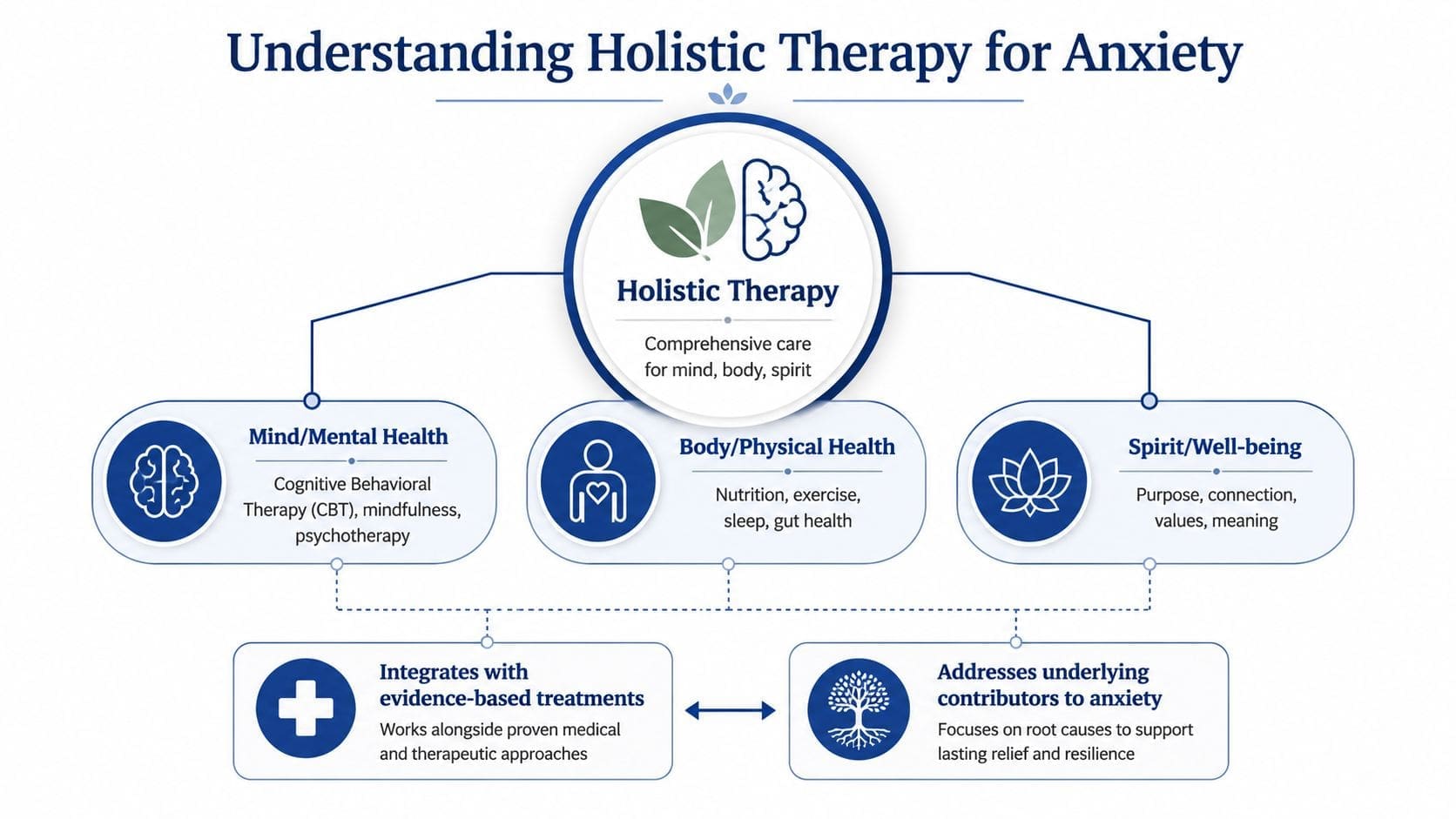
Integrative approaches for anxiety refer to integrative psychiatry, a structured treatment model that combines standard mental health care with selected lifestyle and complementary strategies that have clinical support. It includes diagnosis, symptom tracking, medication evaluation when appropriate, psychotherapy, and targeted work on sleep, physical tension, daily routine, and stress physiology. General wellness advice alone does not meet that standard.
Whole-person care is coordinated care
Good anxiety treatment works like coordinated care. One clinician or treatment team keeps the plan organized, checks for interactions, and decides which tools fit the actual problem. For one person, that may mean therapy plus sleep treatment. For another, it may mean relaxation training, a medication discussion, and a medical workup for symptoms that do not fit anxiety alone.
That process starts with practical questions, not vague labels.
- What diagnosis fits best, and how much is it interfering with work, parenting, sleep, driving, or relationships?
- What is maintaining the anxiety such as avoidance, poor sleep, alcohol, cannabis, stimulant use, perfectionism, or chronic overload?
- Which body-based strategies match the symptom pattern such as panic symptoms, muscle tension, GI distress, or insomnia?
- When is medical evaluation needed because thyroid problems, arrhythmias, medication side effects, trauma, or depression may also be present?
Research on mind-body treatments supports using them as part of a broader anxiety plan, especially relaxation-based approaches, as described in this review of mind-body interventions for anxiety disorders. That does not mean every supplement, breathing exercise, or wellness trend belongs in treatment. It means selected tools can help when they are matched to the diagnosis and monitored over time.
What this looks like in practice
A solid starting plan often includes a symptom inventory, review of current medications and supplements, screening for depression and trauma, and a close look at sleep timing, caffeine, appetite, exercise, and overstimulation. Telehealth can handle much of this well for patients across Pennsylvania, especially when the goal is to build a clear, stepwise plan instead of collecting disconnected advice. Patients who want to understand this model better can review this integrative psychiatry approach to mental health care.
Sleep often changes the whole picture.
Poor sleep can amplify physical anxiety, lower frustration tolerance, increase panic sensitivity, and make therapy harder to use in daily life. Patients sorting out that overlap may find this expert guide on anxiety and sleep useful.
A simple rule helps. If a treatment plan never addresses sleep, movement, substance use, physical symptoms, and daily structure, it is not whole-person care. It is partial care with a broader label.
Evidence-Based Holistic Approaches That Work
The most useful whole-person care isn't built from trends. It's built from interventions that have measurable support and make sense in daily life.
Mind-body treatments with solid support
Relaxation training is often underestimated because it sounds simple. It isn't simplistic. A systematic review and network meta-analysis of 65 studies comprising 5,048 participants found that relaxation therapy showed moderate to large effect sizes over treatment as usual for the acute phase of generalized anxiety disorder, with an overall effect size of 0.62 (Hedges' g). The same analysis reported that meditation showed a slight advantage over other interventions with g = −0.23 and a number needed to treat of 7.74, meaning roughly one additional person benefits meaningfully for every 8 treated, as summarized in this JAMA Psychiatry analysis of psychotherapy and complementary treatments for GAD.
That matters because these tools are practical. They teach patients how to interrupt overactivation instead of only talking about it.
Short, structured relaxation work often includes:
- Diaphragmatic breathing to slow respiratory overdrive and reduce the “can't get a full breath” sensation.
- Progressive muscle relaxation to target jaw, neck, shoulders, chest, and abdominal tension.
- Guided meditation for patients whose minds need an anchor, not silence.
Movement is treatment, not just a lifestyle tip
Exercise is one of the clearest examples of a holistic strategy that deserves to be treated like treatment. In a Swedish cohort followed prospectively for 2 years, people doing moderate to vigorous physical activity for more than 2 hours per week had an adjusted relative risk of 0.56 for anxiety symptoms compared with less active peers, according to this longitudinal study on physical activity and anxiety.
That finding supports something clinicians see every day. Movement helps many patients regulate baseline arousal, sleep pressure, concentration, and physical stress buildup. It also gives the day structure, which matters when anxiety thrives in unstructured time. Patients who need help building a realistic routine often do better with a simple exercise plan than with ambitious goals. An Exercise Routine Generator can make that easier, and a guide on how nutrition affects mental health can help connect daily food choices with symptom stability.
Nutrition matters, but it needs structure
Nutrition isn't a magic fix for anxiety. It is a major modifier of symptoms for some people.
The pattern is usually more important than any single food. Skipped meals, blood sugar swings, excess caffeine, alcohol for “winding down,” and dehydration can all amplify anxiety symptoms or make physical sensations easier to misread as danger. A patient who says they feel panicky every afternoon may be under-fueled, over-caffeinated, sleep deprived, and stressed at the same time.
For readers sorting through supplement claims, this roundup of holistic stress solutions can be a useful starting point, but supplements should still be reviewed clinically because “natural” doesn't always mean appropriate, effective, or safe.
| Modality | Level of Evidence for Anxiety | Best For |
|---|---|---|
| Relaxation therapy | Strong support from systematic review data | Generalized anxiety, panic symptoms, muscle tension |
| Meditation and mindfulness practices | Meaningful support, especially for symptom reduction | Rumination, stress reactivity, emotional overactivation |
| Aerobic exercise | Strong support | Baseline anxiety, sleep regulation, physical tension |
| Nutrition-focused habit change | Clinically useful, especially when symptoms are tied to routine | Energy instability, caffeine sensitivity, poor eating patterns |
| Grounding tools | Practical symptom management support | Acute anxiety spikes, dissociation, overwhelm |
A simple next step for symptom flare-ups is a 5-4-3-2-1 Grounding Tool. It gives the brain something concrete to do when worry becomes physically loud.
Your Integrated Anxiety Treatment Pathway
Good anxiety treatment feels organized. Patients usually do better when they know what happens first, what gets monitored, and what changes if symptoms don't improve.
Evaluation comes first
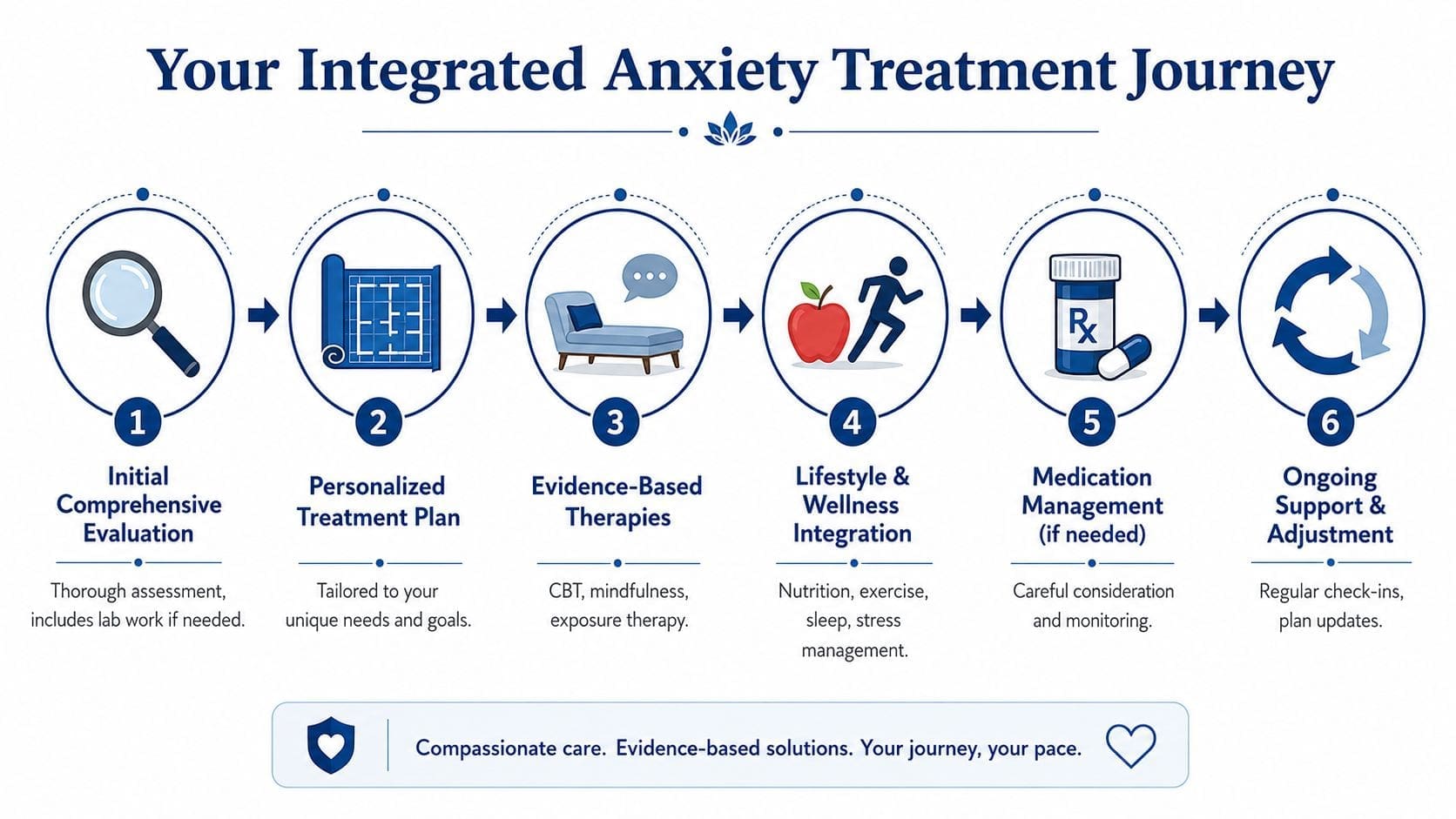
A real integrative plan starts with assessment, not assumptions. That means clarifying whether the main issue is generalized anxiety, panic, social anxiety, trauma-related anxiety, OCD symptoms, depression with anxious distress, or a mix. It also means reviewing sleep, appetite, substance use, energy, concentration, medications, and physical symptoms such as palpitations, dizziness, GI upset, or restlessness.
For some patients, medical review and lab work may be appropriate. Anxiety symptoms can be worsened by thyroid problems, medication side effects, stimulant overuse, poor sleep, or other health issues. The point isn't to overmedicalize distress. The point is to avoid missing contributors that keep treatment stuck.
Medication has a role, but not the only role
Many people search for integrative care because they're worried they'll be pushed toward medication too quickly. Others fear the opposite, that choosing integrative care means they'll be discouraged from using medication even when they need it.
That false choice causes problems. Relying exclusively on non-conventional interventions carries a critical risk of delaying necessary psychiatric intervention for severe anxiety disorders. Complementary approaches aren't standalone replacements for professional psychiatric care in severe cases, as discussed in this review on complementary and alternative medicine for anxiety disorders.
Severe anxiety needs medical judgment, not just coping tools.
Medication can be one tool among several. Some patients need it short term. Some need it longer. Some don't need it at all. What matters is matching the plan to symptom severity, functioning, safety, and patient preference. For people who do need prescriptions and follow-up, online medication management can be part of a broader treatment plan that also includes therapy, habit change, and symptom tracking.
Treatment changes as real life changes
The best plans are adjusted, not rigid. A person in Harrisburg who is doing well in summer may struggle in winter when routine drops, sleep shifts, and stress climbs. A patient in Reading may need exposure-based therapy later, once their nervous system is less reactive. Someone in Allentown may begin with medication support and then gradually focus more on exercise consistency, sleep timing, and therapy homework.
An integrated pathway often includes:
- Clarifying the diagnosis so treatment targets the right problem.
- Stabilizing the body through sleep, food, movement, and nervous system skills.
- Using therapy strategically for worry, avoidance, panic, or trauma patterns.
- Adding medication if indicated and monitoring response carefully.
- Reviewing progress regularly so the plan stays useful in real life.
Practical Self-Help Strategies You Can Use Today
Daily self-management won't replace treatment for moderate or severe anxiety, but it can lower symptom intensity and give the day more traction.

A short daily plan that lowers anxiety load
Most patients do better with small repeatable actions than with dramatic resets. A useful routine often includes only a few pieces.
- Start with one calm-down practice. Try slow diaphragmatic breathing for a few minutes after waking or before bed. The goal isn't perfect relaxation. The goal is signaling safety to the body.
- Write down the worry, then narrow it. A Feeling Journal works well when anxiety is vague. Instead of “everything feels wrong,” patients can name the trigger, body sensations, feared outcome, and one next action.
- Reduce decision fatigue. A Daily Agenda Planner can help structure meals, work blocks, breaks, movement, and bedtime. Anxiety often worsens in chaotic schedules.
- Protect the basics. Eat regularly, reduce late caffeine, and create a consistent wind-down routine before sleep.
A grounding resource can help turn these ideas into action. Patients looking for a concrete tool can use these grounding techniques for anxiety when symptoms start escalating.
A routine doesn't need to be impressive. It needs to be repeatable on a hard day.
When symptoms spike in the moment
Acute anxiety needs fast, simple tasks. Complex advice usually fails when the nervous system is already overloaded.
Try this sequence:
- Name five things in the room to interrupt tunnel vision.
- Unclench the jaw and drop the shoulders because body tension can keep the alarm cycle going.
- Lengthen the exhale slightly rather than trying to take giant breaths.
- Move the body with a short walk, gentle stretching, or stepping outside.
- Delay catastrophic interpretation. A racing heart during anxiety feels dangerous, but feeling alarmed and being in danger aren't always the same thing.
A brief video can also help patients practice calming skills in real time:
Accessing Integrative Anxiety Care in Pennsylvania
Many adults assume this kind of treatment only exists in major cities or boutique in-person clinics. That's no longer true.
Pennsylvania patients can access structured integrative mental health care from Philadelphia, Pittsburgh, Harrisburg, Erie, Scranton, Allentown, Lancaster, and Reading without driving across the state for appointments. For anxiety, that matters because long commutes, packed waiting rooms, missed work, and childcare logistics often become barriers to getting help.
Why virtual care fits anxiety treatment well
Telehealth works especially well for anxiety because much of the work depends on consistency, follow-up, and monitoring rather than physical office procedures. It also helps patients who avoid care because leaving home, commuting, or sitting in a medical office raises anxiety.
The evidence supports that access model. Meta-analyses of randomized controlled trials involving 1,814 participants found that psychiatric treatment for anxiety disorders delivered via telemedicine was statistically comparable to in-person treatment, with a standardized mean difference of −0.01, according to this meta-analysis on telemedicine treatment for anxiety disorders.
Who virtual care helps across Pennsylvania
Virtual care can be a strong fit for:
- Busy professionals in Philadelphia or Pittsburgh who need private appointments around work.
- Parents in suburban and rural areas who don't have easy access to specialty mental health care.
- College students and graduate students managing anxiety alongside demanding schedules.
- Adults with panic or social anxiety who are more likely to start care when the first step feels manageable.
One option available statewide is integrative anxiety treatment in Pennsylvania, which offers virtual psychiatric evaluations, medication management, and evidence-informed treatment planning through telehealth. For many patients, that makes it easier to begin care before symptoms become more impairing.
A practical next step is simple. Check insurance, review treatment options, and book an evaluation if anxiety is affecting sleep, work, relationships, or daily functioning.
Frequently Asked Questions About Holistic Anxiety Treatment
A common question I hear from patients across Pennsylvania is simple: “If I want more than medication, what does treatment look like, and will it be covered?”
Is holistic therapy for anxiety covered by insurance
Coverage usually depends on which part of care you're using. Psychiatric evaluations, follow-up visits, and medication management are often covered differently than coaching, supplements, or non-clinical wellness services. It helps to confirm benefits before the first appointment so you know what applies to telehealth visits, therapy, and prescription care.
Do patients have to stop current anxiety medication to begin integrative treatment
No. Whole-person psychiatric care often starts with a careful review of your current medication, what it helps, and any side effects or gaps. Changes are made only when there is a clinical reason, especially if anxiety is still disrupting sleep, concentration, work, or daily function.
What's the difference between an integrative psychiatric provider and a wellness coach
A licensed psychiatric provider can assess diagnosis, symptom severity, safety concerns, medical causes, and treatment options, including medication when needed. That matters because anxiety can overlap with depression, trauma, ADHD, thyroid problems, substance use, or medication side effects.
A wellness coach may help with routines and accountability. That can be useful, but it does not replace diagnostic evaluation or medical decision-making.
How long does holistic treatment take to work
The timeline depends on the type of anxiety, how long it has been present, how much avoidance has developed, and whether sleep problems, depression, trauma, or substance use are also part of the picture. Some people notice early improvement once sleep becomes more regular and they start using targeted coping skills consistently. Others need a longer course that includes therapy, medication, and repeated adjustments based on response.
The goal is steady functional improvement, not a quick fix.
When should someone seek professional help instead of self-help
Self-help can support mild symptoms. Professional care is the better next step when anxiety is persistent, getting worse, causing panic attacks, interfering with work or school, straining relationships, disrupting sleep, or leading you to avoid normal activities.
Medical care is especially important if symptoms feel hard to control, if you are using alcohol or drugs to cope, or if there are any safety concerns.
Integrative Psychiatry of America provides virtual mental health care throughout Pennsylvania, including support for anxiety, medication management, and integrative treatment planning. Patients can learn more about treatment options, verify insurance coverage, schedule an appointment, or explore free tools such as the Adult ADHD Assessment, Anxiety Symptom Checker, Daily Agenda Planner, Feeling Journal, Exercise Routine Generator, and 5-4-3-2-1 Grounding Tool.