
A positive pregnancy test can bring joy and panic in the same hour, especially for someone who relies on Vyvanse to stay organized, drive safely, work consistently, and manage daily life. The question usually comes fast: Can you take Vyvanse while pregnant? The honest answer isn't a simple yes or no.
Vyvanse, or lisdexamfetamine, is a stimulant used for ADHD. It works as a prodrug, which means the medication becomes active after the body processes it. That slower conversion is one reason many adults find it steadier than shorter-acting stimulants. For someone with significant ADHD symptoms, stopping it suddenly may not feel minor at all.
Pregnancy decisions around ADHD medication work best when they are thoughtful, individualized, and grounded in real evidence instead of fear. People often need help weighing fetal exposure concerns against the risks of untreated ADHD, such as missed appointments, poor follow-through, unsafe driving, or difficulty maintaining nutrition and routines. For readers who want a broader overview of ADHD diagnosis and treatment options, that guide can help frame where medication fits within full ADHD care. Readers can also explore how symptoms often show up differently through this discussion of ADHD in women and integrative treatments.
Table of Contents
- Introduction Navigating ADHD and Pregnancy
- What Is Vyvanse and How Does It Work
- Reviewing the Safety Data on Vyvanse in Pregnancy
- The Hidden Risks of Untreated ADHD in Pregnancy
- The Risk-Benefit Analysis A Clinician's Perspective
- Exploring Alternatives and Non-Drug ADHD Strategies
- Your Next Steps for ADHD Care in Pennsylvania
Introduction Navigating ADHD and Pregnancy
Learning about a pregnancy while taking Vyvanse can trigger immediate worry. Many adults with ADHD don't just use medication for concentration. They use it to manage executive dysfunction, emotional reactivity, time blindness, unfinished tasks, and the basic structure of day-to-day life.
That matters because this decision isn't just about a pill. It's about how a pregnant person functions without it. Some can taper off and do well with extra support. Others become unsafe behind the wheel, lose track of meals, miss prenatal follow-up, or struggle to keep work and home stable.
Why Vyvanse makes this decision complex
Vyvanse is an amphetamine stimulant prescribed for ADHD. Unlike a medication that works the moment it's swallowed, lisdexamfetamine has to be converted by the body into its active form. That conversion tends to create a smoother effect over the day, which is one reason many adults prefer it.
A practical problem follows from that benefit. If a medication has been helping someone maintain routines, show up on time, and regulate impulses, stopping it may create meaningful impairment.
Clinical reality: The safest plan in pregnancy is not always the plan with the least medication. It's the plan with the best balance of maternal functioning and fetal protection.
The first question isn't yes or no
A careful pregnancy medication discussion usually starts with a few basics:
- How severe are the ADHD symptoms: Mild distractibility is different from impairment that affects driving, employment, or home safety.
- What happened on past medication changes: Some people tolerate a dose reduction. Others unravel quickly.
- What other supports are available: Therapy, family help, structured routines, and work flexibility can change the equation.
People searching “can you take Vyvanse while pregnant” usually want certainty. What good care offers instead is a structured way to make a safer decision.
What Is Vyvanse and How Does It Work
Vyvanse is the brand name for lisdexamfetamine, a stimulant medication most often used for ADHD. It belongs to the amphetamine family. In plain terms, it helps some adults improve focus, reduce impulsivity, and complete tasks with less mental friction.
What makes Vyvanse different is its prodrug design. The capsule itself isn't the fully active drug at the moment of swallowing. The body converts lisdexamfetamine into its active form after absorption, which often leads to a more gradual onset and longer coverage.

Why the mechanism matters in pregnancy discussions
When patients ask whether they can take Vyvanse while pregnant, the medication's effect profile matters because it often isn't being used casually. People may rely on it for sustained focus across a workday, childcare responsibilities, school demands, or safe commuting.
That doesn't make it automatically appropriate in pregnancy. It does explain why “just stop it” may not be realistic for everyone.
A few core points help frame the discussion:
| Aspect | Why it matters |
|---|---|
| Stimulant class | Vyvanse is an amphetamine stimulant, so pregnancy discussions draw from broader amphetamine safety data. |
| Longer coverage | Symptom control may extend through much of the day, which can be important for functioning. |
| Functional role | Adults may depend on it for planning, follow-through, and impulse control, not just attention. |
What it helps and what it doesn't
Vyvanse can help with inattention, distractibility, procrastination, and task initiation. It may also improve the ability to prioritize and complete multistep responsibilities. For some adults, those gains are the difference between manageable days and chaos.
It doesn't fix every ADHD challenge. Sleep habits, emotional regulation, routines, therapy, and environmental structure still matter. Readers who want a fuller overview of stimulant options can review this guide to understanding ADHD medication.
Some patients function well enough without medication once supports are built around them. Others don't. That's why pregnancy planning around Vyvanse has to focus on the person, not just the drug name.
Reviewing the Safety Data on Vyvanse in Pregnancy
The most useful way to answer “can you take Vyvanse while pregnant” is to separate the risks people often lump together. The biggest fear is usually major birth defects. The evidence there is more reassuring than many expect. Other pregnancy outcomes still deserve attention.
Early in the evidence base, stimulant exposure in pregnancy raised broad concern because data were limited. Over time, larger studies have allowed more specific questions.
What the strongest available data suggest
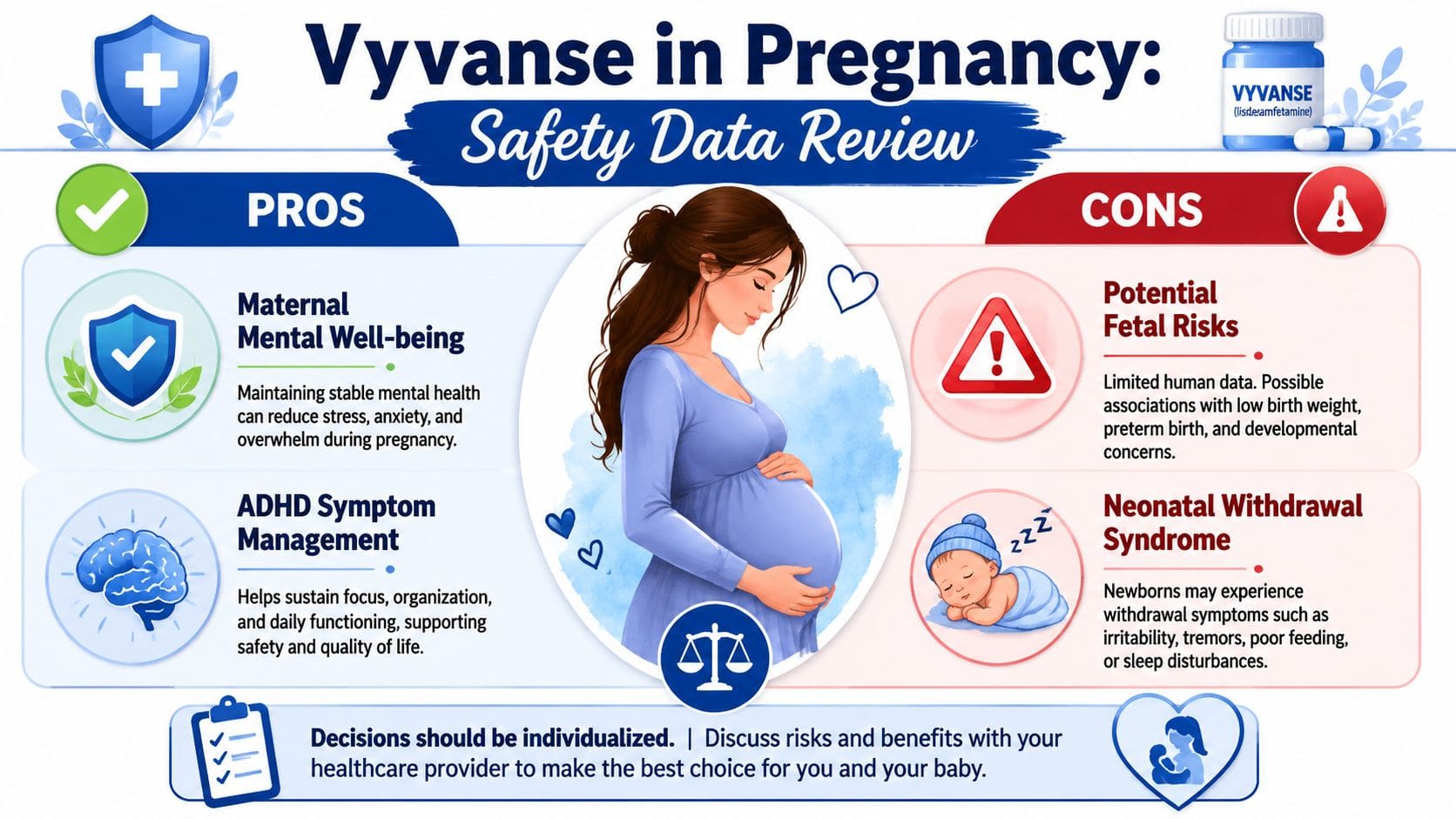
A large U.S. claims-based study published in 2023 and summarized in JAMA Psychiatry evaluated more than 5,000 stimulant-exposed pregnancies and found no significant increase in major birth defects with amphetamine-based ADHD medications such as lisdexamfetamine, while still noting smaller associations with preterm delivery, low birth weight, and gestational hypertension according to this review of Vyvanse and pregnancy safety.
That distinction matters. “No significant increase in major birth defects” does not mean “no possible risk at all.” It means the most feared outcome wasn't supported by that analysis, while other concerns remained on the table.
A broader evidence review also shows why these decisions still feel uncertain. A 12-study systematic review found that seven cohort studies showed no significant adverse maternal or offspring effects overall, while three studies found associations with outcomes such as pre-eclampsia and some congenital abnormalities. The review concluded that decisions should be individualized by balancing maternal functioning against fetal exposure uncertainty, as described in this systematic review on ADHD stimulants in pregnancy.
Why stopping isn't automatically the safest option
A common assumption is that discontinuing medication is always the safest move in pregnancy. That sounds sensible until the person's actual life is considered. If untreated ADHD leads to disorganization, inconsistent self-care, or impaired daily judgment, medication avoidance can create a different set of risks.
This video gives additional context for patients sorting through those trade-offs.
Breastfeeding and the perinatal period
Questions often continue after delivery. The same decision-making style applies then. Pregnancy, birth, postpartum recovery, sleep deprivation, and infant feeding all affect how tolerable ADHD symptoms feel and how cautious medication choices need to be.
For readers looking specifically at treatment planning around pregnancy, this overview of ADHD medication for pregnant women gives a practical framework.
The right question isn't whether risk exists. It does. The real question is which risks are most relevant for this patient, in this pregnancy, with this level of ADHD impairment.
The Hidden Risks of Untreated ADHD in Pregnancy
Medication risk tends to dominate online discussions, but untreated ADHD can disrupt pregnancy care in ways that are easy to underestimate. ADHD doesn't disappear because someone is motivated to protect a pregnancy. In many people, the added demands of pregnancy expose weak points in planning, consistency, and emotional regulation.
A patient may fully intend to eat regularly, take prenatal vitamins, attend appointments, answer OB messages, refill medications on time, and reduce stress. Intention isn't the problem. Execution is.
Where untreated symptoms show up in real life
Clinicians often look for functional consequences more than symptom labels. In pregnancy, those consequences may include:
- Missed prenatal follow-up: Time blindness, forgotten appointments, and poor task tracking can interfere with routine care.
- Inconsistent nutrition: Stopping to plan meals, shop, cook, and eat at regular intervals can be harder than it sounds for someone with executive dysfunction.
- Driving and safety concerns: Distractibility and impulsivity can affect transportation, commuting, and household safety.
- Emotional dysregulation: Frustration tolerance may drop, especially when sleep changes and physical discomfort are added.
These aren't abstract concerns. They shape maternal stability, and maternal stability affects pregnancy.
How clinicians weigh these risks against medication concerns
The practical comparison isn't medication risk versus zero risk. It's one risk profile versus another. That requires nuance.
A pregnant patient with mild ADHD who has strong support at home and flexible work might do well with a taper, therapy, and structure. A patient with severe symptoms, prior failed discontinuation, and a job that requires sustained attention may face a very different set of hazards off medication.
For readers interested in how ADHD medication decisions can intersect with anxiety and day-to-day functioning, this expert guide for ADHD medication decisions is a useful companion read.
When symptoms are severe, untreated ADHD can interfere with the very routines that protect a healthy pregnancy.
Practical signs that symptoms are impairing pregnancy care
A clinician usually becomes more cautious about full discontinuation if any of the following are already happening:
| Sign | Why it matters |
|---|---|
| Frequent forgetfulness | Prenatal care depends on repeated follow-through. |
| Loss of daily structure | Irregular meals, sleep, and medication adherence can snowball quickly. |
| Escalating overwhelm | Distress can reduce a patient's ability to use coping skills consistently. |
| Functional collapse at work or home | Major impairment may signal that non-drug strategies alone won't hold. |
The best plans acknowledge these realities early rather than after a patient is already struggling.
The Risk-Benefit Analysis A Clinician's Perspective
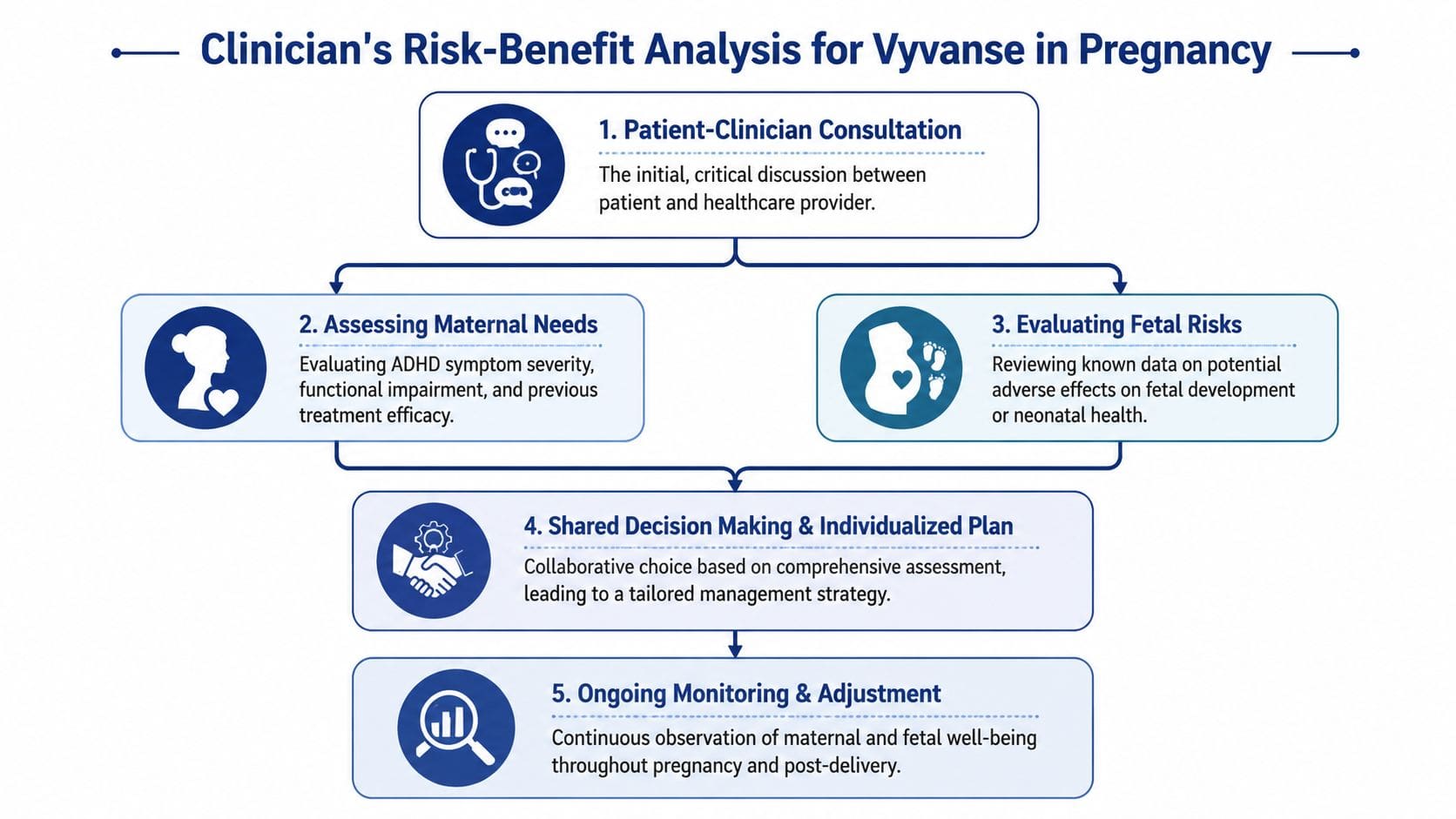
A thoughtful Vyvanse decision in pregnancy starts with one question: how much does the patient lose, functionally and medically, if the medication changes? Clinicians don't just ask whether a drug could pose risk. They ask what happens if it is removed, reduced, or replaced.
That process is more structured than many patients expect. It usually involves symptom severity, pregnancy history, blood pressure concerns, co-occurring anxiety or depression, social support, work demands, driving needs, and prior response to medication changes.
The medical concerns clinicians keep in view
Vyvanse is lisdexamfetamine, an amphetamine stimulant, and amphetamines are associated with pregnancy risks that are mechanistically plausible because they can increase blood pressure and vasoconstriction. That raises concern for preeclampsia, reduced placental blood flow, and preterm birth, and newborn withdrawal symptoms such as irritability, excessive drowsiness, and feeding difficulty have also been reported with in-utero exposure, as summarized in this review of Vyvanse and reproductive health.
Those mechanisms don't mean every exposed pregnancy will have those outcomes. They do explain why monitoring matters, especially if a patient already has blood pressure concerns or other obstetric risk factors.
The options usually considered
A clinician may lay out several paths rather than pushing one answer.
Continue the current medication with close monitoring
This may fit when ADHD impairment is significant and the patient has previously done poorly off medication.Reduce to the lowest effective dose
Some patients can preserve enough function with less exposure, though this only works if symptoms remain manageable.Transition to another treatment approach
Depending on history, a switch may be discussed, but only if there is a credible reason to think the change improves the balance of risks.Discontinue medication and build a support scaffold
This works best when symptoms are milder or when practical supports are strong and consistent.
What shared decision-making actually looks like
Good shared decision-making isn't a vague conversation. It usually includes:
- A symptom audit: Which ADHD problems are annoying, and which are dangerous?
- A functional review: Can the patient still manage work, meals, driving, and medical follow-up?
- A monitoring plan: Which clinician will track blood pressure, pregnancy progress, and medication effects?
- A contingency plan: What happens if the patient becomes significantly impaired after a taper?
One option for Pennsylvania residents who need structured medication review by telehealth is Integrative Psychiatry of America, which provides online psychiatric evaluation and medication management.
Decision point: The best plan is usually the one that the patient can realistically follow, not the one that sounds simplest on paper.
Exploring Alternatives and Non-Drug ADHD Strategies
Pregnancy care goes better when patients know they have more than two choices. The range of available options often includes continuing medication, adjusting it, or stepping back from it while actively building non-drug support.
For some people, that support is enough. For others, it helps but doesn't replace medication fully. Both outcomes are valid.
Non-drug strategies that can meaningfully help
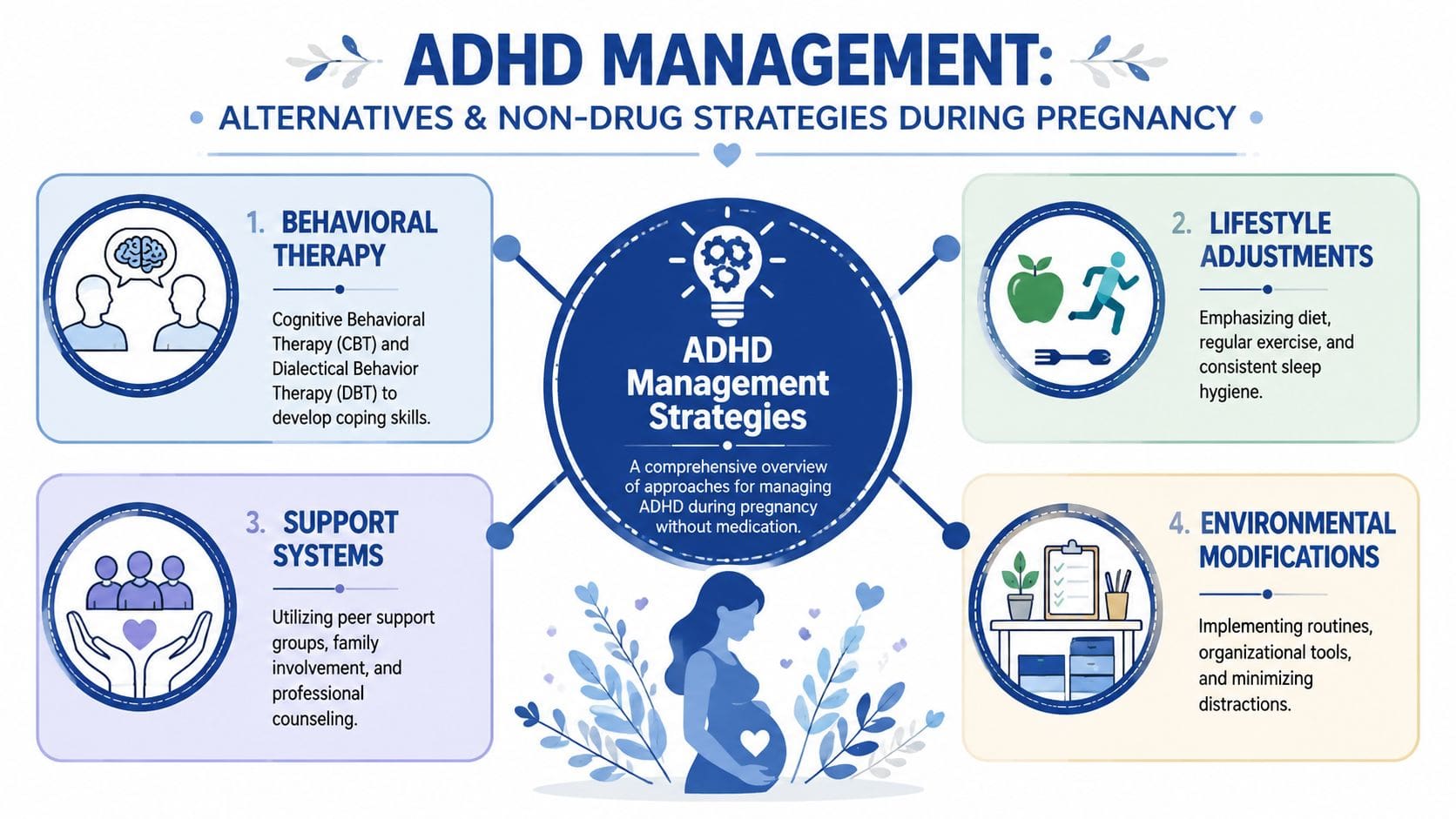
The strongest non-medication plans are concrete. “Try to stay organized” doesn't work. Specific systems do.
- Behavioral therapy: ADHD-focused therapy can help with planning, task initiation, emotional regulation, and realistic daily routines.
- Environmental design: Visual reminders, simplified storage, consistent item placement, calendar alerts, and written checklists reduce reliance on memory.
- Support people: Partners, friends, doulas, therapists, and family can help with appointment tracking, meal planning, and accountability.
- Sleep and movement habits: Pregnancy already strains energy and focus. Regular movement and stable sleep routines can make symptoms less chaotic.
Readers who want practical support on the movement side can review these notes on exercise and ADHD benefits.
When alternatives work best
Non-drug approaches tend to be most useful when symptoms are mild to moderate, or when medication changes are planned early and paired with strong follow-through. They are less reliable when someone already has major impairment, repeated missed obligations, or sharp decline without stimulant treatment.
A solid pregnancy ADHD plan often includes several layers at once:
| Strategy | Best use case |
|---|---|
| Therapy | Building coping tools and reducing overwhelm |
| Routines | Stabilizing sleep, meals, and appointments |
| External reminders | Offloading memory demands |
| Family support | Closing follow-through gaps |
| Medication review | Adjusting treatment when symptoms remain impairing |
The key is honesty. If a patient knows the planner won't be used, the reminders will be ignored, and the therapy homework won't happen consistently, the plan needs to reflect that reality.
Your Next Steps for ADHD Care in Pennsylvania
Patients in Pennsylvania don't have to sort through this alone or make a rushed decision after reading scattered advice online. Pregnancy medication decisions are common in psychiatric practice, and they deserve a calm review of risks, functioning, and alternatives.
A NIH/PMC review reported that stimulant prescriptions during pregnancy increased from 1998 through 2013, and in one cohort of 87 exposed women, 20.7% continued use into the second trimester, showing that this is a scenario clinicians increasingly manage in real practice according to this PMC review of stimulant use during pregnancy.
What to do before changing anything
Before stopping, skipping, or reducing Vyvanse, patients should gather the key details their prescribers and OB clinicians need:
- Current medication pattern: Dose, timing, and how consistently it's taken
- Functional impact: What gets harder when the medication wears off or is missed
- Pregnancy timeline: When pregnancy was confirmed and what trimester the patient is in
- Other health concerns: Blood pressure issues, prior pregnancy complications, anxiety, depression, or sleep problems
What a telepsychiatry visit can help with
A focused telehealth consultation can help a patient review symptom severity, discuss whether continuing Vyvanse while pregnant is reasonable, and map out monitoring and fallback options. For Pennsylvania residents seeking that kind of medication review, this online resource for ADHD medication management explains how telepsychiatry visits are structured.
The goal isn't to pressure someone toward continuing or stopping. It's to build a plan that fits the patient's real life, pregnancy needs, and safety concerns.
If you're in Pennsylvania and need help deciding whether to continue, taper, or replace ADHD medication during pregnancy, Integrative Psychiatry of America offers confidential telepsychiatry visits that review symptom burden, pregnancy considerations, and practical treatment options in collaboration with your broader medical care team.