
Some adults in Center City start looking for ADD treatment center city Philly after years of blaming themselves. Work is slipping. Bills get paid late. Email piles up. They can run a meeting, finish a shift, or manage a household, yet still lose keys, miss deadlines, and feel exhausted from trying to hold everything together.
Others are students or young professionals who were never diagnosed as children. They know they're smart. They also know that getting started, staying organized, and following through feels harder than it seems to be for everyone around them. In a city that moves fast, untreated ADHD can look like burnout, anxiety, low motivation, or chronic underperformance.
Philadelphia's need for accessible ADHD care is real. Philadelphia public school students are diagnosed with ADHD at a rate of 15%, compared with the national average of 9.8%, according to local reporting on ADHD prevalence in Philadelphia. That doesn't mean every distracted adult has ADHD. It does mean many people in this region are actively trying to get evaluated, treated, and supported.
For adults wondering whether this has been the missing explanation all along, learning how to get an ADHD diagnosis as an adult is often the first practical step.
Table of Contents
- Finding Your Path to ADHD Clarity in Philadelphia
- What to Expect From an ADD Treatment Center
- In-Person Care vs Online Telepsychiatry
- Evaluating Providers and Finding the Right Fit
- The Integrative Approach for Adult ADHD
- How IPA Serves Philly with Integrative Telepsychiatry
Finding Your Path to ADHD Clarity in Philadelphia
A common Center City pattern looks like this. Someone performs well enough to stay employed or get through school, but only by relying on last-minute urgency, caffeine, scattered reminders, and constant self-criticism. Friends call them creative. Supervisors call them inconsistent. They call themselves lazy, which is usually the least accurate explanation.
That's why the search for ADD treatment center city Philly matters. It's not only about getting medication. It's about finding a clinician who can separate ADHD from anxiety, depression, sleep problems, trauma, or simple overload. Adults often arrive feeling confused because the symptoms overlap.

Why the local landscape matters
Philadelphia has a busy, crowded treatment environment. There are large hospital systems, private therapy practices, primary care offices, and online mental health platforms. That can help, but it can also make care feel fragmented. One office may offer therapy but not medication management. Another may prescribe but not assess carefully. A third may focus mostly on pediatric ADHD.
Clinical reality: The right treatment plan starts with diagnostic clarity. A stimulant prescription without a careful assessment can create more confusion, not less.
Adults in the city also face practical barriers. Travel, parking, work schedules, caregiving, and privacy concerns all shape whether treatment is realistic. A plan that looks good on paper but doesn't fit daily life usually falls apart within weeks.
What a useful next step looks like
A strong starting point is simple:
- Track patterns: note procrastination, impulsivity, missed details, emotional overwhelm, and difficulty shifting tasks.
- Gather history: old report cards, prior therapy records, and family observations can help.
- Look at impairment: treatment is most useful when symptoms are affecting work, school, relationships, or home life.
People don't need to be in crisis to seek help. They only need enough friction in daily life to know something isn't working.
What to Expect From an ADD Treatment Center
A reputable ADD treatment center city Philly search result should lead to more than a booking page and a list of medications. Quality ADHD care has a structure. The provider should assess, diagnose carefully, explain options clearly, and follow progress over time.
The evaluation should be thorough
A real ADHD evaluation usually includes a clinical interview, symptom review, discussion of childhood history, and screening for other conditions that can look like ADHD. Good clinicians also ask about sleep, substance use, trauma, anxiety, and depression because each can distort attention.
If formal testing is needed, some adults benefit from psychological testing for ADHD. Testing isn't required in every case, but it can be useful when the picture is mixed, the history is unclear, or documentation is needed for work or school accommodations.
A rushed evaluation is a warning sign. ADHD affects concentration, motivation, planning, memory, emotional regulation, and task initiation. Those concerns deserve a careful review, not a five-minute checklist.
Treatment works best when it is layered
Philadelphia programs increasingly use multimodal treatment, meaning medication and therapy are combined instead of treated as competing options. According to Philadelphia-area clinical program information on multimodal ADHD care, evidence-based approaches that combine therapies such as CBT with medication produce better outcomes than medication alone or therapy alone.
That makes sense in practice. Medication may improve attention and reduce internal noise. Therapy helps the patient build systems that medication can't create by itself.
A strong plan often includes:
Medication management
Stimulant and non-stimulant options can both be appropriate. The question isn't which category is trendy. The question is which choice fits symptoms, medical history, side effect concerns, and day-to-day demands.Skills-based therapy
CBT is often used to target time blindness, avoidance, negative self-talk, and poor task sequencing. Some patients also benefit from coaching-style support around routines and accountability.Follow-up and adjustment
The first medication choice isn't always the final one. Dosing, timing, and tolerability need monitoring.
Treatment should reduce friction in real life. If a plan doesn't help someone get to work on time, finish administrative tasks, or manage a household more consistently, it needs revision.
A clinic doesn't have to offer every service under one roof to be effective. But it should be able to coordinate care and explain why each piece matters.
In-Person Care vs Online Telepsychiatry
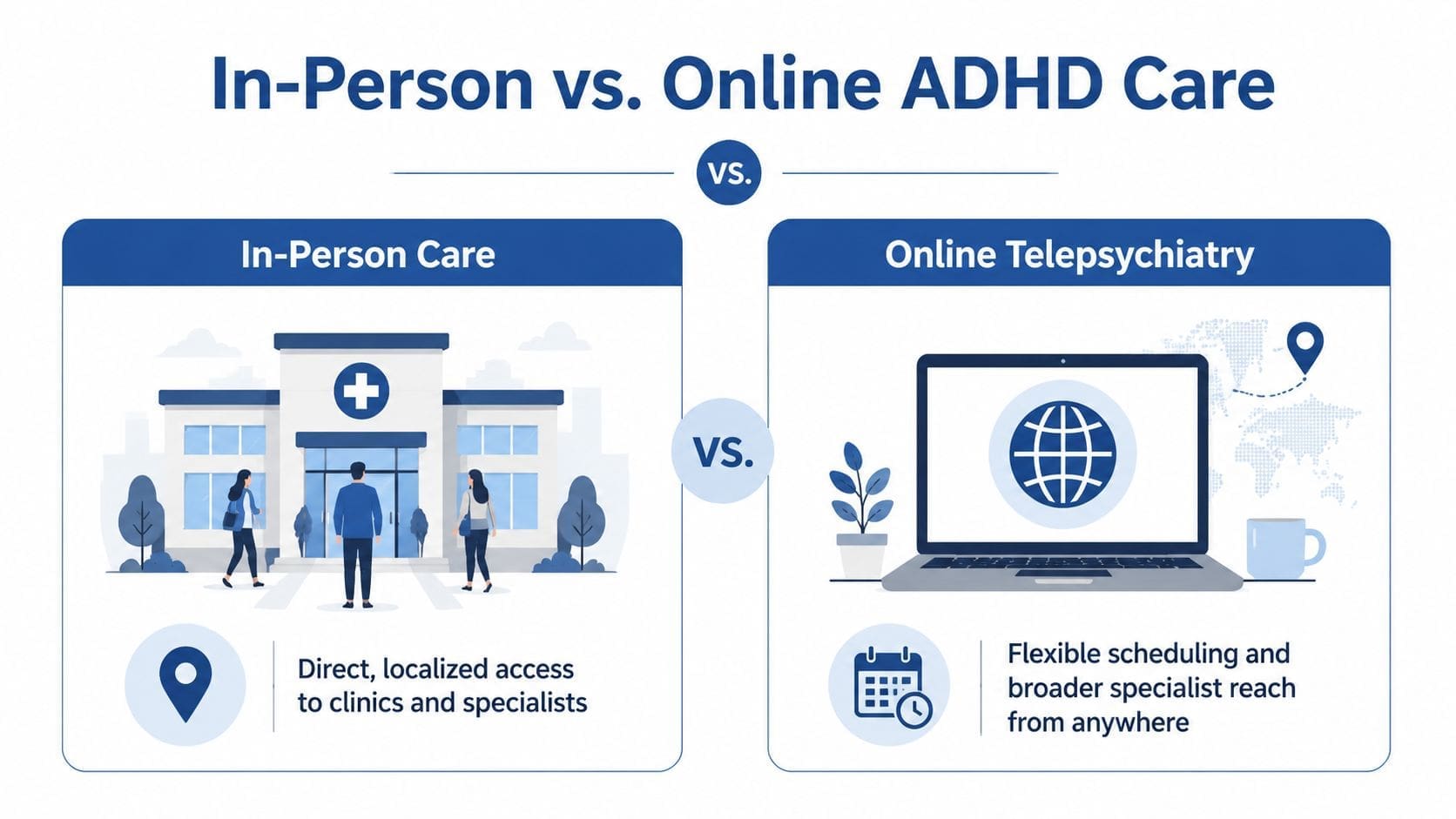
Choosing between a physical clinic and virtual care isn't just a convenience issue. It changes how quickly someone can get seen, how often they can follow up, and whether treatment is sustainable once life gets busy again.
Philadelphia families already know access can be slow. PhillyVoice's reporting on ADHD treatment access notes that specialist wait times for ADHD evaluations can stretch for months, and it also reports that the average age of diagnosis varies by severity.
Where in-person care still makes sense
Some patients prefer face-to-face visits. That preference is valid. In-person care can feel more grounded, especially for people who dislike screens or want a traditional office setting.
It may fit best when a person wants:
- A local office routine: some patients focus better when they physically leave home and attend an appointment.
- Closer coordination with nearby services: this can matter if therapy, family support, or school meetings are happening in the same system.
- A familiar medical setting: large clinics and hospital systems can feel reassuring to some adults.
Still, in-person care has trade-offs. Commutes, parking, waiting rooms, and time off work can all become barriers. For a patient with executive dysfunction, a treatment model that requires too much logistical effort can become another failed system.
Why telepsychiatry fits modern Philly life
Online care removes several friction points at once. A patient can attend from home, a private office, or even a parked car during a work break, as long as privacy and state rules are met. That flexibility matters for professionals, graduate students, parents, and adults whose symptoms make traditional scheduling hard to maintain.
For many adults searching for ADD treatment center city Philly, telehealth works well when they need:
| Decision point | In-person care | Online telepsychiatry |
|---|---|---|
| Travel | Requires transit, parking, or rides | No commute |
| Scheduling | Limited by office hours and travel time | Often easier to fit into workdays |
| Privacy | Public waiting rooms | More discreet for many patients |
| Follow-up consistency | Can drop off if logistics get hard | Easier to maintain routine care |
Pennsylvania residents who want a virtual option can review online psychiatry for ADHD care in Pennsylvania.
Virtual care isn't automatically better. It's better when it makes consistent treatment more likely.
The strongest choice is usually the one the patient can continue.
Evaluating Providers and Finding the Right Fit
Not every clinician who lists ADHD on a website offers the same level of assessment or follow-up. Some focus mostly on children. Others treat ADHD as a quick medication visit. Adults in Philadelphia often need someone who understands executive dysfunction, workplace impairment, and the overlap between ADHD, anxiety, and depression.

Philadelphia's behavioral health system includes integrated access pathways through CBH and DBHIDS. The CBH annual report also notes telepsychiatry options with initial evaluations starting at $225, which gives patients a concrete benchmark when comparing transparency and affordability.
What to ask before booking
A short screening call or website review can reveal a lot. Useful questions include:
How do they diagnose ADHD in adults?
Look for a process that includes history, symptom review, and differential diagnosis.Do they treat coexisting conditions?
Many adults don't have “pure” ADHD. Anxiety, depression, trauma, and sleep disruption often shape the treatment plan.What happens after the first visit?
Follow-up cadence, refill policies, and communication standards should be clear.Do they offer more than prescriptions?
The answer doesn't need to be all-inclusive, but the provider should talk about therapy, habits, sleep, and function.
Credentials and logistics matter
Patients often compare a PMHNP with a physician and aren't sure what the difference means. A helpful starting point is this overview of psychiatric NP vs psychiatrist. What matters most is whether the clinician is trained, licensed, attentive, and experienced with adult ADHD care.
A practical provider checklist looks like this:
- Licensure and scope: confirm they're licensed in Pennsylvania and can provide the services they advertise.
- Adult ADHD focus: a pediatric-heavy practice may not be the best fit for a working adult with subtle symptoms.
- Payment clarity: insurance, cash-pay, membership options, and cancellation policies should be easy to find.
- Communication style: patients do better when instructions are clear, follow-up is structured, and treatment goals are concrete.
A good fit doesn't mean the provider tells a patient what they want to hear. It means the provider explains decisions clearly and follows a consistent clinical process.
The Integrative Approach for Adult ADHD
Some adults improve quickly once the right medication and routine are in place. Others don't. They may feel slightly sharper but still tired, scattered, irritable, or inconsistent. That doesn't always mean the diagnosis is wrong. It may mean treatment is incomplete.

Philadelphia ADHD content often stops at medication and therapy. Yet local discussion of integrative ADHD care highlights a major gap. Nutritional deficiencies, gut-brain health, and genetics can affect symptoms and treatment response, but many local listings barely mention them.
Why medication alone sometimes falls short
Adults with ADHD often ask why a prescription helps attention but not follow-through, sleep, appetite regulation, or emotional reactivity. The answer is that ADHD rarely exists in isolation from the body's broader rhythms. Sleep debt, poor nutrition, stress load, and coexisting conditions can all blunt progress.
That's also why ADHD and comorbidity need attention together. For a practical overview, Orange Neurosciences' ADHD comorbidity resource is useful for understanding how overlapping conditions can complicate diagnosis and treatment.
An integrative plan doesn't reject medication. It places medication inside a larger framework.
What an integrative plan can include
Useful add-ons vary by patient, but these are the most common themes in adult care:
Nutrition review
Some adults function on coffee, takeout, and missed meals. That pattern can worsen focus, irritability, and energy crashes.Sleep optimization
A patient who goes to bed late, scrolls for hours, and wakes up depleted may look “medication resistant” when the bigger problem is sleep disruption.Exercise counseling
Movement can improve regulation, mood, and task initiation for many adults.Lab and genetic review when clinically indicated
Some patients benefit from looking more closely at biological factors that may influence symptoms or how medication is tolerated.
This short explainer gives a simple overview of how a broader treatment lens can work in practice:
The goal of integrative care isn't to make ADHD treatment more complicated. It's to remove obstacles that standard treatment sometimes misses.
For adults who've tried medication before and felt underwhelmed, this model can be more practical than repeatedly changing prescriptions without looking at the rest of the system.
How IPA Serves Philly with Integrative Telepsychiatry
A recurring problem in Philadelphia is the adult who never got recognized early. CHOP's ADHD center focuses on younger patients, and CHOP's ADHD program information reflects the broader local pattern in which pediatric pathways are easier to find than adult ones. Many adults are left trying to decide whether they have anxiety, depression, burnout, or ADHD that has been missed for years.
That gap is one reason telepsychiatry has become such a practical option for ADD treatment center city Philly searches. It can reduce travel friction, make follow-up easier, and support adults who need privacy around evaluation and treatment. It also fits people who can't reliably step away from work, classes, parenting, or caregiving to attend office visits in Center City.
One option available to Pennsylvania residents is virtual integrative psychiatry care in Philadelphia. Integrative Psychiatry of America provides all-virtual psychiatric care through psychiatric nurse practitioners, including ADHD evaluation, medication management, psychotherapy, and broader lifestyle-informed treatment planning. The model also includes a secure patient portal, which can simplify messaging, refills, and appointment coordination.
When this model fits well
This style of care tends to fit adults who:
- Need evaluation without a long commute
- Want ADHD care that also looks at anxiety, depression, sleep, or nutrition
- Prefer discreet treatment from home or work
- Have struggled with fragmented care across multiple offices
For many Philadelphia adults, the right treatment path isn't the most traditional one. It's the one that combines access, diagnostic care, medication oversight, and enough whole-person thinking to make the plan hold up in real life.
If ADHD symptoms are affecting work, school, relationships, or daily routines, Integrative Psychiatry of America offers a practical next step for Pennsylvania adults seeking virtual, whole-person psychiatric care. Patients can explore services, review care options, and request an appointment online.