
A parent in Pittsburgh may be searching late at night for a therapist who takes TRICARE. A service member near Harrisburg may already have a referral for counseling but still can't tell whether medication visits, virtual follow-ups, or more intensive treatment are covered. A spouse in Philadelphia may finally decide to seek help for anxiety, depression, ADHD, OCD, or PTSD, only to run into plan terms that seem written for administrators instead of families.
That confusion is common, especially when someone needs care now, not after days of reading policy pages. Tricare military insurance for mental health care in Pennsylvania can open the door to therapy, medication management, and telehealth, but the challenge is knowing which services are practical to use, when a referral is needed, and where the gaps still exist.
Clarity is paramount. Families across Philadelphia, Pittsburgh, Harrisburg, Erie, Scranton, Allentown, Lancaster, Reading, and rural parts of the state often need a direct answer to one question: what can be used today without getting stuck in insurance limbo?
Table of Contents
- The Search for Clear Mental Health Answers with TRICARE in Pennsylvania
- What Mental Health Services Does TRICARE Cover
- How to Find a Provider and Navigate Referrals
- TRICARE Prime vs Select Comparing Your Mental Health Costs
- Understanding Coverage Gaps and Integrative Solutions
- Start Your Path to Wellness with Virtual Psychiatry in PA
The Search for Clear Mental Health Answers with TRICARE in Pennsylvania
The hardest part for many military families isn't admitting that help is needed. It's figuring out what TRICARE will pay for, who can provide the care, and how to get started without making the wrong call first.

A common Pennsylvania scenario looks like this. Someone in Lancaster or Scranton knows they need more than occasional support. Symptoms may include panic, low motivation, poor sleep, irritability, intrusive memories, focus problems, or the sense that things are getting harder to manage at work and at home. They search for a counselor, a psychiatric prescriber, or virtual treatment and quickly run into terms like Prime, Select, network provider, authorization, and outpatient level of care.
That creates a second layer of stress on top of the original mental health concern.
Why families get stuck
TRICARE does cover meaningful mental health treatment. The trouble is that coverage rules don't always address the practical question a family is asking. Families aren't seeking a policy definition. They're asking things like:
- Can an adult in Pennsylvania get medication management online with TRICARE
- Does a spouse need a referral for virtual therapy
- What happens if symptoms feel urgent tonight
- Why is a recommended level of care not covered
Clear mental health guidance should reduce panic, not add to it.
For adults seeking care for depression, anxiety, ADHD, OCD, or PTSD, the best path is often the most direct one. Start with covered outpatient services, confirm whether the chosen clinician is in network, and understand referral rules before the first appointment is booked. In many cases, virtual care is the option that removes the most friction, especially for patients balancing military schedules, childcare, long commutes, or a shortage of local prescribers.
What usually works best
A practical approach often includes these steps:
- Choose the level of care first: decide whether the need is routine outpatient support, urgent crisis help, or a higher level of care.
- Confirm plan details before the intake: Prime and Select don't work the same way.
- Prioritize access: if local options are limited, statewide telepsychiatry may be the fastest workable route.
- Look for covered essentials: psychiatric evaluation, medication management, therapy, and follow-up visits are usually the services families need first.
The rest of the process becomes easier once those basics are clear.
What Mental Health Services Does TRICARE Cover
For most adults in Pennsylvania, the practical starting point is outpatient care. That usually means a psychiatric evaluation, medication management, therapy, or a combination of those services. For some patients, a higher level of care such as inpatient treatment or a partial hospitalization program may be recommended if symptoms are more severe.
Core covered categories
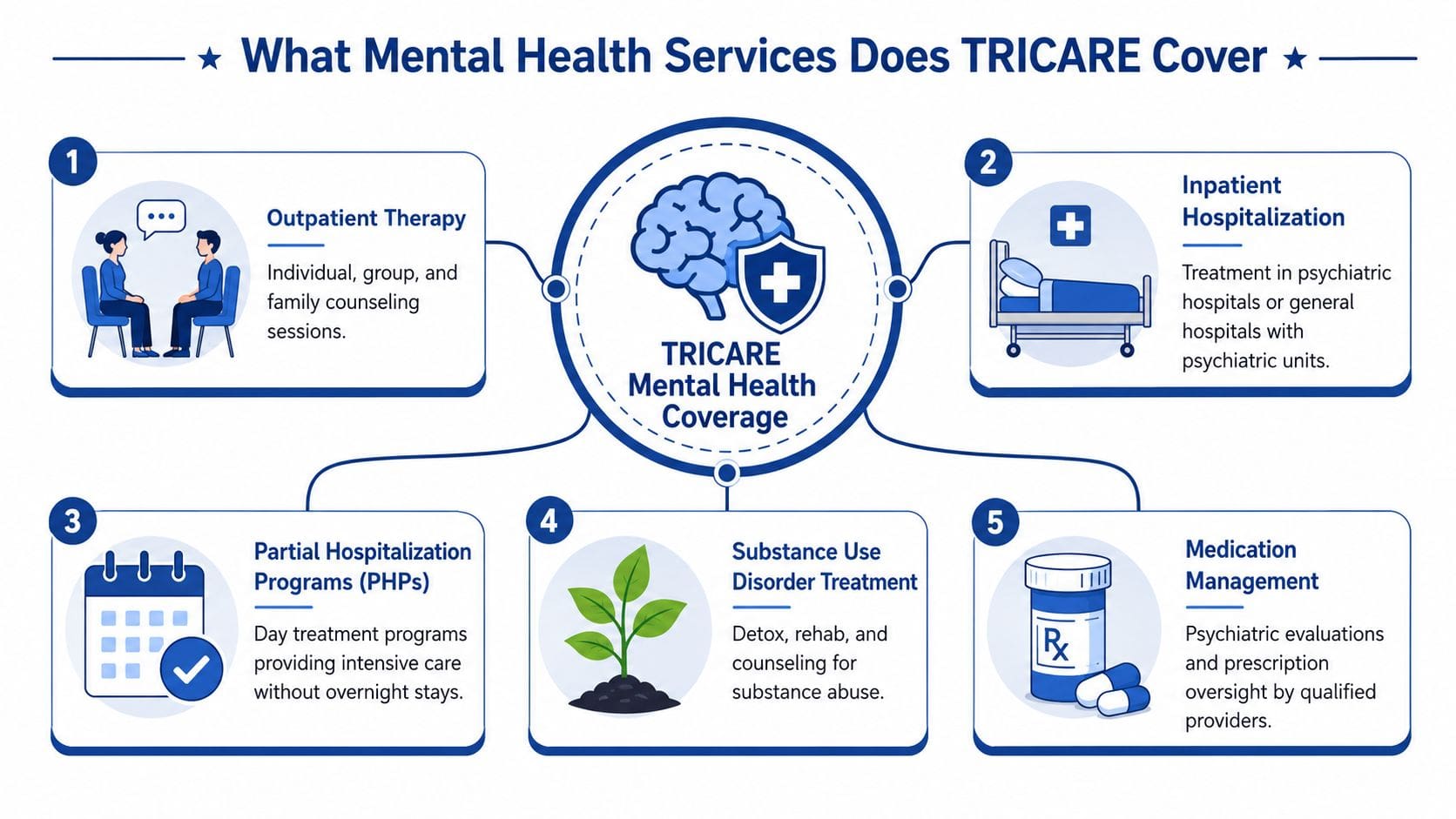
TRICARE mental health coverage generally centers on services that diagnose, stabilize, and treat active psychiatric symptoms. In plain terms, that often includes:
- Outpatient therapy: individual, family, and group psychotherapy are part of standard mental health care.
- Medication management: psychiatric evaluations and follow-up visits for medications are part of the routine treatment pathway for many adults with depression, anxiety, ADHD, OCD, or PTSD.
- Inpatient hospitalization: when symptoms are severe enough that a patient needs hospital-level psychiatric treatment.
- Partial hospitalization programs: structured day treatment without an overnight stay.
- Substance use disorder treatment: care for addiction-related needs, which sits under its own coverage rules.
Patients looking for support with mood symptoms may also want to review treatment options for online depression treatment and medication support.
Why telehealth matters in Pennsylvania
Telehealth isn't a temporary TRICARE exception. It's part of the ongoing benefit structure. TRICARE covers telemental health services, including individual psychotherapy, crisis management, family therapy, and group therapy as permanent benefits beyond the coronavirus pandemic, and active duty service members must obtain a referral before using telemental health through secure video on a computer, tablet, or smartphone, according to TRICARE's telehealth mental health guidance.
That matters in Pennsylvania because access isn't evenly distributed. Someone in Philadelphia may have more in-person options than someone in Erie, Reading, or a smaller community outside Allentown. Telepsychiatry can narrow that gap by allowing medication visits and many therapy appointments to happen from home.
Practical rule: If the needed service can safely happen by secure video, virtual care often removes the biggest barrier, which is getting in the door at all.
For many families, that's the difference between delaying care and starting it.
How to Find a Provider and Navigate Referrals
Finding a clinician is usually easier than understanding the referral chain. That's where people lose time. They call a practice, learn it accepts TRICARE, then find out their specific plan still has rules that affect scheduling.
Who usually needs a referral
The referral question depends on military status and plan structure. Under TRICARE policy, emergency mental health care doesn't require a referral, but patients must contact their regional contractor within 24 hours if admitted. Non-active duty members don't need referrals for routine outpatient telemental health care with network providers, according to TRICARE's mental health access guidance.
For a family trying to make sense of that, the practical takeaway is simple:
- Emergency situations: go for help first. Referral rules shouldn't delay emergency care.
- Non-active duty routine virtual outpatient care: network telemental health is often accessible without a referral.
- Active duty care: extra referral steps can apply and should be checked before booking.
- Higher levels of care: more approvals may still be needed even when routine outpatient care is easier to access.
That distinction matters because many adults don't need inpatient treatment. They need consistent outpatient support, medication adjustment, and a clinician who can see them soon.
A practical way to start care
When families call a clinic or submit an intake request, the most useful approach is to ask focused questions rather than broad ones.
- Ask whether the provider is in network with the relevant TRICARE region. Pennsylvania patients usually need to verify network participation under TRICARE East.
- State the service needed. Say whether the visit is for therapy, medication management, ADHD evaluation, anxiety treatment, PTSD support, or follow-up care.
- Clarify military status. Active duty rules can differ from rules for spouses, retirees, and dependents.
- Ask whether a referral is needed before scheduling. That avoids preventable delays.
- Confirm whether the visit can be done virtually. For many patients, this is the fastest route to care.
A referral coordinator can also reduce friction when records or insurance paperwork are slowing things down. In these instances, resources on psychiatric referrals in Pennsylvania can help patients and referring clinicians organize the handoff.
If the first phone call feels confusing, that's usually a systems problem, not a sign that care isn't available.
In Pennsylvania, the best provider match isn't always the closest office. It may be the clinician who can see the patient virtually, accepts the plan, and treats the condition the patient is experiencing.
TRICARE Prime vs Select Comparing Your Mental Health Costs
Cost questions often sit underneath every other question. Families want to know whether a visit will be affordable before they commit to treatment. Prime and Select can both support mental health care, but they don't feel the same in day-to-day use.
Side by side cost and access comparison
TRICARE Prime beneficiaries enrolled in virtual mental health care can have copays as low as $0, while TRICARE Select beneficiaries may have copays starting around $33. Referrals are required for active duty service members but not typically for family members or retirees on TRICARE Prime, according to Telemynd's TRICARE overview.
| TRICARE Virtual Mental Health Copay Comparison (2026 Estimates) | ||
|---|---|---|
| TRICARE Plan | Referral Needed (Non-Active Duty) | Network Provider Copay (Virtual) |
| TRICARE Prime | Often no for family members or retirees | As low as $0 |
| TRICARE Select | Often not required for routine network outpatient virtual care | Starting around $33 |
The main trade-off is straightforward. Prime may offer lower out-of-pocket costs, but plan rules can feel more structured. Select often gives patients more flexibility in choosing providers, though the patient may pay more.
How families usually decide
A family that values predictable cost may prefer Prime if the needed providers are available and referral logistics aren't creating delays. A patient who wants broader provider choice may prefer Select, especially if finding a specialist for ADHD, OCD, trauma, or medication management has been difficult.
This comparison becomes even more relevant when local options are limited and the family is looking at statewide virtual treatment. Ongoing care often isn't one appointment. It's a relationship with repeated follow-ups, medication checks, and symptom monitoring over time.
A few decision points help:
- Provider access: if the preferred clinician is easier to reach through one plan setup, that matters.
- Administrative burden: some families care more about fewer steps than the lowest possible copay.
- Ongoing visit frequency: repeated follow-ups can make cost differences more noticeable.
- Medication oversight: patients needing regular prescription management may want to review options for online medication management in Pennsylvania.
The right plan fit isn't always the cheapest one on paper. It's the one that lets treatment happen.
Understanding Coverage Gaps and Integrative Solutions
Most TRICARE mental health discussions stop at covered services. That's only half the story. Frustration often begins when a patient needs a service that sounds clinically reasonable but doesn't fit cleanly inside the benefit rules.
The adult residential treatment gap
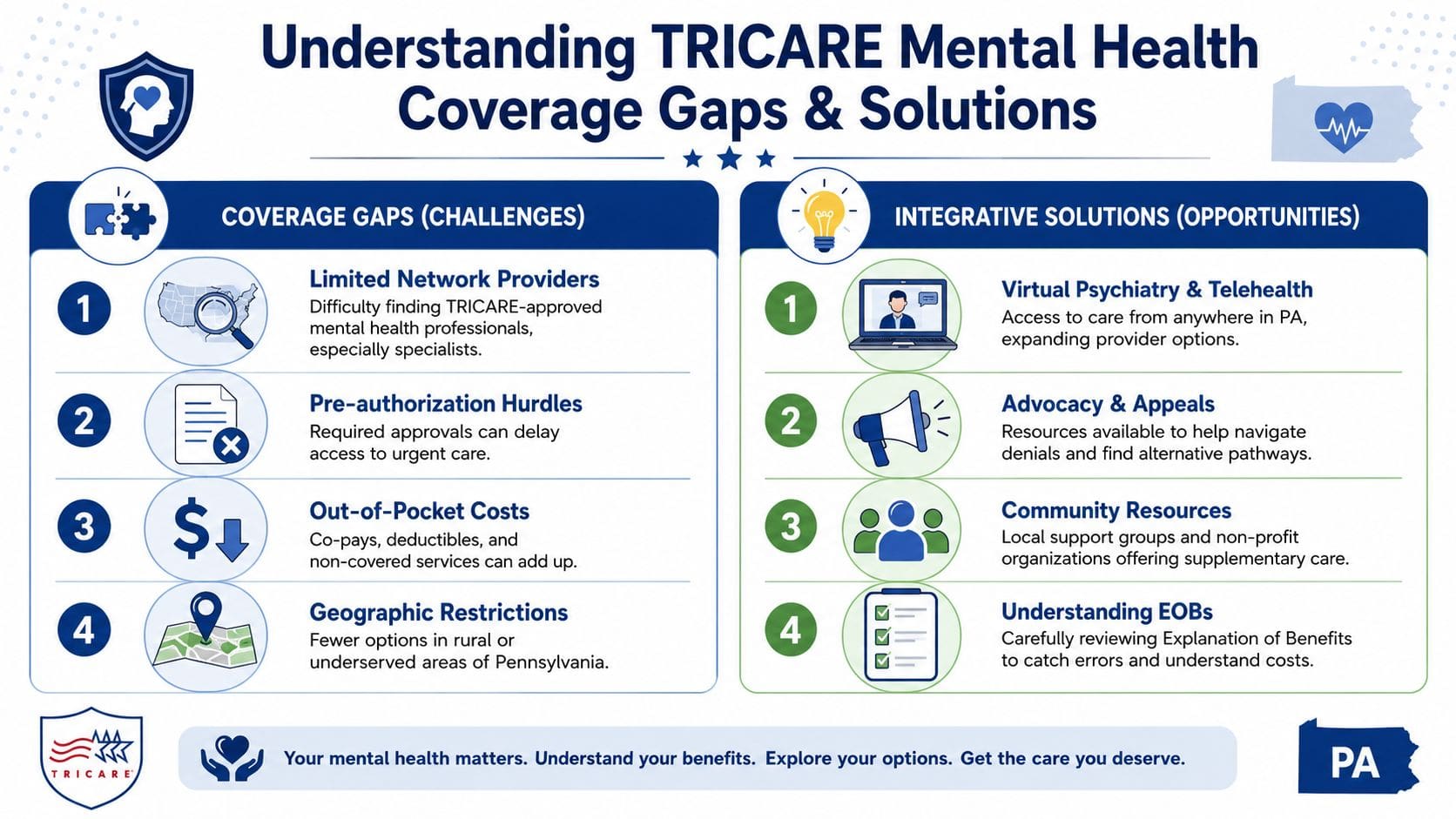
One of the least understood gaps affects adults who need intensive residential mental health treatment. Adult TRICARE beneficiaries in Pennsylvania face a critical gap because TRICARE excludes coverage for intensive residential mental health treatment for adults unless it is for a substance use disorder, and this benefit is only available for beneficiaries under age 21, according to the TRICARE behavioral health coverage and requirements document.
That creates a painful mismatch. An adult with severe PTSD, bipolar symptoms, or another serious condition may clinically need more structure than weekly outpatient visits provide, but still not have coverage for non-substance-use residential care.
Some of the hardest insurance conversations happen when the recommended care is real, necessary, and still not a covered adult benefit.
This is also why statewide telepsychiatry becomes so important. It doesn't replace every higher level of care, but it often becomes the most accessible covered option before a crisis escalates.
Where integrative care gets complicated
Another gap involves outpatient integrative and ancillary services. Many adults want treatment that includes exercise guidance, nutrition support, mindfulness strategies, sleep routines, journaling, and practical behavior change. Those approaches can be valuable, but TRICARE's outpatient adult coverage doesn't automatically extend to every standalone integrative modality.
In practice, that means patients may receive covered therapy and medication management, while lifestyle-focused supports are handled as part of broader clinical guidance rather than as separately covered outpatient benefits. That's an important distinction. A whole-person treatment plan may still include behavioral routines, symptom tracking, sleep hygiene, grounding techniques, and structured daily planning, but not every component is reimbursed as its own insurance service.
Families dealing with long waits or limited specialist access may also relate to the broader mental health provider shortage in Pennsylvania, which makes efficient use of covered telehealth even more important.
Helpful non-insurance tools can still support care between visits, including an Adult ADHD Assessment, an Anxiety Symptom Checker, a Daily Agenda Planner, a Feeling Journal, an Exercise Routine Generator, and a 5-4-3-2-1 Grounding Tool. These don't replace treatment, but they can make treatment more usable in daily life.
Start Your Path to Wellness with Virtual Psychiatry in PA
For many adults, the most workable answer isn't a perfect insurance system. It's a practical care path that fits inside the system that already exists. In Pennsylvania, virtual psychiatric care often does that better than traditional in-person scheduling.
Why virtual care is often the easiest path
Multiple providers under TRICARE East in Pennsylvania, including those offering online therapy and psychiatry, accept new patients with locations such as Philadelphia, Pittsburgh, and Harrisburg listed for virtual access, and copays typically match in-person visits, according to this Pennsylvania TRICARE East provider overview.
That matters for adults with busy schedules, transportation issues, privacy concerns, or symptoms that already make it hard to leave home. It also matters for people in Erie, Scranton, Reading, Lancaster, and smaller communities where specialty mental health options may be thinner.
Virtual care can be especially helpful for:
- Medication follow-up appointments: these often don't require travel to a physical office.
- Anxiety and depression treatment: patients can attend from a familiar environment.
- ADHD care: easier scheduling can improve consistency.
- PTSD and OCD support: reduced logistical stress can make treatment easier to start and continue.
Simple next steps
A low-friction start usually looks like this:
- Verify insurance first: confirm TRICARE participation and ask about referral requirements based on plan and status.
- Book the evaluation: choose a secure video visit if that fits the clinical need.
- Bring a short symptom summary: include major concerns, prior diagnoses, current medications, and any past treatment.
- Use support tools between visits: structured tracking and coping tools can help patients notice patterns and stay engaged.
Adults seeking statewide telepsychiatry for ADHD, anxiety, depression, OCD, PTSD, and medication management can explore virtual integrative mental health services in Pennsylvania. That can be especially useful for people who want confidential, home-based treatment anywhere in the state.
Mental health care doesn't have to start with a perfect answer to every insurance question. It usually starts with one clear next step.
Integrative Psychiatry of America provides virtual psychiatric evaluations, medication management, and evidence-informed mental health treatment across Pennsylvania. Adults in Philadelphia, Pittsburgh, Harrisburg, Erie, Scranton, Allentown, Lancaster, Reading, and statewide can learn more, verify insurance, explore free tools such as the Adult ADHD Assessment, Anxiety Symptom Checker, Daily Agenda Planner, Feeling Journal, Exercise Routine Generator, and 5-4-3-2-1 Grounding Tool, or schedule an appointment at Integrative Psychiatry of America.