
A lot of people in Pennsylvania start looking for mental health care with one hand on the keyboard and the other on the brakes. They may live in Philadelphia and worry about being rushed through a medication visit. They may live outside Harrisburg, Erie, or Scranton and worry that everyone knows everyone. They may already have one bad appointment behind them and don't want to repeat it.
The fear is usually not just about symptoms. It's about what the appointment will feel like. Will the provider listen? Will they push for details before trust exists? Will they mistake shutdown, irritability, panic, or missed appointments for lack of effort?
That's where trauma informed mental health care matters. It isn't a buzzword for people with one diagnosis. It's a practical standard for making care feel safer, steadier, and more respectful from the first contact forward.
Table of Contents
- The Search for Safer Mental Health Care in Pennsylvania
- What Trauma Informed Care Actually Means for You
- The Six Core Principles in a Telehealth Visit
- How Trauma Informed Care Works in Virtual Psychiatry
- Meeting the Needs of Diverse Pennsylvanians
- What to Expect and Questions to Ask Your Provider
- Begin Your Healing Journey with Integrative Psychiatry of America
The Search for Safer Mental Health Care in Pennsylvania
Someone in Pittsburgh might delay care for months because they don't want to explain why sleep feels impossible. Someone in Lancaster might worry that talking about childhood chaos will instantly change how a clinician sees them. Someone in a rural part of the state may want help for anxiety, depression, ADHD, OCD, PTSD, or medication questions, but still feel uneasy about entering a system that has felt cold before.
That hesitation makes sense. Many adults seeking psychiatric care aren't only managing symptoms. They're also managing memories of being dismissed, overexposed, misunderstood, or rushed. Even people without a PTSD diagnosis may carry experiences that affect how safe a clinical conversation feels.
A major reason trauma informed care has become standard is simple. Potentially traumatic experiences are common. A World Mental Health Survey across 24 countries found that approximately 70.4% of respondents reported at least one potentially traumatic event in their lifetime, with an average of about 3.2 traumas per person. That's why health systems increasingly assume many patients have trauma histories instead of waiting for disclosure.
What patients are often trying to avoid
The average patient search isn't just “find a prescriber near me.” It's usually something closer to this:
- Being judged: Worry that panic, avoidance, anger, or emotional numbness will be mistaken for attitude.
- Losing control: Fear that a provider will push for details before enough trust exists.
- Repeating harm: Concern that a clinical visit will feel impersonal, invasive, or shaming.
- Getting fragmented care: Frustration that mental health symptoms are treated separately from sleep, stress, body symptoms, or daily functioning.
Pennsylvania adds another layer. Access can be uneven, and long waits are common in many communities. That reality is part of why so many patients turn to statewide telehealth options when local care feels limited or delayed. The broader access problem is already visible in discussions about the mental health provider shortage in Pennsylvania.
Trauma informed care doesn't ask patients to prove they've been through enough to deserve gentleness. It starts with respect as the default.
What safer care feels like
Good trauma informed mental health care doesn't feel theatrical or overly scripted. It feels predictable. The provider explains what's happening. The patient knows they can pause. Sensitive questions come with context. Medication management isn't reduced to a checklist. The visit leaves room for the patient's pace, values, and boundaries.
That's the difference many individuals seek, whether they're in Philadelphia, Reading, Allentown, or a town with few local options.
What Trauma Informed Care Actually Means for You
Trauma informed care is not one specific therapy. It's the way care is designed. That includes intake forms, telehealth consent, medication conversations, follow-up messages, and how a provider responds when someone becomes overwhelmed, guarded, or unsure.
A useful comparison is home construction. An earthquake-resistant house isn't waiting for damage before it adds structure. The support is built in from the start. Trauma informed mental health care works the same way. It assumes stress, adversity, and past harm may shape how a person experiences treatment, so safety and choice are built into the process.
The shift in the clinical question
Older models often sounded like, “What's wrong with you?” Trauma informed care asks a better question. “What happened to you, and how is it affecting you now?”
That change matters for people with depression, anxiety, ADHD, OCD, sleep problems, or trauma symptoms. A person who misses appointments may be overwhelmed, distrustful, or freezing under stress. A person who looks “fine” on video may still be in a high-alert state internally. A person who says “I don't know” may be protecting themselves, not refusing care.
Based on the Adverse Childhood Experiences study and related public health findings, SAMHSA formally defined and promoted a trauma-informed approach by 2014, which helped shift mental health services toward this broader framework.
What it is and what it isn't
A lot of confusion comes from treating trauma informed care like a branded technique. It isn't.
| Approach | What it means |
|---|---|
| Trauma informed care | A framework for making all care safer and less likely to re-activate harm |
| Therapy modality | A specific treatment method such as CBT or EMDR |
| Medication management | Decisions about medication that can still be delivered in a trauma informed way |
That means a patient can receive trauma informed psychiatric evaluation, medication management, supportive therapy, and referrals without being forced into trauma narrative work before they're ready. It also means the provider pays attention to pacing, consent, body-based stress reactions, and the patient's sense of control.
Practical rule: If a treatment plan sounds technically correct but leaves the patient feeling cornered, unheard, or exposed, it isn't trauma informed in practice.
For readers exploring care for trauma symptoms specifically, it can help to review options for PTSD treatment support while still asking how the whole treatment experience is structured.
The Six Core Principles in a Telehealth Visit
The clearest way to understand trauma informed mental health care is to look at what a patient can notice during an appointment.
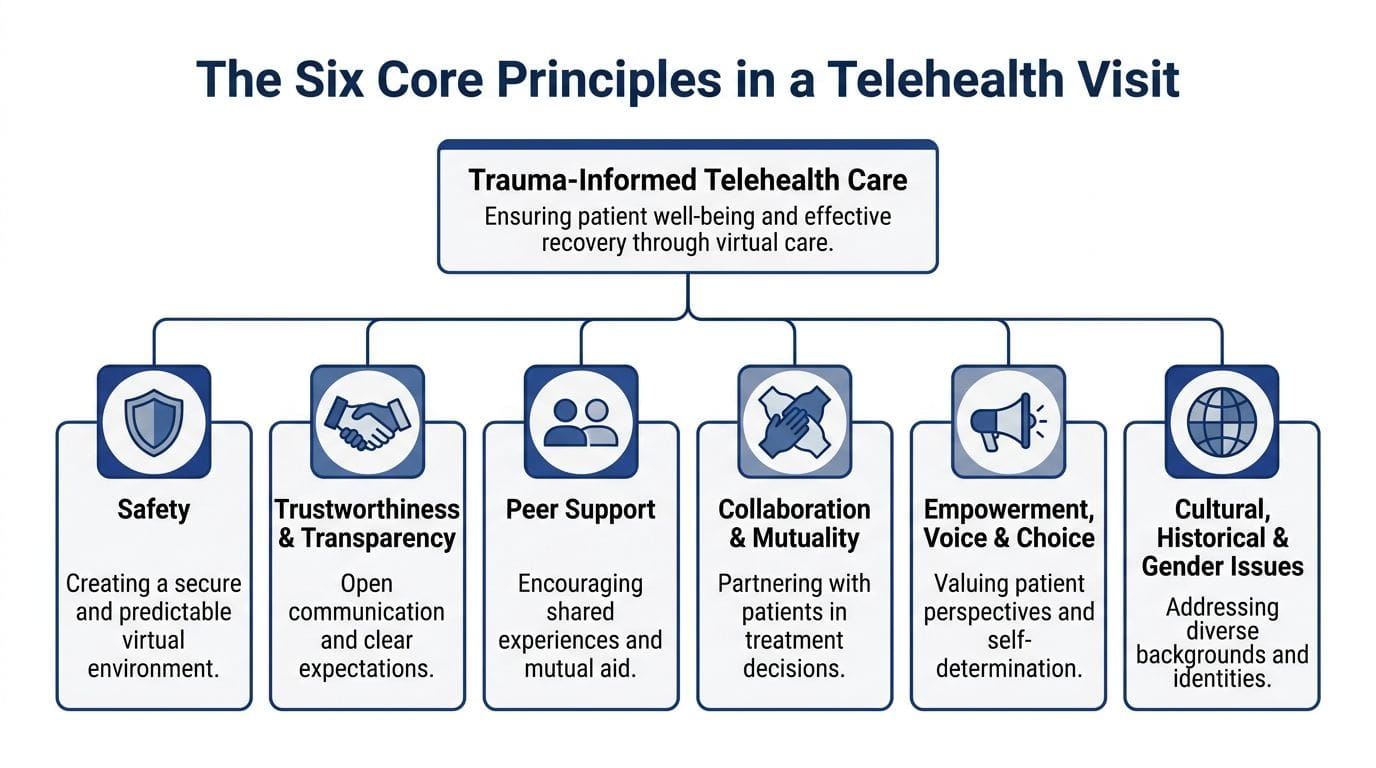
When clinicians apply these principles, patients report higher psychological safety, lower symptom severity on tools such as the PHQ-9 and GAD-7, and better adherence, and a TIC care plan can improve retention by roughly 15 to 25% over 6 to 12 months according to SAMHSA-linked implementation findings.
Safety
Safety means more than “you are not in immediate danger.” In telehealth, it means the visit feels emotionally and procedurally steady.
This looks like a provider asking whether the patient is in a private place, explaining what will happen in the visit, and checking what helps if the conversation becomes activating. It may also include practical tools such as the 5-4-3-2-1 Grounding Tool for moments when a person needs to reorient to the present.
Trustworthiness and Transparency
Patients usually relax when the process stops feeling mysterious. Transparency lowers threat.
This looks like hearing why a question is being asked before answering it. It looks like clear explanations of medication options, side effects, refill rules, documentation, and what happens after the session. If a provider needs to assess safety risk, they should say so plainly instead of switching tone without warning.
A patient should never have to guess what the clinician is doing.
Peer Support
Peer support doesn't always mean a peer joins the visit. It means the care model respects the healing value of shared experience and community.
For some patients, that may mean referral to a recovery group, a trauma support community, or a trusted educational resource. For others, it means normalizing that symptoms like shame, hypervigilance, or emotional shutdown are common responses to overwhelming experiences.
Collaboration and Mutuality
A trauma informed visit is not one person directing and the other complying. It's a working partnership.
If medication is being considered, collaboration means discussing goals, concerns, previous reactions, and what the patient hopes will improve first. If therapy support is part of the plan, it means matching the referral to the person's readiness and preferences. For whole-person treatment, it can also include sleep, exercise, nutrition, and lab discussions handled with consent and context instead of pressure.
A statewide option such as virtual mental health services in Pennsylvania can support that collaboration by making follow-up easier for adults who need consistent care without long travel.
A short overview can help make these principles more concrete in practice.
Empowerment Voice and Choice
Many patients have had experiences where their body, story, or treatment was handled without enough input. Trauma informed care actively reverses that pattern.
- Pacing matters: The patient can slow down the conversation.
- Options matter: A provider can offer choices rather than a single imposed path.
- Consent matters: The patient should understand what they're agreeing to.
- Small preferences matter: Camera placement, note-taking explanations, and whether to start with symptoms or goals all affect comfort.
Cultural Historical and Gender Issues
No patient arrives as a blank slate. Race, gender identity, sexuality, religion, language, family roles, disability, and previous experiences with institutions all shape what feels safe.
In telehealth, this may look like using affirming language, not making assumptions about identity, respecting concerns about surveillance or privacy, and understanding why some patients need more time before trust forms.
How Trauma Informed Care Works in Virtual Psychiatry
A lot of people still assume virtual mental health visits are less personal. That can happen if the platform is rushed, automated, or rigid. It doesn't have to happen.
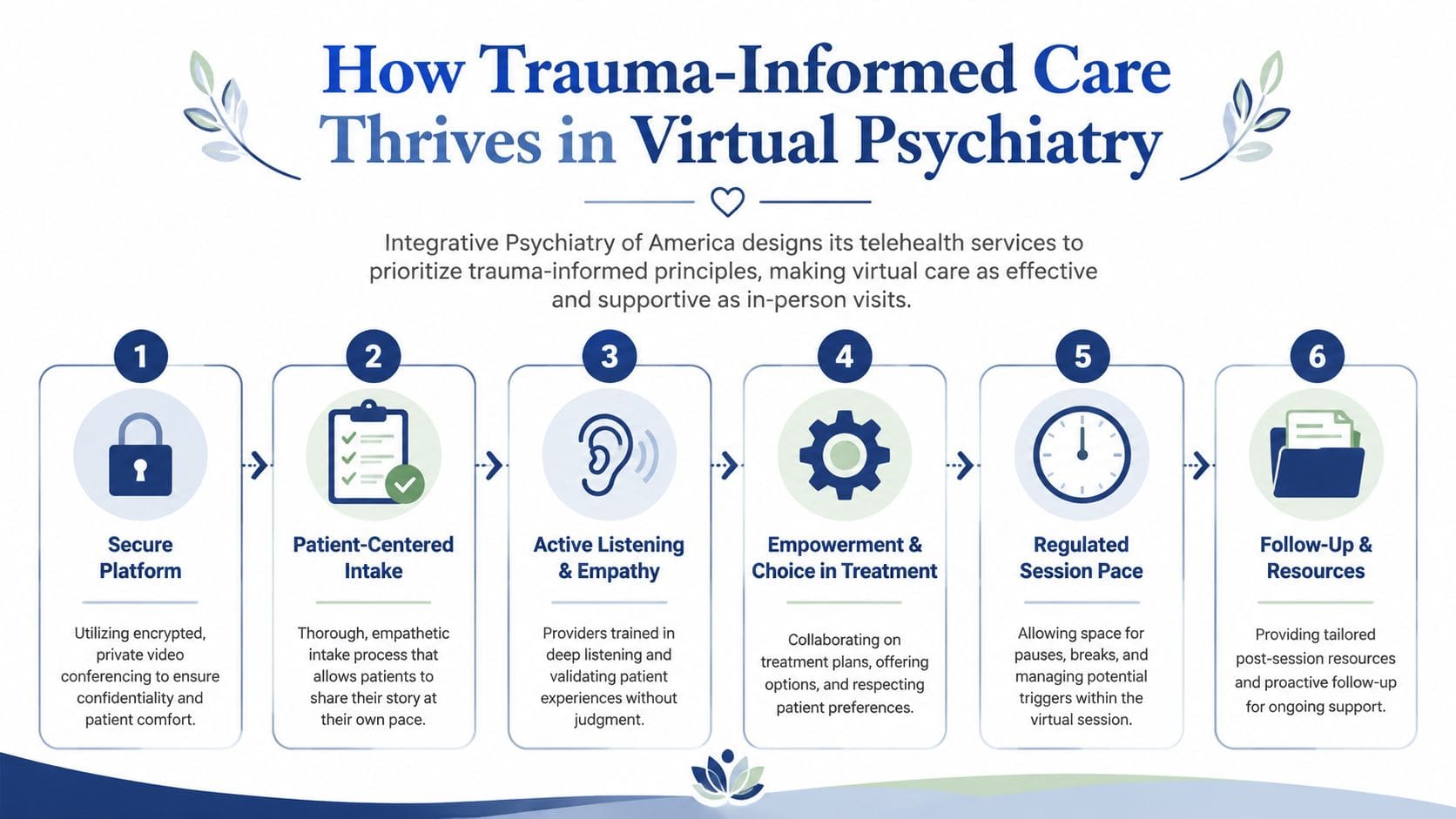
Telehealth can support trauma informed care well when the system is designed for predictability, privacy, and patient control. That's especially relevant for adults in Pennsylvania who may prefer care at home, in a parked car, or in another private setting where they feel less exposed than in a waiting room.
The Four Rs in a virtual setting
SAMHSA defines a trauma-informed approach through the four Rs. Realize, Recognize, Respond, and Resist re-traumatization. The Center for Health Care Strategies summary of SAMHSA's framework explains how these principles can be operationalized through telehealth policies such as standardized safety planning templates and transparent telehealth consent scripts.
In practice, that often looks like this:
- Realize: The clinic assumes many patients may have trauma histories, even if they never name them directly.
- Recognize: Staff notice signs such as shutdown, avoidance, agitation, missed follow-up, or difficulty trusting.
- Respond: Policies support clear reminders, respectful intake, transparent consent, and flexible communication.
- Resist re-traumatization: The system avoids surprise, coercion, unnecessary repetition of painful history, and power struggles.
Why virtual care can feel safer
For some patients in Scranton, Lancaster, Reading, or smaller communities, telehealth solves more than travel. It reduces exposure. No lobby. No chance meeting with a neighbor. No commute after an emotional visit.
The platform itself still matters. If messages are unclear, forms feel intrusive, or camera expectations are rigid, virtual care can become its own source of stress. Thoughtful workflows make a big difference. Some practices also borrow operational ideas from outside healthcare technology, such as Simbie AI's virtual assistant insights, to reduce confusion around scheduling, reminders, and routine patient communication without replacing the human relationship that trauma informed care depends on.
A virtual session becomes safer when the patient knows what happens next, what choices they have, and how to pause if they feel flooded.
A practical telehealth model may include secure video, clear pre-visit instructions, respectful reminders, a patient portal for refill requests or questions, and permission for patients to say when a topic is too much for that day. The point isn't perfection. The point is reducing avoidable threat.
Meeting the Needs of Diverse Pennsylvanians
Trauma informed care isn't one script delivered to everyone in the same tone. It adapts to the patient's context, identity, and lived experience.

Current literature still leaves major gaps in how telehealth-based TIC should serve communities with historical mistrust of healthcare. The Rural Health Information Hub discussion of trauma-informed care acceptability notes that low-touch telehealth can undermine TIC, while trusted asynchronous communication and culturally affirming workflows can reduce barriers for LGBTQ+ and BIPOC populations.
First responders
First responders often arrive with a high-functioning exterior and a nervous system that rarely powers down. Hypervigilance may look like “always on” scanning, short sleep, irritability, emotional distance, or trouble shifting out of work mode. A trauma informed approach doesn't interpret this as simple noncompliance or lack of insight.
Useful care usually includes direct language, respect for privacy, and treatment plans that don't confuse toughness with wellness. Medication discussions often work better when they're framed around function, sleep, irritability, concentration, and recovery instead of labels alone.
LGBTQ+ individuals
For many LGBTQ+ adults, the clinical question isn't only “Will this help?” It's also “Will this be safe to disclose?” That concern may come from prior rejection, discrimination, family conflict, religious trauma, or healthcare encounters that felt invalidating.
Trauma informed telehealth for LGBTQ+ patients should include affirming language, room to clarify name and pronouns, and an understanding that identity exploration may affect anxiety, depression, substance use, sleep, or trauma symptoms. Patients shouldn't need to teach a provider why certain assumptions shut communication down.
People with substance use disorders
Substance use often functions as an attempt to regulate pain, stress, numbness, panic, or intrusive memory. A trauma informed lens doesn't excuse harmful behavior, but it does avoid reducing a person to the behavior.
That matters in treatment. Shame-heavy conversations tend to narrow honesty. Curious, structured, accountable conversations tend to widen it. Patients are more likely to discuss cravings, relapse risk, and medication concerns when they're not bracing for moral judgment.
For Pennsylvanians seeking a more humane and whole-person approach, resources on compassionate psychiatry and mental health care in Pennsylvania can help clarify what respectful treatment should look like.
What to Expect and Questions to Ask Your Provider
Patients don't have to guess whether a practice is actually trauma informed. They can ask. In fact, they should.
What a first visit should feel like
A strong first telehealth appointment usually feels organized without feeling cold. The provider should explain privacy, the flow of the session, and how urgent safety concerns are handled. Questions should have a reason behind them, and the pace should leave room for the patient to think.
Many adults also want practical answers. Can medication be managed virtually across Pennsylvania? What happens if side effects show up? How are follow-ups scheduled from Philadelphia, Pittsburgh, Allentown, or Erie? Good care answers those questions directly.
A clear comparison of roles can also help when choosing a prescriber. For example, some patients review the difference between a psychiatric nurse practitioner and psychiatrist roles before deciding what type of provider fits their needs.
Questions worth asking before you book
These questions put control back where it belongs:
- How do you help patients feel safe during appointments? Listen for specific answers about pacing, consent, and what happens if a patient becomes overwhelmed.
- How do you collaborate on treatment plans? A good answer includes shared decision-making, not just recommendations delivered from above.
- What happens if discussing trauma feels too activating? The provider should have a plan for slowing down, redirecting, grounding, or rescheduling more carefully.
- How do you handle privacy in telehealth? Patients deserve a clear explanation of platform security and visit procedures.
- Do you address sleep, stress, and physical health along with symptoms? That question matters for people whose mental health overlaps with fatigue, appetite change, pain, or body-based stress responses.
If a provider seems irritated by thoughtful questions before care starts, that reaction is useful information.
Begin Your Healing Journey with Integrative Psychiatry of America
The term trauma informed mental health care should feel less abstract after seeing what it looks like in practice. It means care that respects the nervous system, explains the process, reduces avoidable threat, and treats the patient as an active participant. It also means psychiatric care doesn't stop at symptom labels. It can include medication management, supportive therapy, lifestyle discussion, and attention to physical health without shame or pressure.
For adults across Pennsylvania, virtual care can make that approach easier to access. Integrative Psychiatry of America is a Pennsylvania-based telehealth practice that provides virtual psychiatric evaluations, medication management, and evidence-informed treatment for concerns such as anxiety, depression, ADHD, OCD, and PTSD. The practice also offers patient education tools that can support care between visits, including the Anxiety Symptom Checker, Adult ADHD Assessment, Daily Agenda Planner, Feeling Journal, and Exercise Routine Generator.
Safe, respectful care isn't a luxury. It's the standard patients should expect, whether they're seeking help from Philadelphia, Harrisburg, Pittsburgh, Scranton, Lancaster, Reading, Erie, or anywhere else in the state.
If a more respectful and predictable approach to psychiatric treatment sounds like the right next step, explore care options at Integrative Psychiatry of America. Patients can learn about virtual treatment across Pennsylvania, review insurance options, schedule an appointment, or start with one of the free mental health tools to take a low-pressure first step.