
The search often starts late at night. A Philadelphia professional has missed another deadline despite caring a great deal about the work. A graduate student keeps rereading the same page without absorbing it. A parent wonders why daily tasks feel harder than they seem for everyone else. The browser tab says ADHD evaluation Philadelphia, but the underlying question is usually more personal: “What is truly going on with me, and how do I find out without getting brushed off?”
That mix of doubt, relief, and urgency is common. Many adults have spent years being told they're anxious, disorganized, lazy, overcommitted, or bad at time management. Some do have ADHD. Some don't. Some have ADHD plus anxiety, depression, trauma-related symptoms, sleep problems, or burnout. A careful evaluation matters because the right answer changes the treatment plan.
Philadelphia residents have several paths to assessment, including local office-based care and telehealth. For adults who want clarity without unnecessary complexity, a practitioner-led process can feel much more manageable when each step is explained clearly and tied to real clinical decision-making.
Table of Contents
- Navigating the Path to an ADHD Diagnosis in Philadelphia
- What a Comprehensive ADHD Evaluation Actually Involves
- Telehealth vs In-Person Evaluations in Philadelphia
- Ruling Out Look-Alikes and Understanding Comorbidities
- How to Prepare for Your ADHD Evaluation Appointment
- Understanding Costs, Insurance, and Timelines
- After the Diagnosis Integrative Treatment Options
Navigating the Path to an ADHD Diagnosis in Philadelphia
An ADHD assessment rarely begins with a neat list of symptoms. It often begins with friction. Someone is bright, capable, and trying hard, yet everyday demands keep spilling over. Bills are paid late. Emails pile up. Emotional reactions feel bigger than expected. Work gets done in bursts, then stalls.
That's why many people searching for ADHD evaluation Philadelphia aren't looking for a label alone. They're looking for an explanation that fits their actual life. In practice, the process works best when it slows down enough to sort out patterns rather than chasing a fast answer.
Philadelphia also presents a practical challenge. People want care that's accessible, confidential, and realistic for a packed schedule. Parents, students, healthcare workers, and professionals often need appointments that don't require travel across the city or a long wait for niche testing. At the same time, convenience shouldn't come at the cost of diagnostic quality.
A useful evaluation doesn't just ask whether someone endorses ADHD symptoms. It asks when those symptoms began, where they show up, what they disrupt, and what else could explain them.
Board-certified psychiatric nurse practitioners often play a central role in this work. They diagnose, prescribe when appropriate, and manage treatment over time while keeping an eye on the broader clinical picture. That broader picture matters in ADHD because attention problems can come from many places, and treatment only works well when the diagnosis is sound.
What a Comprehensive ADHD Evaluation Actually Involves
The biggest misconception is that there's a single definitive ADHD test. There isn't. Penn Medicine notes that there is no single test that can diagnose ADHD, and that diagnosis depends on a pattern of symptoms, functional impairment, and clinical history. Penn also describes tools such as the Adult ADHD Self-Report Scale, which includes 18 symptoms and a 6-item screening subset that can help identify who needs fuller assessment, not replace it (Penn Medicine ADHD overview).
Why a quick test isn't enough
An online screener can be a useful starting point. It can't tell whether distractibility is coming from ADHD, chronic stress, poor sleep, depression, anxiety, substance use, or a medical issue. That's the difference between screening and diagnosis.
A good clinician works more like a detective than a gatekeeper. Symptom checklists are clues. School history is a clue. Work performance patterns are clues. Family observations, prior records, and treatment history are clues. The diagnosis comes from how those clues fit together.
Some people also benefit from added testing that supports the clinical interview. For readers comparing options, psychological testing for ADHD can be part of the broader assessment picture in selected cases.
What clinicians are actually looking for
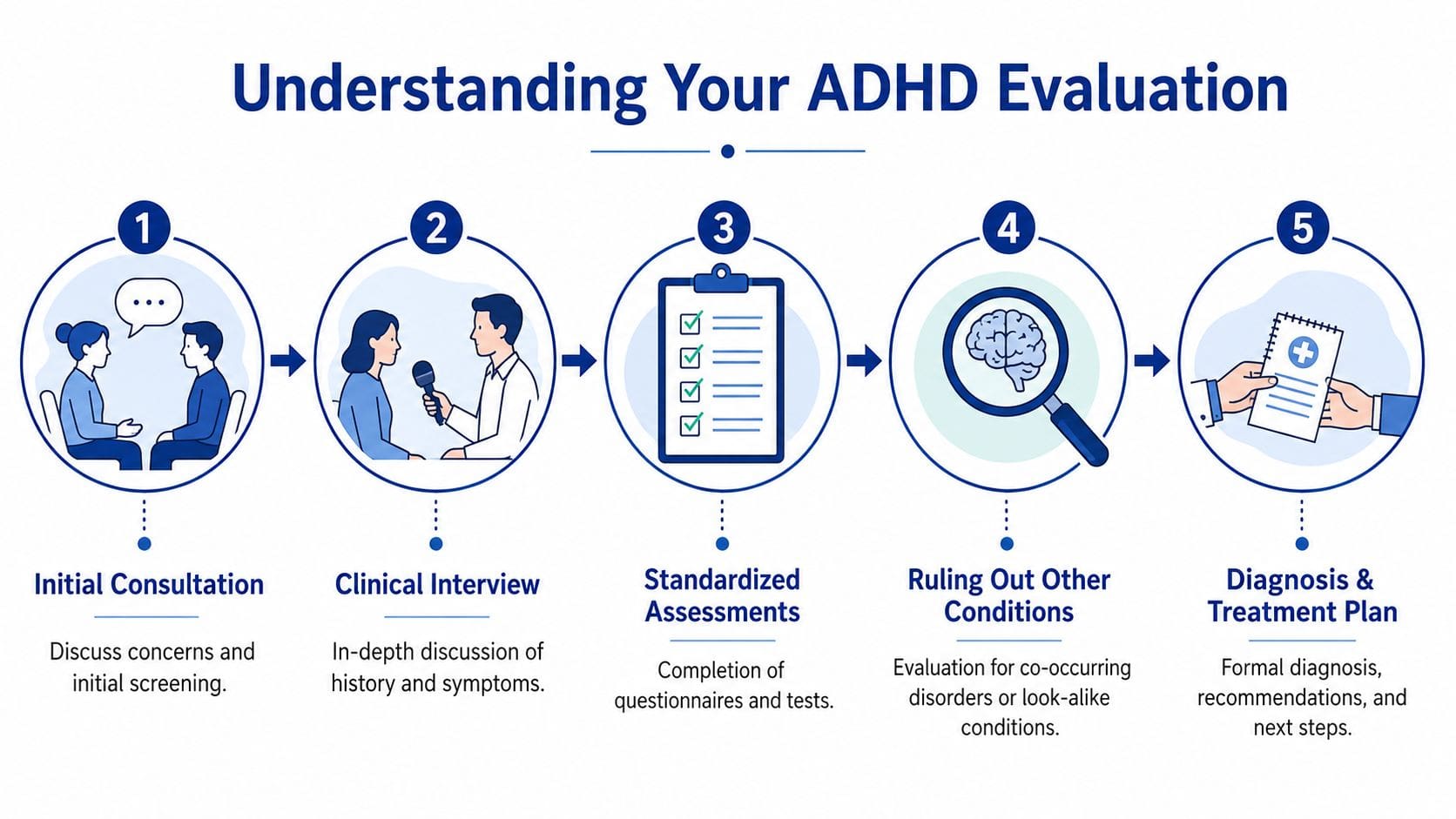
A thorough ADHD evaluation usually includes several parts:
A detailed clinical interview
This covers childhood development, school functioning, work habits, organization, impulsivity, relationships, sleep, mood, and current daily impairment.Standardized symptom measures
Tools such as the ASRS help organize symptom reporting in a structured way.Collateral information when available
Old report cards, comments from family, or prior records can help confirm long-standing patterns.Assessment of impairment
Symptoms matter, but impairment matters just as much. Plenty of people relate to ADHD traits without meeting criteria for a disorder.Differential diagnosis
During this stage, clinicians sort ADHD from other explanations.
Practical rule: If the process feels too fast to explore childhood history, current functioning, and alternative explanations, it may be too fast to trust.
In some cases, objective computerized tools can add another layer of information. QbTest-based assessments measure inattention, impulsivity, and activity through continuous performance tasks and motion tracking, usually in about 15 to 20 minutes, and often flag scores above +1.5 standard deviations as clinically significant. These tools can help document baseline severity and reduce reliance on recall alone, but they still supplement clinical judgment rather than replace it (QbTest assessment details).
Telehealth vs In-Person Evaluations in Philadelphia
Telehealth and in-person ADHD care each solve different problems. For many adults, the better option isn't the one that sounds most traditional. It's the one that allows enough time, privacy, and continuity to complete a high-quality evaluation and follow through with treatment.
When telehealth fits well
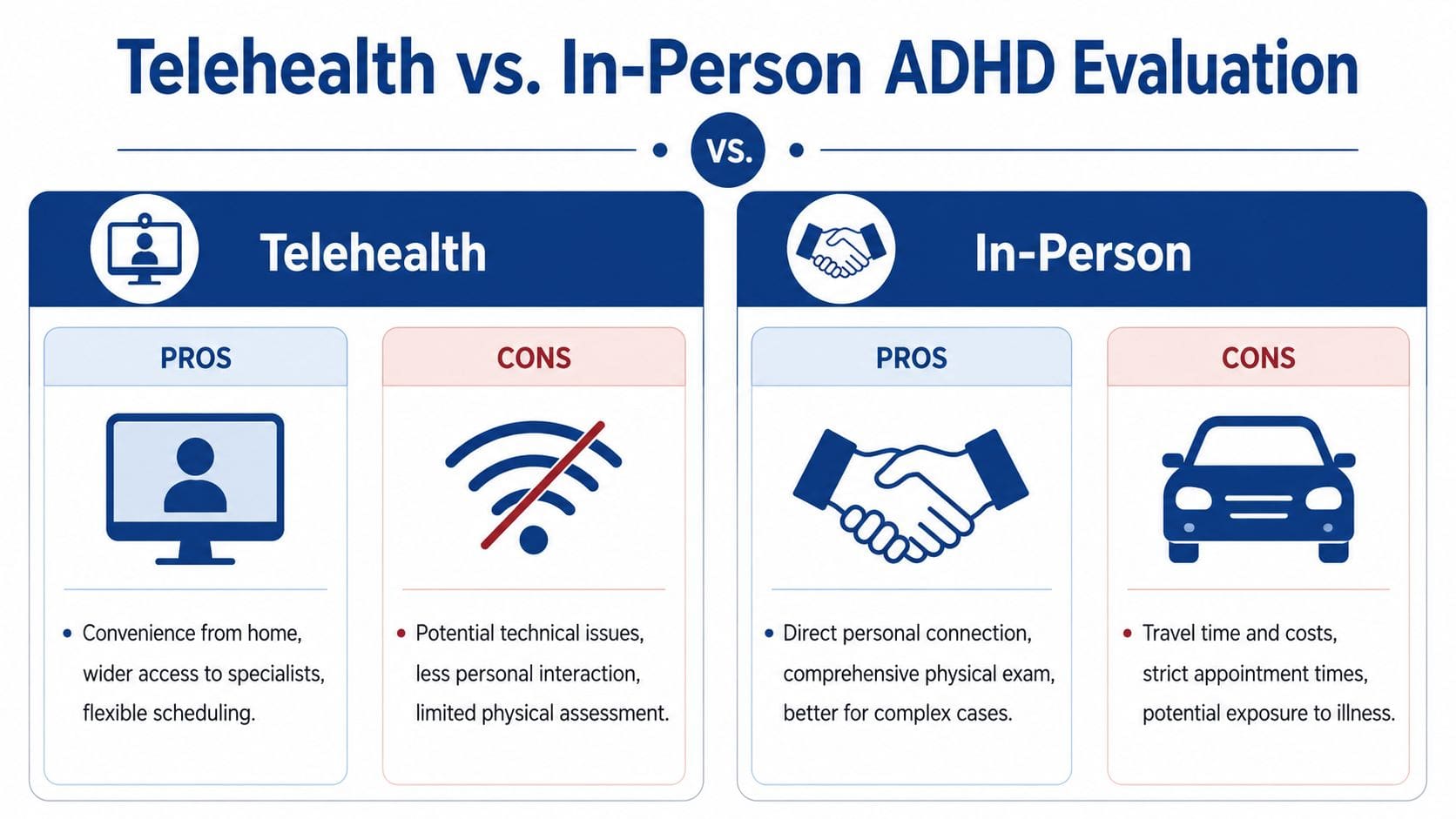
Telehealth works especially well for adults who need flexibility. That includes people with demanding jobs, students balancing classes and work, parents who can't easily leave home, and anyone who values privacy. Clinical interviews, rating scales, diagnostic review, and medication management can all be done well through secure virtual care when the case is appropriate.
For people who want a plain-language overview of how virtual visits typically function, this guide helps learn about Blue Haven RX virtual care.
A Pennsylvania-specific option for ongoing virtual ADHD care is online psychiatry in Pennsylvania for ADHD care, which reflects the kind of telehealth model many adults look for when travel and scheduling are barriers.
A short visual explanation can help make the differences easier to compare.
When in-person care may make more sense
In-person assessment may be preferable when the presentation is unusually complex, when hands-on neuropsychological testing is being considered, or when there are concerns that are harder to evaluate virtually. Some people also think better face-to-face, especially if they feel overwhelmed or mistrustful of digital care.
A side-by-side view helps:
| Format | Often works well for | Potential limitation |
|---|---|---|
| Telehealth | Busy adults, privacy needs, follow-up care, medication management | Tech issues or home distractions |
| In-person | More complex presentations, preference for face-to-face contact, specialized testing pathways | Travel, scheduling friction, less convenience |
The wrong assumption is that telehealth equals shallow care. The dividing line isn't screen versus office. It's whether the clinician still performs a full diagnostic process.
Ruling Out Look-Alikes and Understanding Comorbidities
A rushed evaluation frequently encounters issues. Difficulty focusing is real, but it isn't specific to ADHD. People can feel scattered because they're sleeping poorly, carrying untreated anxiety, living in a constant stress response, or struggling with depression. Trauma can also disrupt concentration, memory, and emotional regulation in ways that look very similar on the surface.

The timeline matters
A technically sound evaluation is anchored in DSM-based developmental history. A rigorous adult assessment is built around the requirement that symptoms began before age 12 and cause impairment in at least two settings, such as home and work. That framework helps separate ADHD from look-alike conditions such as anxiety, depression, sleep disorders, thyroid disease, trauma, and substance use (adult ADHD evaluation breakdown).
That means a clinician isn't only asking, “Do you struggle now?” The clinician is also asking:
- Childhood onset: Were there signs early on, even if nobody named them ADHD at the time?
- Multiple settings: Did the pattern show up in school, home life, work, or relationships?
- Functional impact: What has this interfered with?
- Alternative causes: Could another condition explain the same symptoms more convincingly?
If attention problems appeared only after a major depressive episode, severe insomnia, trauma, or substance use, the clinician has to take that seriously before calling it ADHD.
Comorbidity complicates things further. Someone may have ADHD and anxiety. Or ADHD and depression. In those cases, both conditions need attention, because untreated anxiety can derail ADHD treatment, and untreated ADHD can keep someone stuck in cycles of shame and overwhelm.
For adults dealing with overlapping symptoms, co-occurring ADHD, anxiety, and depression in Philadelphia is a useful example of how these patterns often intersect in real treatment planning.
Why adult women are often overlooked
Adult women are one of the most commonly missed groups in ADHD care. Many weren't disruptive in school. They were daydreamy, perfectionistic, emotionally overextended, or chronically disorganized behind the scenes. Because the presentation wasn't obvious hyperactivity, they were often labeled anxious, sensitive, scattered, or burned out.
That's one reason quick online pathways can be misleading. A brief symptom screen may catch distress, but it may miss the context. Hormonal shifts, sleep disruption, caregiving load, trauma history, and internalized pressure can all shape how ADHD presents in women and midlife adults.
A whole-person evaluation doesn't treat sleep and nutrition as side notes. It asks whether someone is exhausted, under-fueled, over-caffeinated, constantly dysregulated, or living on a schedule that would impair anyone's concentration. Those factors don't rule out ADHD. They do need to be assessed before the final diagnosis carries weight.
How to Prepare for Your ADHD Evaluation Appointment
Preparation doesn't need to be elaborate. It just needs to be useful. The goal is to make the appointment more accurate, not more stressful.
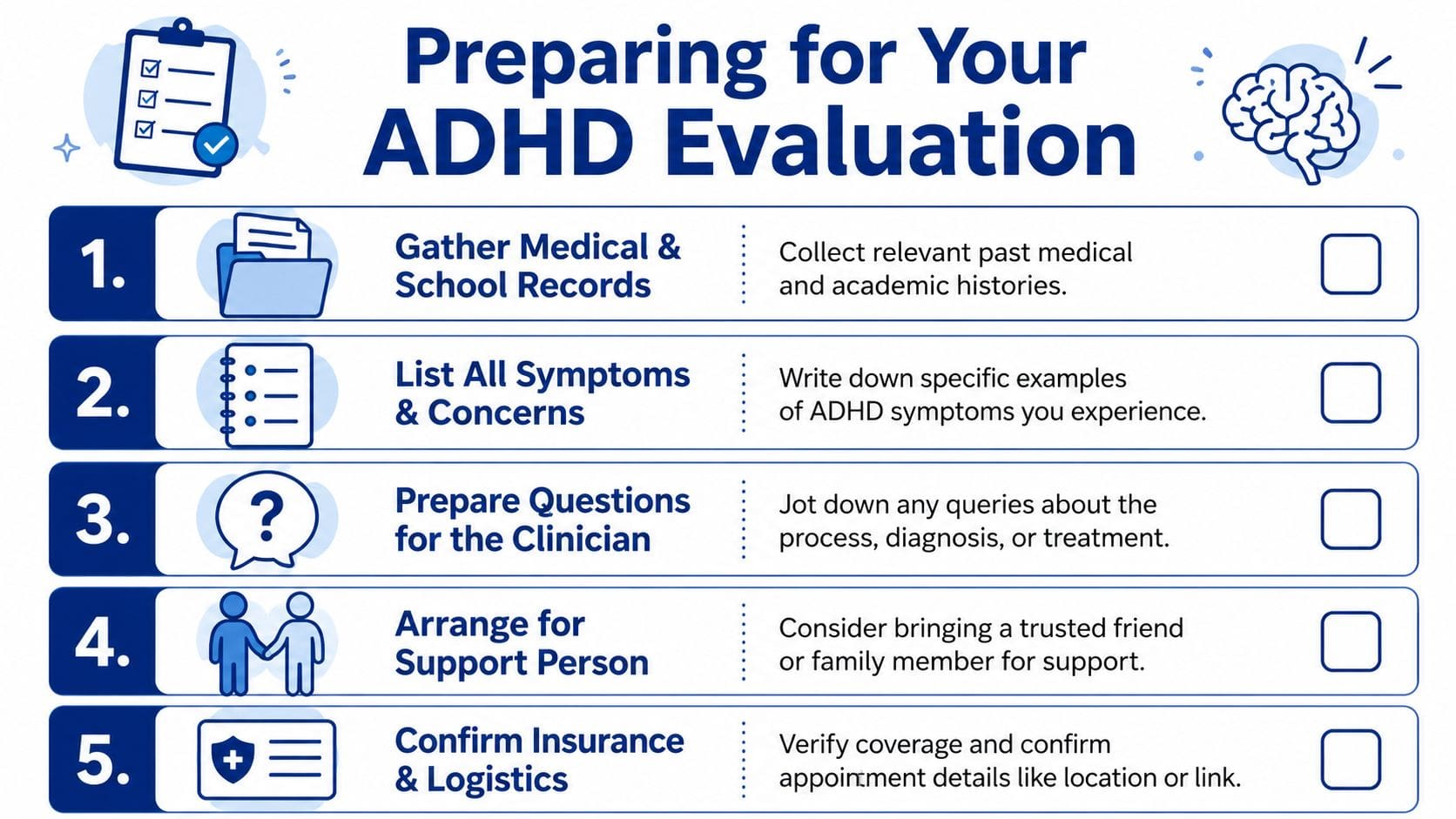
What to gather before the visit
The most helpful materials are the ones that show patterns over time.
- School records: Report cards, teacher comments, testing reports, or college accommodation documents can reveal earlier concerns about attention, organization, or follow-through.
- Medical history: A list of current medications, past psychiatric medications, supplements, and major medical conditions gives the clinician a cleaner starting point.
- Outside observations: If a spouse, parent, or trusted family member has noticed long-standing patterns, those observations can help, especially when childhood memory is fuzzy.
What to write down
A short written list often helps more than trying to remember everything in real time.
- Daily examples: Missed deadlines, forgotten appointments, unfinished tasks, emotional blowups, chronic lateness, or difficulty starting routine work.
- Setting differences: Whether symptoms show up at work, at home, in relationships, while driving, or during school.
- Questions for the visit: Ask how the clinician distinguishes ADHD from anxiety, whether more testing is needed, and what treatment would look like if ADHD is confirmed.
Bring examples, not just labels. “I interrupt people and miss details in meetings” is more useful than “I think I'm impulsive.”
This kind of preparation turns the appointment into a collaborative assessment rather than a vague conversation driven by memory alone.
Understanding Costs, Insurance, and Timelines
People usually want two straightforward answers. How long will this take, and will insurance help cover it? The honest answer is that the timeline and cost depend on how thorough the evaluation needs to be.
What affects the timeline
A brief online screening is not the same thing as a full clinical workup. An ADHD evaluation often unfolds across more than one visit, allowing time to gather history, review questionnaires, consider records, and sort out other possible explanations. That slower pace can be frustrating when someone wants immediate relief, but it usually improves diagnostic confidence.
Delays also happen when collateral records are hard to find or when the clinical picture is mixed. For example, if sleep deprivation, trauma symptoms, panic, or depression are all active, the clinician may need to clarify those factors before making a final call.
What affects cost and coverage
Insurance plans vary widely in how they handle psychiatric evaluation, follow-up visits, and any added testing. The practical step is to verify mental health benefits directly and ask specific questions about diagnostic evaluation, medication management, and telehealth coverage.
Cash-pay practices may offer more scheduling flexibility or a different evaluation model. That doesn't automatically make them better or worse. It changes the payment structure and sometimes the visit length.
For readers trying to compare models, how much ADHD testing costs is worth reviewing because it frames the difference between quick screening and fuller assessment. The important issue isn't just price. It's scope. If a lower-cost option skips developmental history, differential diagnosis, and functional review, it may not deliver the clarity someone is paying for.
A reasonable question to ask any clinic is this: what is included in the evaluation, and what would trigger a recommendation for additional assessment?
After the Diagnosis Integrative Treatment Options
A diagnosis should create direction. It shouldn't leave someone with a prescription and no plan for daily life. Effective ADHD treatment usually works best when medication, behavior change, and lifestyle foundations are considered together.
Medication is one tool, not the whole plan
Medication can be helpful for many adults. That may include stimulant or non-stimulant options, depending on symptom profile, side effects, medical history, and patient preference. Ongoing prescribing works best when the clinician monitors benefit, function, tolerability, sleep, appetite, and emotional changes rather than only asking whether focus improved.
For people exploring this part of care, ADHD medication management is one example of the follow-up structure many patients need after diagnosis.
The broader need for structured care is clear. In the Philadelphia region, commercially insured children diagnosed with ADHD increased 33% from 2010 to 2017, according to Blue Cross Blue Shield Association claims data summarized by Independence Blue Cross. The same report noted that this local increase outpaced the national trend, underscoring the importance of accurate diagnosis and sustainable long-term care as people move into adulthood (Independence Blue Cross summary of BCBSA ADHD data).
Whole-person treatment improves follow-through
Medication alone won't teach planning, sleep consistency, or emotional regulation. That's where an integrative approach becomes practical rather than decorative.
Consider the pillars:
- Skills-based therapy or coaching: This can target time blindness, task initiation, prioritization, and self-criticism.
- Sleep work: If someone stays up late from mental overactivation or has fragmented sleep, daytime focus may never stabilize well.
- Nutrition and routines: Irregular eating, dehydration, and chaotic scheduling can intensify executive dysfunction.
- Exercise and regulation strategies: Movement, mindfulness, and predictable routines can reduce restlessness and support mood stability.
Integrative Psychiatry of America provides telepsychiatry in Pennsylvania with medication management and broader support that can include psychotherapy, exercise counseling, nutritional education, and mindfulness-based strategies, depending on clinical need. That kind of model often makes sense for adults whose symptoms don't exist in isolation.
An ADHD diagnosis isn't a verdict on character. It's a framework for making treatment more precise, realistic, and humane.
If getting clear answers has felt harder than it should, Integrative Psychiatry of America offers online psychiatric evaluation and ongoing treatment for adults in Pennsylvania, including Philadelphia. A thoughtful ADHD assessment can help clarify whether the problem is ADHD, a look-alike condition, or several overlapping issues that need to be treated together.