
Typing “adhd doctors near me” often leads to the same frustrating page of results. Some listings are therapy practices that don’t evaluate ADHD. Some offer medication visits but say very little about how diagnosis works. Others look promising until the first available appointment is months away.
That confusion matters because ADHD care isn’t just about finding any mental health provider. It’s about finding someone who can sort out what’s going on, rule out lookalike conditions, and build a treatment plan that fits real life. In a CDC summary of ADHD data, 11.4% of U.S. children ages 3 to 17, about 7 million children, had been diagnosed with ADHD in a 2022 national parent survey. The same CDC page notes that boys were diagnosed more often than girls, 15% versus 8%. Search demand rises when more families and adults are trying to make sense of attention problems, executive dysfunction, and delayed diagnosis.
For adults in Pennsylvania, the search also needs to expand beyond a short driving radius. Telehealth changed what “near me” means. A strong ADHD provider may be available across the state, not just across town.
Table of Contents
- The Overwhelming Search for ADHD Care
- Your Smart Search Strategy for Finding ADHD Providers
- Decoding Provider Qualifications and Finding the Right Fit
- Exploring Treatment Options Beyond the Prescription
- Navigating Insurance, Costs, and What to Watch For
- Begin Your Journey with Integrative Psychiatry of America
- Frequently Asked Questions About Finding ADHD Care
The Overwhelming Search for ADHD Care
Search results rarely explain the trade-offs clearly. One listing may say “ADHD specialist” but only offer brief medication follow-ups. Another may emphasize testing even when testing isn’t the most useful path. A third may treat anxiety or depression well but have little experience separating those symptoms from ADHD.
That matters because attention problems don’t come from one cause. Poor sleep, anxiety, trauma, depression, substance use, thyroid issues, and burnout can all look similar. A patient who starts with the wrong provider can spend months chasing the wrong answer.
Practical rule: The right ADHD provider doesn’t begin with a prescription. The right provider begins with a careful differential diagnosis.
Many adults searching for adult ADHD evaluation, ADHD treatment Philadelphia adult, or online ADHD care Pennsylvania are also looking for privacy and flexibility. Telepsychiatry helps with both. It removes commuting, widens the pool of qualified clinicians, and makes it easier to stay consistent with follow-up care.
A better search starts when patients stop asking only, “Who is closest?” and start asking, “Who does thorough ADHD assessment, medication management, therapy coordination, and whole-person follow-up?” That question usually leads to better care.
Your Smart Search Strategy for Finding ADHD Providers
Beginning with Google is a common practice. That’s fine, but it shouldn’t be the only method. Search engines reward practices with stronger local visibility, not always practices with the strongest ADHD process.

Start with the practical filters
Insurance directories are still useful if they’re used carefully. Search by license type, telehealth availability, age group served, and medication management. If the directory allows keyword filtering, use terms like adult ADHD, PMHNP, telepsychiatry, behavioral health, and medication management.
Then compare that list against each provider’s own website. The website usually shows whether the practice offers a real ADHD assessment, ongoing follow-up, and support for co-occurring anxiety, depression, OCD, or PTSD.
A strong statewide option matters if local openings are limited. Patients looking for online psychiatry in Pennsylvania for ADHD care often find more flexibility through telehealth than through strictly local in-person clinics.
Use better search phrases
Generic searches produce generic results. Specific searches produce better screening.
Try combinations like these:
- “telehealth PMHNP adult ADHD Pennsylvania” for broad statewide care
- “integrative ADHD evaluation Philadelphia” if medication-only care doesn’t feel sufficient
- “adult ADHD medication management Pennsylvania telehealth” for follow-up focused visits
- “ADHD and anxiety treatment online Pennsylvania” when symptoms overlap
- “holistic ADHD treatment Pennsylvania” for multimodal care
- “executive dysfunction treatment adult Pennsylvania” when ADHD is suspected but not confirmed
Professional organizations can also help. CHADD’s resource directory and ADDA’s adult ADHD resources are useful starting points for education and support while narrowing clinical options.
Search for the service and the method. “ADHD provider” is broad. “Adult ADHD telehealth PMHNP Pennsylvania” is much closer to what most adults actually need.
A good search strategy is less about finding the first available name and more about building a short list of providers whose process matches the problem.
Decoding Provider Qualifications and Finding the Right Fit
Credentials matter, but process matters more. A provider can have an impressive title and still offer a weak ADHD evaluation. Another can have a less familiar title to the public and provide excellent assessment and follow-up.
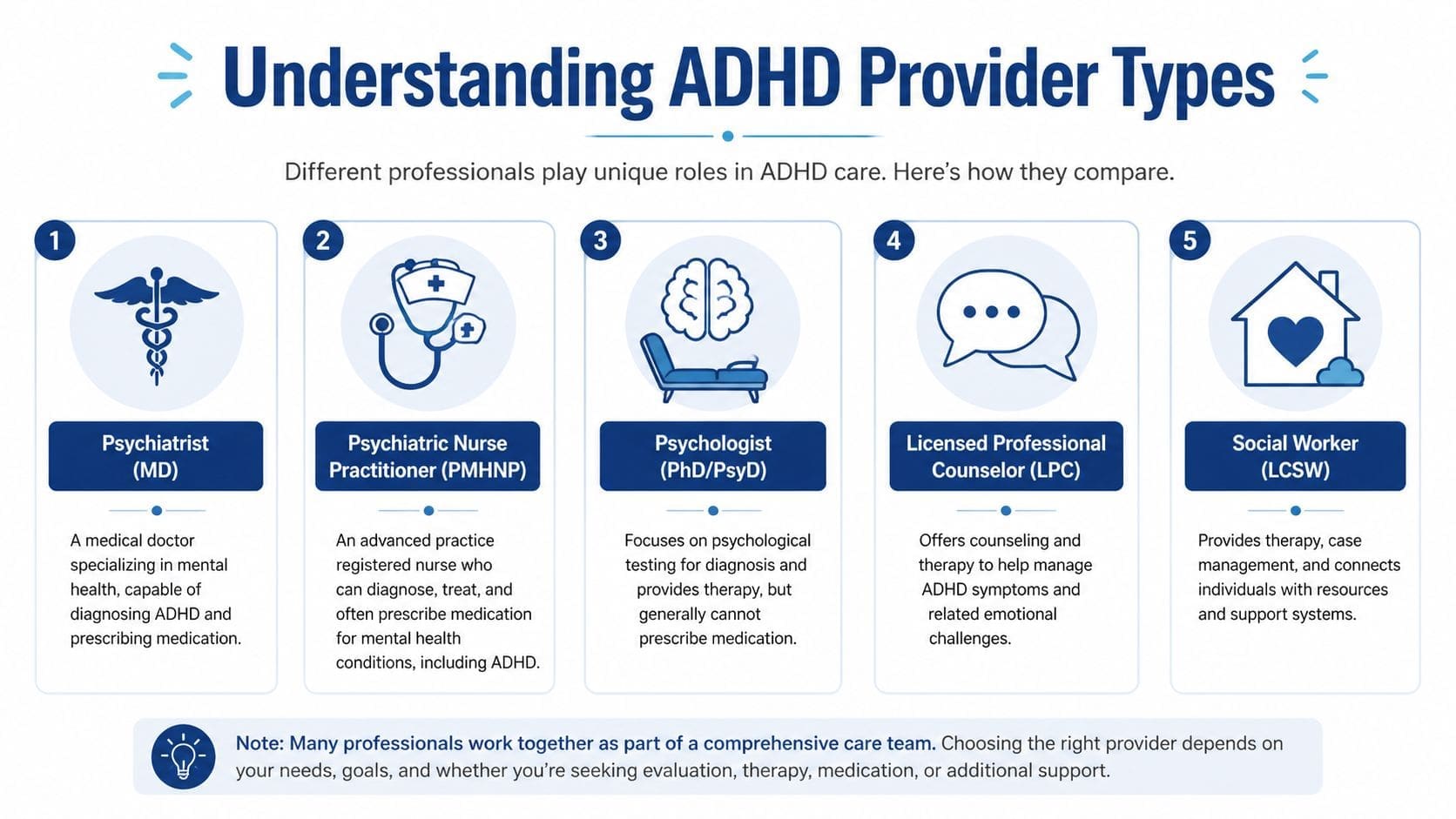
Who does what in ADHD care
Psychiatrists, psychiatric nurse practitioners, psychologists, counselors, and social workers all play different roles. For many adults, the best fit depends on whether they need diagnosis, medication, therapy, coaching, or a combination.
| Provider Type | Can Diagnose ADHD? | Can Prescribe Medication? | Primary Focus |
|---|---|---|---|
| Psychiatrist | Yes | Yes | Medical diagnosis and medication treatment |
| Psychiatric Nurse Practitioner | Yes | Yes, where permitted by law and practice setting | Diagnosis, medication management, and whole-person psychiatric care |
| Psychologist | Yes | Generally no | Assessment, testing, and psychotherapy |
| Licensed Professional Counselor | May contribute clinically, but not typically the primary medical diagnostician | No | Counseling and skill-building |
| Social Worker | May contribute clinically, but not typically the primary medical diagnostician | No | Therapy, case support, and care coordination |
Patients comparing provider types often find it helpful to read a plain-language breakdown of psychiatrist versus psychiatric NP roles. For ADHD care, board-certified PMHNPs can diagnose, prescribe, monitor response, and coordinate broader treatment plans.
What a real ADHD evaluation looks like
The fastest visit isn’t usually the safest visit. According to the AAMC discussion of adult ADHD diagnosis, a thorough ADHD diagnosis requires a clinical interview covering developmental history and current impairments, plus collateral input from close contacts. That same source notes that relying on self-report rating scales alone can inflate false positives by up to 90%, and neuropsychological testing often isn’t necessary because it identifies deficits in only about 25% of confirmed ADHD cases.
That creates a useful benchmark. Strong ADHD assessment usually includes:
- Developmental history: symptoms aren’t judged only by what happened this month
- Current impairment review: work, school, relationships, daily routines, and organization all matter
- Collateral information: partner, parent, or another person may add context
- Screening for mimics: anxiety, trauma, sleep problems, substance use, and medical issues need attention
- A treatment discussion: not every confirmed case should start the same way
A rating scale is a tool. It isn’t a diagnosis.
When evaluating a provider, patients should ask direct questions. How long is the intake? Do they gather history from more than one source? Do they assess anxiety, mood, sleep, and substance use? Those answers reveal far more than a directory listing does.
Exploring Treatment Options Beyond the Prescription
Medication can be life-changing for the right patient. It can also be overemphasized in search results, especially when clinics market ADHD care as a fast evaluation followed by a refill plan.
A more complete approach matters because many adults don’t have ADHD in isolation. They may also be dealing with anxiety, disrupted sleep, appetite problems, trauma, burnout, or inconsistent routines. Treatment works better when those realities are addressed directly.
Medication is one tool, not the whole plan
Stimulants and non-stimulants both have a place in ADHD care. What matters is matching the medication strategy to the person, not forcing every patient into the same sequence. Some adults need careful titration because side effects appear early. Others need a non-stimulant path when anxiety or trauma symptoms are prominent.
Medication follow-up should also be active. That means checking sleep, appetite, focus, irritability, work performance, and adherence instead of only asking whether the prescription was filled.
What integrative ADHD care can include
Search visibility still lags behind clinical reality. A review of the gap in common search results noted that most “ADHD doctors near me” listings prioritize medication management and underrepresent integrative care. That’s one reason patients often miss options that combine medication with nutritional guidance, exercise counseling, and other supportive interventions.
Useful additions to an ADHD plan may include:
- CBT for ADHD: practical work on routines, task initiation, planning, and self-monitoring
- Nutrition support: identifying patterns that worsen energy, concentration, or medication tolerance
- Exercise counseling: building repeatable movement habits that support mood and attention
- Mindfulness training: reducing reactivity, improving pause-and-plan skills
- Lab or genetic review when clinically indicated: helping clarify contributors to poor response or side effects
One Pennsylvania telehealth option that includes these kinds of services is nutrition and integrative psychiatry support for ADHD, depression, and anxiety.
Patients searching holistic ADHD treatment, executive function help, behavioral therapy for ADHD, non stimulant ADHD treatment, and mindfulness for ADHD are often looking for this broader model, even if they don’t have the exact words for it yet.
Navigating Insurance, Costs, and What to Watch For
The clinical side of ADHD care can feel complicated. The financial side often feels worse. Many patients book an evaluation first and ask coverage questions later, which usually creates avoidable stress.

How to check coverage before booking
Call the number on the back of the insurance card and ask specific questions. “Do you take my insurance?” isn’t enough because some practices accept the plan for some services but not others.
Use a short checklist:
- Ask about in-network status: confirm the exact practice name and clinician if possible
- Ask about telehealth mental health visits: some plans handle these differently
- Ask whether deductible applies: a covered visit can still cost more than expected
- Ask about copay or coinsurance: both affect out-of-pocket cost
- Ask whether prior authorization is needed: especially for certain medications or visit types
Patients weighing self-pay options may also want a practical cost overview before booking. This guide on how much ADHD testing can cost helps clarify why prices vary and what patients should ask before committing.
Some people choose cash-pay care for scheduling flexibility, privacy, or access to a provider who isn’t in-network. That isn’t automatically better or worse. It’s a trade-off.
A short overview can also help patients organize questions before the first call:
Red flags during the search
A few warning signs show up often in ADHD care.
- Guaranteed diagnosis: no ethical clinician can promise ADHD before an evaluation
- Very brief intake with big conclusions: speed can be convenient, but it can also miss anxiety, trauma, sleep disorders, and substance issues
- One-size-fits-all treatment: not every patient should receive the same medication plan
- Dismissive communication: if questions about side effects, alternatives, or lifestyle factors are brushed aside, long-term care usually suffers
- Testing pushed as mandatory for everyone: some patients need formal testing, but many don’t
Good ADHD care feels collaborative. It shouldn’t feel like a conveyor belt.
Patients searching ADHD specialist near me, ADHD medication management, telehealth mental health Pennsylvania, PMHNP ADHD care, and private ADHD evaluation should treat transparency as a non-negotiable sign of quality.
Begin Your Journey with Integrative Psychiatry of America
Adults in Pennsylvania often want three things at once. They want confidentiality, competent diagnosis, and treatment that goes beyond a refill. Telehealth makes that combination more realistic than it used to be.

Integrative Psychiatry of America provides secure online psychiatric care across Pennsylvania through board-certified psychiatric nurse practitioners. The practice offers ADHD evaluation and treatment, medication management, psychotherapy support, exercise counseling, nutritional education, lab and genetic review when clinically indicated, and care for related concerns such as anxiety, depression, OCD, PTSD, and opioid dependence. Adults looking for an integrative mental health provider near them can review services, insurance options, and scheduling online.
The first steps are straightforward:
- Review the practice website and confirm that the treatment model matches the kind of care needed.
- Verify insurance or cash-pay options before the intake is scheduled.
- Book an online visit and prepare history, symptom examples, medication records, and any collateral information that may help with diagnosis.
For many adults, the best answer to “adhd doctors near me” isn’t the closest office. It’s the provider with a thorough process, a workable telehealth system, and a treatment plan built around the whole person.
Frequently Asked Questions About Finding ADHD Care
Can a psychiatric nurse practitioner diagnose and prescribe for ADHD
Yes. A psychiatric mental health nurse practitioner can evaluate ADHD, diagnose mental health conditions, prescribe medication within the rules of the state and practice setting, and provide ongoing follow-up care.
Is adult ADHD diagnosis different from child ADHD diagnosis
Yes. Adults often arrive with overlapping issues such as anxiety, depression, sleep disruption, trauma history, or substance use. That’s why a careful developmental history and review of current impairment matter so much.
Do all adults with ADHD need medication
No. Some do well with medication. Others need therapy, habit restructuring, sleep improvement, nutrition support, or a combined plan. The treatment should fit the symptoms and the person’s goals.
Should patients get neuropsychological testing before treatment
Not automatically. Some patients benefit from testing, especially when the picture is unclear or other cognitive concerns are present. But testing isn’t the default requirement for every adult with suspected ADHD.
What if anxiety and ADHD seem mixed together
That’s common. The provider should sort out which symptoms reflect anxiety, which reflect ADHD, and whether both conditions are present. Treatment usually works better when both are addressed rather than forcing one label too early.
If the search for Integrative Psychiatry of America has felt confusing, a clearer next step is available. Adults across Pennsylvania can review services, verify insurance, and schedule secure telehealth care built around careful ADHD evaluation, medication management, and integrative mental health support.