
We do Virtual Visits in the comfort of your own home
Online addiction psychiatry, dual diagnosis treatment, and medication-assisted treatment for adults across Pennsylvania.
Insurance accepted · Virtual appointments available across Pennsylvania · 888-790-0929
Addiction psychiatry is a medical specialty focused on the evaluation, diagnosis, and treatment of substance use disorders. Unlike general addiction counseling or therapy-only programs, addiction psychiatry specifically addresses the medical and psychiatric dimensions of substance use — including the brain chemistry, co-occurring mental health conditions, and the need for medication management that many patients require for successful, lasting recovery.
At Integrative Psychiatry of America, our providers are trained not only to treat addiction itself but also to identify and manage the underlying psychiatric conditions that frequently contribute to substance use. In fact, research consistently shows that addressing both addiction and mental health together — rather than separately — leads to significantly better outcomes. This is why our approach is fundamentally integrative.


One of the most important advantages of working with an addiction psychiatrist, as opposed to a counselor alone, is access to evidence-based medications. Medications for addiction treatment — often referred to as medication-assisted treatment (MAT) — can reduce cravings, manage withdrawal symptoms, and support long-term sobriety. Furthermore, when a patient has a co-occurring condition such as depression, anxiety, ADHD, PTSD, or insomnia, medication management becomes even more essential. Treating only the addiction without addressing these conditions often results in relapse.
Dual diagnosis refers to the simultaneous presence of a substance use disorder and a mental health condition. This combination is extremely common — yet it is frequently under-recognized and undertreated. For example, a person struggling with alcohol use disorder may also be dealing with untreated depression or undiagnosed ADHD. Similarly, someone using opioids may be managing chronic pain alongside PTSD. Consequently, treating the addiction in isolation rarely resolves the full picture.
Our addiction psychiatry team is specifically equipped to evaluate and treat dual diagnosis presentations. As a result, patients receive a comprehensive, individualized care plan that addresses the complete clinical picture — not just the surface-level substance use.
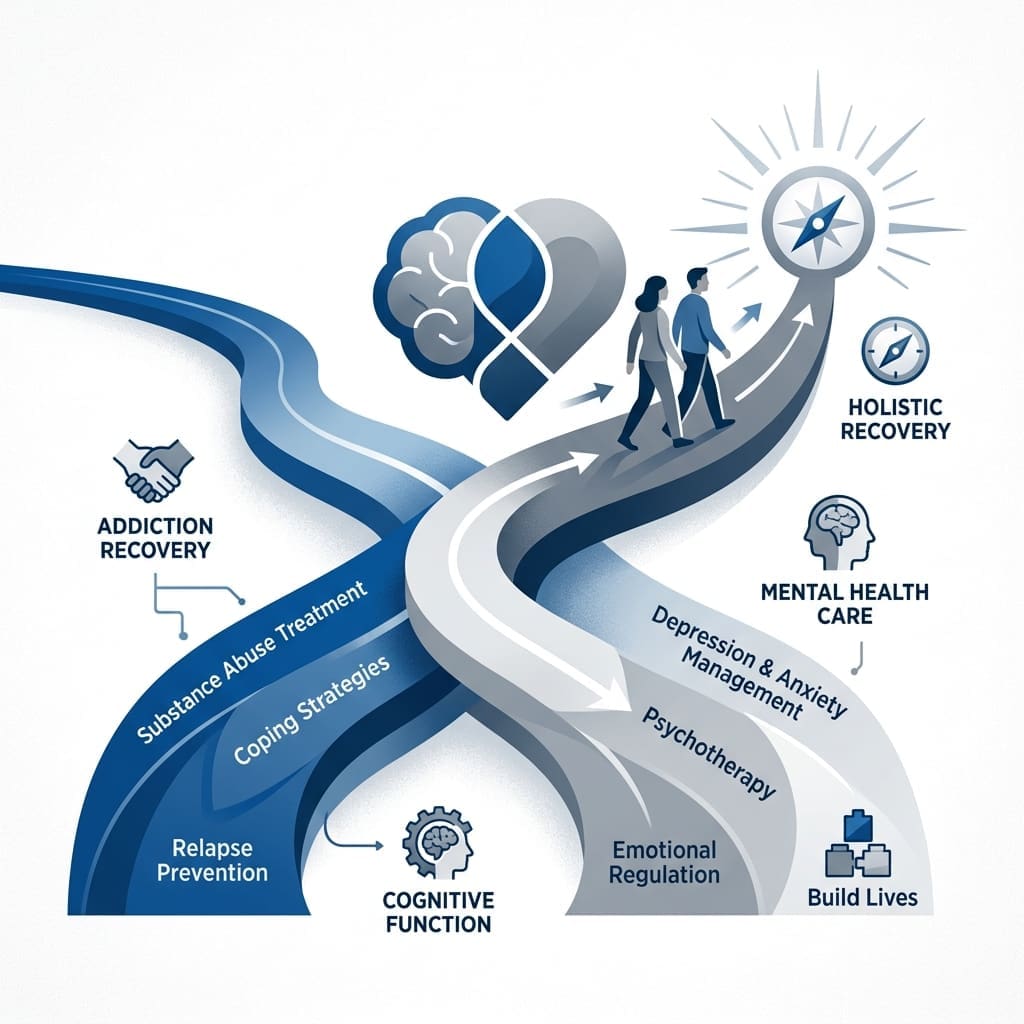

Before recommending any treatment, we conduct a thorough psychiatric evaluation. This evaluation is important because it allows us to identify co-occurring conditions, understand the history of substance use, assess current medications, and develop a personalized treatment plan. Without this evaluation, treatment is often generic rather than targeted. Moreover, a psychiatric evaluation ensures that any medications prescribed are appropriate, safe, and tailored to your specific needs — especially when other mental health conditions are present.
Whether you are located in Philadelphia, Pittsburgh, Allentown, Lancaster, Reading, Harrisburg, Erie, Scranton, Bucks County, Montgomery County, Delaware County, or Chester County, our virtual appointments make it possible to access specialized addiction psychiatry care from the comfort of your own home.
We evaluate and treat a broad range of substance use disorders and behavioral addictions in adults across Pennsylvania. Because each patient’s situation is unique, treatment is always individualized after a comprehensive psychiatric evaluation.
Gambling disorder — including compulsive online sports betting and casino gambling — is a behavioral addiction that responds to many of the same psychiatric interventions used for substance use disorders. We offer evaluation, medication management, and coordination of care for this increasingly common condition. Learn more →
Board-certified psychiatric providers. Virtual appointments across Pennsylvania. Insurance accepted.
AUDIT-C Alcohol Screening Questionnaire
This brief alcohol screening tool can help you reflect on whether alcohol use may be affecting your health, mood, relationships, or daily life.
This tool is educational only and does not diagnose alcohol use disorder. If you are concerned about your drinking, schedule an appointment with a licensed psychiatric provider.
This self-assessment can help you reflect on whether alcohol, cannabis, opioids, stimulants, prescription medications, or other substances may be causing problems in your life.
This tool is educational only and does not diagnose addiction or substance use disorder.
This tool can help you reflect on whether substance use may be connected to mental health symptoms such as anxiety, depression, ADHD, trauma, mood instability, or sleep problems.
This self-check is educational only and does not diagnose addiction, substance use disorder, or a mental health condition.
Medication-assisted treatment (MAT) uses FDA-approved medications, combined with individualized psychiatric care, to treat substance use disorders. MAT can significantly reduce cravings, manage withdrawal, and support long-term recovery. Below is an overview of medications that may be discussed as part of your treatment plan.
An opioid receptor antagonist that blocks the euphoric effects of opioids and alcohol. Non-addictive and non-controlled. Used for both alcohol use disorder and opioid use disorder. Reduces the reward associated with substance use, thereby supporting sobriety over time.
FDA-approved for alcohol use disorder. Acamprosate modulates glutamate and GABA systems that are dysregulated by prolonged alcohol use. As a result, it reduces the persistent discomfort, anxiety, and restlessness — sometimes called protracted withdrawal — that many patients experience after stopping alcohol.
Gambling disorder — including compulsive online sports betting and casino gambling — is a behavioral addiction that is often overlooked in traditional addiction treatment settings. However, the neurological mechanisms underlying gambling disorder are remarkably similar to those driving substance use disorders. As a result, many of the same psychiatric interventions that are effective for alcohol and drug addiction are also effective for gambling disorder.
At Integrative Psychiatry of America, we offer evaluation and treatment for gambling disorder through virtual appointments available throughout Pennsylvania. Whether you are dealing with compulsive sports betting, online poker, casino gambling, or other forms of problematic gambling, our providers can help you understand what is driving the behavior and develop an individualized treatment plan.


















Integrative Psychiatry of America provides virtual addiction psychiatry appointments to adults throughout Pennsylvania. Because our appointments are conducted entirely via telehealth, patients across the state can access the same high-quality psychiatric care — without travel, without waiting rooms, and without unnecessary barriers.
We currently serve patients in the following areas, among others:
If you are located elsewhere in Pennsylvania and are looking for online addiction treatment, we encourage you to reach out. As long as you are a Pennsylvania resident, you are eligible to receive care through our telehealth platform.
Substance use disorders frequently co-occur with other psychiatric conditions. If you or someone you care about is dealing with any of the following, we offer integrated treatment that addresses both addiction and mental health together.
Below you will find answers to the questions we hear most often from patients and families considering addiction psychiatry treatment in Pennsylvania. If your question is not listed here, please feel free to contact us directly.
Far far away, behind the word mountains, far from the countries Vokalia and Consonantia, there live the blind texts. Separated they live in Bookmarksgrove right at the coast
Yes. We provide virtual addiction psychiatry appointments to patients throughout Pennsylvania. Whether you are located in Philadelphia, Pittsburgh, Allentown, Lancaster, Reading, Erie, Harrisburg, Scranton, Bucks County, Montgomery County, Delaware County, or Chester County, you can access our services from the comfort of your own home. All you need is a phone, tablet, or computer with a camera.
Yes. Alcohol use disorder is one of the most common conditions we evaluate and treat. Our approach includes a thorough psychiatric evaluation, individualized medication management — which may include naltrexone, acamprosate, or disulfiram — and treatment of any co-occurring conditions such as anxiety, depression, or insomnia that may be contributing to alcohol use.
Yes. We offer evaluation and medication management for opioid use disorder. Treatment recommendations are individualized after a psychiatric evaluation. Patients are encouraged to discuss their full history and any concerns about specific medications during their initial appointment so that we can develop the most appropriate plan.
Yes. Dual diagnosis — the simultaneous presence of a substance use disorder and a mental health condition — is a primary focus of our practice. We evaluate and treat conditions including depression, anxiety, ADHD, PTSD, bipolar disorder, and sleep disorders alongside substance use disorders. Treating both conditions together, rather than separately, leads to significantly better outcomes for most patients.
Yes. Anxiety and substance use disorder frequently occur together, and treating them simultaneously is both possible and advisable. Our providers offer integrated evaluation and treatment so that both conditions are addressed within a single, coordinated plan. This approach avoids the common problem of treating one condition in isolation while the other continues to drive symptoms.
Yes. Depression is one of the most common conditions occurring alongside substance use disorder. Treating both conditions together generally produces better outcomes than treating each sequentially. Our providers evaluate for depression during the initial psychiatric assessment and, where appropriate, incorporate depression treatment into the overall addiction care plan.