
A lot of adults start this search the same way. It's late, work is still open on the laptop, messages have piled up, and a simple task that should have taken twenty minutes has somehow swallowed the evening. The search bar gets the question many people in Philadelphia type when frustration finally outweighs avoidance: Best Psychiatrist Philadelphia ADHD.
That search usually carries more than curiosity. It often comes with years of second-guessing. Maybe the problem is ADHD. Maybe it's anxiety. Maybe it's burnout, poor sleep, depression, or some combination that's been misread for a long time. The hard part isn't only finding someone with an appointment. It's finding someone who can sort out what's happening and build a treatment plan that fits real adult life.
Table of Contents
- The Search for Adult ADHD Care in Philadelphia
- What Best ADHD Care in Philadelphia Really Means
- Evaluating ADHD Providers Psychiatrists and PMHNPs
- The Power of Telehealth for ADHD Treatment in Pennsylvania
- What an Effective Integrative ADHD Treatment Plan Looks Like
- Begin Your Journey to Clarity with Integrative Psychiatry of America
- FAQs About Finding ADHD Care in Philadelphia
- Do adults need a referral to get evaluated for ADHD in Pennsylvania
- What if someone was diagnosed in childhood but hasn't had treatment in years
- Should adults look for therapy, medication management, or both
- How can someone tell if an ADHD provider is a good fit
- Is telehealth a realistic long-term option for ADHD treatment
The Search for Adult ADHD Care in Philadelphia
An adult in Center City, the Main Line, South Jersey, or the western suburbs may look successful on paper and still feel like daily life is held together by adrenaline and apology. Deadlines get met at the last minute. Bills are paid late. Meetings are survived, but details disappear. Home life becomes a string of unfinished chores, missed texts, and promises to “get more organized next week.”
That's usually the moment the search begins. Not because the symptoms are new, but because the cost of compensating has become too high.
Why the search feels harder than it should
Many adults assume the next step is simple. Find a local ADHD prescriber. Book the visit. Get an answer. In practice, adult ADHD assessment is more nuanced than that.
A major reason is diagnostic overlap. In a review of adult ADHD practice, 40% of psychiatrists reported difficulty distinguishing ADHD from other disorders, which is exactly why a careful evaluation matters for adults trying to sort out attention problems from anxiety, depression, trauma, or sleep-related issues, as noted in the CDC-linked overview of ADHD diagnosis and treatment patterns.
Adults usually don't need a faster prescription process. They need a better sorting process.
A rushed appointment can miss the central question. Is this primarily ADHD, or is ADHD one part of a more layered picture? That distinction shapes everything that follows, including whether medication helps, which medication makes sense, and what non-medication supports are worth adding.
What people actually need from that first appointment
The most useful first visit usually does three things well:
- Clarifies the pattern: Symptoms should be reviewed across work, school history, relationships, routines, and stress response.
- Rules out look-alikes: Anxiety, depression, trauma, sleep disruption, substance use, and burnout can imitate ADHD or amplify it.
- Creates a next step: Patients should leave knowing whether the plan is further evaluation, medication discussion, therapy, skills work, or a combination.
Adults looking for ADHD diagnosis in Philadelphia usually aren't looking for a lecture. They want clarity, structure, and a clinician who won't dismiss the problem because they've “managed this long.”
What Best ADHD Care in Philadelphia Really Means
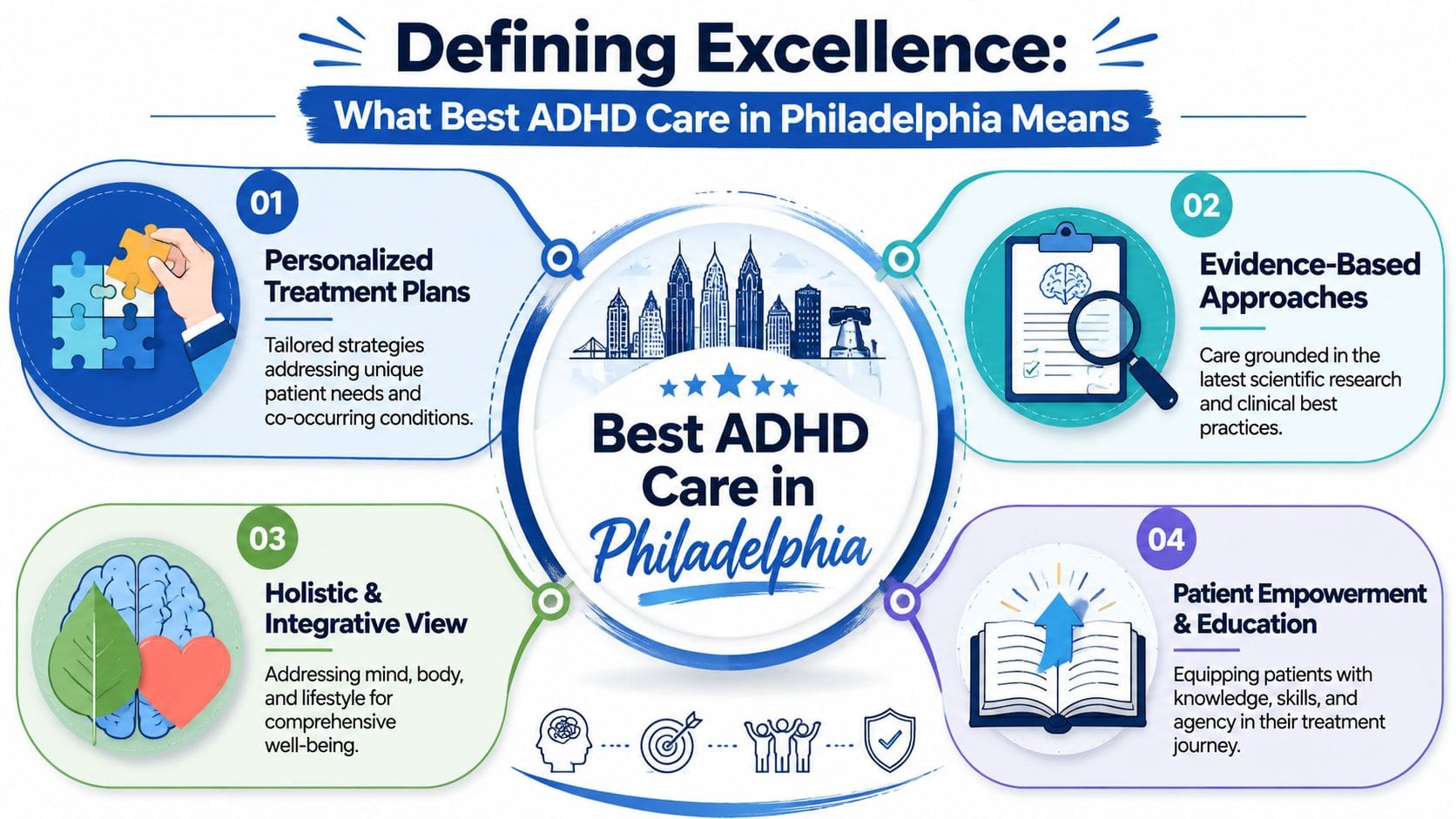
“Best” ADHD care isn't a title, a building, or a long list of credentials by itself. It's a standard of care. For adults, that means the treatment process has to be accurate, individualized, and practical enough to improve daily functioning outside the appointment.
Best care starts with a real evaluation
A strong adult ADHD evaluation goes beyond a symptom checklist. It should explore developmental history, current impairment, co-occurring conditions, sleep patterns, stress load, and previous treatment attempts. Adults often arrive wondering whether they need medication, therapy, both, or neither. A good clinician doesn't force that decision before the assessment is complete.
Children's systems have long recognized that ADHD care often requires more than medication. CHOP's guidance emphasizes behavioral therapy and care coordination, and that broader principle matters for adults too, especially when clinicians need to distinguish ADHD from anxiety, depression, burnout, or related concerns in order to build an effective plan, as described in CHOP's Center for Management of ADHD.
The real standard is function, not just symptom relief
Some adults can sit through meetings better after starting treatment and still keep losing track of deadlines, sleep, meals, or paperwork. That's not failure. It means the plan is incomplete.
The most useful care looks at daily function in a wider way:
| Focus area | What good care asks |
|---|---|
| Work performance | Are tasks started on time, completed, and prioritized more consistently? |
| Home life | Is there less chaos with routines, bills, chores, and follow-through? |
| Emotional regulation | Are frustration, shame, and overwhelm improving? |
| Physical rhythm | Are sleep, meals, movement, and energy more stable? |
Clinical reality: Adults often judge treatment by whether they “feel different.” A better question is whether life is becoming easier to run.
What weak ADHD care often looks like
A lot of disappointing care follows a predictable pattern:
- Checklist-only visits: The clinician confirms symptoms quickly but doesn't ask what else could be driving them.
- Medication without monitoring: A prescription is given, but no one tracks sleep, appetite, stress, or functional change.
- Generic advice: Patients hear “use a planner” without support on how to make systems stick.
Strong ADHD care in Philadelphia should feel collaborative. It should help a patient understand what's happening, why the plan makes sense, and how progress will be measured.
Evaluating ADHD Providers Psychiatrists and PMHNPs
Many adults searching for the best psychiatrist in Philadelphia for ADHD are really asking a different question. Who is qualified to evaluate and treat this well? That's where the comparison between psychiatrists and psychiatric mental health nurse practitioners often becomes important.
Titles matter less than ADHD-specific skill
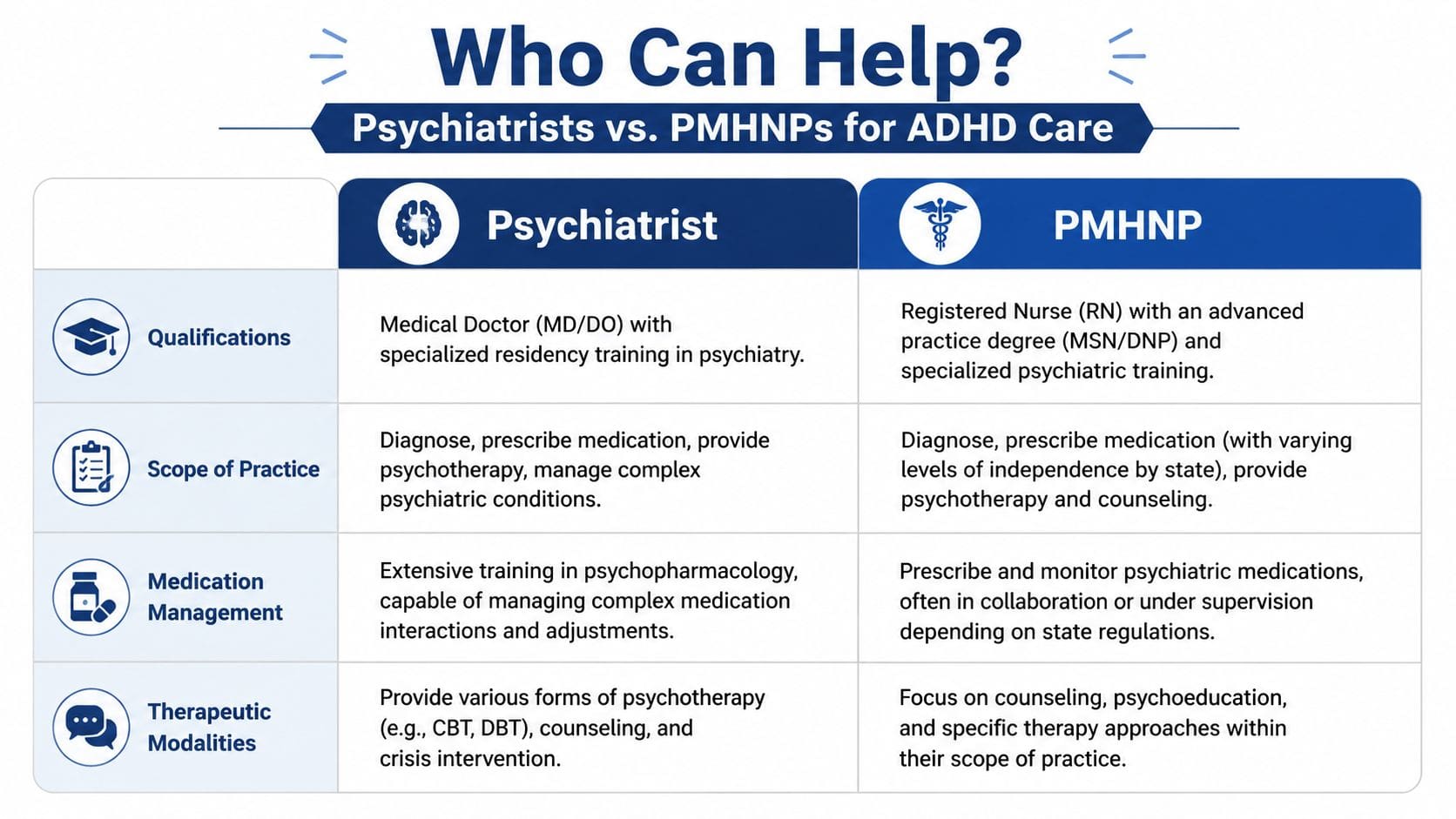
Psychiatrists are physicians with specialized psychiatric training. PMHNPs are advanced practice psychiatric clinicians with focused mental health training. Patients often assume the physician title automatically means better ADHD care, but that's too simplistic.
What usually matters more is whether the clinician regularly evaluates adult ADHD, understands how it overlaps with other conditions, and can manage treatment over time rather than just start it.
A review discussed by Penn Medicine highlights why experience matters. In that literature, 40% of psychiatrists cited difficulty differentiating ADHD from other disorders, and limited diagnostic experience was also identified as a barrier in adult care. That helps explain why dedicated adult ADHD programs exist and why patients benefit from clinicians who do this work routinely, such as the Penn Medicine Adult ADHD Treatment and Research Program.
What patients should compare side by side
The better question isn't “psychiatrist or PMHNP?” It's “which clinician is equipped to evaluate my situation thoroughly and manage the next steps well?”
A patient can compare providers using criteria like these:
- Evaluation depth: Does the clinician assess ADHD against anxiety, depression, trauma, sleep issues, and burnout?
- Medication comfort: Can the provider explain stimulant and non-stimulant options clearly and monitor response carefully?
- Follow-up style: Are visits structured around real-world function, not just “any side effects?”
- Treatment philosophy: Does the clinician discuss therapy, coaching, routines, sleep, and lifestyle supports, or only prescriptions?
For adults trying to understand the difference in more detail, this overview of psychiatric NP vs psychiatrist can help frame the decision around scope, fit, and treatment style rather than assumptions.
A short visual explanation may also help clarify the roles and overlap.
Questions worth asking before booking
A brief call or website review can reveal a lot. Useful questions include:
- Do they focus on adult ADHD, or only list it among many conditions?
- Do they explain how they rule out look-alikes?
- Can they provide both evaluation and ongoing medication management?
- Do they mention structured follow-up, not just intake availability?
- Do they work comfortably by telehealth across Pennsylvania if location or schedule is a barrier?
The most reassuring credential is often not the letters after the name. It's a clear, disciplined process.
The Power of Telehealth for ADHD Treatment in Pennsylvania
Telehealth fits ADHD care unusually well. Adults with attention and executive function difficulties often struggle with exactly the tasks traditional care adds to the process: commuting, parking, waiting rooms, time off work, and coordinating repeated follow-ups.
A virtual model removes a lot of that friction. A patient in Philadelphia can meet from home. A patient in Pittsburgh, Lancaster, Reading, Scranton, Harrisburg, Erie, or Allentown can reach the same type of psychiatric care without searching locally for a narrow specialty.
Why virtual care helps adults stay engaged
Consistency matters in ADHD treatment. The best plan in the world won't help much if follow-up becomes too cumbersome to maintain.
Telehealth often improves continuity because it reduces common drop-off points:
- Less travel burden: No commute, parking, or cross-city scheduling strain.
- More realistic follow-up: Shorter gaps between visits are easier to maintain.
- Better statewide access: Patients aren't limited to whatever adult ADHD expertise is nearest to home.
- Lower activation energy: Logging in is often easier than organizing an in-person appointment day.
For adults looking specifically for remote treatment options, online psychiatry in Pennsylvania for ADHD care reflects how a telehealth-first model can simplify access while keeping care structured.
The controlled-substance question is reasonable
Many adults hesitate because ADHD treatment can involve controlled medications, and telehealth rules have changed repeatedly. That concern is valid. Patients should ask about it directly instead of assuming the system is stable.
Federal telemedicine flexibilities for controlled substances have been repeatedly extended while longer-term rules are still being refined. That uncertainty is one reason it's important to work with a provider who follows Pennsylvania telehealth requirements closely and has a clear process for refill timing, follow-up intervals, and contingency planning, as noted by Dara Psychiatry's discussion of telehealth and ADHD care.
What good telehealth ADHD care should include
A strong virtual practice should be able to answer practical questions without dodging them:
| Question | What a clear answer sounds like |
|---|---|
| How are evaluations done remotely? | The clinician explains the interview process, history review, and how diagnosis is established. |
| How are medications monitored? | The practice outlines follow-ups, side effect review, and what happens if the plan needs to change. |
| What if travel or life changes interrupt care? | The provider discusses location rules, scheduling expectations, and refill planning clearly. |
Telehealth isn't a shortcut version of psychiatric treatment. When done well, it's a more workable delivery model for many adults with ADHD.
What an Effective Integrative ADHD Treatment Plan Looks Like
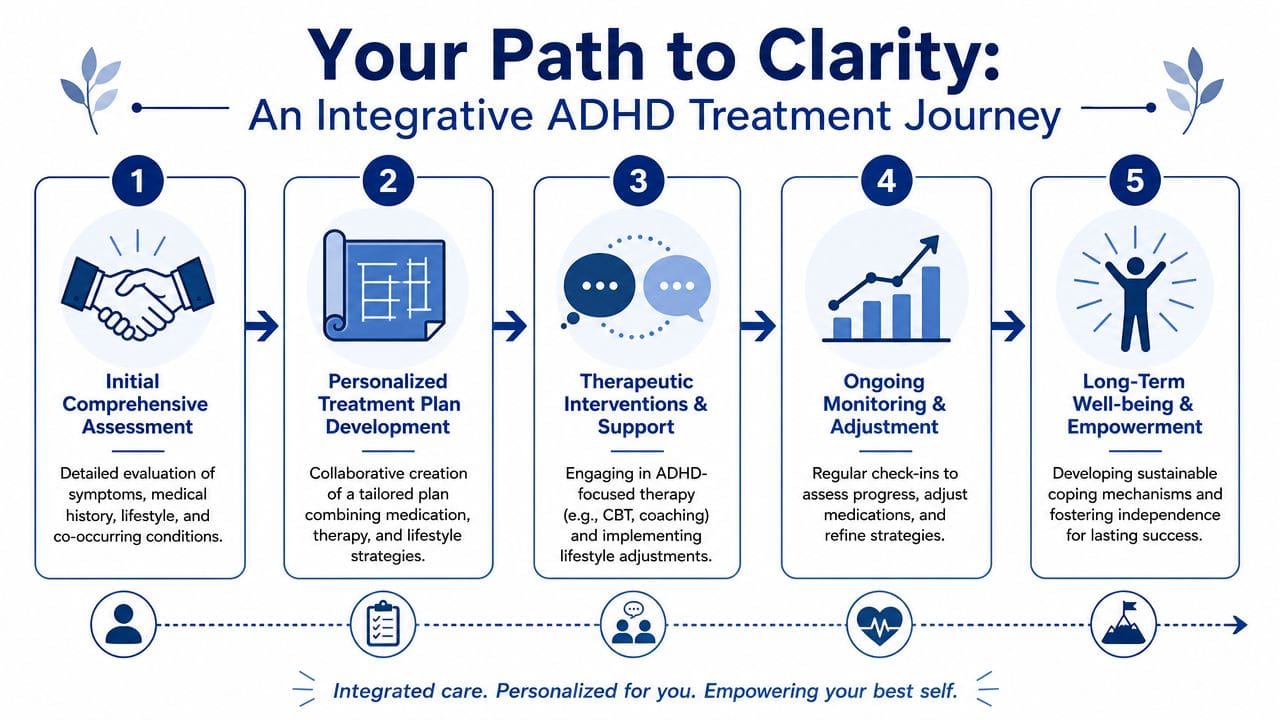
A good ADHD plan doesn't stop at diagnosis. It has to translate symptoms into a working system for real life. That means organizing treatment around function, not just around whether a medication was prescribed.
Step one is careful assessment
The first phase should identify symptom patterns, co-occurring issues, medical history, previous treatment, sleep habits, work demands, and the parts of daily life that are breaking down most often. A patient who struggles mainly with planning and overwhelm may need something different from a patient whose biggest problem is impulsivity or emotional reactivity.
This is also the right time to use structured tools. An Adult ADHD Assessment can help patients organize symptoms before an appointment so the discussion starts with clearer examples and fewer forgotten details.
Medication is often one tool, not the whole plan
For some adults, medication is central. For others, it's helpful but incomplete. Stimulant and non-stimulant options can both play a role, depending on symptoms, side effects, anxiety profile, sleep, and prior response.
What matters most is that medication management is active, not passive. The clinician should track whether attention improved, but also whether the patient is planning better, following through more consistently, and feeling less overloaded.
Research cited by a Philadelphia-area ADHD service reported 30% greater improvement in executive functioning when medication was paired with structured behavioral and lifestyle interventions, compared with medication alone, supporting a broader plan that targets organization, planning, and stress regulation alongside core symptoms, as described by Integrative Psychiatry of America's ADHD medication management page.
Medication may reduce friction. It usually doesn't build routines by itself.
The non-medication pieces that often change outcomes
The patients who do best long term usually have more than a prescription. They have a repeatable structure.
Some of the most practical additions include:
- Behavioral strategies: Calendar systems, task initiation methods, cueing, body-doubling, and simpler environmental setup.
- Sleep support: ADHD gets harder to manage when bedtime drifts, sleep quality drops, or mornings become chaotic.
- Nutrition planning: Irregular eating can worsen focus, irritability, and medication tolerability. Support around nutrition and integrative psychiatry for ADHD, depression, and anxiety can be useful when meals, appetite, and energy are part of the problem.
- Exercise and stress regulation: Movement, pacing of the workday, and basic nervous-system regulation often improve treatment durability.
A Daily Agenda Planner can help patients turn treatment recommendations into a daily routine instead of a vague intention.
Ongoing care should adapt over time
ADHD treatment works best when it's adjusted to life stage and context. A graduate student during finals, a parent with young children, and an executive managing travel all need different strategies even if the diagnosis is the same.
One Pennsylvania-based telehealth option is Integrative Psychiatry of America, which provides virtual psychiatric evaluations, medication management, and evidence-informed treatment planning across the state. The relevant point for patients isn't the brand name. It's the model: adult ADHD care tends to work better when medication review, behavioral strategies, and lifestyle factors are managed together rather than in separate silos.
Begin Your Journey to Clarity with Integrative Psychiatry of America
The search for the best psychiatrist in Philadelphia for ADHD usually starts with one urgent need. Find someone who can make sense of the symptoms and help life feel manageable again. By that point, most adults don't need more generic advice. They need a clinician who can evaluate carefully, explain options clearly, and provide ongoing care that fits a busy schedule.
For adults in Philadelphia and across Pennsylvania, all-virtual psychiatric care in Philadelphia offers a practical path to assessment and treatment without the usual in-person barriers. That includes people in Scranton, Reading, Pittsburgh, Allentown, Lancaster, Harrisburg, and Erie who want ADHD care delivered through secure telehealth.
Christopher Clark, MSN, PMHNP-BC, leads the practice's psychiatric care model with a focus on whole-person treatment. That kind of framework matters for adults whose attention difficulties overlap with anxiety, low mood, sleep disruption, stress, or inconsistent daily routines.
Patients who are ready for next steps can review treatment options, check insurance, schedule an appointment, or start with a free tool such as the Adult ADHD Assessment, Feeling Journal, Anxiety Symptom Checker, Exercise Routine Generator, or 5-4-3-2-1 Grounding Tool.
FAQs About Finding ADHD Care in Philadelphia
Do adults need a referral to get evaluated for ADHD in Pennsylvania
Often, they don't. Many psychiatric practices accept self-referred adult patients. Insurance plans differ, so it's smart to verify benefits before booking, especially if the goal is medication management.
What if someone was diagnosed in childhood but hasn't had treatment in years
That history can help, but it usually shouldn't replace a current adult evaluation. Symptoms, responsibilities, sleep, anxiety, and work demands may look very different now than they did years ago, so the current treatment plan should be based on present functioning.
Should adults look for therapy, medication management, or both
That depends on the pattern of impairment. Some adults mainly need medication review and structured follow-up. Others need a combined plan because organization, planning, stress regulation, or emotional overwhelm are still causing problems even after core attention symptoms improve.
How can someone tell if an ADHD provider is a good fit
A good fit usually shows up in the process. The clinician asks careful questions, explains how diagnosis is made, discusses alternatives, and offers a treatment plan that feels individualized instead of generic.
Is telehealth a realistic long-term option for ADHD treatment
For many adults, yes. The key is working with a Pennsylvania practice that has a clear process for evaluations, follow-ups, prescribing rules, and continuity if regulations change.
Integrative Psychiatry of America provides secure virtual psychiatric care for adults across Pennsylvania, including ADHD evaluations, medication management, and integrative treatment planning. Patients can explore services, verify insurance, schedule an appointment, or use free mental health tools directly through Integrative Psychiatry of America.