
Some people start this search at 2 a.m. from a couch in South Philly, after another week of canceled plans, poor sleep, and the dull feeling that nothing sounds worth the effort. Others start from an office bathroom in Center City, trying to decide whether what they're dealing with is stress, burnout, grief, or depression. Many wait longer than they want to because the process feels confusing. Who treats depression. Who prescribes. Who offers therapy. Who takes insurance. Who can see patients online.
That confusion is common, but it shouldn't stop care. Depression is a medical condition, and in Philadelphia there are real treatment pathways, from standard outpatient therapy to medication management, higher levels of care, and telepsychiatry that can be done from home. The challenge usually isn't whether help exists. It's knowing how to access the right kind of help without wasting energy on dead ends.
Table of Contents
- The Search for Depression Treatment in Philadelphia
- Understanding Your Treatment Options in Philadelphia
- The Power of Integrative and Holistic Psychiatry
- How Telepsychiatry Is Making Care More Accessible
- Your Practical Guide to Starting Treatment
- How Our Psychiatric Nurse Practitioners Can Help
- Frequently Asked Questions About Depression Care
The Search for Depression Treatment in Philadelphia
Depression often narrows a person's world before they realize that's what's happening. Work starts to feel harder. Basic errands take too much effort. Texts go unanswered, laundry piles up, and even enjoyable parts of city life start to feel distant. In a place as active as Philadelphia, that kind of isolation can feel especially sharp.
The local need is substantial. In 2023, 19.3% of adults in Pennsylvania reported depression, and Philadelphia County recorded more than 94,000 adult depression cases, the highest volume in the state, according to a Pennsylvania mental health statistics summary. When considering depression treatment in Philadelphia, PA, those numbers matter for one reason. They confirm that this isn't rare, and they explain why demand for timely care is so high.
Why the search feels harder than it should
Individuals seeking support aren't starting with a clean, organized checklist. They're often searching while exhausted, unmotivated, and unsure whether they need a therapist, a prescriber, or something more structured. Many local treatment pages don't help much because they list services without helping readers decide what fits.
A better first step is narrowing the question. Instead of asking "Who treats depression," ask:
- Do symptoms feel mild, moderate, or severe
- Is safety a concern right now
- Is work, parenting, school, or daily functioning slipping
- Is the biggest obstacle time, cost, travel, or privacy
Those answers shape the next move. Someone who can still function but feels persistently down may need outpatient therapy, medication evaluation, or both. Someone who can't get through the day safely may need urgent in person assessment.
Depression care works better when the first appointment matches the real level of need, not just the first provider with an opening.
Philadelphia patients also don't need to limit their search to offices within a short commute. For many adults, finding Philadelphia telehealth psychiatric care is the point where treatment becomes realistic enough to start. Removing parking, transit, and waiting room friction doesn't solve depression by itself, but it often removes the barrier that kept treatment from beginning.
Understanding Your Treatment Options in Philadelphia
The most useful way to think about depression care is stepped care. That means treatment intensity should match symptom severity, safety needs, and how much daily functioning has been affected. A person doesn't need the highest level of care just because symptoms are painful. But weekly care isn't always enough, either.
A Philadelphia program description from New Mind Wellness lays out this progression clearly. Standard outpatient involves one on one sessions. IOP includes multiple sessions per week, and PHP offers daytime structured treatment without an overnight stay. Inpatient care is used when someone needs round the clock supervision and stabilization.
What stepped care actually means
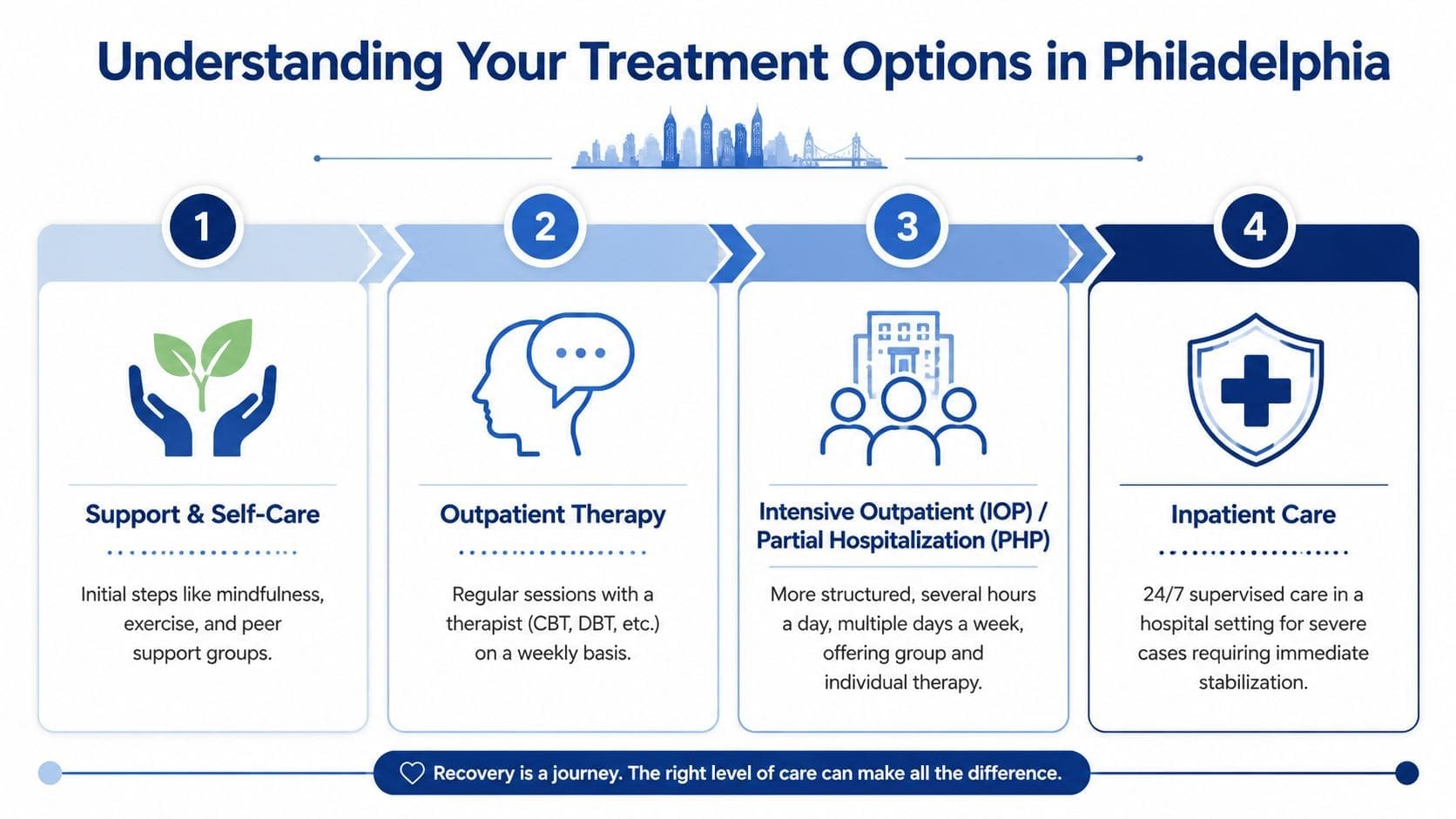
Supportive routines and self care can help, but they are not a substitute for clinical treatment when depression is persistent or impairing. Outpatient care is usually where adults begin. That may include psychotherapy, medication management, or a combination.
When symptoms become more disruptive, more contact often works better than waiting longer between appointments. That's where IOP or PHP may fit. These levels offer more structure, more observation, and more opportunities to adjust the plan quickly. For some patients in Pennsylvania exploring options such as online ketamine informed psychiatric care, the broader point is the same. The treatment has to fit the clinical picture, not the other way around.
Comparing common levels of care
| Level of Care | Typical Time Commitment | Best For |
|---|---|---|
| Support and self care | Flexible, self directed | Early symptom awareness, stress management, added support alongside formal care |
| Outpatient therapy or medication management | Usually scheduled visits on a regular basis | Mild to moderate depression, stable safety, people who can function day to day but need treatment |
| Intensive Outpatient Program IOP | Multiple sessions per week | Depression that needs more structure than weekly care but doesn't require overnight monitoring |
| Partial Hospitalization Program PHP | Daytime structured treatment without overnight stay | Significant impairment, need for close support, frequent monitoring, or transition from higher acuity care |
| Inpatient care | Continuous supervision | Safety crises, severe suicidality, inability to maintain safety, or need for immediate stabilization |
Practical rule: If a person is asking whether they can keep themselves safe, that question is already beyond routine outpatient triage.
What doesn't work well is choosing care based only on convenience. Weekly visits can be excellent treatment when they're enough. They can also become a holding pattern when someone clearly needs more support.
The Power of Integrative and Holistic Psychiatry
Medication only is sometimes too narrow. Lifestyle advice only is often too weak. Good depression care usually sits between those extremes.
An integrative psychiatry approach treats depression as both a brain based and whole body condition. That means using evidence based tools such as medication management and psychotherapy while also looking at sleep, appetite, movement, substance use, stress load, medical issues, and daily routine. These factors don't replace standard treatment. They affect how well standard treatment works.
What whole person depression care looks like

A peer reviewed meta analysis in PMC on IPT and antidepressant treatment for major depression supports a combined approach. It notes that interpersonal psychotherapy and antidepressant medications are both recommended interventions, and that combining psychotherapy with medication can support not only mood improvement but also social functioning, quality of life, and coping.
That aligns with what many psychiatric nurse practitioners see in practice. Depression is rarely just sadness. It can disrupt concentration, relationships, sleep timing, work consistency, motivation to eat well, and the ability to use healthy coping skills. A plan that ignores those domains is often incomplete.
Examples of an integrative plan may include:
- Medication management when indicated for persistent, moderate, or recurrent symptoms
- Therapy with a clear target such as relational patterns, grief, negative thinking, avoidance, or self criticism
- Sleep stabilization because irregular sleep can worsen mood and reduce resilience
- Movement and nutrition support because depleted routines often make treatment feel less effective
- Mindfulness or reflection practices to help patients notice patterns instead of automatically following them
Where lifestyle tools fit and where they do not
Journaling is a good example. It won't replace medication when someone is severely depressed, but it can help track triggers, thought patterns, energy shifts, and treatment response. For patients who want a structured way to reflect between visits, this guide to discover journaling for mental wellness offers practical formats that can support therapy work.
Another useful resource for readers considering a broader care model is holistic depression treatment options.
Effective integrative care doesn't ask patients to choose between science and self care. It combines them in the right order, at the right intensity.
What doesn't work is using wellness language to avoid clinical treatment. If depression is impairing daily life, treatment should be organized, measurable, and medically informed.
How Telepsychiatry Is Making Care More Accessible
For many Philadelphia adults, access isn't mainly a motivation problem. It's a logistics problem. Commuting across the city, leaving work early, sitting in traffic on the Schuylkill, arranging childcare, or worrying about being seen walking into a clinic can be enough to delay care for months.
Telepsychiatry changes that. A patient in Fishtown, West Philly, Chestnut Hill, the Main Line, or a nearby suburb can attend from home or another private space. That convenience matters because depression often makes extra effort feel impossible.
Why virtual care works for many adults
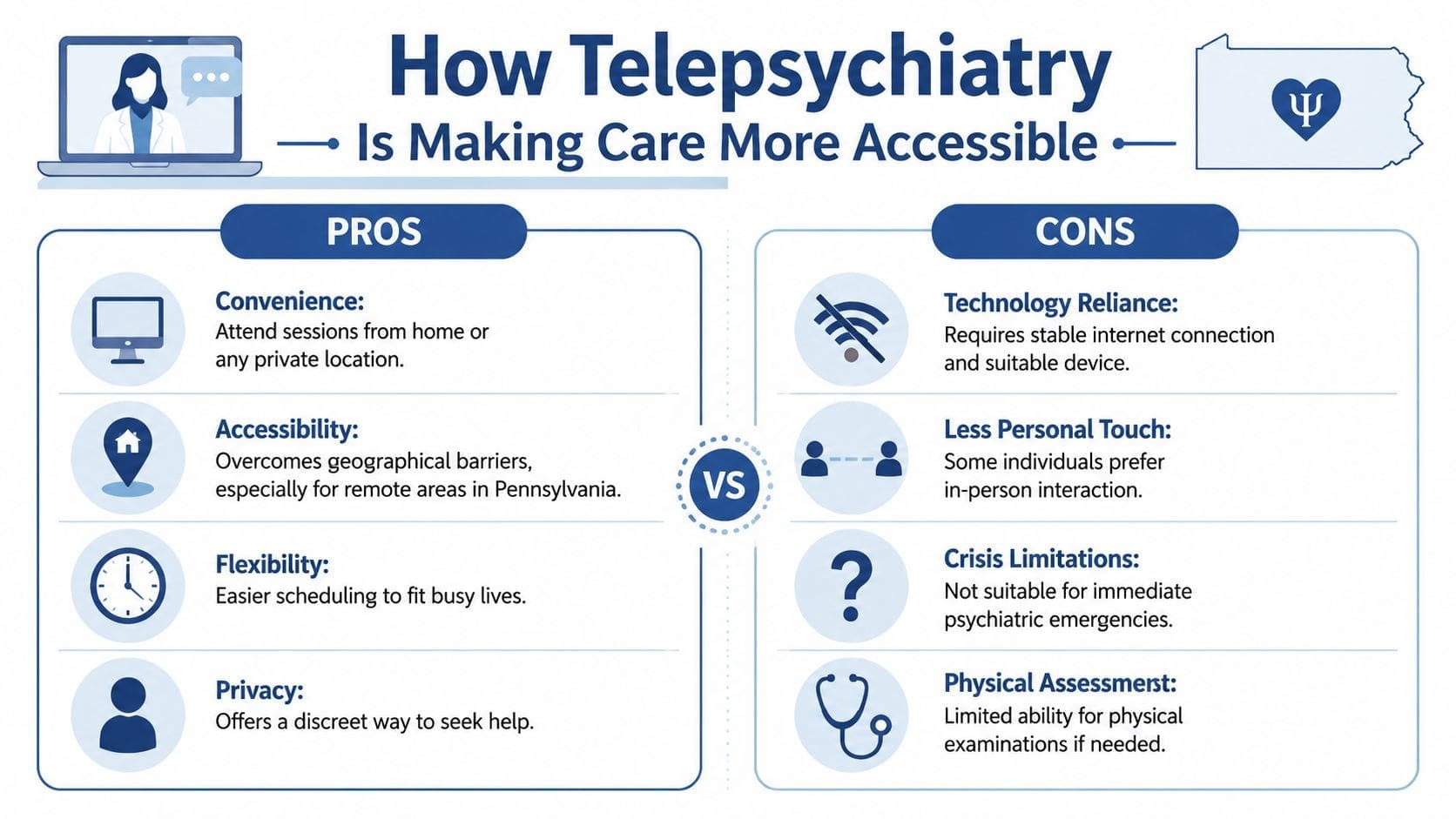
Virtual care works especially well for services that depend on conversation, symptom tracking, medication review, and treatment planning. That includes psychiatric evaluations, follow ups, many forms of therapy, and ongoing medication management. For adults seeking online depression psychiatry in Philadelphia, telehealth can make treatment more consistent because appointments fit more easily into real life.
Common advantages include:
- Less friction because there is no commute, parking, or waiting room
- More privacy for people who feel uneasy about seeking local in person care
- Better continuity when travel, mobility issues, or work schedules would otherwise cause missed visits
- Easier access outside the city core for people in surrounding Pennsylvania communities
There are trade offs. Some patients focus better in a physical office. Some don't have reliable internet or a private room. Others prefer face to face interaction. Those preferences matter and should be respected.
When telepsychiatry is not enough
Telepsychiatry is not the right tool for every situation. It is not a substitute for emergency care when a person is in immediate danger, unable to maintain safety, or experiencing symptoms that need urgent in person evaluation. It also has limits when a patient needs close daily observation or a highly structured program.
That doesn't make telehealth weaker. It makes it specific. The best use of telepsychiatry is not trying to force it into every case. It's using it where it improves access without lowering clinical quality.
Your Practical Guide to Starting Treatment
Starting care is easier when the process is broken into small decisions. A perfect plan isn't necessary; the next clear step is.
A financial barrier is part of this picture in Pennsylvania. NAMI's Pennsylvania state fact sheet reports that 25.7% of adults were unable to get the counseling or therapy they needed, and among adults who did not receive needed mental health care, 32.7% cited cost. That makes insurance verification and payment clarity part of treatment access, not an administrative detail.
Start with insurance and cost clarity
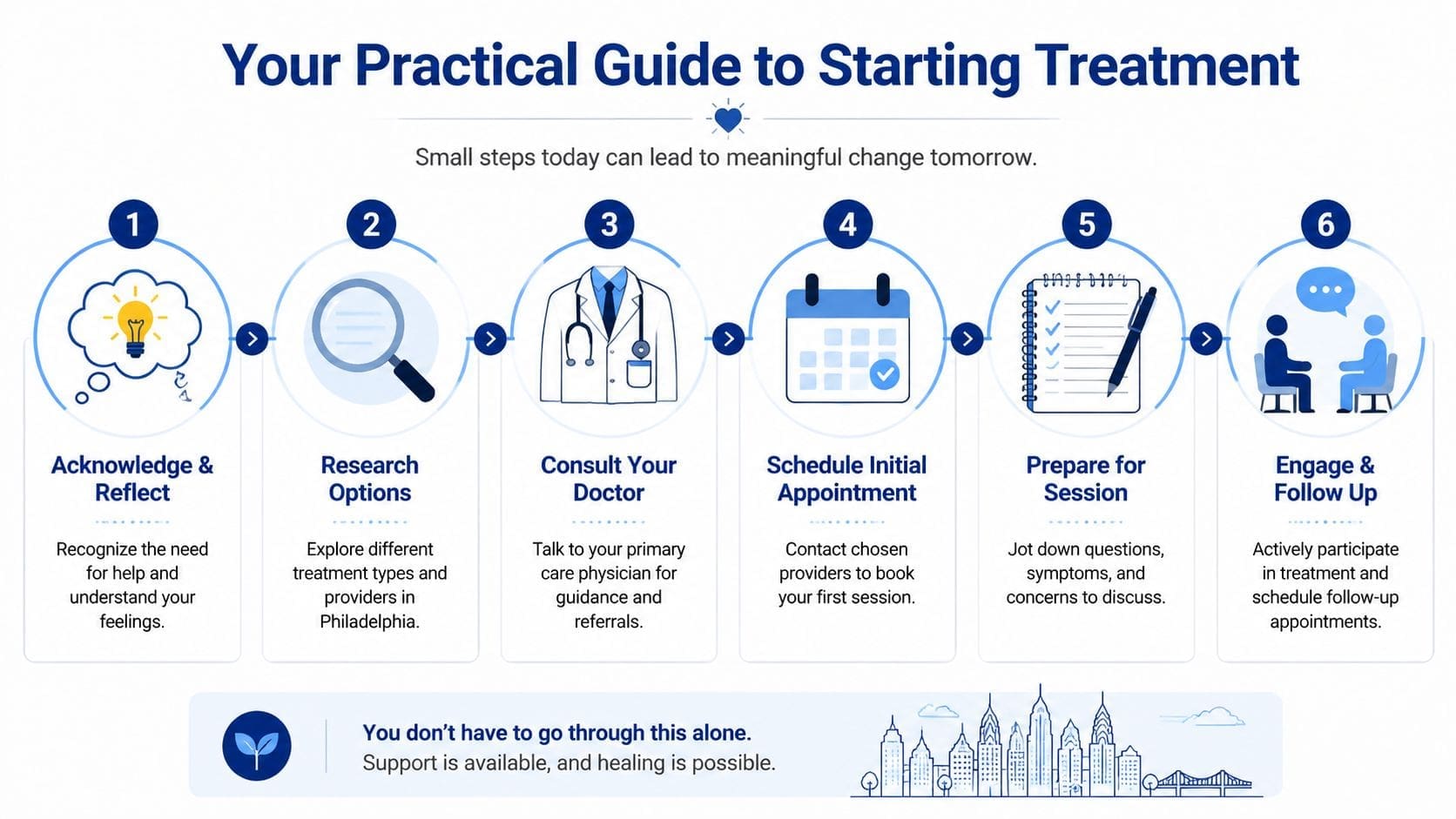
Before scheduling, ask practical questions in plain language:
- Is the practice in network with the plan
- If not, are out of network benefits available
- What is the expected cost for an intake and for follow ups
- Are there cash pay or membership options
- How are refills, missed appointments, and paperwork handled
A clinic that answers these directly is usually easier to work with long term. Confusion about billing often leads patients to stop treatment early.
Choose the right type of clinician
For depression treatment philadelphia pa, patients often need one of three things, and sometimes more than one:
- A therapist for regular psychotherapy
- A psychiatric prescriber, such as a PMHNP, for diagnosis, medication management, and treatment planning
- A higher level program if symptoms are too severe for routine outpatient care
A primary care clinician can also be part of the process, especially when depression overlaps with sleep problems, fatigue, pain, or other medical concerns.
This short video can help normalize the process of reaching out for care.
Prepare for the intake visit
The first visit usually goes better when patients don't try to remember everything on the spot. A short note on the phone is enough.
Helpful items to bring into the appointment include:
- Current symptoms and when they started
- Sleep changes including trouble falling asleep, early waking, or oversleeping
- Past treatment such as therapy, medications, or prior diagnoses
- Substance use because alcohol or cannabis can complicate depression treatment
- Safety concerns including hopelessness or thoughts of self harm
- Goals such as better concentration, less isolation, improved sleep, or return to work
The first appointment does not need a polished life story. It needs honest information that helps the clinician choose a safe starting point.
How Our Psychiatric Nurse Practitioners Can Help
A PMHNP led model can address several of the barriers that make depression treatment hard to start. Psychiatric nurse practitioners evaluate symptoms, diagnose, prescribe when appropriate, monitor response, and adjust treatment over time. That makes them a practical fit for adults who need both clinical oversight and a more accessible format.
What a PMHNP led model solves
For readers comparing provider types, this overview of a psychiatric NP versus psychiatrist explains the roles in more detail. The important point for many patients is functional. They need a clinician who can assess depression thoroughly, discuss medication options clearly, and build a plan that fits work, family, and energy limits.
Integrative Psychiatry of America offers telepsychiatry across Pennsylvania with psychiatric nurse practitioners, medication management, psychotherapy support, insurance verification, and cash or membership pathways described on its site. That model directly addresses common access problems discussed earlier, especially when patients need convenience, privacy, and a whole person approach rather than a medication only encounter.
Who may benefit from this approach
This model often fits adults who:
- Want treatment from home because commuting creates too much friction
- Need medication management plus behavioral guidance rather than one or the other alone
- Prefer a holistic framework that includes sleep, exercise, nutrition, mindfulness, and lab or genetic screening when clinically appropriate
- Need inclusive care that respects identity, work culture, and day to day reality
What usually works best is steady follow up, realistic goals, and a plan that can change as symptoms change. What tends not to work is starting treatment with the hope that one visit, one prescription, or one insight will fix everything quickly.
Frequently Asked Questions About Depression Care
Can depression be treated fully online
Often, yes. Many adults can complete psychiatric evaluations, medication follow ups, and therapy through secure telehealth. The main exceptions are situations involving immediate safety concerns, need for urgent medical assessment, or need for a more structured in person level of care.
How fast should treatment feel different
That depends on the treatment plan and the severity of symptoms. Some people notice early changes in sleep, anxiety, or daily rhythm before mood lifts fully. Others improve more gradually. A useful approach is tracking function, not just feelings. Are mornings easier. Is concentration slightly better. Are basic tasks becoming more manageable.
What if weekly therapy has not been enough
That doesn't mean treatment has failed. It may mean the level of care, the treatment method, or the diagnosis needs another look. Some patients need medication added. Others need therapy with a different focus. Others need IOP, PHP, or a closer review of sleep, substance use, trauma, or medical factors affecting mood.
When is urgent in person help the right move
Urgent in person care is appropriate when safety is uncertain, suicidal thinking feels hard to control, basic functioning is collapsing, or symptoms become too severe for outpatient treatment. In those moments, convenience matters less than immediate assessment and stabilization.
A good depression treatment plan is not the one that sounds most appealing online. It's the one that matches severity, safety, and what a patient can realistically sustain.
If depression has been affecting daily life and the search for care feels harder than it should, Integrative Psychiatry of America is one option for adults in Pennsylvania who want confidential telepsychiatry, medication management, and an integrative treatment approach from psychiatric nurse practitioners. The next useful step is simple. Verify coverage, schedule an intake, and start with an assessment that matches the level of support needed.