
Typing “adhd psychiatrist philadelphia” into a search bar usually happens after months, sometimes years, of trying to push through. Work is slipping. Bills get missed. Emails pile up. A smart adult who’s handled a lot in life starts wondering whether the problem is stress, burnout, anxiety, or ADHD that never got recognized.
The search itself can make things worse. One listing says “therapy.” Another says “testing only.” Another looks promising, but the provider doesn’t treat adults, doesn’t prescribe, or has a long waitlist. For many adults in Philadelphia, the challenge isn’t just finding someone qualified. It’s finding care that’s practical, thorough, and reachable from real life.
Table of Contents
- Navigating Your Search for ADHD Care in Philadelphia
- Where to Find Reputable ADHD Providers
- How to Choose the Right Provider for You
- What to Expect From Your First ADHD Appointment
- Exploring Integrative ADHD Treatment Options
- Your Next Steps to Getting ADHD Care
Navigating Your Search for ADHD Care in Philadelphia
The frustration is real. Philadelphia has high demand for ADHD services, and that changes the search experience from the start. In Philadelphia, ADHD diagnosis rates among school-aged children are approximately 15%, compared with the national average of 9.8%, and the region saw a 33% increase in diagnoses over seven years, contributing to long specialist wait times and making accessible options like telehealth more important (Philadelphia ADHD prevalence data).
That pressure shows up later in adulthood. Adults who suspect ADHD often find themselves sorting through outdated directories, unclear credentials, and practices that still revolve around in-person scheduling. A search for adhd psychiatrist philadelphia may bring up useful names, but it often doesn’t tell a patient how the office evaluates ADHD, whether telehealth is offered, or whether treatment goes beyond refills.

Why the search feels harder than it should
A good ADHD evaluation takes time, pattern recognition, and careful differential diagnosis. It also takes access. When specialist schedules fill up, adults often delay care, second-guess themselves, or settle for fragmented treatment.
That’s one reason psychiatric nurse practitioners have become an important part of ADHD care. A PMHNP can assess symptoms, diagnose, prescribe when clinically indicated, and manage treatment over time. For many adults, that model is more available and easier to continue than waiting months for a traditional office visit.
Practical rule: The right provider isn’t just the one who appears in search results first. It’s the one who can evaluate ADHD carefully and follow through with treatment that fits daily life.
Why telehealth matters for adults with ADHD
Telehealth-first care solves several common barriers at once. It cuts down on commute time, reduces missed appointments, and makes follow-up medication checks more manageable for adults balancing work, parenting, or inconsistent schedules. It also helps patients stay engaged when ADHD itself makes logistics harder.
For readers trying to understand the insurance and administrative side of outpatient mental health care, this overview of optimize mental health billing can help explain why coverage, claims, and practice structure sometimes affect access more than patients expect.
Adults who want a clearer starting point can also review options for ADHD doctors near me in Philadelphia, especially when they want virtual care rather than another waitlist.
Where to Find Reputable ADHD Providers
A provider search works better when it starts with categories, not random listings. Most adults looking for ADHD care in Philadelphia will encounter three main types of clinicians.
Psychiatrists are medical doctors who diagnose mental health conditions and prescribe medication.
Psychologists usually focus on testing and therapy, depending on the practice and state rules.
Psychiatric nurse practitioners diagnose, prescribe, and provide ongoing medication management, often with a more lifestyle-oriented and education-heavy approach.
Start with the places people actually search
Insurance directories are often the first stop. They can help identify in-network options, but they’re often incomplete or outdated. A provider may be listed without clear details on whether they treat adult ADHD, whether they offer telehealth, or whether they handle complex cases involving anxiety, depression, or sleep concerns.
Professional directories can be more descriptive. They usually include treatment focus, age range, and practice style. But there’s still a gap between a polished profile and a usable care path. A listing might mention ADHD while offering only therapy, or mention medication management without explaining how diagnosis is established.
A local referral can still be useful. Primary care clinicians, therapists, and even workplace EAP programs sometimes know who handles adult ADHD thoughtfully. The limitation is that many referrals reflect older patterns of care, not necessarily telehealth availability or integrative treatment.
The telehealth gap is real
A projected 2025 CDC report cited in a Philadelphia provider roundup notes that 78% of Pennsylvania adults with ADHD prefer telepsychiatry, yet only 20% of traditionally listed providers explicitly advertise this service, creating a meaningful access gap for adults who need virtual care (Philadelphia ADHD provider listings).
That matters because adults rarely need only a diagnosis. They need follow-up. They need medication monitoring when appropriate. They need a provider who can adjust a plan when side effects, sleep disruption, or work stress change the picture.
Many adults don’t need more names on a list. They need fewer dead ends.
A practical search filter
When reviewing providers, it helps to screen for a few basics before reaching out:
- Adult ADHD focus: The practice should clearly state that it evaluates and treats adult ADHD.
- Prescribing authority when needed: If medication may be part of care, the clinician should be licensed to prescribe and manage it.
- Telehealth availability: The site should say whether secure virtual visits are offered.
- Ongoing care model: Look for language about follow-up, monitoring, therapy integration, or lifestyle support.
- Clear next step: Booking, intake, or consultation instructions should be easy to find.
For adults comparing provider types and care settings, this guide to finding a Philadelphia mental health provider for medication management and telepsychiatry can help clarify what different practices offer.
How to Choose the Right Provider for You
Finding names is one task. Choosing well is another. Adults often get stuck here because credentials look similar on paper, but the treatment experience can be very different.
Look at philosophy before credentials alone
Some practices take a medication-only approach. That can be efficient, but it may not address the broader issues that commonly travel with ADHD, such as disorganization, sleep problems, poor routines, shame, inconsistent eating, or anxiety that developed after years of struggling.
An integrative practice usually looks at symptom control and daily functioning together. That means asking whether the patient can finish work, manage appointments, regulate stress, and build systems that last outside the appointment.
A second major filter is accessibility. Adults with ADHD often miss care when the system is too hard to use. Long drives, narrow office hours, repeated phone tag, and unclear refill policies create friction that can derail treatment.
For a useful overview of how website and portal design affect patient access, this article on digital accessibility in healthcare is worth reading. ADHD care works better when scheduling, forms, messaging, and follow-up are easy to use.
Compare the care model, not just the title
The difference between a traditional office and an integrative PMHNP-led practice often shows up in the details.
| Factor | Integrative PNP (e.g., at IPA) | Traditional Psychiatrist |
|---|---|---|
| Evaluation style | Often combines symptom review, functional assessment, history, and practical lifestyle discussion | Often strong diagnostically, but approach varies by practice |
| Access | Frequently telehealth-first, with easier follow-up for working adults | May be in-person heavy with longer waits |
| Treatment philosophy | More likely to combine medication with behavioral strategies, sleep, nutrition, and habit support | May focus more narrowly on medication management |
| Visit flow | Often more collaborative and education-focused | Can be efficient but sometimes more medicalized |
| Fit for busy adults | Works well when convenience affects adherence | Depends on office structure and availability |
No single model fits every patient. Some adults want a very traditional psychiatric approach. Others want a provider who will look at food patterns, exercise, therapy tools, and work structure alongside medication decisions.
A strong ADHD provider should be able to explain not only what the diagnosis is, but how treatment will work in everyday life.
For readers who want a clearer comparison of training and scope, this explanation of psychiatrist vs psychiatric NP helps sort out what each role can do in ADHD care.
What to Expect From Your First ADHD Appointment
The first appointment usually feels less mysterious once the process is spelled out. Most adults worry that they’ll be judged, rushed, or asked to prove something they’ve had difficulty explaining for years.
A structured ADHD evaluation is more methodical than that. Psychiatric nurse practitioners use a structured evaluation process that achieves diagnostic confirmation in over 90% of cases, similar to specialist referrals, and they report higher confidence in adult ADHD diagnosis and evidence-based management than general physicians (adult ADHD evaluation research).
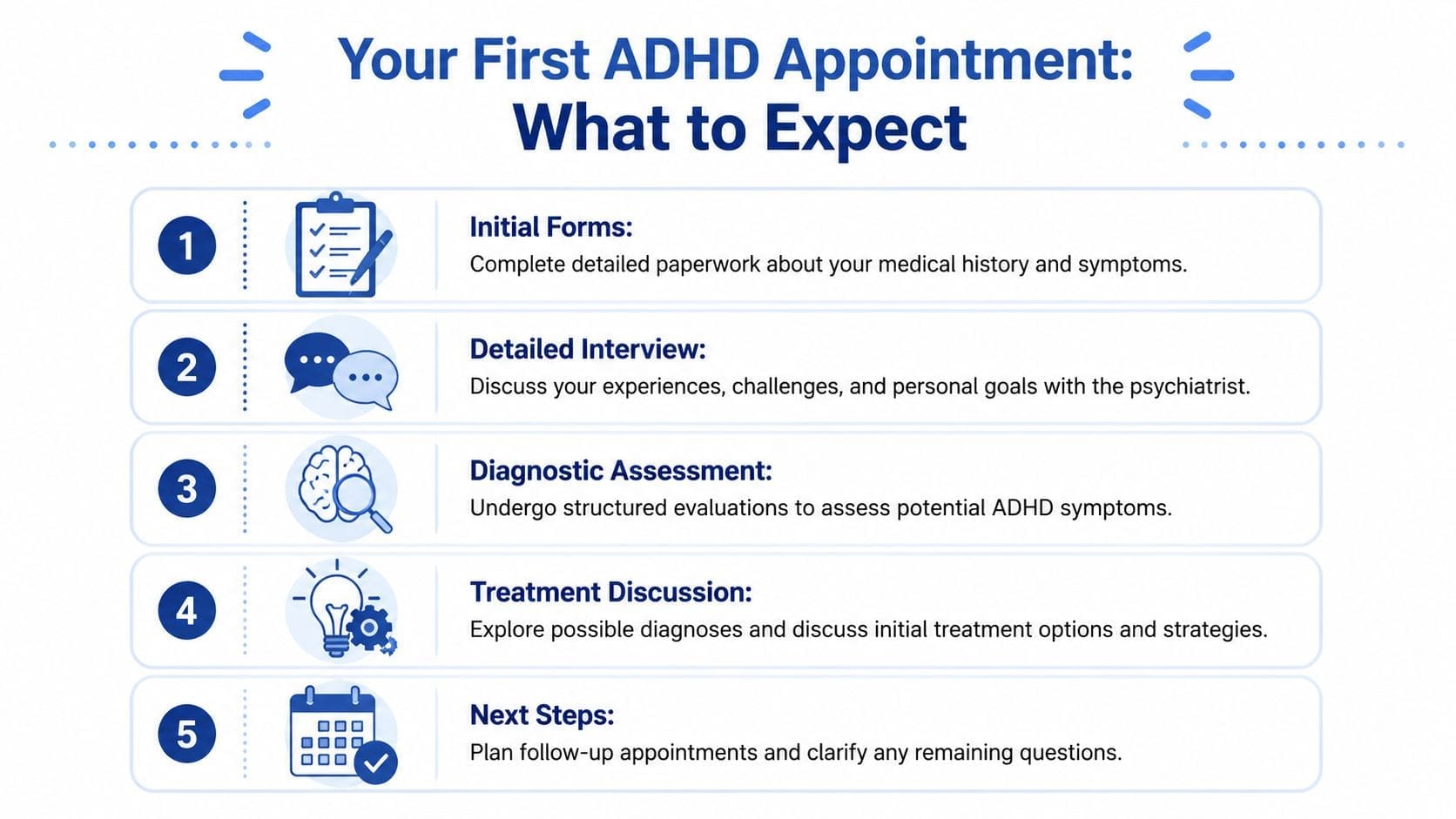
A visual summary can help make the intake process feel more concrete.
What usually happens in the first visit
The visit often starts with forms and history. That includes current symptoms, medical history, past mental health treatment, sleep, substance use, and any prior diagnosis. The provider will usually ask what’s happening now that pushed the patient to seek care.
Then comes the interview. Adults are often asked about childhood patterns, school performance, forgetfulness, procrastination, restlessness, emotional regulation, work problems, and what happens at home. A validated screening tool such as the ASRS may be included as one part of the picture, not the whole picture.
The next step is differentiation. ADHD can overlap with anxiety, depression, trauma, sleep disorders, thyroid problems, or chronic stress. A careful clinician doesn’t assume every focus problem is ADHD.
This short video can also help patients prepare for the rhythm of an evaluation and follow-up discussion.
What helps the evaluation go smoothly
Patients don’t need to show up with perfect records. A few details help:
- Examples from real life: missed deadlines, unfinished tasks, messy finances, frequent lateness, or relationship friction
- Childhood clues: report cards, parent observations, old patterns of distractibility, or comments like “bright but inconsistent”
- Medication history: what has or hasn’t been tried before for attention, mood, sleep, or anxiety
- Questions about testing: some adults need testing for accommodations, while others can be diagnosed clinically
When more formal assessment is needed, patients can learn how psychological testing for ADHD fits into the larger diagnostic process.
Exploring Integrative ADHD Treatment Options
A diagnosis matters. A treatment plan matters more. ADHD care works best when it helps a person function, not just score lower on a symptom checklist.
Expert protocols that combine medication management with CBT and coaching achieve 75-85% success rates for symptom control and functional improvement, and this multimodal approach performs better than medication alone, with CBT showing strong effects on inattention (multimodal ADHD treatment overview).

What tends to work better than medication alone
Medication can be a strong foundation. For some adults, a stimulant is appropriate. For others, a non-stimulant may be a better fit because of side effects, medical history, or personal preference. The right decision depends on symptoms, risks, and how the person responds over time.
Medication by itself usually doesn’t solve disorganization, avoidance, poor planning, or the emotional fallout of years spent feeling behind. That’s where CBT, coaching strategies, and practical structure come in. Patients often benefit from learning how to break tasks down, externalize reminders, reduce overwhelm, and create routines that don’t collapse under stress.
Lifestyle work matters too. Sleep disruption can mimic or worsen ADHD symptoms. Skipped meals can make focus worse. Sedentary routines can increase restlessness and poor mood. Mindfulness can help some adults notice impulses and regain a small pause before distraction takes over.
One option in Pennsylvania is Integrative Psychiatry of America, which offers telehealth psychiatry with medication management plus nutrition and lifestyle-oriented support for ADHD and related conditions.
Treatment usually works best when the patient can answer yes to two questions: “Can I focus better?” and “Is daily life actually getting easier?”
What often does not work well
Several patterns tend to stall progress:
- Medication without follow-through: A prescription can help, but it won’t automatically create systems for planning, prioritizing, and consistency.
- Therapy without ADHD-specific strategy: Supportive therapy can be valuable, but adults with ADHD often need concrete behavioral tools.
- Overcomplicated plans: A long list of habits, supplements, apps, and rules usually falls apart. Simpler systems stick better.
- Ignoring coexisting problems: Sleep issues, anxiety, substance use, and depression can blur the picture and weaken results if they aren’t addressed directly.
A practical treatment plan is usually flexible. It gets adjusted when sleep changes, work pressure spikes, or side effects show up.
Your Next Steps to Getting ADHD Care
At this point, the goal isn’t more research. It’s movement. Adults often stay stuck because they think they need total certainty before booking an appointment. They don’t.
A few concrete steps make the process easier:
Prepare a short personal summary
Write down what’s been hardest lately. Keep it plain. Trouble starting tasks, chronic lateness, losing items, zoning out in meetings, impulsive spending, poor follow-through, or constant overwhelm are all useful examples.
Gather background that may help
Bring any prior diagnosis, medication history, therapy notes, or old school comments if they’re easy to find. If they aren’t, that’s okay. A good evaluation doesn’t depend on perfect paperwork.
Decide what kind of care is needed
Some adults need diagnosis only. Most need diagnosis plus treatment planning. Many do best with a provider who can both prescribe and monitor progress through virtual follow-up.
Ask practical questions before booking
A short list helps:
- Do they treat adult ADHD regularly?
- Do they offer telehealth for Pennsylvania patients?
- Can they provide medication management if appropriate?
- Do they address therapy, sleep, nutrition, or behavioral strategies too?
The most useful next step is usually the simplest one. Book the first evaluation, then let the process clarify the diagnosis.
Adults in Pennsylvania who want a telehealth-first path to ADHD evaluation and ongoing treatment can schedule with Integrative Psychiatry of America. The practice provides secure online psychiatric care through psychiatric nurse practitioners, with support for ADHD assessment, medication management when clinically appropriate, and integrative treatment planning that can include psychotherapy, nutrition, exercise guidance, and mindfulness.