
Finding mental health care in Pennsylvania can feel harder than it should. Many adults start with a simple search for online psychiatrist pennsylvania, then run into long wait times, confusing insurance rules, and mixed information about who can diagnose, prescribe, and follow treatment over time.
That frustration is real. Pennsylvania ranks 17th nationally with 51.9% of adults with mental illness remaining untreated, representing more than 1 million people without access to care, and only 14.0% of adult outpatient behavioral health counselors had appointment availability for new patients according to the Pennsylvania Insurance Department network adequacy assessment. For many people, telepsychiatry isn't a backup option. It's the most realistic path to consistent care.
Table of Contents
- Why Pennsylvanians Are Turning to Online Mental Health Care
- Understanding Online Psychiatric Services in Pennsylvania
- What to Expect from Your First Virtual Visit
- Navigating Insurance and Payment for Online Care
- How to Choose a Qualified Telehealth Provider
- The Integrative Psychiatry of America Approach to Holistic Care
Why Pennsylvanians Are Turning to Online Mental Health Care

A common pattern appears across Pennsylvania. Someone decides it's time to get help for anxiety, depression, ADHD, PTSD, or burnout. Then the search begins, and the process becomes exhausting before treatment even starts.
Access problems are driving the shift
The state shortage is measurable. Pennsylvania ranks 17th nationally with 51.9% of adults with mental illness remaining untreated, representing more than 1 million people without access to care, and only 14.0% of adult outpatient behavioral health counselors had appointment availability for new patients according to the Pennsylvania Insurance Department's 2024 mental health survey report.
That doesn't just describe a policy problem. It describes why so many people keep calling offices and hearing that no one can see them soon.
For adults in Philadelphia, Pittsburgh, smaller towns, and rural communities, telepsychiatry closes the gap between needing care and getting it. A well-run virtual practice can reduce travel, lower logistical stress, and make follow-up appointments easier to keep.
Many patients don't need more motivation. They need fewer barriers.
Pennsylvania residents who want a clearer picture of the access problem can review this overview of the mental health provider shortage in Pennsylvania.
Why virtual care fits real life
Online mental health care works well because psychiatric treatment depends heavily on conversation, observation, history-taking, symptom tracking, and follow-up. Those pieces can be handled effectively through secure video when the clinician is licensed, the workflow is organized, and the treatment plan is thoughtful.
For many adults, the practical benefits matter as much as the clinical ones:
- Less disruption: A visit can happen from home, a private office, or another confidential space.
- More consistency: Follow-ups are easier to fit around work, parenting, school, and caregiving.
- More privacy: Some people feel more comfortable starting treatment without sitting in a waiting room.
- Better reach: A patient isn't limited to whoever practices nearby.
What doesn't work is assuming every virtual service offers the same level of care. Some platforms feel rushed and transactional. Others build enough time into evaluation and follow-up to support real diagnosis, medication management, and behavior change.
Understanding Online Psychiatric Services in Pennsylvania
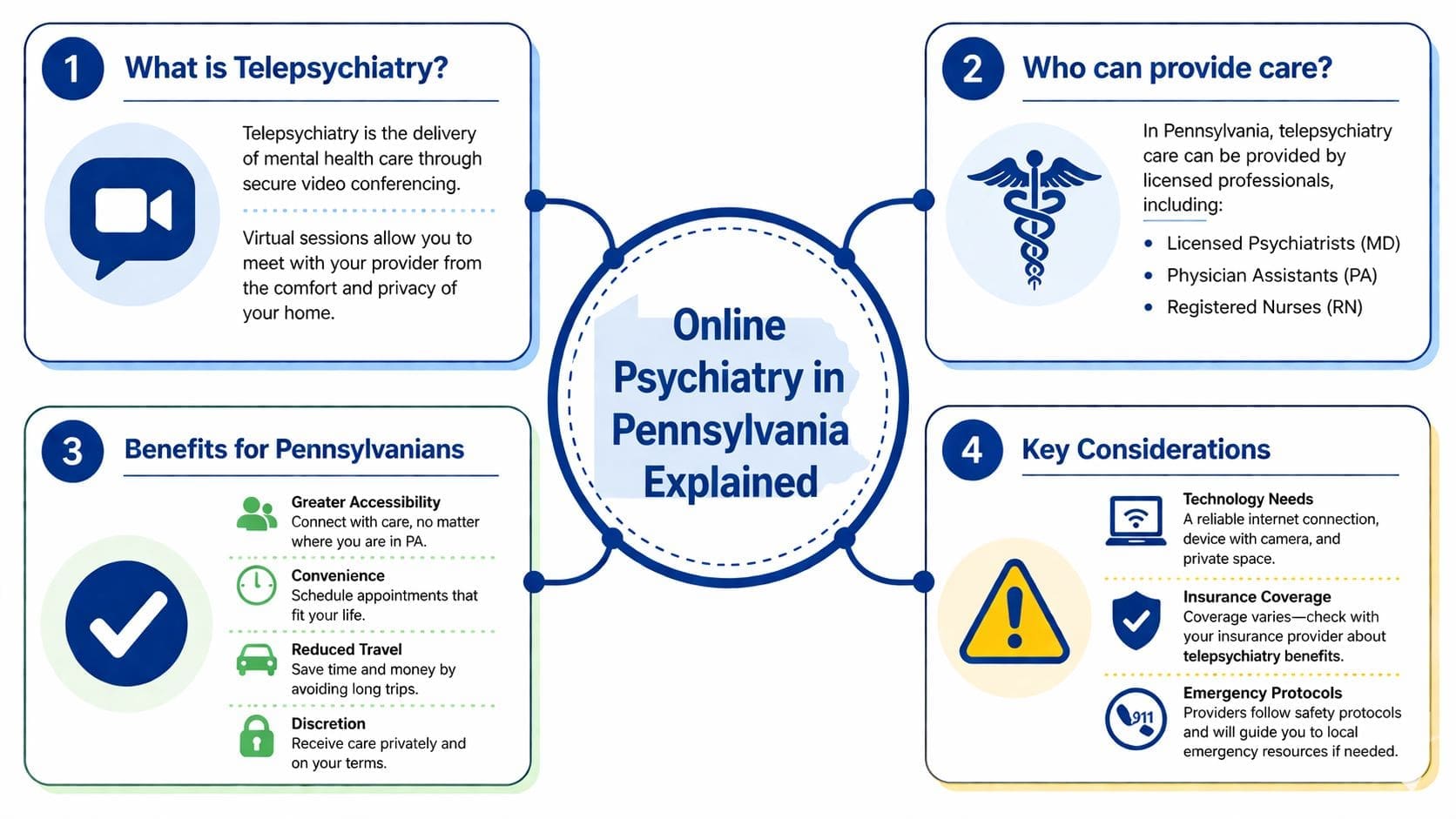
Searching for online psychiatrist pennsylvania often leads to a mix of provider types. That can be confusing, especially when one website uses "psychiatrist" as a general search term but the actual care is delivered by a psychiatric nurse practitioner.
What online psychiatric care actually includes
Telepsychiatry usually covers psychiatric evaluation, diagnosis, medication management, treatment planning, and follow-up visits through secure video. Depending on the practice, it may also include supportive therapy, care coordination, lab review, portal messaging, and lifestyle guidance.
The key point is quality, not just format. The American Psychiatric Association endorses online psychiatry as comparable to traditional in-person care, and providers like board-certified psychiatric nurse practitioners can diagnose, treat, and prescribe according to this overview of online psychiatry in Pennsylvania.
That means virtual care isn't "lighter" care. It's psychiatric care delivered through a different channel.
Who can provide this care in Pennsylvania
Patients may see different licensed professionals in telehealth settings. Two of the most relevant are medical doctor psychiatrists and psychiatric mental health nurse practitioners, often written as PMHNP-BC when board certified.
A PMHNP is an advanced practice clinician trained to evaluate mental health conditions, prescribe psychiatric medications, monitor response, and adjust treatment. In many telepsychiatry settings, that clinician is the person handling the full course of care.
A useful way to think about provider choice is this:
| Provider question | What matters most |
|---|---|
| Can this clinician diagnose? | The clinician must be properly licensed in Pennsylvania. |
| Can this clinician prescribe? | The practice should clearly explain prescribing policies, including controlled substances when appropriate. |
| Will treatment be personalized? | Look for a full evaluation, not a symptom checklist and fast refill model. |
Patients who want a deeper explanation of provider roles can review this comparison of a psychiatrist vs psychiatric NP.
A good telepsychiatry visit should feel like a real medical appointment, not a rushed app transaction.
For readers looking at practice models that combine virtual prescribing with broader lifestyle support, this overview of integrative psychiatry in PA virtual mental health services shows how that structure can work.
What to Expect from Your First Virtual Visit

The first appointment usually feels easier once the process is less mysterious. Most telepsychiatry practices follow a sequence that starts with scheduling, intake paperwork, and portal setup, then moves into a structured clinical interview.
Before the appointment
Patients are often asked to complete history forms, consent documents, medication lists, pharmacy details, and symptom questionnaires. Many practices use digital intake workflows, and tools like Formzz patient intake forms show the kind of information secure pre-visit paperwork can gather before a mental health evaluation.
A few practical steps help the visit go smoothly:
- Choose a private space: A bedroom, office, or parked car can work if the setting is quiet and confidential.
- Test the device early: Confirm camera, microphone, speaker, and internet connection before the appointment starts.
- Keep essentials nearby: Have current medications, supplement lists, prior diagnoses, and insurance information ready.
Adults in southeastern Pennsylvania looking for telehealth medication management may also compare local options such as a Philadelphia psychiatric provider page.
During the evaluation
In Pennsylvania, initial telepsychiatry evaluations conducted by PMHNPs typically last 60 to 75 minutes, and that time is used to review psychiatric history, medical background, previous treatment, symptoms, and medication options according to this description of psychiatric medication management.
That length matters. A thorough intake gives the clinician room to ask whether concentration problems are really ADHD, whether anxiety is driving insomnia, whether trauma is contributing to depression, or whether a medical issue needs parallel evaluation.
Common topics include:
- Current symptoms: Mood, sleep, focus, panic, irritability, compulsions, trauma reactions, appetite, and energy
- Past treatment: Medications tried, side effects, therapy history, hospitalizations, and what helped or didn't
- Medical context: Thyroid issues, hormonal concerns, substance use, pain, neurologic symptoms, and other factors that can affect mental health
A short video explanation can also help patients visualize the rhythm of a telehealth visit.
After the visit
If medication is recommended, the clinician explains why, what benefits to watch for, common side effects, and when follow-up should happen. For some patients, that may include treatment for ADHD, anxiety, or depression. For controlled substances, the plan should include clear monitoring, refill expectations, and safety rules.
What doesn't help is leaving the appointment without a roadmap. Patients should know the diagnosis being considered, the purpose of each medication, what happens next, and how to reach the office if something changes.
Navigating Insurance and Payment for Online Care
Cost questions stop many people before they start. That's understandable. Patients shouldn't have to guess whether telepsychiatry is covered, whether a PMHNP is considered in-network, or whether a copay changes when the visit happens by video.
Questions to ask before booking
The fastest way to avoid billing surprises is to call the insurance company before the first appointment. Ask direct questions and write the answers down.
A useful script includes:
- Coverage type: "Do you cover telepsychiatry visits in Pennsylvania?"
- Provider type: "Do you cover medication management with a psychiatric mental health nurse practitioner?"
- Financial responsibility: "What is the copay, deductible, or coinsurance for these visits?"
- Network rules: "Does the provider need to be in-network, and do I need preauthorization or a referral?"
- Pharmacy issues: "Are there separate requirements for psychiatric medications?"
If claims or coding questions become complicated, local billing resources can help patients understand the administrative side of care. For example, this overview of Lancaster PA medical billing services gives a sense of the kinds of support billing professionals provide.
Practical rule: Verify both the clinician and the telehealth service itself. Patients sometimes confirm one and forget the other.
When self-pay makes sense
Self-pay isn't only for uninsured patients. Some adults choose it because they want more privacy, don't want to work within a narrow network, or prefer a practice model that includes broader lifestyle and integrative support.
This option works best when the fee structure is transparent. A serious psychiatric practice should explain initial visit fees, follow-up costs, refill policies, missed appointment rules, and whether messaging or form completion is included.
Some patients also use HSA or FSA funds for eligible mental health services. Others prefer membership-style models when they expect regular follow-ups and want predictable monthly budgeting.
For a clearer sense of how one telepsychiatry practice structures rates and options, patients can review psychiatric pricing information.
How to Choose a Qualified Telehealth Provider
A polished website doesn't guarantee good psychiatric care. The safer approach is to judge the clinical model. Patients usually get better results when they choose a provider based on credentials, evaluation quality, communication style, and treatment philosophy rather than speed alone.
What to look for
Strong telepsychiatry practices usually share a few traits. They state who provides care, explain how prescribing works, use a secure portal, and set expectations for follow-up.
Privacy also matters before the first appointment. If a practice collects health information online, patients should pay attention to how forms are handled. This review of secure online forms and HIPAA is a useful reminder that convenience tools still need to be considered through a privacy lens.
A short checklist helps:
- Board certification: Look for credentials such as PMHNP-BC when the provider is a psychiatric nurse practitioner.
- Appointment depth: Initial visits should allow enough time for proper diagnosis and treatment planning.
- Clear prescribing policy: The practice should explain how medication decisions are made, especially for stimulants and other controlled medications.
- Follow-up structure: There should be a defined plan for reassessment, side-effect review, and medication adjustments.
Red flags that matter
Some warning signs are easy to miss because they sound convenient. They still matter.
- Guaranteed prescriptions: No ethical clinician should promise a specific medication before evaluation.
- Rushed intake: A fast questionnaire isn't the same as a full psychiatric assessment.
- No emergency guidance: Patients should know what to do if they have a crisis outside business hours.
- Vague credentials: If it's hard to tell who is treating patients, that's a problem.
Here is a practical comparison.
| Feature | Standard Telehealth Service | Integrative Practice (like IPA) |
|---|---|---|
| Initial evaluation | Focuses on symptom review and medication decision | Includes symptom review plus broader lifestyle and medical context |
| Treatment tools | Medication management is often central | Medication may be combined with nutrition, exercise, mindfulness, and additional screening when indicated |
| Follow-up style | Brief check-ins | Ongoing care with more attention to adherence, habits, and whole-person functioning |
| Patient experience | Functional but sometimes transactional | More collaborative and education-focused |
| Portal use | Scheduling and refills | Scheduling, refills, communication, and care coordination may be more integrated |
Patients weighing provider types can use this guide to compare psychiatrist and psychiatric NP roles.
The Integrative Psychiatry of America Approach to Holistic Care
Many telehealth practices stop at diagnosis and medication. That helps some patients, but it leaves out a large part of what affects mood, attention, sleep, and long-term stability. Mental health symptoms are often influenced by daily habits, physical health, stress load, and how well a treatment plan fits a person's life.
Why integrative care matters
A key underserved angle in Pennsylvania telepsychiatry is the lack of guidance on integrative treatments. Integrative models can boost patient adherence by 25% to 40%, and 35% of telepsychiatry users are actively seeking these broader options according to this discussion of telepsychiatry in Pennsylvania.
That doesn't mean every patient needs every tool. It means many patients do better when medication is only one part of the plan.
The most effective psychiatric plan is often the one a patient can realistically follow.
What holistic telepsychiatry can include
An integrative model may combine psychiatric prescribing with targeted changes that support the same goals. Depending on the patient, that can include sleep hygiene, exercise planning, nutrition counseling, mindfulness work, lab review, genetic screening discussions, or testosterone replacement therapy when clinically indicated and appropriately evaluated.
Used carefully, those additions can make treatment more practical:
- For depression: Medication may be paired with sleep stabilization, movement, and nutrition support.
- For ADHD: Treatment may include stimulant or non-stimulant prescribing plus structure, routine planning, and coaching around functioning.
- For anxiety and trauma-related symptoms: Medication may help, but patients often also benefit from mindfulness practices and body-based stress regulation.
- For weight-related concerns: Psychiatric care may need to account for eating patterns, motivation, metabolic issues, and emotional drivers.
Integrative Psychiatry of America is one example of a Pennsylvania telepsychiatry practice using that broader model through virtual care, including medication management alongside exercise counseling, nutritional education, mindfulness, genetic and lab screenings, and TRT when appropriate. Patients interested in that type of whole-person framework can review this explanation of the integrative psychiatry approach.
Some adults want a straightforward medication visit. Others want mental health care that also addresses sleep, energy, hormonal concerns, recovery habits, and daily functioning. Neither goal is wrong. The important step is choosing a practice whose care model matches the kind of help needed.
If searching for an online psychiatrist pennsylvania has led to long waits, unclear answers, or care that feels too narrow, Integrative Psychiatry of America offers a telehealth option built around board-certified psychiatric nurse practitioners, personalized medication management, and whole-person support for adults across Pennsylvania.