
Searching for a philadelphia psychiatrist often starts the same way. A person finally decides to get help, opens a dozen tabs, sees long waitlists, confusing insurance information, and office locations that add another commute to an already packed week. By the time a callback arrives, the motivation to start care may already feel worn down.
That frustration makes sense. Mental health care in Philadelphia is in high demand, and the old model of care doesn't always fit real life. For many adults, the better option isn't another office across town. It's thoughtful, secure, online psychiatric care that meets them where they are.
Table of Contents
- The Search for Mental Health Care in Philadelphia
- What to Expect from Online Psychiatric Care
- Conditions Treated with Integrative Telepsychiatry
- The Integrative Psychiatry of America Difference
- Navigating Insurance Affordability and Privacy
- Your Next Steps to Mental Wellness
- Frequently Asked Questions About Online Care
The Search for Mental Health Care in Philadelphia
Typing philadelphia psychiatrist into a search bar usually means someone is already carrying a lot. Work hasn't slowed down. Sleep is off. Focus is slipping. The idea of sitting in traffic, finding parking, and waiting in a lobby for a short medication visit can feel like one more obstacle instead of a path forward.

Why the search feels so difficult
Philadelphia's demand for care is real. Approximately 20% of residents, around 300,000 people, experience a mental illness each year, and Pennsylvania needs an estimated 500 additional psychiatrists to meet current demand, according to Philadelphia mental health statistics. That gap helps explain why many people struggle to find an appointment that works.
A shortage changes the patient experience in practical ways. It can mean delayed evaluations, fewer follow-up options, and rushed medication management. It can also push people to settle for fragmented care, where therapy, medication, and lifestyle guidance all happen in separate places, if they happen at all.
Practical rule: If getting care feels harder than it should, that doesn't mean treatment isn't available. It often means the delivery model needs to change.
That shift is part of why many adults now look beyond the traditional office search. A secure telepsychiatry practice can remove the commute, cut the waiting-room friction, and make follow-up more realistic for people with jobs, caregiving duties, or limited energy.
Why telepsychiatry isn't a lesser option
Online care works best when it doesn't merely copy an office visit onto a screen. It should make treatment easier to access, easier to maintain, and easier to fit into daily life. For adults in Pennsylvania, that can mean seeing a licensed psychiatric provider from home, from a private office, or from any quiet location with a stable connection.
For readers trying to understand the broader context, this overview of the mental health provider shortage in Pennsylvania gives useful background on why access can feel so strained.
A modern search for a philadelphia psychiatrist often leads people to another important discovery. In many cases, the provider they are seeking may also be a psychiatric mental health nurse practitioner, or PMHNP, who can evaluate symptoms, diagnose conditions, prescribe appropriate medications, and build a treatment plan around the whole person rather than a single symptom.
What to Expect from Online Psychiatric Care
Some people delay care because telepsychiatry sounds technical or impersonal. In practice, it usually feels much simpler than expected. Think of it as a secure video appointment with a mental health specialist, plus a patient portal for scheduling, forms, messages, and prescription management.
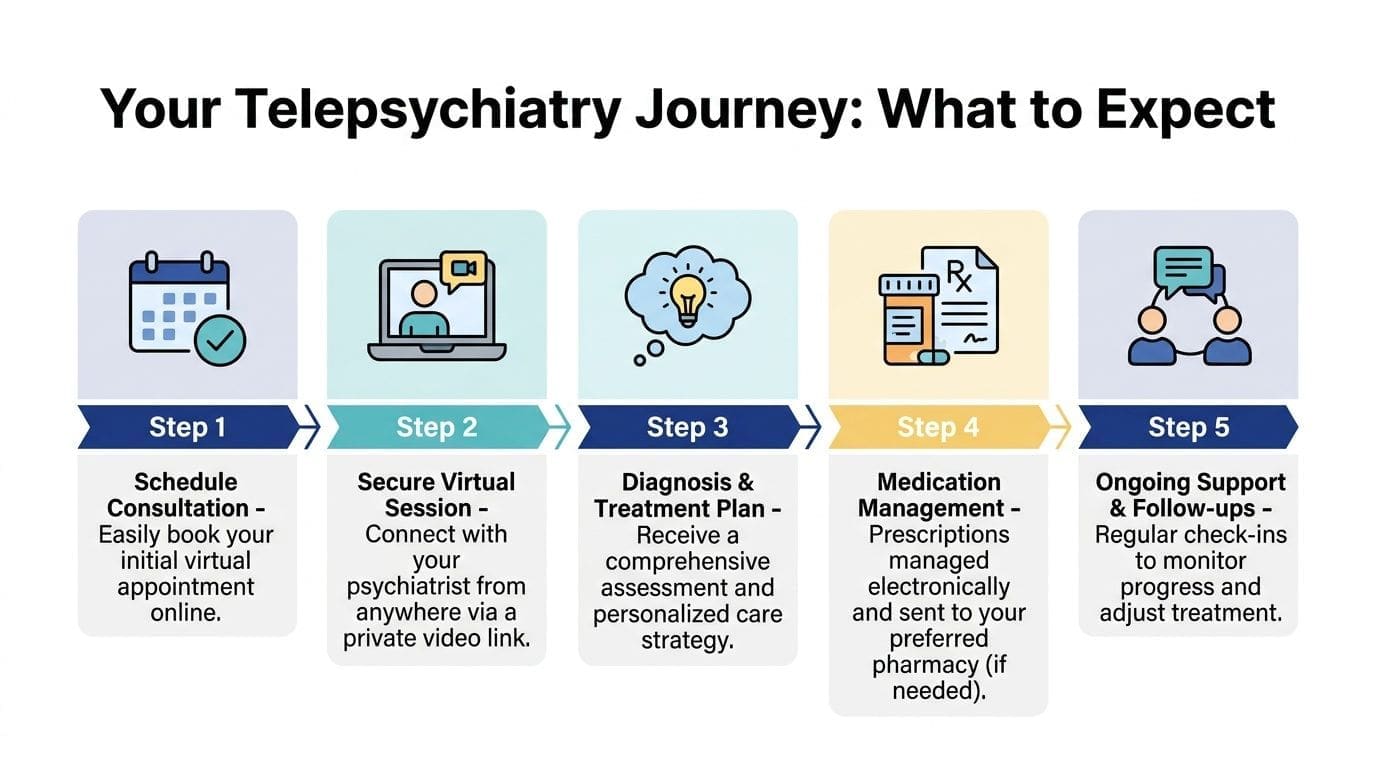
How the process usually works
A typical online psychiatry process follows a clear sequence:
- Scheduling comes first. Patients choose an appointment time, complete intake forms, and share basic medical and mental health history.
- The video link arrives securely. The session takes place through a HIPAA-compliant platform rather than a public video app.
- The evaluation covers the full picture. Symptoms matter, but so do sleep, stress, substance use, medical history, past medication trials, and daily functioning.
- The treatment plan gets built collaboratively. Medication may be part of care, but it shouldn't be the whole conversation.
- Follow-up keeps the plan useful. Medications often need monitoring, side effects need review, and treatment should evolve with the patient's response.
That process is less glamorous than people imagine, which is a good thing. Good psychiatric care should feel organized, clear, and grounded.
What happens during visits
Initial visits are usually longer than follow-ups because there is more to understand at the start. A psychiatric provider will often ask about mood changes, anxiety patterns, concentration, trauma history, appetite, sleep, family history, and any previous counseling or medication experiences. The goal isn't to interrogate the patient. It's to avoid guessing.
Follow-ups are more focused. They review what's changed since the last appointment, whether the medication is helping, what side effects are showing up, and whether the original diagnosis still fits the lived reality.
A useful psychiatric appointment leaves the patient with a plan they can explain back in plain language.
People who want a closer look at this care model can review these virtual mental health services in Pennsylvania. The key point is simple: effective telepsychiatry isn't just convenient. It can also support more consistent treatment because patients are less likely to miss care over traffic, transportation issues, or workday disruption.
Common concerns people bring to telepsychiatry
| Concern | What usually helps |
|---|---|
| "Will it feel awkward?" | Most people adjust within minutes once the conversation starts. |
| "Is it private?" | HIPAA-compliant platforms and secure portals are built for protected health information. |
| "Can the provider really assess me online?" | A thorough psychiatric interview can be done effectively by video when the platform is secure and the setting is private. |
| "What if I need medication changes?" | Follow-up telehealth visits are designed for monitoring response, refills, and adjustments when clinically appropriate. |
Conditions Treated with Integrative Telepsychiatry
Individuals don't search for a philadelphia psychiatrist because they want a label. They search because something in daily life isn't working. They can't settle their mind at night. Their concentration collapses at work. Their anxiety keeps turning ordinary tasks into exhausting ones.

Depression and anxiety
Depression and anxiety often travel together, but they don't always look dramatic from the outside. A person may still go to work, answer emails, and show up for family while feeling flat, restless, or emotionally overextended. That's one reason treatment has to go beyond a symptom checklist.
Evidence from integrated care models shows that combining medication management with psychotherapy in single appointments yields a 60% improved chance of recovery for depression and anxiety compared with medication alone, according to Talkspace's summary of integrated depression treatment. That matters because many adults don't need one more disconnected service. They need care that joins medication decisions with practical coping work.
A combined visit can address thought patterns, avoidance, relationship stress, work pressure, and medication response in the same treatment arc. For some patients, that's the difference between temporary symptom relief and durable progress.
ADHD OCD and PTSD
ADHD in adults often shows up as unfinished tasks, chronic lateness, overwhelm, impulsive decisions, or the sense that ordinary planning takes too much effort. OCD can bring intrusive thoughts and rituals that consume time and mental energy. PTSD may look like irritability, sleep disruption, hypervigilance, or emotional shutdown.
For people dealing with overlapping concerns, a single diagnosis rarely explains everything. Integrative telepsychiatry becomes particularly useful. A provider can look at the interaction between attention problems, anxiety, depression, trauma, and daily habits rather than treating each one as if it exists in isolation.
This discussion of co-occurring ADHD anxiety and depression in Philadelphia reflects a pattern seen often in adults who thought they had only one issue for years.
A brief educational video can help make the idea of integrated psychiatric treatment more concrete.
What integrated treatment changes
Medication can be valuable. It can also be insufficient when used by itself in a rushed, isolated way. For adults seeking depression treatment online medication, anxiety treatment online pennsylvania, or adhd treatment philadelphia adult, the strongest plan often includes several layers working together:
- Medication management when symptoms and history support it
- Psychotherapy-informed visits that address patterns, triggers, and behavior
- Lifestyle review around sleep, exercise, and nutrition
- Clinical monitoring so the plan can change when the patient changes
Treatment works better when the provider asks not only "What medication fits?" but also "What keeps this problem going in real life?"
The Integrative Psychiatry of America Difference
A lot of people use the term philadelphia psychiatrist when what they really need is a qualified psychiatric prescriber who can diagnose, treat, and manage ongoing care. In Pennsylvania, a Psychiatric Mental Health Nurse Practitioner, or PMHNP, can fill that role in a highly substantive way.
What a PMHNP does
A PMHNP is trained to assess psychiatric symptoms, make diagnoses, prescribe medication where appropriate, monitor safety, and adjust treatment over time. That includes care for depression, anxiety, OCD, PTSD, ADHD, and more complex presentations. The job isn't limited to writing prescriptions. It includes clinical judgment, medication strategy, risk assessment, and patient education.
PMHNPs can initiate and manage advanced medication regimens, including adjuncts such as Abilify for non-responders, achieving symptom reduction in 50-70% of major depression cases within 4-6 weeks, as described in Doctor On Demand's overview of online psychiatry. For patients, the takeaway is practical: the provider title matters less than whether the clinician is qualified to diagnose carefully, prescribe appropriately, and follow treatment closely.
A good prescriber doesn't chase symptoms one at a time. A good prescriber builds a coherent plan and revises it when the facts change.
What whole-person care looks like
An integrative psychiatric model asks broader questions. How is sleep affecting mood? Is nutrition stable enough to support attention and energy? Is exercise helping regulation or has stress pushed it out of the week entirely? Are there medical or hormonal factors that deserve evaluation? When clinically indicated, some practices also incorporate lab review, genetic screening, mindfulness strategies, or testosterone replacement therapy as part of a larger plan.
One example is Integrative Psychiatry of America's whole-person model, which combines online psychiatric care with medication management, psychotherapy-informed treatment, lifestyle interventions, and additional supports such as nutrition, exercise counseling, and screenings.
Who may benefit from this model
This style of care can be especially useful for:
- First responders and high-stress professionals who need care that respects irregular schedules and chronic stress exposure
- LGBTQ+ adults looking for an affirming mental health setting
- Patients with layered symptoms such as anxiety plus ADHD, or depression plus trauma history
- Adults exploring related health concerns like mood changes alongside weight management or possible hormonal issues
What doesn't work as well is a narrow approach that treats psychiatric care like a refill service. People usually seek help because life has become harder to manage. Effective treatment has to respond to that whole reality.
Navigating Insurance Affordability and Privacy
People often put off psychiatric care for three reasons. They aren't sure whether their insurance will cover it, they worry online visits won't be private, or they assume the overall process will be expensive and hard to manage.

Insurance questions to ask early
Before booking, patients should verify a few specific details with the practice or insurer:
- Telehealth eligibility for psychiatric evaluation and follow-up visits
- Provider network status and whether the visit is billed in-network or out-of-network
- Medication visit coverage if ongoing follow-ups are needed
- Deductible and copay structure so there are no surprises
Those questions save time. They also help patients compare options realistically instead of choosing based on search rankings alone.
How privacy works in telehealth
HIPAA compliance means the platform and workflow are designed to protect health information. In practical terms, that usually includes secure video technology, protected messaging, intake forms handled through a secure portal, and clear expectations around where the patient should take the visit. A parked car with poor reception and people walking by isn't ideal. A private room with headphones is much better.
Privacy also depends on the patient's setup. Using a personal device, closing other apps, and taking the session in a quiet space all improve confidentiality.
Cost privacy and fit all matter
Not every patient has straightforward insurance coverage, and not every patient wants to use insurance. That's why flexible payment structures matter. As noted in this Philadelphia mental health resource guide, stigma and insurance hurdles can be meaningful barriers, and inclusive telehealth providers often offer flexible cash and membership options for underserved adults, including LGBTQ+ individuals and communities of color.
A useful way to compare options is this short checklist:
| Decision area | What to look for |
|---|---|
| Cost | Clear explanation of insurance, self-pay, or membership options |
| Privacy | HIPAA-compliant platform and secure portal |
| Clinical fit | Experience with your condition, not just general mental health listings |
| Inclusivity | Respect for identity, culture, and lived experience |
| Follow-through | Messaging, refill process, and a realistic follow-up system |
A polished website isn't enough. Patients need a care model that is workable, confidential, and responsive once treatment begins.
Your Next Steps to Mental Wellness
Getting started doesn't require perfect certainty. It requires one concrete action. For many adults, the best next move is to stop comparing endless provider pages and move toward an actual evaluation.
Three simple actions
- Visit the practice contact or scheduling page. A direct starting point helps more than another round of searching. The contact page for online psychiatric care is one example of where patients can begin the process.
- Verify insurance or choose a payment path. If coverage is unclear, ask before the first visit. If insurance isn't the best fit, ask whether a self-pay or membership option exists.
- Book the initial evaluation. The first visit is where symptoms get organized into a treatment plan. Waiting for a "better time" often keeps people stuck longer than they intended.
That sequence is simple on purpose. Complicated intake systems tend to lose people who are already stressed, discouraged, or exhausted.
Support between appointments
Some patients benefit from trustworthy education while they're deciding whether to start treatment. A practical example is this free anxiety education hub, which offers plain-language material for people trying to understand anxiety patterns and next steps.
Getting evaluated isn't a commitment to one medication or one path. It's a commitment to getting accurate information about what's happening.
The right psychiatric care should leave room for questions, preferences, and adjustment. It should also respect that mental wellness isn't built in one visit. It develops through a treatment plan that is realistic enough to continue when life gets busy.
Frequently Asked Questions About Online Care
A few questions come up repeatedly for adults looking for a philadelphia psychiatrist or an online psychiatric prescriber. Direct answers help people choose care with clearer expectations.
Common Questions About Telepsychiatry in PA
| Question | Answer |
|---|---|
| What's the difference between a psychiatrist and a psychiatric nurse practitioner? | A psychiatrist is a physician specializing in mental health. A psychiatric mental health nurse practitioner is an advanced practice nurse with specialized psychiatric training who can also evaluate, diagnose, prescribe, and manage treatment in Pennsylvania. |
| Can online psychiatry treat anxiety, depression, ADHD, OCD, or PTSD? | Yes. These are common reasons adults seek telepsychiatry. The key issue isn't whether the visit is online or in person. It's whether the provider conducts a thorough assessment and offers appropriate follow-up. |
| Are medications prescribed through telepsychiatry? | When clinically appropriate, yes. Electronic prescribing is commonly used for non-controlled psychiatric medications. |
| Will online care feel less personal? | Not necessarily. Many patients find virtual visits more comfortable because they can talk from a familiar private space instead of a waiting room. |
| Can a PMHNP handle more complex medication plans? | Yes. PMHNPs can manage medication changes, monitor response, and build structured treatment plans for many psychiatric conditions. |
| Is telepsychiatry only for mild symptoms? | No. Online psychiatric care can be appropriate for many levels of need, provided the patient is safe for outpatient treatment and the provider can support the clinical situation. |
| How should patients check insurance? | Contact the practice, review the patient portal or intake information, and confirm telehealth behavioral health benefits with the insurer before the first visit. |
| Are stimulants always prescribed in virtual ADHD care? | Patients shouldn't assume that. Some practices limit or avoid controlled substances in telehealth settings, so it's important to ask about policy early. |
| What if someone needs more than medication? | That's often the better question. Many patients do best with a treatment plan that includes psychotherapy-informed support, behavior change, and lifestyle review alongside medication management when needed. |
A final point matters. The best online psychiatric care doesn't promise a quick fix. It offers a structured, ethical, and workable path forward for people who are ready to be assessed carefully and treated like whole human beings.
Adults in Philadelphia and across Pennsylvania can access confidential online mental health care through Integrative Psychiatry of America. The practice provides telepsychiatry with psychiatric nurse practitioners, medication management, psychotherapy-informed care, and integrative support for conditions such as anxiety, depression, ADHD, OCD, PTSD, and opioid dependence.