
If you’ve struggled with mental health treatments that just don't seem to work, understanding methylfolate for MTHFR genetic variations could be a major turning point. This strategy bypasses a common genetic roadblock by using the body’s most active form of folate. It directly supports the brain chemistry you need for a better mood and clearer thinking, moving beyond one-size-fits-all approaches.
The Genetic Link Between MTHFR and Your Mental Health
Have you ever felt like you’re doing everything right for your mental health, but nothing delivers lasting relief? The problem might not be your efforts but your genes. A powerful link exists between your MTHFR gene, how your body processes the B-vitamin folate, and your overall mental well-being.
The MTHFR gene gives your body the blueprint for making an enzyme called methylenetetrahydrofolate reductase. This enzyme is essential for converting the folate from your food into its usable, active form: L-methylfolate.
An Inefficient Production Line
Think of this process like a factory assembly line. The MTHFR enzyme is a key worker tasked with a single, crucial job: assembling a final product called L-methylfolate. If a genetic variation makes this worker slow or less efficient, the entire production line slows down.
When your body can't create enough active folate, it struggles to produce vital neurotransmitters, including:
- Serotonin: The "feel-good" chemical that regulates your mood, sleep, and appetite.
- Dopamine: Crucial for motivation, focus, and feelings of pleasure.
- Norepinephrine: Which impacts your alertness, concentration, and energy.
An imbalance in these neurotransmitters can cause or worsen conditions like depression, anxiety, and ADHD. This biological bottleneck also explains why standard antidepressants don't work for everyone. Many of these medications help the brain use existing serotonin, but if you aren’t producing enough to begin with, the treatment’s effectiveness is limited.
The Role of Methylfolate
This is where L-methylfolate supplementation comes in. It’s like getting a pre-assembled part delivered directly to your internal production line, completely bypassing the inefficient worker. By supplementing with this active form, you give your body the exact ingredient it needs to get neurotransmitter production back on track.
The frustration of trial-and-error treatment is an all-too-common story. In one study of 186 patients with conditions like PTSD and ADHD, a significant number had MTHFR variations. These individuals had already tried an average of six different medications before genetic testing finally pointed to an underlying biological issue.
This genetic insight offers a new direction for those who feel stuck. It shifts the focus from just managing symptoms to addressing a core biological process that underpins mental wellness. Understanding your MTHFR status can be the key to unlocking a more effective and personalized treatment path.
Of course, this is just one piece of a larger puzzle. Other factors, like inflammation, can also significantly impact mental health. You can learn more about the inflammation gut-brain axis in our related article.
Understanding the MTHFR Gene and Its Variations
To understand why methylfolate for MTHFR is a cornerstone of modern integrative psychiatry, we first need to look at the gene itself. The MTHFR gene is essentially the blueprint for an enzyme called methylenetetrahydrofolate reductase. Think of this enzyme as a critical conversion specialist in your body’s B-vitamin assembly line.
Its main job is to take the folate from your diet (and folic acid from supplements) and transform it into L-methylfolate—the only form of folate your brain can actually use. But not everyone’s internal factory runs at full capacity. Many of us have common genetic variations, or polymorphisms, that can significantly slow down this conversion process.
Common Variations and Their Impact
Two of the most well-studied MTHFR variations are C677T and A1298C. It’s important to see these not as "defects," but simply as different operating instructions for your body's biochemistry.
Having one of these variations means your body’s folate conversion factory is less efficient. This slowdown has a direct impact on a vital biological process known as methylation.
Methylation is a fundamental biochemical process happening billions of times per second in every cell. It’s responsible for repairing DNA, controlling gene expression, detoxification, and—most critically for mental health—building your mood-regulating neurotransmitters.
When a sluggish MTHFR enzyme impairs methylation, your brain might not get enough of the raw materials it needs to maintain emotional balance. This can show up as persistent low mood, anxiety, or brain fog, highlighting why a more intelligent nutritional strategy is often necessary.
The table below breaks down the two most common MTHFR gene variations and what they mean for your health.
Common MTHFR Gene Variations and Their Impact
| Variation | Common Name | Impact on Enzyme Function | Associated Health Considerations |
|---|---|---|---|
| C677T | "The Cardio Variant" | Can reduce enzyme function by up to 70% in individuals with two copies. | Primarily linked to elevated homocysteine levels, an inflammatory marker associated with cardiovascular risks. May also impact mood. |
| A1298C | "The Neurotransmitter Variant" | Can reduce enzyme function by up to 40%, particularly affecting the production of BH4. | More closely associated with a slowdown in producing neurotransmitters like serotonin and dopamine, directly impacting mood regulation and cognitive function. |
Understanding your specific genetic profile helps explain why you might feel the way you do and provides a clear path toward targeted support.
How Methylation Affects Your Mood
An inefficient MTHFR enzyme means your body produces less L-methylfolate. Less L-methylfolate leads to sluggish methylation. Sluggish methylation, in turn, means lower production of key neurotransmitters like serotonin, dopamine, and norepinephrine.
This biological chain reaction directly connects your unique genetic makeup to how you feel every single day.
Seeing this connection is empowering. It helps shift the conversation from, "What's wrong with me?" to, "How can I support my body's specific needs?" For many, the answer is to bypass the faulty conversion step by supplementing directly with the L-methylfolate their body struggles to make.
These genetic quirks are surprisingly common. They are a normal part of human diversity that influences how millions of people process this key nutrient. For instance, with the 677C>T variant, research shows that 18-21% of Hispanics and 10-15% of North American Caucasians have two copies. These are significant numbers, reflecting just how widespread this trait is across diverse populations, including right here in Pennsylvania. You can find more details on the prevalence of MTHFR variants on Wikipedia.
This prevalence is exactly why a one-size-fits-all approach to mental wellness so often misses the mark. By identifying and addressing this foundational genetic factor, we can finally move toward more precise and effective support for conditions like depression and anxiety.
How Methylfolate Provides a Targeted Solution
Now that we have a clear picture of the MTHFR gene and its variations, we can get right to the solution. This is where L-methylfolate, the active form of folate, comes into play as a targeted nutritional tool for anyone with a sluggish MTHFR enzyme.
To really understand why it’s so effective, you need to know the difference between the various forms of this B-vitamin. While many people use "folate" and "folic acid" interchangeably, they are worlds apart, especially for someone with an MTHFR gene variation.
The Key and Lock Analogy
I like to think of the body’s methylation cycle as a series of locked doors. Each one needs a very specific key to open.
-
Folic Acid: This is the synthetic, man-made version you find in fortified foods and most standard multivitamins. Think of it as a blank key. Your MTHFR enzyme has to cut this blank into the right shape (L-methylfolate) before it can unlock anything. If your enzyme works perfectly, no problem. But if you have an MTHFR variation, that key-cutting process is slow and often fails, leaving important doors locked.
-
Food Folate: This is the natural form from foods like leafy greens. It’s also a blank key, just a slightly better quality one than folic acid. It still needs a functional MTHFR enzyme to cut it, so the conversion problem remains.
-
L-Methylfolate: This is the body-ready, fully bioavailable form. It’s the master key—already perfectly cut. It doesn’t need the MTHFR enzyme at all. Instead, it completely bypasses that faulty conversion step and gets to work opening the doors to your methylation cycle right away.
This is a critical concept, as a faulty MTHFR gene directly impacts the production of mood-regulating brain chemicals.
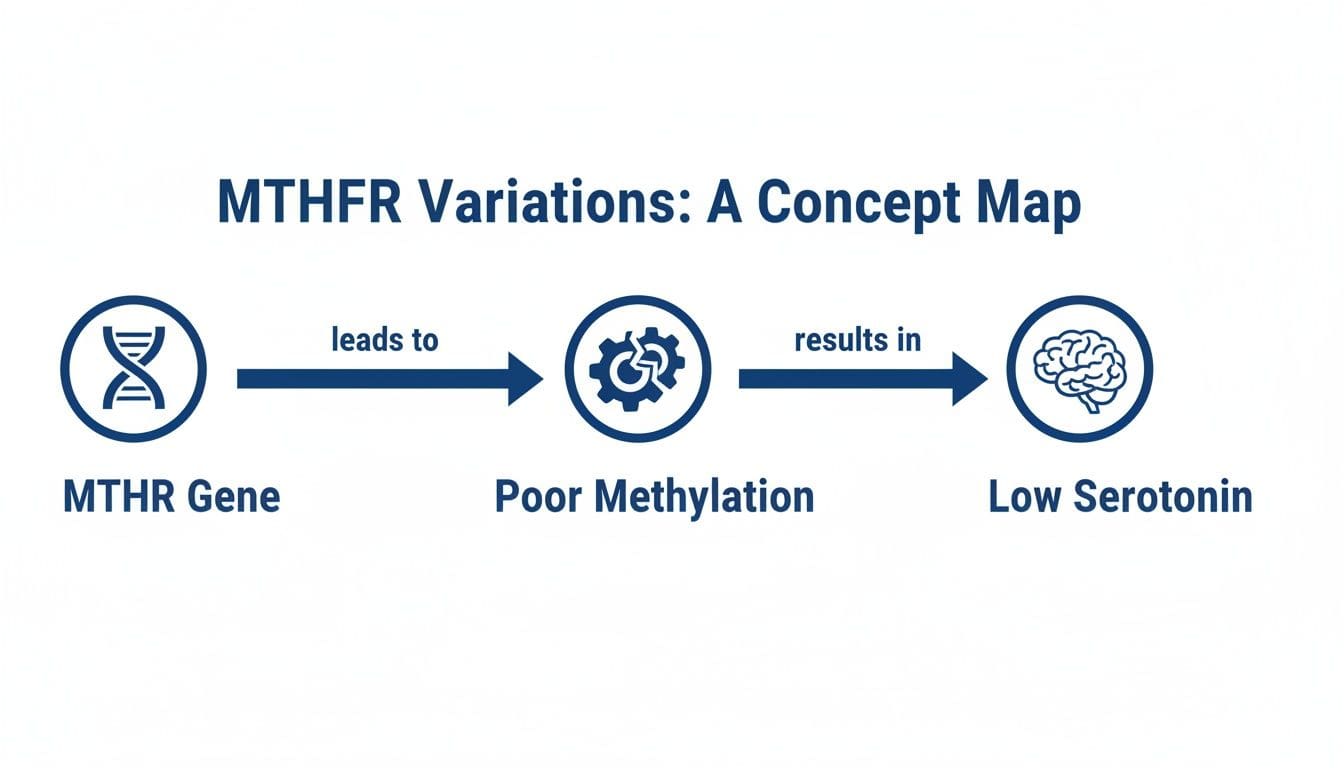
As you can see, a compromised MTHFR gene disrupts methylation, which can directly lead to lower levels of essential neurotransmitters like serotonin.
Fueling Neurotransmitter Production Directly
By supplementing with L-methylfolate, you’re giving the brain the exact, finished ingredient it needs to build these vital neurotransmitters. This is precisely why using methylfolate for MTHFR can be a game-changer for depression and anxiety, particularly when standard antidepressants haven't been enough. It works by addressing the root biochemical imbalance instead of just managing the downstream symptoms.
For many of our patients, this is a powerful augmentation strategy that helps their existing medications work better. If an SSRI is designed to help your brain use its serotonin more efficiently, L-methylfolate provides the raw material to make more serotonin in the first place.
The following table breaks down the key differences between synthetic folic acid and the active L-methylfolate.
Folic Acid vs. L-Methylfolate Quick Comparison
| Feature | Folic Acid (Synthetic) | L-Methylfolate (Active Form) |
|---|---|---|
| Form | Man-made, inactive form of vitamin B9. | Natural, body-ready form of vitamin B9. |
| Conversion | Requires the MTHFR enzyme to be converted into a usable form. This process can be slow and inefficient. | Requires no conversion. It is immediately available for use by the brain and body. |
| MTHFR Impact | Can build up as unmetabolized folic acid in those with MTHFR variations, potentially causing issues. | Bypasses the MTHFR enzyme completely, making it the ideal choice for individuals with genetic variations. |
| Bioavailability | Lower bioavailability, especially for those with compromised MTHFR function. | High bioavailability; it can cross the blood-brain barrier to support neurotransmitter synthesis directly. |
This comparison makes it clear why L-methylfolate is the superior choice for anyone with a known or suspected MTHFR variation. It bypasses the genetic bottleneck to deliver exactly what the brain needs.
Lowering Homocysteine Levels
There’s another major benefit to using L-methylfolate: its ability to manage homocysteine. When the MTHFR enzyme is underperforming, an amino acid called homocysteine can build up in your blood. High homocysteine is a well-known inflammatory marker linked to an increased risk for cardiovascular disease, cognitive decline, and mood disorders.
L-methylfolate is the key player needed to convert that inflammatory homocysteine back into methionine, a harmless and useful amino acid. By ensuring you have a ready supply of L-methylfolate, you directly support this crucial cleanup process, helping to lower inflammation and protect your brain and heart.
This dual-action benefit—boosting neurotransmitters and reducing inflammation—is why using methylfolate for MTHFR has become a cornerstone of modern integrative mental healthcare. For those looking to understand the broader context, learning more about supplements in depression treatment for Pennsylvania can provide valuable insight into this powerful approach. It perfectly bridges the gap between a genetic problem and a practical nutritional solution.
How We Test for and Address MTHFR Variations
When it comes to your mental health, guessing just isn’t good enough. That’s why at Integrative Psychiatry of America, our psychiatric nurse practitioners use a data-first approach to understand your unique biology. We test, we don’t guess. This lets us build a treatment plan based on your specific biochemistry, not just trial and error.
Our entire goal is to get a complete, accurate picture of what’s happening inside your body so we can create a plan that actually works for you.
Getting the Full Picture: Genetic and Lab Testing
To really understand how your body handles methylation, we look at it from two different angles. This combination of genetic and functional testing gives us a clear roadmap for your treatment.
First, we use genetic testing. This is a simple test, usually just a quick cheek swab. It tells us exactly which MTHFR gene variation you have (like C677T or A1298C). Think of this as looking at the “factory blueprint”—it shows us how well your body is genetically wired to convert folate into its active form.
Next, we run functional lab tests. These tests show us the real-world results of your genetics. For example, we can check your blood levels of homocysteine. When methylation is slow or “sluggish,” this inflammatory marker can build up. High homocysteine is a major red flag that an MTHFR variation is actively impacting your health.
A test result on its own is just data; it’s not a diagnosis or a do-it-yourself project. The true value comes from having a qualified clinician, like our psychiatric nurse practitioners, interpret these results in the context of your symptoms, lifestyle, and overall health.
This two-part view helps us connect the dots between your genes, your biochemistry, and the symptoms you’re experiencing every day. For a more detailed look at this process, check out our guide on genetic testing for mental health.
Building Your Personalized Plan
Getting your test results is where our real work begins. We use that information to create a precise, evidence-based plan just for you. With methylfolate for MTHFR, precision is everything.
Here’s how we determine the right support for your body:
-
Starting Low and Going Slow: We always begin with a very low dose of L-methylfolate. This “start low and go slow” philosophy lets your body adjust and helps us pinpoint the smallest dose you need to feel better.
-
Tuning In to Your Response: We monitor you closely to see how you feel. Too much methylfolate, too fast, can sometimes trigger side effects like anxiety or irritability. Regular check-ins allow us to make small adjustments to maximize the benefits while avoiding any unwanted effects.
-
Looking at the “Teammates”: Methylfolate doesn’t work alone. We also look at your levels of other key nutrients, like Vitamin B12 and B6. These are essential cofactors, or “teammates,” that help the methylation cycle run smoothly.
This careful and structured approach ensures we aren’t just giving you a supplement—we’re strategically correcting a core biochemical imbalance. When you partner with one of our experienced psychiatric nurse practitioners, you can be confident that you’re on a safe, effective path toward feeling like yourself again.
Building a Holistic Strategy Beyond Methylfolate

While L-methylfolate is a powerful and direct tool for anyone with an MTHFR variation, it rarely works in a vacuum. Think of it as a star player on a team; for that player to truly shine, they need a strong supporting cast.
At Integrative Psychiatry of America, we know that lasting mental wellness comes from a strategy that addresses your entire system, not just a single pathway. A single supplement is almost never a complete fix.
True success means moving beyond just supplementing with methylfolate for MTHFR. It means building a solid foundation for whole-person health.
The Essential Teammates for Methylation
The methylation cycle is a complex biological process that depends on more than just active folate. Several other key nutrients act as essential co-factors, or “teammates,” ensuring the entire system runs smoothly.
Without them, even the right dose of L-methylfolate might not deliver its full benefits.
Imagine your methylation cycle is a high-performance engine. L-methylfolate is the premium fuel, but you still need good oil, coolant, and electrical connections to make the car go.
These crucial teammates include:
- Active Vitamin B12 (Methylcobalamin): This form of B12 works hand-in-hand with L-methylfolate. Together, they convert inflammatory homocysteine back into the useful amino acid methionine. If B12 is low, the cycle stalls, no matter how much methylfolate you have on board.
- Active Vitamin B6 (P-5-P): Vitamin B6 is another critical player. It helps direct homocysteine down a different pathway to be converted into important antioxidants like glutathione. It also plays a direct role in creating neurotransmitters like serotonin and dopamine.
- Magnesium: This mineral is involved in over 300 enzymatic reactions in the body, including several steps within the methylation cycle. It helps activate the very enzymes that L-methylfolate supports, making it a foundational nutrient for optimal function.
By assessing and addressing potential deficiencies in these co-factors, our psychiatric nurse practitioners ensure your body has all the tools it needs for the methylation engine to run smoothly.
A well-rounded approach recognizes that the body is an interconnected system. Optimizing the entire methylation team is often the key to unlocking better outcomes for depression, anxiety, and ADHD.
Integrating Lifestyle Interventions
Supplements are only one part of the equation. How you live your life—what you eat, how you move, and how you manage stress—has a profound impact on your genetic expression and overall mental health.
Our integrative philosophy weaves these lifestyle factors directly into your treatment plan. We help you build a comprehensive wellness strategy that supports your body from every angle.
To dig deeper into this connection, you can explore our article on how nutrition affects mental health.
Your Personalized Wellness Blueprint
Our goal is to give you a blueprint for wellness that is both effective and sustainable. We focus on practical, real-world changes that complement your targeted supplement plan.
-
Nutrition Counseling: We guide you on incorporating folate-rich foods like leafy greens, lentils, and avocados into your diet. While food-based folate isn’t a substitute for L-methylfolate when you have an MTHFR variation, a nutrient-dense diet provides the broad spectrum of vitamins and minerals your body needs to thrive.
-
Stress Management Techniques: Chronic stress depletes B vitamins and puts a massive strain on your methylation cycle. We introduce evidence-based practices like mindfulness, meditation, and breathing exercises to help you manage stress, which in turn supports your biochemistry.
-
Exercise Guidance: Regular physical activity is a powerful tool for mental health. It can boost neurotransmitter production, reduce inflammation, and improve mood. We help you find a sustainable exercise routine that works for your body and your lifestyle.
This complete approach ensures we are not just patching a problem but rebuilding your foundation for long-term health.
By combining targeted methylfolate for MTHFR supplementation with essential co-factors and smart lifestyle changes, we empower you to take back control of your well-being.
Partnering with a Psychiatric Nurse Practitioner for MTHFR Management
Figuring out your mental health, especially with an MTHFR variation in the mix, isn’t something you should do alone. While the internet is full of information on methylfolate for MTHFR, trying to self-diagnose and self-dose is risky. The safest and most effective way forward is to partner with a knowledgeable clinician.
At Integrative Psychiatry of America, our board-certified psychiatric nurse practitioners are experts in this process. We build personalized mental wellness plans based on a deep understanding of your unique biochemistry, providing supportive and expert care to help you manage your mental health.
Why Professional Guidance Is Essential
Trying to supplement for an MTHFR variation on your own can lead to problems. Even though L-methylfolate is a natural substance, finding the correct dose requires clinical precision.
Self-dosing usually leads to one of two outcomes: taking too little and getting no benefit, or taking too much, too quickly. The second scenario can trigger uncomfortable side effects, including increased anxiety, irritability, headaches, or insomnia. This is why a “start low and go slow” approach, managed by a professional, is so important.
Our psychiatric nurse practitioners take the guesswork out of the equation. We use an evidence-based method to carefully titrate your dose, monitoring your response to find the exact amount that supports your brain chemistry without causing overstimulation.
This careful management makes sure your journey toward better health is both safe and successful. You can also learn more about the distinct roles and advantages of working with psychiatrist vs psychiatric NPs in our detailed guide.
Accessible, Supportive Care Across Pennsylvania
We believe getting expert mental health care should be convenient and straightforward. That’s why we offer our services to adults across Pennsylvania through a secure, easy-to-use telepsychiatry platform. You can access top-tier care from the comfort and privacy of your home.
We are dedicated to creating a supportive and inclusive environment. Our team has deep experience helping individuals manage complex conditions like:
- Treatment-resistant depression
- Anxiety disorders
- ADHD
Our goal is to build a trusting partnership with you. We listen to your story, interpret your test results in the context of your life, and work with you to create a plan that empowers you. If you’re ready to move beyond trial-and-error and toward truly personalized care, we invite you to take the next step.
You can easily schedule a consultation through our secure patient portal. Let us help you unlock a more effective path to mental wellness.
Common Questions About Methylfolate and MTHFR
As you start to learn about the connection between MTHFR and mental health, it’s normal to have a lot of questions. Getting clear, practical answers is the first step toward figuring out if methylfolate is the right fit for your treatment plan.
Below, we’ve answered some of the most common questions our psychiatric nurse practitioners hear from patients every day.
Can I Just Take a Higher Dose of Folic Acid Instead of Methylfolate?
This question comes up a lot, and it makes sense. Unfortunately, for someone with an MTHFR gene variant, taking more folic acid usually doesn’t work and can even create new problems.
Think of it like a bottleneck in your body’s assembly line. The MTHFR enzyme is supposed to convert synthetic folic acid into its active form, L-methylfolate. If that enzyme is slow, the folic acid just piles up, unmetabolized. This buildup is linked to other health issues, and more importantly, it fails to solve the core problem: your brain still isn’t getting the L-methylfolate it needs to make neurotransmitters.
That’s why we bypass this faulty step and supplement directly with L-methylfolate.
How Long Does It Take for Methylfolate to Work?
There’s no one-size-fits-all timeline. How quickly you feel a difference depends on your specific MTHFR genetics, how deficient you were to begin with, your dosage, and your unique body chemistry.
Some people notice small shifts in their energy and mood within a few weeks. For others, it might take one to three months to feel a significant, lasting improvement.
The key is to see methylfolate for MTHFR as one part of a comprehensive treatment plan, not a quick fix. Success requires consistency, patience, and working closely with a provider who is monitoring your progress.
Are There Any Side Effects of Taking Methylfolate?
Yes, while L-methylfolate is generally very well-tolerated, side effects can happen. They are most common when the dose is too high or increased too fast. Some people might feel overstimulated, with symptoms like:
- Anxiety or feeling jittery
- Irritability
- Trouble sleeping or insomnia
- Headaches
This is exactly why working with an experienced clinician is so important. At our practice, we use a “start low and go slow” approach. We begin with a small dose and increase it gradually, carefully watching how you respond. This method dramatically lowers the risk of side effects and helps us find the right dose for you.
Do I Have to Stop My Antidepressant if I Have an MTHFR Mutation?
Absolutely not. You should never stop taking any prescribed medication without talking to your healthcare provider first.
In fact, L-methylfolate is often used as an adjunctive therapy—meaning it’s added to your existing medication to make it work better. For people with MTHFR variants who haven’t responded well to antidepressants like SSRIs, adding L-methylfolate can be the missing piece of the puzzle. It supplies the raw material your brain needs to produce more serotonin, which can help your antidepressant do its job more effectively.
The goal isn’t to replace your treatment, but to optimize it. All of these decisions should be made as a team with your psychiatric nurse practitioner.
At IPA Integrative Psychiatry of America, our board-certified psychiatric nurse practitioners deliver expert, personalized care for MTHFR and related mental health conditions across Pennsylvania via telepsychiatry. If you’re ready to get a treatment plan built for your unique biology, schedule a consultation today.
Drafted with Outrank tool