
Imagine if your mental health treatment could be guided by a biological roadmap, unique to you. That's the core idea behind genetic testing for mental health. It’s a process that helps us move past guesswork and toward personalized care that’s driven by your own data. This isn’t about predicting whether you’ll get sick—it's about making your treatment more effective right from the start.
The End of Medication Guesswork
For years, finding the right medication for depression, anxiety, or ADHD has felt like a frustrating cycle of trial and error. You might start a medication only to struggle with side effects, then switch to another that provides zero relief. This process can drag on for months, leaving you feeling discouraged and unwell.
What if your provider could skip much of that frustrating guesswork? Think of it like trying to unlock a door. The traditional way is like fumbling with a huge key ring, trying key after key, hoping one eventually fits. Pharmacogenomic testing (PGx), a specific type of genetic testing, is like being handed the right key from the very beginning.
Pharmacogenomics is the study of how your unique genetic makeup affects your body’s response to medications. Instead of a one-size-fits-all approach, it gives your provider a personalized blueprint to follow.
This shift from generalized treatment to precise, individualized care is a major step forward in psychiatry. It allows clinicians to make informed decisions based on your specific biology, rather than just observation and chance.
A Data-Driven Approach to Treatment
Genetic testing doesn’t reveal whether you will develop a mental health condition. Instead, it uncovers crucial information about how your body metabolizes, or processes, medication. This helps your provider understand:
- Which medications are most likely to work for you: Your report can highlight drugs that align well with your genetic profile.
- Which medications might cause serious side effects: It can flag drugs your body may not process effectively, which could lead to adverse reactions.
- What dosage may be the most appropriate: The results can suggest if you need a standard, lower, or even higher dose for a medication to be both safe and effective.
Having this information upfront helps you and your provider create a much more efficient treatment plan. It cuts down on the exhausting trial-and-error cycle, lowers the risk of side effects, and helps you find relief faster. This scientific approach can also validate your past struggles with medications that didn’t work and offer a clear, proactive path forward.
To better understand this shift, it's helpful to see the two approaches side-by-side. The traditional method relies on standard protocols and observation, while a genetically-guided approach uses your biological data to personalize every step.
Treatment Approach Comparison: Traditional vs. Genetically-Guided
| Aspect | Traditional Approach | Genetically-Guided Approach (Pharmacogenomics) |
|---|---|---|
| Medication Selection | Based on clinical guidelines, symptoms, and provider experience. | Informed by genetic markers indicating likely efficacy and tolerability. |
| Process | Trial and error; trying different medications sequentially. | Data-driven; narrows down options to the most suitable medications first. |
| Side Effects | Discovered through patient experience, often leading to discontinuation. | Potential for adverse reactions is identified before prescribing. |
| Dosage | Starts with standard doses, adjusted based on patient feedback over time. | Initial dosage can be guided by genetic metabolism rates (e.g., poor vs. rapid metabolizer). |
| Time to Relief | Can take months or even years to find an effective treatment. | Aims to shorten the time to symptom relief by reducing guesswork. |
| Patient Experience | Often frustrating, with multiple medication failures and side effects. | More empowering; validates past experiences and provides a clear path forward. |
This table shows how pharmacogenomics is not just a new tool—it represents a more respectful and efficient way to approach mental health care. By using your genetic information, we can move away from a system that asks you to endure failed trials and toward one that prioritizes getting you well, faster.
How Your Genes Influence Medication Effectiveness
Have you ever wondered why a standard antidepressant dose works perfectly for a friend but leaves you with frustrating side effects? The answer is often found in your unique genetic code, which acts as a personal instruction manual for your body.
This genetic blueprint directs everything from your hair color to how you process medications. When it comes to mental health drugs, this is the focus of pharmacogenomics—a field that examines how your genes guide your body’s response to specific medicines. It’s not about having “good” or “bad” genes, but simply understanding how your body works so we can make treatment safer and more effective.
Your Unique Medication Metabolism
Think of your body’s ability to process medication like a coffee filter system. The medication is the coffee, and enzymes in your liver, instructed by your genes, act as the filter. The goal is a perfect cup, where the coffee drips through at just the right speed.
Genetic variations, however, mean that everyone's filter works a bit differently. This creates different "metabolizer statuses" for how you handle each medication.
- Poor Metabolizers: Your filter is too fine, so the medication builds up in your system. This slow processing increases the risk of side effects, even at a standard dose.
- Normal (Extensive) Metabolizers: Your filter is just right. You process medication at the expected rate and are likely to respond well to standard doses.
- Ultrarapid Metabolizers: Your filter has large holes, so the medication rushes through too quickly. It’s cleared from your body before it has a chance to work, making standard doses ineffective.
This is why up to 30-50% of patients with mental health conditions go through a frustrating trial-and-error process with their medications. Pharmacogenomic testing, like the GeneSight test, analyzes how your genes influence your response to dozens of psychiatric medications. With a simple cheek swab, we can see your metabolizer status and avoid months of guesswork.
This testing shifts the entire approach from guesswork to precision.
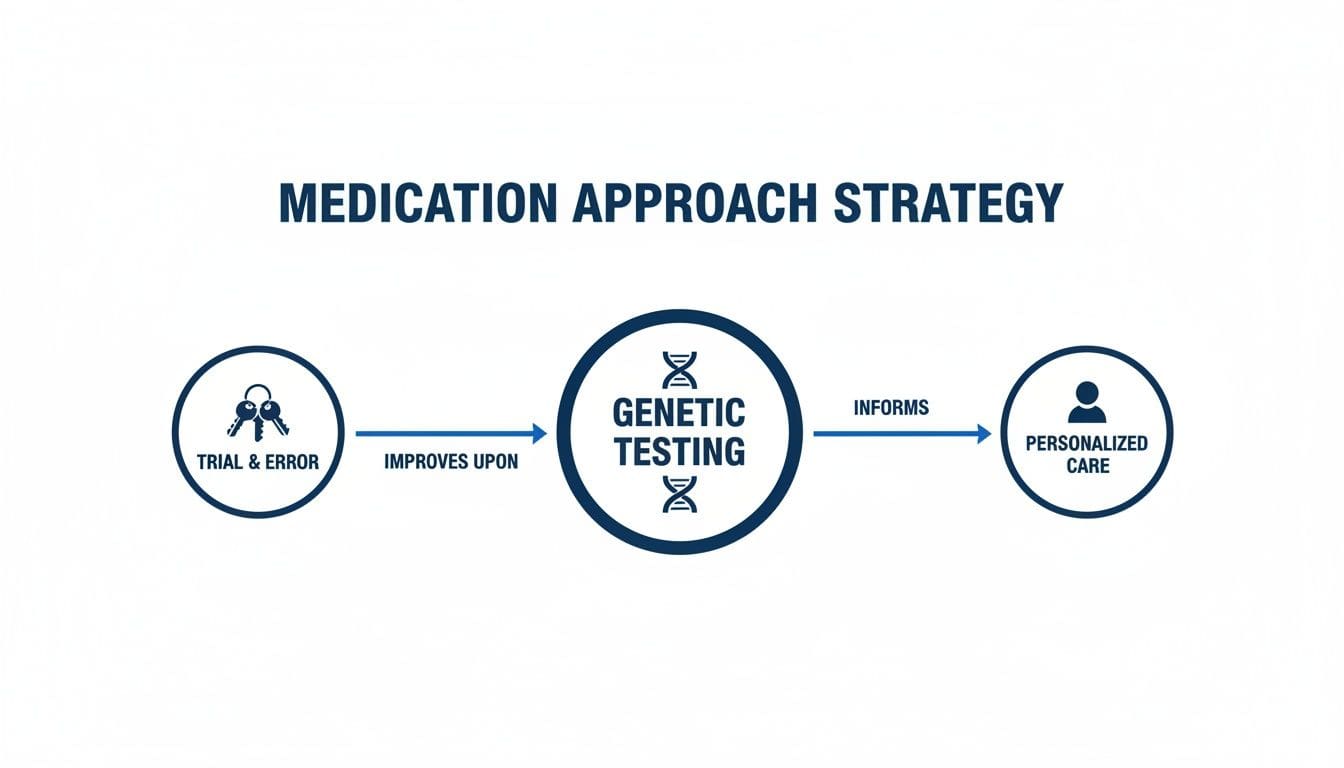
As you can see, we move from a frustrating cycle of trial and error to a genetically-informed strategy that points directly toward personalized care.
Key Genes in Mental Health Treatment
When we use genetic testing for mental health, we focus on a few key genes that have a major impact on how you process psychiatric medications. Two of the most important are the CYP2D6 and CYP2C19 genes.
These genes provide the instructions for creating enzymes in the cytochrome P450 family. These enzymes are workhorses, responsible for breaking down a huge percentage of all prescribed drugs, including many antidepressants and antipsychotics.
The CYP2D6 gene, for instance, influences how your body metabolizes about 25% of all clinical drugs, including many common SSRIs. If your genetic report shows you are a poor metabolizer for CYP2D6, your provider knows to either avoid certain SSRIs or start them at a much lower dose to prevent side effects.
This data removes the blindfold. Instead of just hoping a medication works, your provider can use your genetic blueprint to make a more informed choice from day one. It’s a critical piece of the puzzle that, when combined with other factors like diet and lifestyle, helps create a much fuller picture of your health. It’s a similar principle to what we explore in our article on the role of gut health in mental health, where we look at other key biological factors influencing well-being.
The Scientific Proof Behind Genetic-Guided Treatment

When you're exploring a new path for your mental health, a fair question always comes up: "Does the science actually back this up?" With genetic testing, the answer is a confident yes. The idea that our genes shape our mental health isn't some new trend—it's built on decades of research that laid the groundwork for the tools we use today.
Long before we could sequence a single gene, scientists relied on twin studies to untangle the role of genetics. They compared identical twins, who share nearly 100% of their DNA, with fraternal twins, who share about 50%. Time and again, they found that conditions like depression, anxiety, and ADHD have a real, measurable genetic link.
These studies gave us the first solid clues that our biology is a major player in our mental well-being.
Think of it like this: your genes aren't a crystal ball predicting your future. They're more like biological breadcrumbs—a set of clues that, when combined with your life experiences, give us a far more complete map to guide your treatment.
That early understanding has since blossomed from broad observations into a remarkably detailed science. We've moved from knowing that genes matter to identifying which genes matter.
From Theory to Concrete Evidence
The leap from theory to hard data has been incredible. Huge research collaborations, like the Psychiatric Genomics Consortium (PGC), have analyzed genetic information from millions of people all over the world. Their work has pinpointed specific genetic markers tied to different mental health conditions, giving us powerful validation for using these insights in the clinic.
A groundbreaking 2026 study in Nature shows just how far we’ve come. Researchers analyzed data from over 6 million people—1 million with psychiatric disorders and 5 million without. They discovered significant genetic overlap across 14 different conditions, including depression, anxiety, ADHD, and PTSD. You can read the full research about these genetic findings.
The study identified five major genetic clusters, proving that these conditions often share common biological roots. This helps explain why it's so common for one person to be diagnosed with multiple conditions. It's not just a coincidence; it’s often wired into their shared genetic vulnerabilities.
Building a More Complete Picture of You
This wealth of scientific evidence is so important because it gives us a biological "why" behind your symptoms and your response to medications. It shifts mental healthcare from a reactive, trial-and-error process to a proactive, personalized one.
When your provider understands your genetic makeup, they're not just chasing symptoms anymore. They're responding directly to your unique biology.
This is a core part of a modern, whole-person approach to mental wellness. Your genetic data becomes one vital piece of a much larger puzzle, which also includes:
- Your unique symptoms and personal history: How your condition affects you day-to-day.
- Your lifestyle factors: Things like diet, exercise, and sleep habits.
- Environmental influences: Including your stress levels and support network.
By putting all these pieces together, we can create a treatment plan that’s truly designed for you. This strong scientific backing confirms that genetic testing for mental health is a legitimate and powerful tool. It’s central to the future of personalized care, a principle we live by at IPA. You can learn more about our philosophy by reading our guide on the integrative psychiatry approach.
Is Pharmacogenomic Testing Right for You
Deciding on genetic testing for mental health can feel like a big step. For many, though, it’s the turning point they’ve been searching for after years of frustrating treatment cycles. While this testing can offer valuable insights for almost anyone starting psychiatric medication, certain situations make it especially beneficial.
Thinking about this test isn’t about asking, "What's wrong with me?" Instead, it’s about asking, "How can my unique biology guide my care?" It's a proactive step that can finally explain past struggles with medication and provide a clear, data-driven path forward.
Who Benefits Most from This Testing
Pharmacogenomic testing isn't a requirement for mental health treatment, but it can be a game-changer for individuals in specific circumstances. If you recognize yourself in any of the following scenarios, genetic insights could provide the breakthrough you need.
Consider this testing if you have:
- A History of Failed Medications: You’ve tried several different antidepressants or other psychiatric drugs, but none have provided significant relief. This is a strong indicator that your genetics may be influencing how your body responds to them.
- Experienced Debilitating Side Effects: If you’ve consistently stopped medications because of side effects like nausea, weight gain, fatigue, or brain fog, your body may be a "poor metabolizer." Testing can identify which drugs to avoid.
- A Family History of Adverse Drug Reactions: If a close relative had a severe negative reaction to a specific psychiatric medication, you might share the genetic trait responsible. This testing can help you avoid a similar experience.
These experiences are far from uncommon, and testing finally offers a scientific explanation for why they happen.
Proactive Reasons to Consider Testing
Beyond addressing past challenges, genetic testing is also a powerful tool for being proactive about your mental wellness journey. It empowers you and your provider to make better decisions from the very beginning.
This testing is invaluable for anyone who wants to minimize the guesswork and uncertainty that often comes with starting a new medication. It’s about making an informed first choice, not a fifth one.
It is particularly useful for individuals with:
- Treatment-Resistant Depression (TRD): When standard depression treatments fail, genetic data offers a new angle of attack. It can reveal which alternative medications might finally work for you.
- Complex or Co-Occurring Conditions: For those managing multiple conditions like anxiety and ADHD, testing helps a provider choose medications that won't negatively interact or worsen other symptoms.
- A Desire to Avoid Trial and Error: If you're just starting treatment, you can use genetic insights to bypass much of the frustrating and time-consuming process of finding the right fit from day one.
Ultimately, deciding to get tested is an empowering choice. It shifts the focus from a reactive approach—waiting to see what fails—to a proactive strategy designed for your unique biology. It’s a practical investment in your well-being, providing a personalized roadmap to help you feel better, faster. For more details on the investment, you can explore information about our pricing and payment options.
How to Integrate Genetic Insights into Your Treatment

Getting your genetic test results back is a major step, but it’s really just the starting point. The true value of genetic testing for mental health comes from integrating these biological insights into a complete treatment plan. This is where an experienced clinician makes all the difference.
A pharmacogenomic report isn't a simple instruction manual. It's a complex dataset full of biological clues. A provider doesn’t just look at the “green” (use) or “red” (avoid) columns and write a prescription. They act as an interpreter, blending this genetic information with the full picture of your life.
This integrative process includes your specific symptoms, health history, lifestyle, and—most importantly—your own goals. It’s about treating you as a whole person, not just a lab report.
From Data Points to a Personalized Plan
The idea that our genes influence our mental health isn't new. Science has long pointed to a strong hereditary component in many conditions. Twin studies, for example, have been key in demonstrating this link.
Research shows that if one identical twin has schizophrenia, the other has a 46% chance of also developing it. For fraternal twins, that number drops to just 14%. The same pattern appears with bipolar disorder, where the risk for an identical twin is between 40-70%, compared to only 8% for a fraternal twin.
These powerful statistics from resources like the NIMH's Genetics Workgroup report highlight the deep biological roots of mental illness. Today, we can use this knowledge in a much more direct way to create a plan that finally works for you.
A Real-World Example of Integration
Let's walk through a common scenario to see how this all comes together in practice.
Meet Sarah. She has struggled with generalized anxiety for years, and her experience with medication has been frustrating. The SSRI her last doctor prescribed left her feeling exhausted and nauseous, with almost no relief from her anxiety.
Feeling discouraged, Sarah decides to try a new approach that includes genetic testing. Her results reveal a critical piece of information: she is a "poor metabolizer" for the gene that breaks down her current SSRI. Her body was processing the drug too slowly, causing it to build up and trigger those difficult side effects.
Her new provider at IPA uses this insight as a key part of the puzzle. The process looks like this:
- Review the Genetic Report: The provider sees that Sarah’s body struggles with her current medication but identifies another class of drugs in her genetic "green" column.
- Integrate with Patient History: The provider discusses Sarah’s specific anxiety symptoms—racing thoughts and physical tension—and her negative experience with the SSRI.
- Collaborate on a New Plan: Together, they decide to switch to a medication that aligns with her genetics, starting at a precise dose calculated for her metabolism.
- Add Holistic Strategies: The provider also introduces mindfulness techniques and suggests specific nutritional adjustments to help manage her physical anxiety symptoms.
Within a few weeks, Sarah finally starts to feel better. The new medication works without the harsh side effects, and the mindfulness practices give her a tool to manage anxiety in the moment. This is the power of combining precision data with integrative care.
This whole-person method is at the core of our practice. You can learn more about how we blend various therapeutic approaches in our overview of integrative psychiatry services. Sarah's story shows that genetic testing isn’t a magic solution—it's a vital part of building a smarter, more compassionate, and more effective treatment plan.
How Genetic Testing Works With Your Telepsychiatry Provider
The idea of genetic testing for mental health can feel intimidating, but when you work with a modern telepsychiatry provider, the entire process is designed to be simple, private, and convenient. You never even have to leave your home.
Think of it less as a cold, clinical test and more as the start of a new, highly informed conversation about your health. The results aren't a final verdict; they're valuable clues that help you and your provider finally build a treatment plan that feels right for you.
Step 1: Your Initial Consultation
It all starts with a secure video appointment with your provider. During this first meeting, you’ll talk through your mental health history, your symptoms, and what has—or hasn't—worked for you in the past. This is the time to be open about frustrations with trial-and-error medication or worries about side effects.
If you both agree that pharmacogenomic testing makes sense, your provider will order an at-home kit for you. It arrives at your door in discreet packaging, so your privacy is respected right from the start. No trips to a lab, and no blood draws needed.
Step 2: The Simple At-Home Cheek Swab
When your kit arrives, you’ll find clear instructions and a sterile cheek swab. Collecting the sample is incredibly easy and takes just a minute or two.
You simply rub the swab firmly on the inside of your cheek to collect cells. Then, you place it in the secure container provided and send it back to the lab in the prepaid, pre-addressed envelope. It’s designed to be completely non-invasive.
This simple cheek swab contains all the genetic information the lab needs to analyze how your body is likely to process dozens of common psychiatric medications. It’s a small step that yields powerful insights.
From there, a specialized lab analyzes your DNA for key genetic variations known to influence how you metabolize and respond to different medications. Your provider typically receives the secure, detailed report in about one to two weeks. That quick turnaround means you won't be left waiting long to create a better plan.
Step 3: Reviewing Your Results and Building Your Plan
This is the most important step. You’ll have a follow-up telepsychiatry appointment where your provider will walk you through the report, page by page. They won't just hand you a confusing document; they'll explain what it all means in plain language, connecting the genetic data to your personal history and symptoms.
Together, you'll use these insights to build a truly personalized treatment plan. This is where the real power of genetic testing for mental health comes alive. Your new plan might involve:
- Switching to a medication that falls into your genetic "green" column (likely to be effective with fewer side effects).
- Adjusting the dosage of a medication based on how quickly or slowly your body metabolizes it.
- Adding holistic support, like nutritional counseling or stress management, to complement your new regimen.
This entire process ensures that hard science enhances, not replaces, compassionate and holistic care. By combining precision data with a whole-person approach, you and your provider can finally move beyond guesswork. To see how this fits into our broader care model, you can learn more about our virtual integrative psychiatry services in Pennsylvania.
Frequently Asked Questions About Genetic Testing for Mental Health
It's completely normal to have questions when you’re considering something as personal as genetic testing for mental health. Concerns about privacy, cost, and what the results really mean are common. We've gathered the most frequent questions to give you clear, straightforward answers.
Is My Genetic Data Private and Secure?
Absolutely. We treat your genetic data with the same strict confidentiality as all your other medical records. Every piece of your information is protected under HIPAA standards, which we follow without exception.
The specialized labs we partner with are also legally required to uphold these privacy laws. This means your data is used only to inform your clinical care—it is never sold or shared with third-party companies unless you provide direct, explicit consent. You are always in control.
Does Insurance Cover Genetic Testing for Mental Health?
Coverage for pharmacogenomic testing is becoming more common every day. A growing number of major insurance plans, including Medicare, now cover these tests for patients who meet their criteria.
A documented history of failed medication trials is often a key factor for securing insurance coverage. If you've struggled with treatments that didn't work, testing may be covered.
Our care team is here to help you verify your insurance benefits to see what your specific plan includes. If you don't have coverage, we'll walk you through our affordable self-pay and membership options so you can still access this valuable information.
Will This Test Tell Me if I Will Get a Mental Illness?
No, and this is a very important distinction. Pharmacogenomic testing is not predictive. It cannot tell you whether you will develop depression, anxiety, or any other mental health condition.
This test has a different, very specific job: to guide your treatment after a diagnosis has been made. It analyzes your unique genetic makeup to help your provider choose medications that are more likely to work well with your body, taking much of the guesswork out of building your care plan.
How Long Does It Take to Get Results?
The process is quick and simple. After you use the at-home kit to collect a sample with a simple cheek swab, you just mail it back to the lab in the prepaid mailer provided.
Once the lab gets your sample, the results are typically processed and sent securely to your provider in just one to two weeks. We'll then schedule a follow-up telepsychiatry appointment to review the findings with you and create your new, personalized treatment plan together.
Ready to move beyond medication guesswork? The team at IPA Integrative Psychiatry of America is here to help you integrate these powerful insights into a whole-person treatment plan. Schedule your consultation today to get started on your path to personalized mental wellness.
Powered by the Outrank app